
Judge, 1934-02 · page 23 of 36
Judge — February 1934 — page 23: what you’re looking at
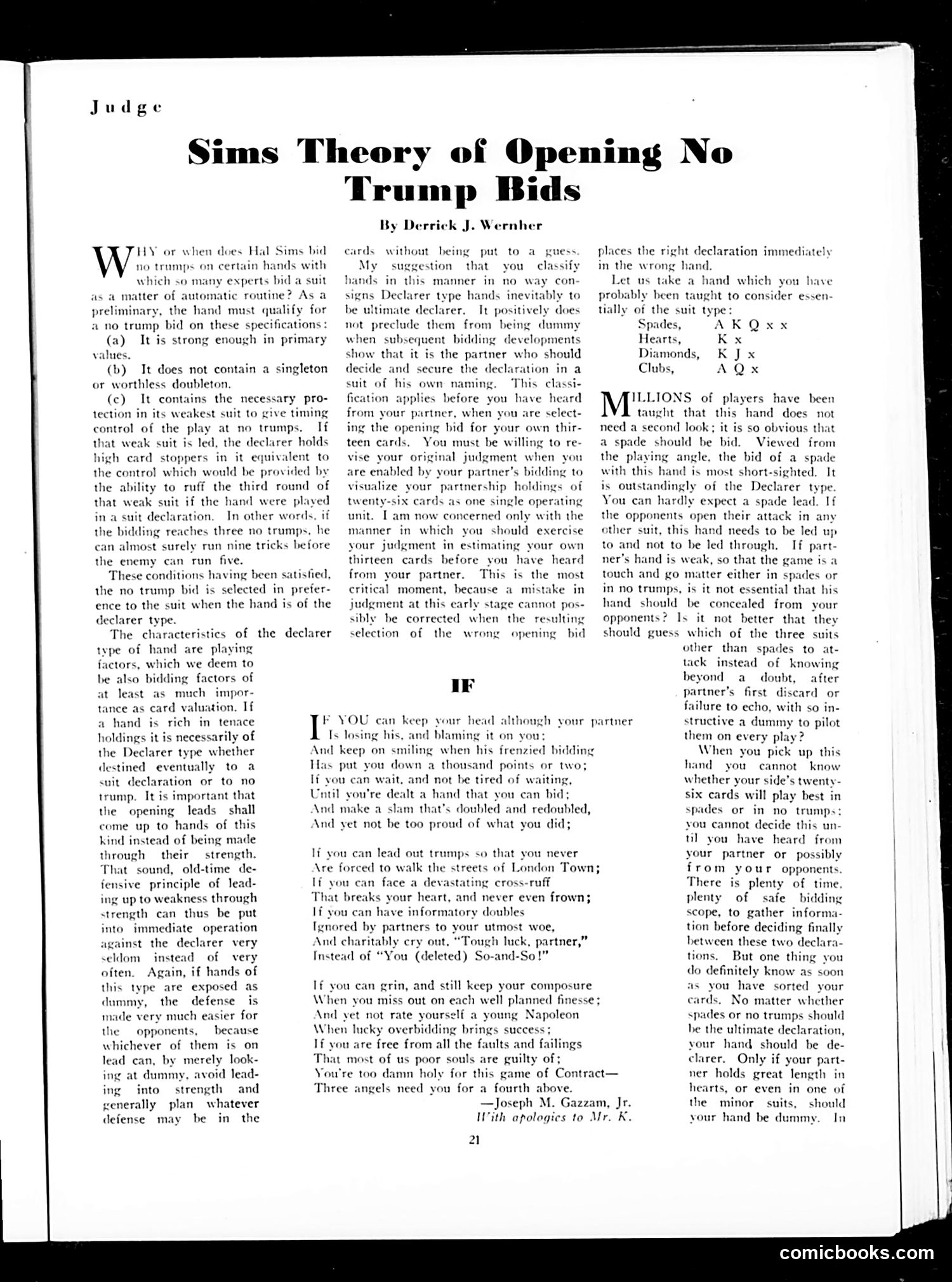
A restored page from Judge, 1934-02. Page through the whole issue in the reader above.
📄 Transcribed text from this page (OCR, searchable)
Machine-transcribed from the original scan — historical spelling and the odd misread are preserved.
Judge Sims Theory of Opening No HY or when does Hal Sims bid 1o trumps on certain hands with which so many experts bid a suit as a matter of automatic routine? As a preliminary, the hand must qualify for a no trump bid on these specifications: (a) It is strong enough in primary values. (b) It does not contain a singleton or worthless doublet (c) It contains the necessary pro- tection in its weakest suit to give timing control of the play at no trumps. If that weak suit is led, the declarer holds high card stoppers in it equivalent to the control which would be provided by the ability to ruff the third round of that weak suit if the hand were played in a suit declaration. In other words, if the bidding reaches three no trumps, he can almost surely run nine tricks be the enemy can run five. These conditions having been satisfi the no trump bid is selected in prefer- ence to the suit when the hand is of the declarer type. The characteristics of the declarer pe of hand are playing factors, which we deem to be also bidding factors of at least as much impor- tance as card valuation, If a hand is rich in tenace I holdings it is necessarily of the Declarer type whether destined eventually to a ore trump. It is important that he opening leads shall me up to hands of this kind instead of being made through their — strength. That sound, old-time de- fensive principle of lead- ing up to weakness through strength can thus be put into immediate operation against the declarer very seldom instead of very oiten. Again, if hands of this type are exposed as dummy, the defense is made very much easier for whichever of them is on lead can, by merely look- ing at dummy, avoid les ing into strength and generally plan whatever defense may be in’ the Trump Bids By Derrick J. Wernher cards without 1 My — suggestion hands in this ma gy put to a guess. that you classify iner in no way con signs Declarer type hands inevitably to be ultimate declarer. It positively does not preclude them from being dummy when subsequent bidding developments show that it is the partner who should decide and secure the declaration in a suit of his own naming. This classi- fication applies 1 ore you have heard from your partner, when you are select- ing the opening bid for your own thir- teen cards, You must be willing to re- vise your orig nal judgment when y abled by your partner's bidding to visualize your partnership holdings of twenty-six are er ards as one single operating unit. [am now concerned only with the manner in which you should exercise your judgment in estimating your own thirteen cards before you have heard from your partner. This is the most critical moment, because mistake in judgment at this early stage cannot pos- sibly be corrected when the resulting selection of the wrong opening bid IF YOU can keep your head although your partner Is losing his, and bl: ming it on you: And keep on smiling when his frenzied bidding Has put you down a thousand points or two; suit declaration or to no If you ¢. n wait, and not be tired of waiting, Until you're dealt a hand that you can bid; And make a slam that’s doubled and redoubled, And yet not be too proud of what you did; Ii you can lead out trumps so that you never \re forced to walk the streets « Ii you can face a devastating cross-ruff That breaks your heart, and never even frown; If you can have informatory doubles Ignored by partners to your utmost woe, And charitably ery out. Instead of “You (deleted) So-and-So!” ough luck, partner,” If you can grin, and still keep your composure When you miss out on each well planned finesse; And yet not rate yourself a young Napoleon the opponents, — because When luc! overbidding brings success nd failings If you are free from all the faults That most of us poor souls are guilty of; d- You're too damn holy for this game of Contract— Three angels need you for a fourth above. —Joseph M. Gazzam, Jr. IWith apologies to Mr.K. 21 places the right declaration immediately in the wrong hand. Let us take ably been taught to consider essen- tially of the suit type: Spades, AKQxx Hearts, ; Diamonds, ILLIONS of players have been second look; it is so obvious that spade should be bid. Viewed from the playing angle, the bid of a spade with this hand is most short-sighted. It is outstandingly of the Declarer type. You can hard the opponents open their attac! other suit, this hand needs to be led up to and not to be led through. If part- ner’s hand is weak, so that the game i London Town; nd which you have nA x Jx Q A x that this hand does not y expect a spade lead. If in any touch and go matter either in spades or in no trumps, is it not essential that his be concealed from your opponents? Is it not better that they should guess which of the three suits other than spades to tack instead of knowing beyond a doubt, after partner's first discard or failure to echo, with so in- structive a dummy to pilot them on every play? When you pick up this hand you nnot know whether your side’s twenty- six cards will play best in spades or in no trump you cannot decide this un- til you have heard from | your partner or possibly from your opponents. There is plenty of time. plenty of safe bidding scope, to gather informa- tion before deciding finally hetween these two declara tions. But one thing you do definitely know as soon s you have sorted your cards, No matter whether Jes or no trumps should he the ultimate declaration, your hand should be de- clarer. Only if your part- ner holds great length in hearts, or even in one of the minor suits, should your hand be dummy. In comicbooks.com