
Judge, 1934-02 · page 9 of 36
Judge — February 1934 — page 9: what you’re looking at
What you’re looking at
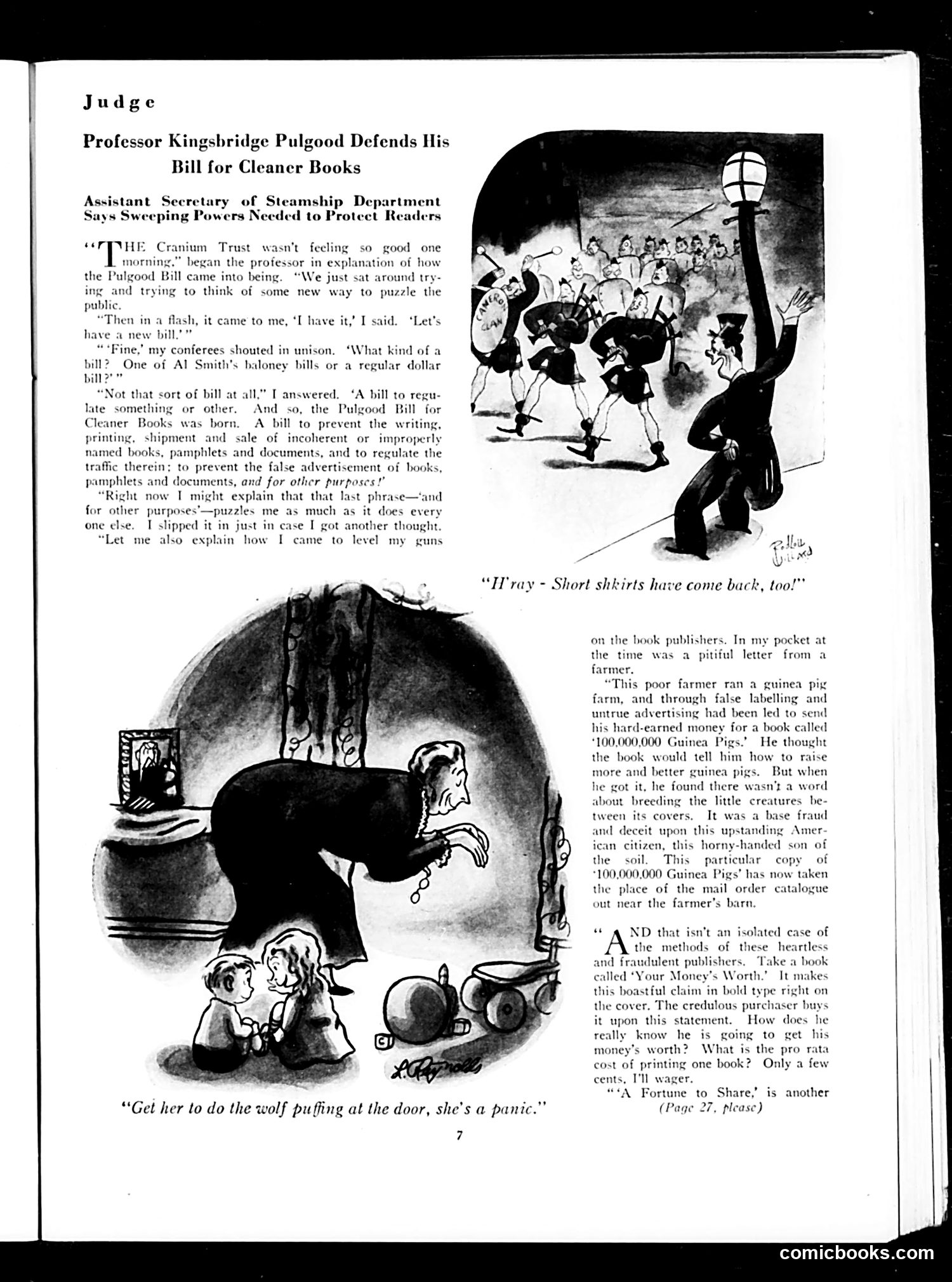
# Explanation for Modern Readers This Judge magazine article satirizes legislative overreach and self-serving politicians. Professor Kingsbridge Pulgood openly admits that he and his colleagues invented the "Pulgood Bill for Cleaner Books" simply to create *some* new regulation without genuine purpose—they cynically included vague language like "for other purposes" as a joke because they had no real agenda. The satire exposes the absurdity: Pulgood claims moral concern for a defrauded farmer who bought a guinea pig book (likely the real 1933 exposé *100,000,000 Guinea Pigs*), but this is merely a pretext. The cartoons show people confused about fashion trends and moral panic—illustrating public gullibility. The point: politicians manufacture "reform" bills not to solve actual problems but to expand power and appear virtuous. The mockery targets legislative dishonesty and the public's susceptibility to hollow moral crusades dressed up as protection.
📄 Transcribed text from this page (OCR, searchable)
Machine-transcribed from the original scan — historical spelling and the odd misread are preserved.
Judge Professor Kingsbridge Pulgood Defends His Bill for Cleaner Books Assistant Secretary of Steamship Department ys Sweeping Powers Necded to Protect R erp He Cranium Trust wasn't feeling so good one morning,” began the professor in explanation of how the Pulgood Bill came into being. “We just sat around try- ing and trying to think of some new way to puzzle the public. “Then ina flash, it came to me, ‘I have it,’ I said. ‘Let's have a new bill” “*Fine,’ my conferees shouted in unison. ‘What kind of a bill? One of Al Smith's baloney bills or a regular dollar bill??" “Not that sort of bill at all.” [ answered. ‘A bill to regu- late something or other. And so, the Pulgood Bill for Cleaner Books was born. A bill to prevent the writing, printing, shipment and sale of incoherent or improperly named books, pamphlets and documents, and to regulate the traffic therein; to prevent the false advertisement of books, pamphlets and documents, and for other purposes!’ “Right now T might explain that that last phrase—‘and for other purposes “—puzzles me as much as it does every one else. [ slipped it in just in case I got another thought. “Let me also explain how I came to level my guns on the book publishers. In my pocket at the time was a pitiful letter from a farmer, “This poor farmer ran a guinea pig farm, and through false labelling and untrue advertising had been led to send his hard-earned money for a book called ‘100,000,000 Guinea Pigs.’ He thought the book would tell him how to raise more and better guinea pigs. But when he got it, he found there wasn’: a word about breeding the little creatures be- tween its covers. It was a base fraud and deceit upon this upstanding Amer ican citizen, this horny-handed son of the soil. This particular copy of *100,000,000 Guinea Pigs’ has now taken > place of the mail order catalogue near the farmer's barn. #8 ND that isn’t an isolated case of A tie methods of these heartless and fraudulent publishers. Take a book called ‘Your Money’s Worth.’ It makes this boastful claim in bold type right on the cover, The credulous purchaser buys it upon this statement. How does he really know he is going to get his What is the pro rata cost of printing one book? Only a few “ I'll wager. Fortune to Share,’ is another “Get her to do the wolf puffing at the door, she's a panic.” (Page 27, please) 7 comicbooks.com