
Judge, 1934-02 · page 14 of 36
Judge — February 1934 — page 14: what you’re looking at
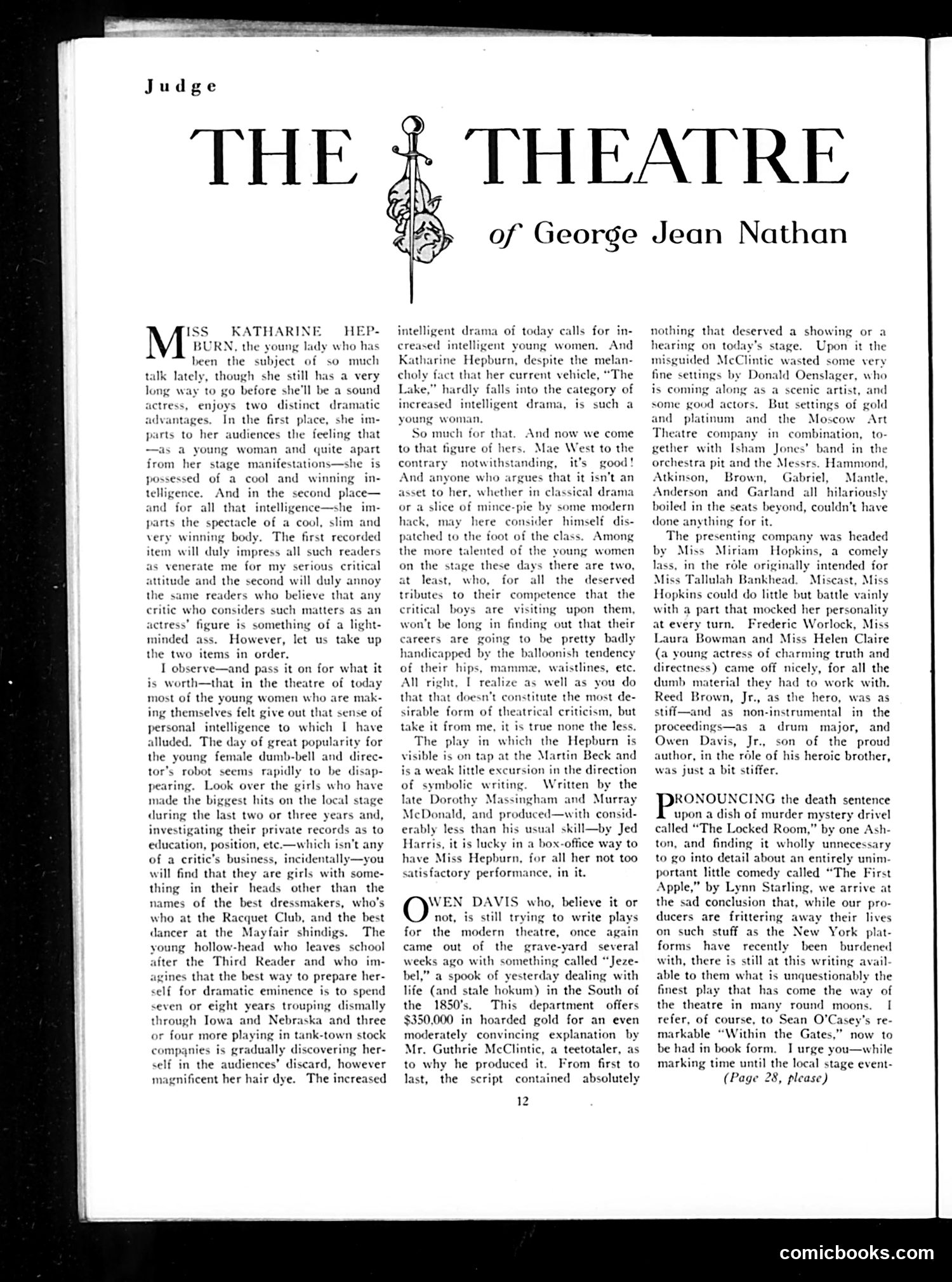
A restored page from Judge, 1934-02. Page through the whole issue in the reader above.
📄 Transcribed text from this page (OCR, searchable)
Machine-transcribed from the original scan — historical spelling and the odd misread are preserved.
SS KATHARIN HEP- M BURN, the young lady who has been the subject of so much talk lately, though she still has a very long way to go before she'll be a sound actress, enjoys two distinct dramatic advantages. In the first place, she im- parts to her audiences the feeling that a young woman and quite apart from her stage manifestations—she is possessed of a cool and winning in- telligent And in the second place— and for all that intelligence—she im- parts the spectacle of a cool, slim and very winning bod The first recorded item will duly impress all such readers as venerate me for my serious critical attitude and the second will duly annoy the same readers who believe that any critic who considers such matters as an actress’ figure is something of a light- minded ass. However, let us take up the two items in order. I observe—and pass it on for what it is worth—that in the theatre of today most of the young women who are ma ing themselves felt give out that sense of personal intelligence to which I have alluded, The day of great popularity for the young female dumb-bell and direc- tor's robot seems rapidly to be disap- pearing. Look over the girls who have made the biggest hits on the local stag during the last two or three years and, investigating their private records as to education, position, ete.—which isn’t any of a critic’s business, incidentally will find that they are girls with som thing in their heads other than the names of the best dressmakers, who's who at the Racquet Club, and the best dancer at the Mayfair shindigs. The young hollow-head who leaves school after the Third Reader and who im- gines that the best way to prepare her- self for dramatic eminence is to spend seven or eight years tr through Iowa and Nebraska and three or four more playing in tank-town stock companies is gradually discovering her- self in the audiences’ discard, however magnificent her hair dye. The increased you sping dismally THEATRE of George intell creas ent drama of today calls for in- 1 intelligent young women. And Katharine Hepburn, despite the melan- choly fact that her current vehicle, “The Lake,” hardly falls into the category of increased intelligent drama, is such a young woman, So much for that. And now we come to that figure of hers. Mae West to the contrary notwithstanding, it’s good! And anyone who argues that it isn’t an asset to her, whether in classical drama or a slice of mince-pie by some modern hack, may here consider himself dis- patched to the foot of the class. Among the more talented of the young women on the stage these days there are two, at least, who, for all the deserved tributes to their competence that the critical boys are visiting upon them, won't be long in finding out that their careers are going to be pretty badly handicapped by the balloonish tendency of their hips, mammz, waistlines, etc. All right, I realize as well as you do that that doesn’t constitute the most de- sirable form of theatrical criticism, but take it from me, it is true none the less. The play in which the Hepburn is visible is on tap at the Martin Beck and is a weak little excursion in the direction of symbolic writing. Written by the late Dorothy Massingham and Murray McDonald, and produced—with consid- erably less than his usual skill—by Jed Harris, it is lucky in a box-office way to have Miss Hepburn, for all her not too satisfactory performance, in it. WEN DAVIS who, believe it or not, is still trying to write plays for the modern theatre, once again me out of the grave-yard several weeks ago with something called “Jeze- bel,” a spook of yesterday dealing with life (and stale hokum) in the South of the 1850's. This department offers $350,000 in hoarded gold for an even moderately convincing explanation by Mr. Guthrie McClintic, a teetotaler, as to why he produced it. From first to last, the script contained absolutely 12 Jean Nathan nothing that deserved a showing or a hearing on today’s stage. Upon it the misguided MeClintic wasted some very fine settings by I is coming along some good actors. ld Oenslager, who a scenic artist, and But settings of gold and platinum and the Moscow Art Theatre company in combination, to- gether with Isham Jones’ band in the orchestra pit and the Messrs. Hammond, Atkinson, Brown, Gabriel, Mantle, Anderson and Garland all hilariously boiled in the seats beyond, couldn’t done anything for it. ave The presenting company was headed by Miss Miriam Hopkins, a comely lass, in the role originally intended for Miss Tallulah Bankhead. Miscast, Miss Hopkins could do little but battle vainly with a part that mocked her personality at every turn. Frederic Worlock, Miss Laura Bowman and Miss Helen Claire (a young actress of charming truth and directness) came off nicely, for all the dumb material they had to work with. Reed Brown, Jr., as the hero, was as stiff—and as non-instrumental in the proceedings—as a drum major, and Owen Davis, Jr, son of the proud author, in the role of his heroic brother, was just a bit stiffer. IRONOUNCING the death sentence upon a dish of murder mystery drivel called “The Locked Room,” by one Ash- . and finding it wholly unnecessary to go into detail about an entirely unim- portant little comedy called “The First Apple,” by Lynn Starling, we arrive at the sad conclusion that, while our pro- ducers are frittering away their lives on such stuff as the New York plat- forms have recently been burdened with, there is still at this writing avail- able to them what is unquestionably the finest play that has come the way of the theatre in many round moons. I refer, of course, to Sean O" markable “Within the Gates,” now to be had in book form. I urge you—while marking time until the local stage event- (Page 28, please) sey’s re- comicbooks.com