A complete issue · 36 pages · 1934
Judge — January 1934
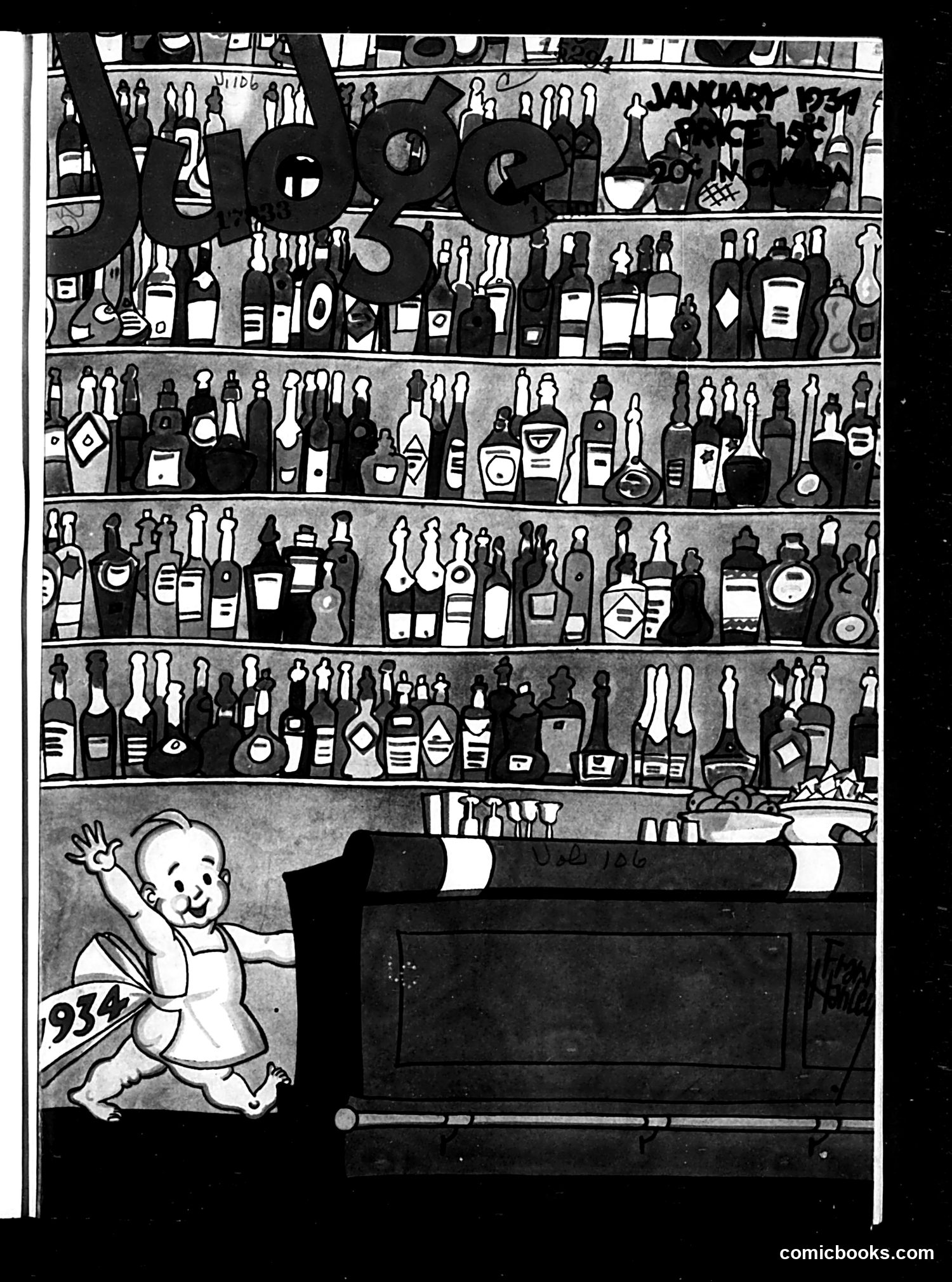
# Analysis This appears to be a 1934 Judge magazine advertisement for liquor, featuring extensive shelves of bottles. The cartoon character at bottom left—a cheerful, rotund baby figure labeled "1934"—celebrates with raised arms, suggesting optimism about that year. The satire likely references **Prohibition's repeal in December 1933**. The massive display of diverse liquor bottles represents the sudden legal availability of alcohol after 13 years of federal prohibition. The jubilant "1934" baby personifies American joy at regaining legal drinking. The humor targets both the absurdity of Prohibition's failure and society's eager embrace of alcohol's return. For modern readers: this celebrates the end of a major federal ban, treating resumed drinking as cause for national celebration—a cultural touchstone that defined 1930s American life.
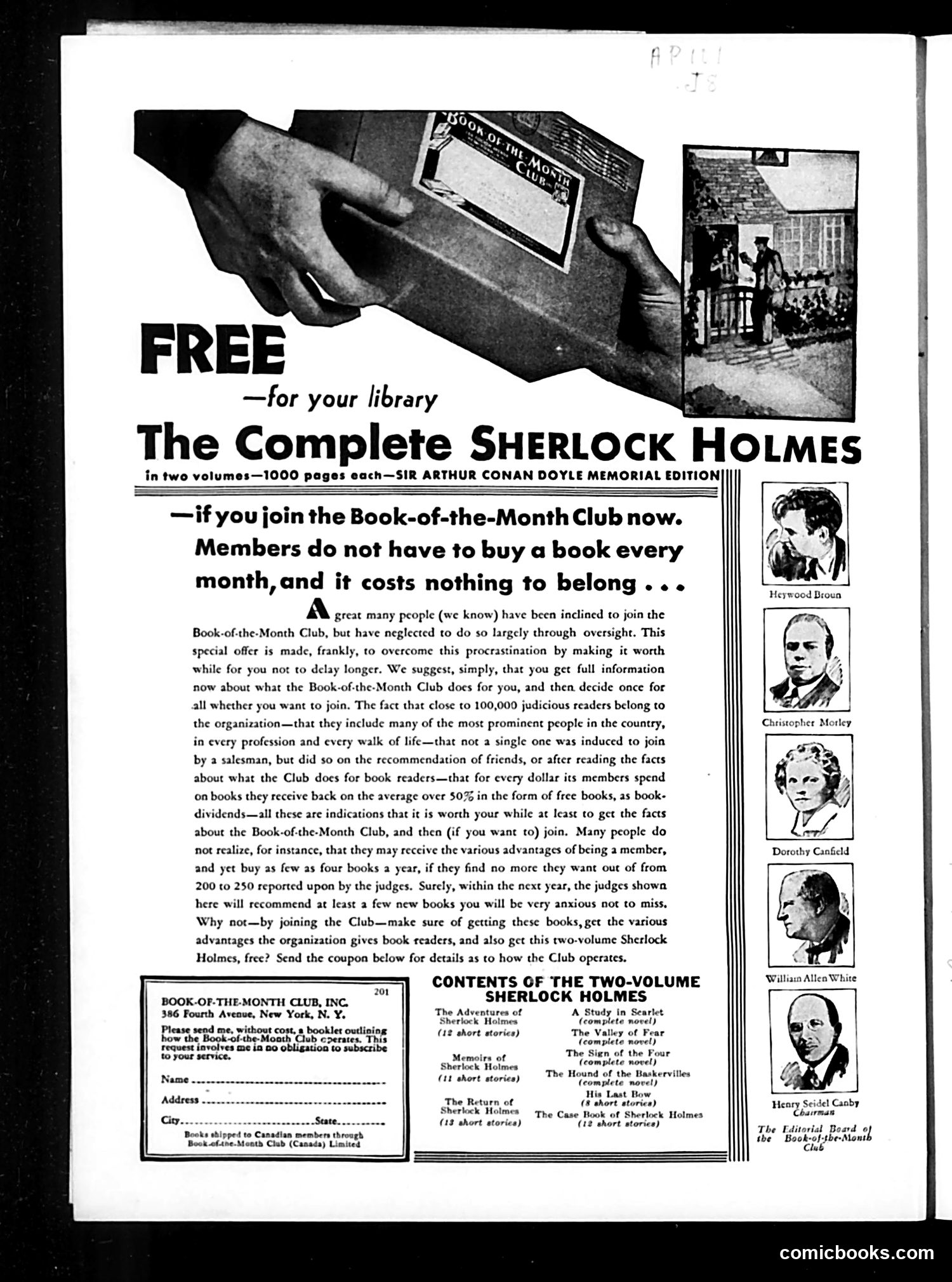
# Analysis This page is primarily **advertising, not satire or political commentary**. It's a Book-of-the-Month Club promotion offering a free two-volume Sherlock Holmes collection (Sir Arthur Conan Doyle Memorial Edition) to new members. The imagery shows a hand holding a book and a photograph of what appears to be a Victorian-era street scene, likely evoking the Holmes stories' period setting. On the right are portraits of five people identified as the "Editorial Board of the Book-of-the-Month Club," including names like Heywood Broun and Dorothy Canfield. The text is persuasive marketing emphasizing membership benefits and value. There is **no political satire** present—this is straightforward commercial advertising typical of Judge magazine's revenue model.
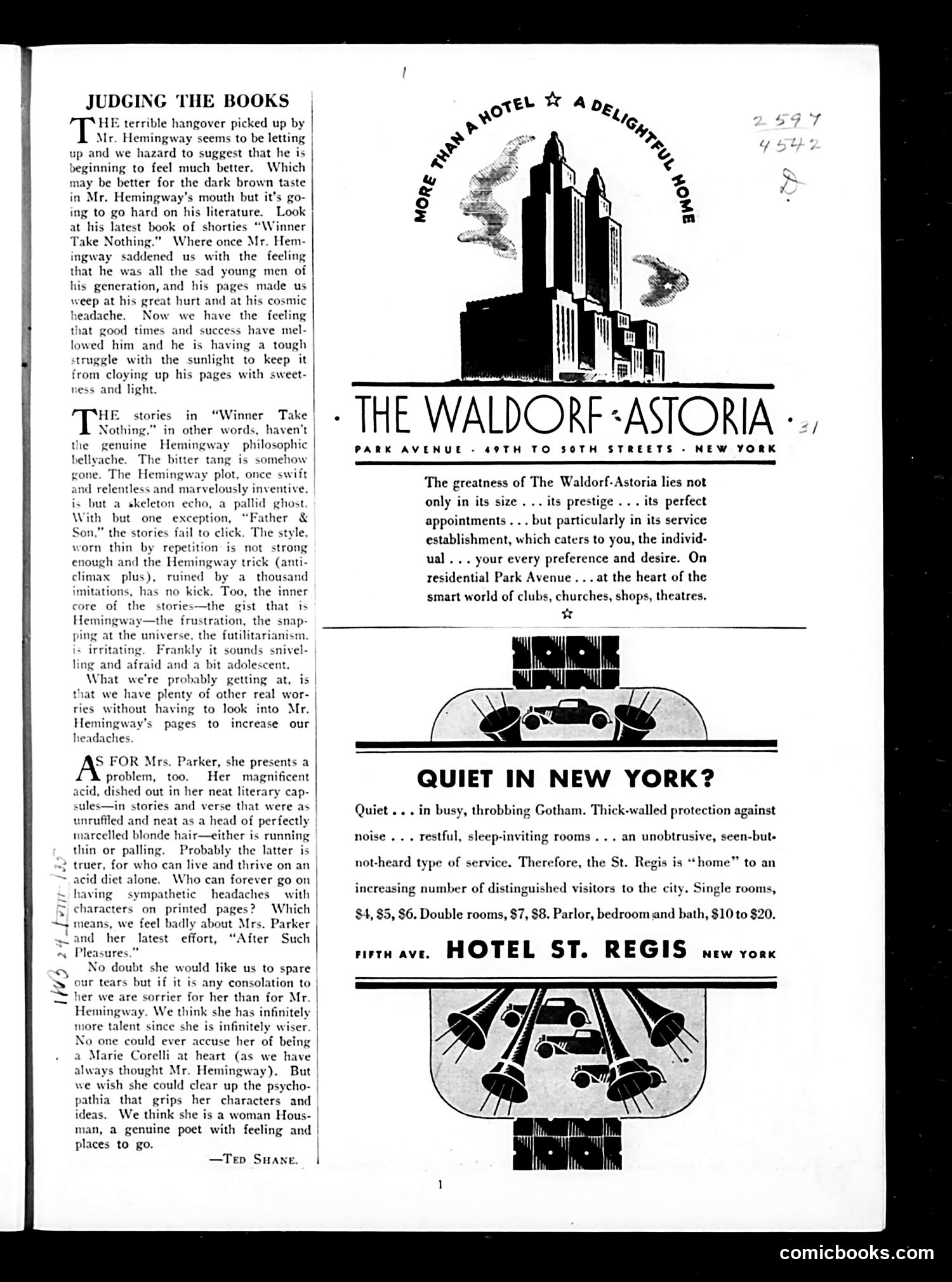
# Analysis This page is primarily **advertising rather than political satire**. The left column contains a book review titled "Judging the Books" by Ted Shane, critiquing Ernest Hemingway's short story collection "Winner Take Nothing" and Dorothy Parker's work. Shane argues Hemingway's stories lack the philosophical depth of his earlier work, though he acknowledges Parker's superior talent. The right side features two hotel advertisements—The Waldorf-Astoria and Hotel St. Regis—both emphasizing luxury accommodations in New York City. The ads use Art Deco design typical of the era and target wealthy travelers seeking quiet, refined lodging. There is **no political cartoon** on this page. It represents Judge's mixed content format combining literary criticism with upscale advertising.
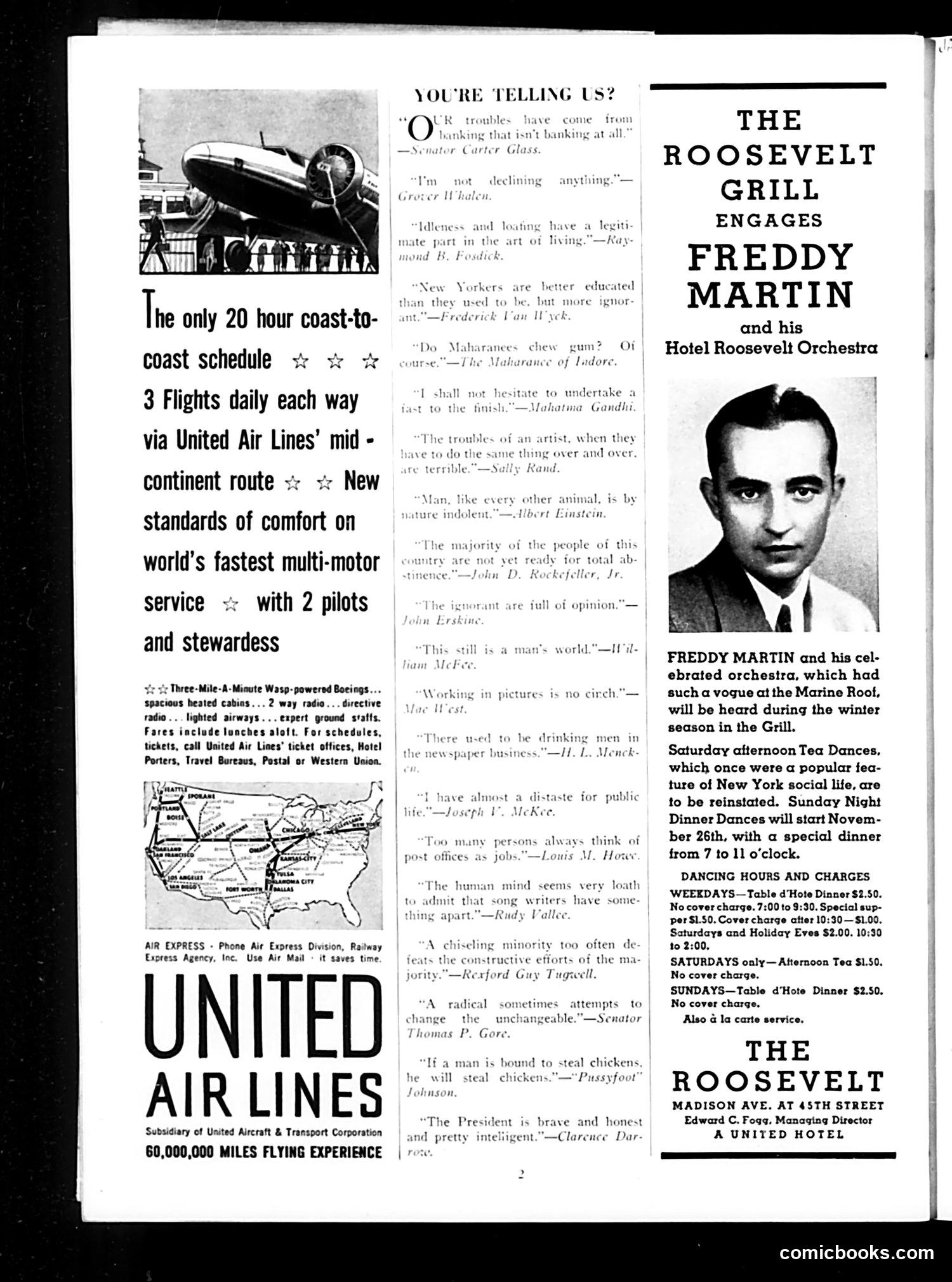
# Analysis This page is primarily **advertising rather than satire or political commentary**. The left side features a **United Airlines advertisement** promoting their new 20-hour coast-to-coast service with three daily flights, highlighting comfort and modern amenities. A small map shows the mid-continent route. The right side advertises **The Roosevelt Hotel's grill**, announcing entertainment by Freddy Martin and his Hotel Roosevelt Orchestra. It promotes Saturday afternoon tea dances and Sunday night dinner dances, with pricing and cover charge information. The center column contains random quotations—some witty, some philosophical—from various public figures (Senator Glass, Gandhi, Einstein, Rockefeller, etc.), a common Judge magazine feature meant to provide brief social commentary or humor. The page reflects 1930s-40s leisure culture: commercial aviation, upscale hotel entertainment, and urban nightlife.
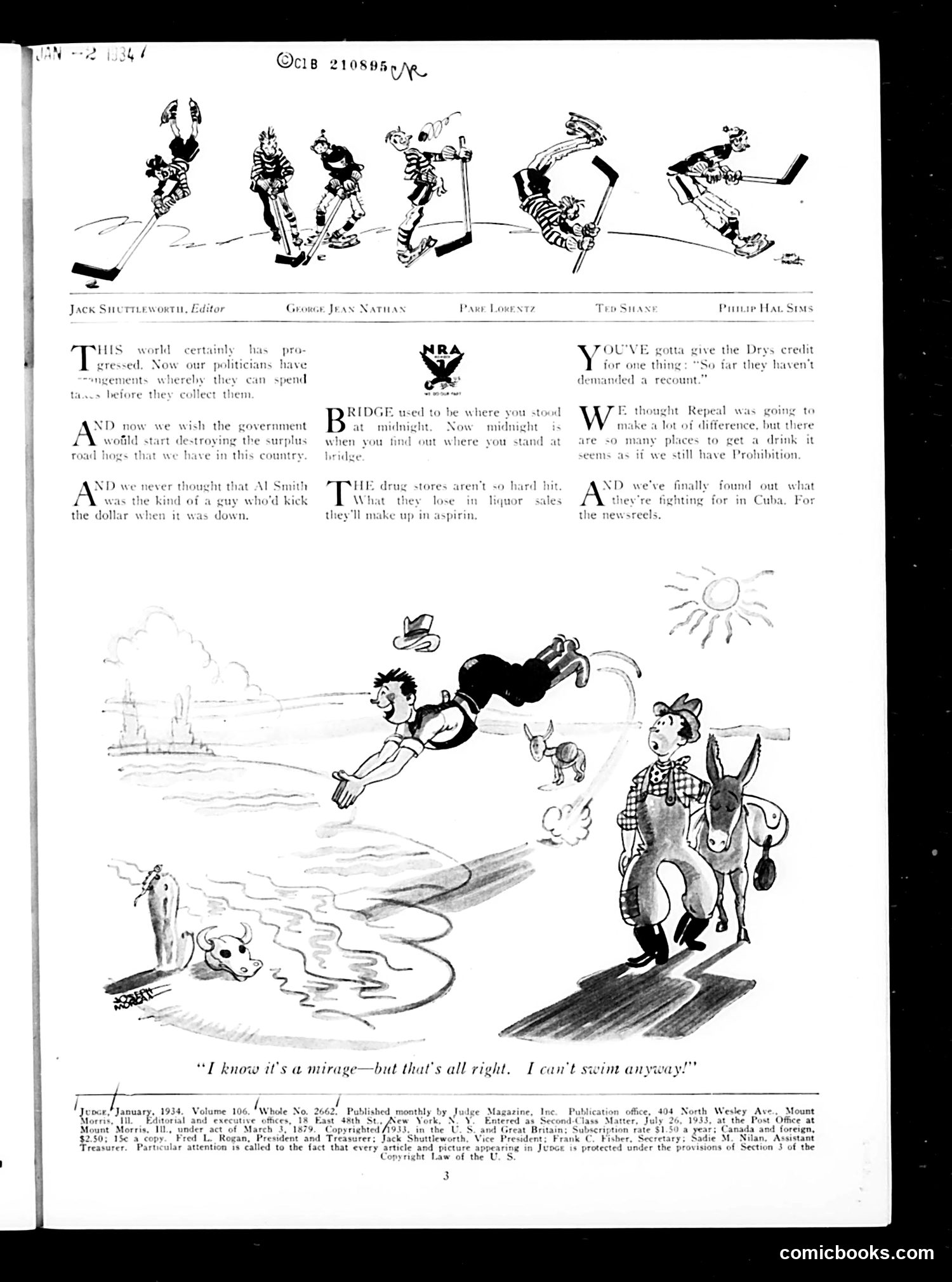
# Analysis This January 1934 *Judge* page contains political satire about contemporary issues. The top strip shows six figures labeled with editors' names, each performing hockey-related actions—likely satirizing political figures through sport metaphors. The text comments mock government inefficiency ("politicians have amusements whereby they can spend taxes before they collect them"), reference Prohibition's repeal, and joke about drug stores selling liquor. One quip about "Al Smith" and "kicking the dollar" references the former presidential candidate and economic concerns. The bottom cartoon depicts a man swimming while a donkey approaches on land—captioned "I know it's a mirage—but that's all right. I can't swim anyway!" This appears to satirize Depression-era desperation, where even illusory hope seems preferable to the current situation.
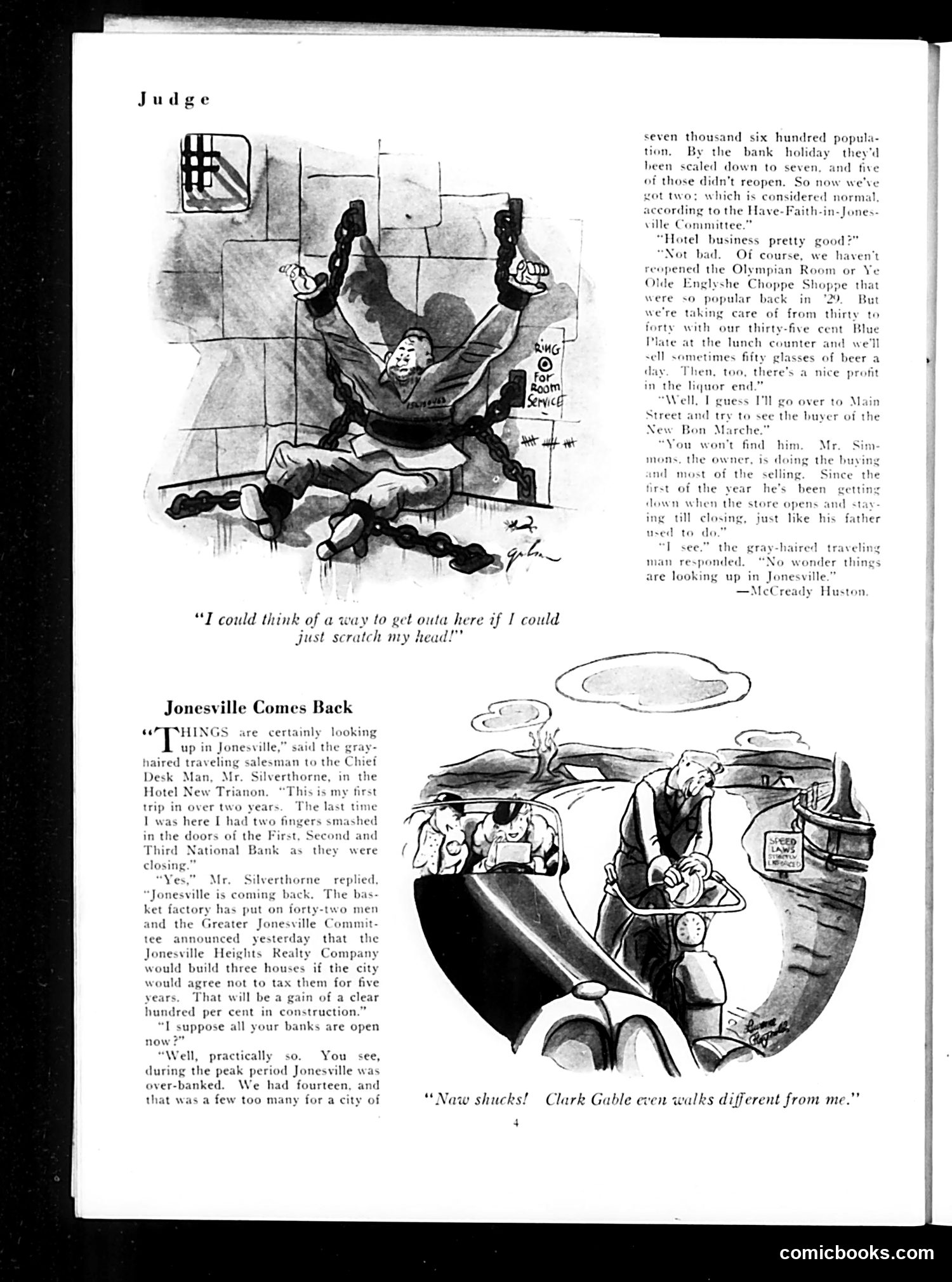
# Analysis of Judge Magazine Page The page contains two distinct cartoons: **Top cartoon ("Judge"):** Shows a man trapped in what appears to be a cell or confined space, unable to scratch his head—a visual gag about frustration and helplessness. **Bottom cartoon ("Jonesville Comes Back"):** Depicts a traveling salesman discussing Jonesville's economic revival with a hotel desk clerk. The text references bank closures during an economic downturn, followed by recovery efforts including new construction incentives (tax breaks for builders). The second cartoon's caption jokes that "Clark Gable even walks different from me"—likely a reference to the famous actor's distinctive gait, used here as a humorous aside about class or status differences. Both pieces appear focused on American economic conditions and small-town recovery, typical Judge magazine satirical fare.
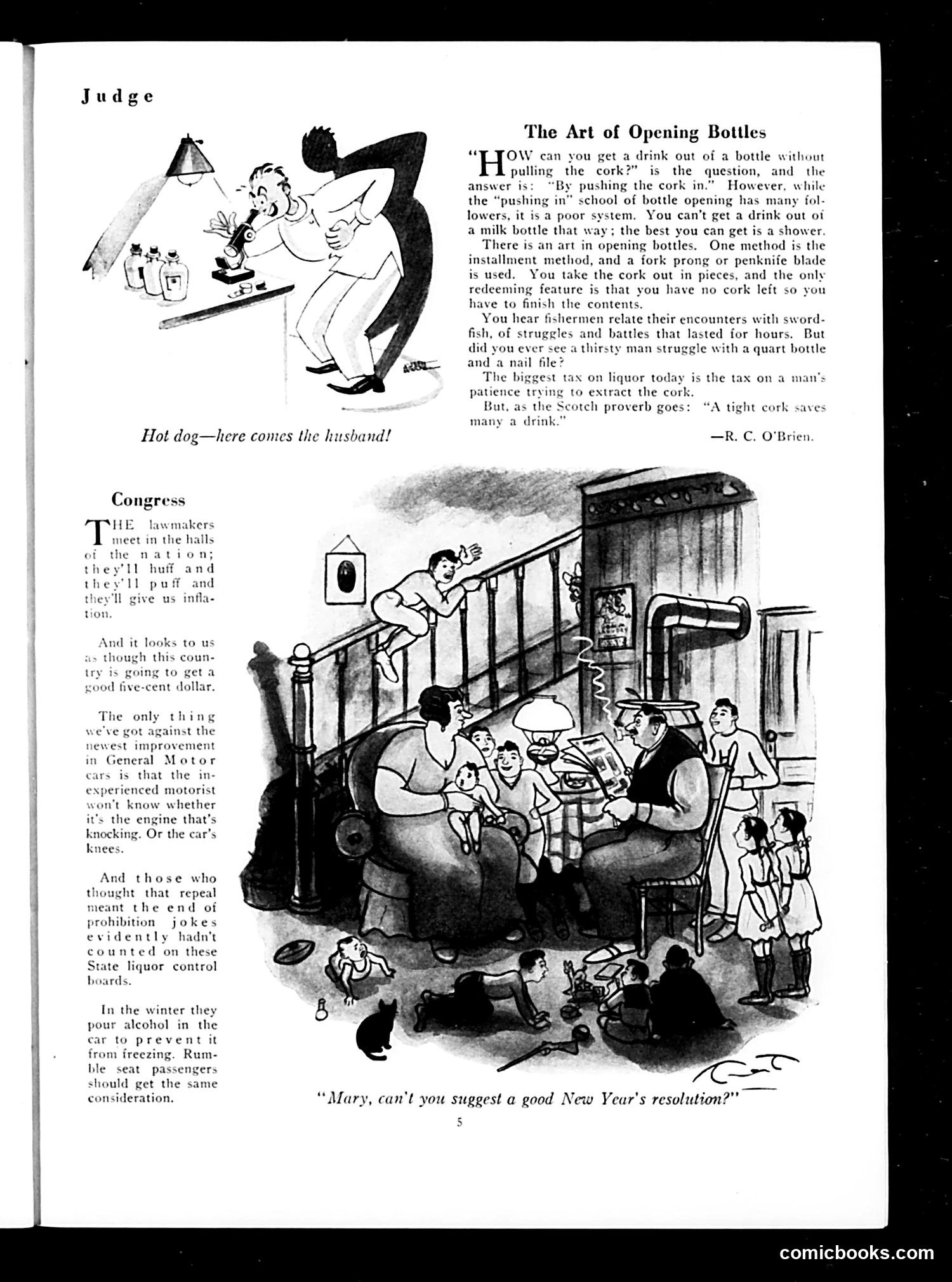
# Analysis of Judge Magazine Page This page contains two satirical pieces from Judge magazine (likely 1920s-30s based on style): **"The Art of Opening Bottles"** (top right) humorously addresses Prohibition-era frustration with cork extraction, attributing it to patience-taxing difficulty. The accompanying cartoon shows a man struggling with a bottle while his wife waits—satirizing how even mundane domestic tasks became absurd under alcohol prohibition laws. **"Congress"** (left) mocks lawmakers as ineffective, suggesting they "huff and puff" while producing inflation. The large cartoon below depicts a crowded, chaotic domestic scene with the caption "Mary, can't you suggest a good New Year's resolution?"—likely satirizing Congress's inability to solve real problems affecting American families during the economic/social turbulence of the era. Both target government incompetence.
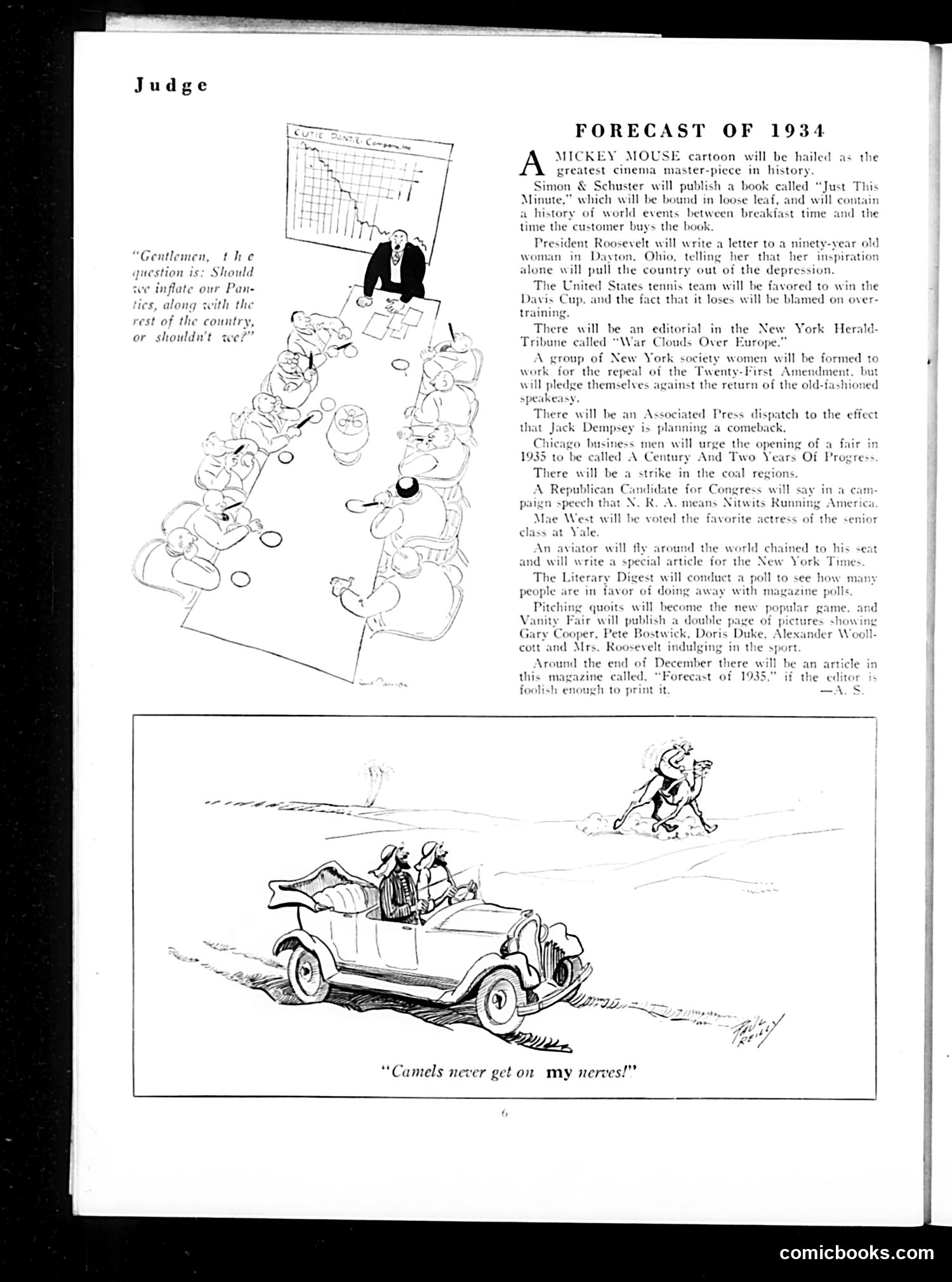
# Analysis This page contains two distinct elements: **Top Section:** A political cartoon depicting a judge presiding over a debate about fiscal policy. Gentlemen argue whether to "inflate our Panics, along with the rest of the country, or shouldn't we?" The cartoon satirizes economic disagreement during what appears to be Depression-era debate about inflation versus deflation policy—a core disagreement among policymakers in the early 1930s. **Bottom Section:** A humorous cartoon showing a car stuck in desert sand with the caption "Camels never get on my nerves!" This is a simple joke about the frustration of automobile travel, likely poking fun at the unreliability of early 1930s cars compared to the dependability of camels in harsh terrain. The page also includes forecast predictions for 1934 events.
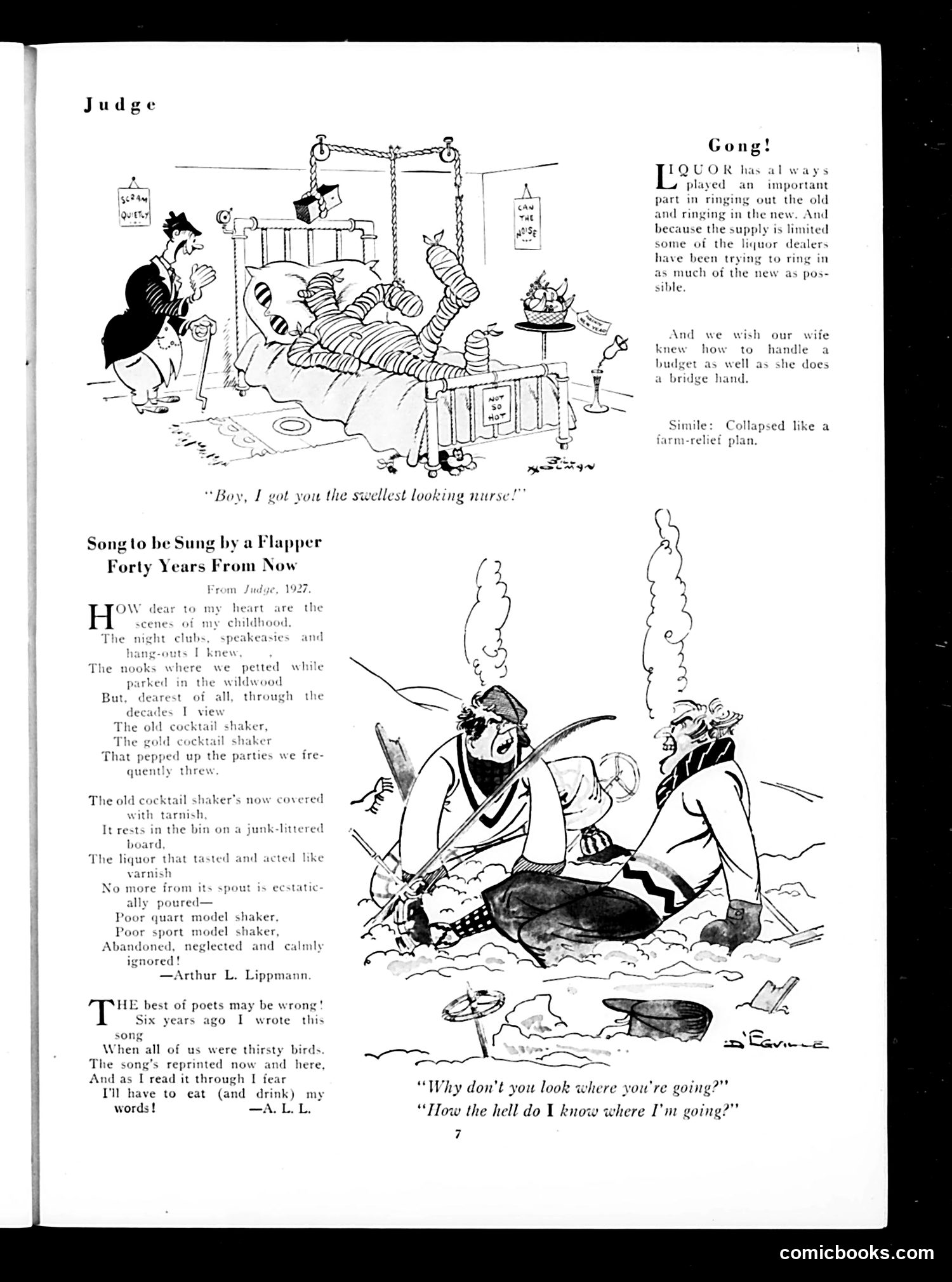
# Analysis for Modern Readers This 1927 *Judge* page satirizes Prohibition-era America through two pieces: **Top cartoon ("Boy, I got you the swellest looking nurse!")**: A man presents an elaborate, mummy-wrapped patient to his wife. The joke is that he's disguised a liquor bottle as a "nurse" to sneak alcohol past her—playing on Prohibition's ban on alcohol sales and the common practice of hiding booze during this period. **Lower section**: A poem laments the decline of cocktail culture. Written by Arthur L. Lippmann in 1927 and reprinted from six years prior, it nostalgically recalls the "old cocktail shaker" now covered in tarnish, abandoned and useless. The accompanying illustration shows two figures lost in a snowy landscape, with dialogue mockingly questioning how anyone knows where they're going—likely referencing society's confused direction under Prohibition. Together, these pieces express *Judge*'s satirical frustration with Prohibition's effects on American social life and the drinking culture the magazine valued.
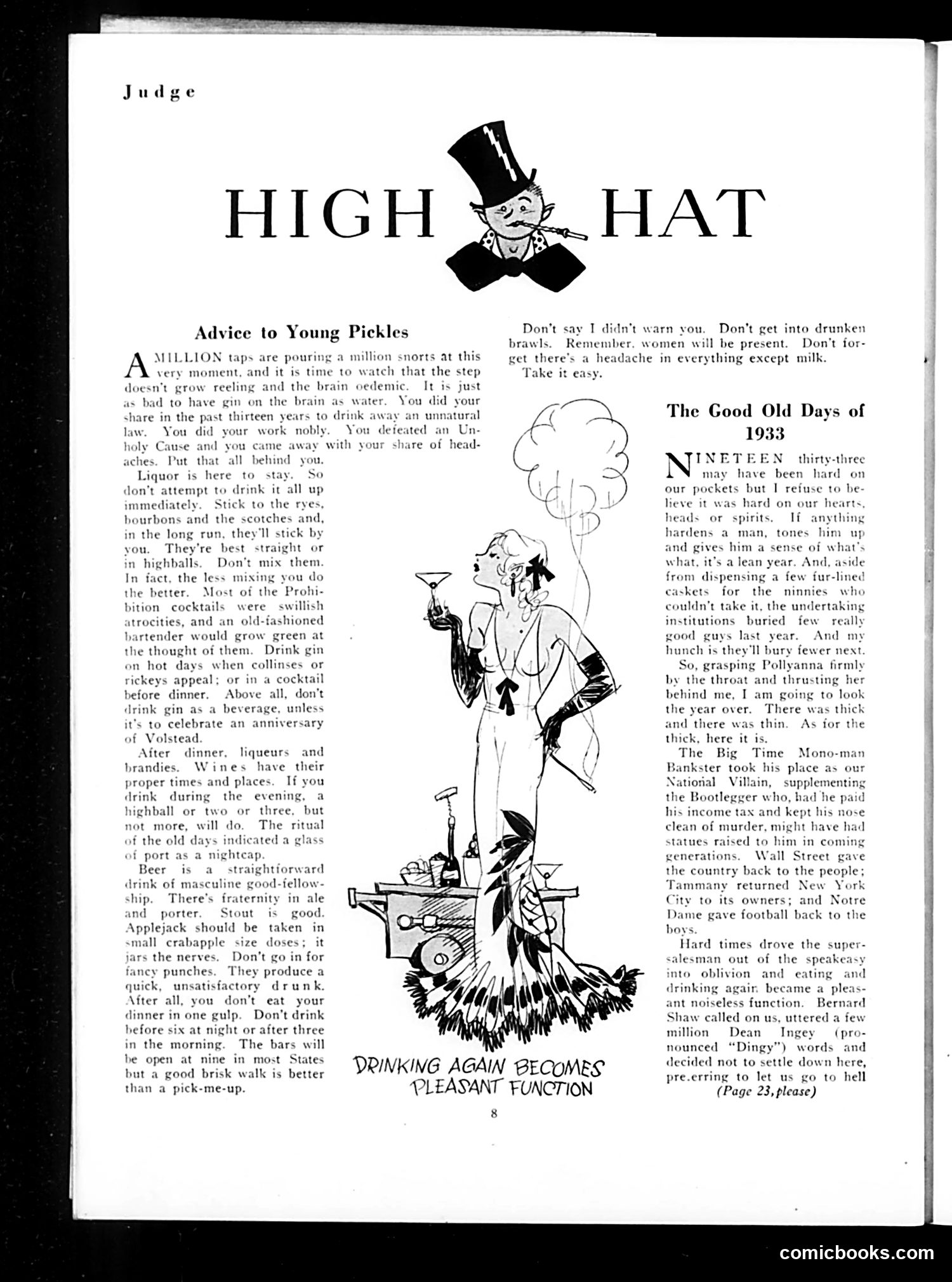
# Analysis: "High Hat" Judge Magazine Page This page from Judge (likely 1933, based on "The Good Old Days of 1933" article) addresses Prohibition's repeal, which occurred in December 1933. **Main Content:** The "Advice to Young Pickles" column ironically offers etiquette for drinking now that alcohol is legal again. The satire mocks the sudden shift from Prohibition enforcement to regulated consumption—advising moderation to those eager to overindulge after years of illegality. **"The Good Old Days of 1933" article** nostalgically reviews the Depression year, noting that hardship built character. It references real 1933 figures: "Mono-man Bankster" (likely banker villainy generally), the "Bootlegger" (now unemployed post-Repeal), and Bernard Shaw's visit to America. The piece celebrates that Wall Street and Tammany Hall returned wealth/power, and Notre Dame football resumed—trivial consolations for economic suffering. **The cartoon illustration** shows a fashionable woman holding a cocktail over discarded liquor bottles and broken prohibition paraphernalia—celebrating Repeal's arrival. The overall satire: Americans are returning to drinking with comic earnestness, treating it as a "pleasant function" rather than criminal excess.
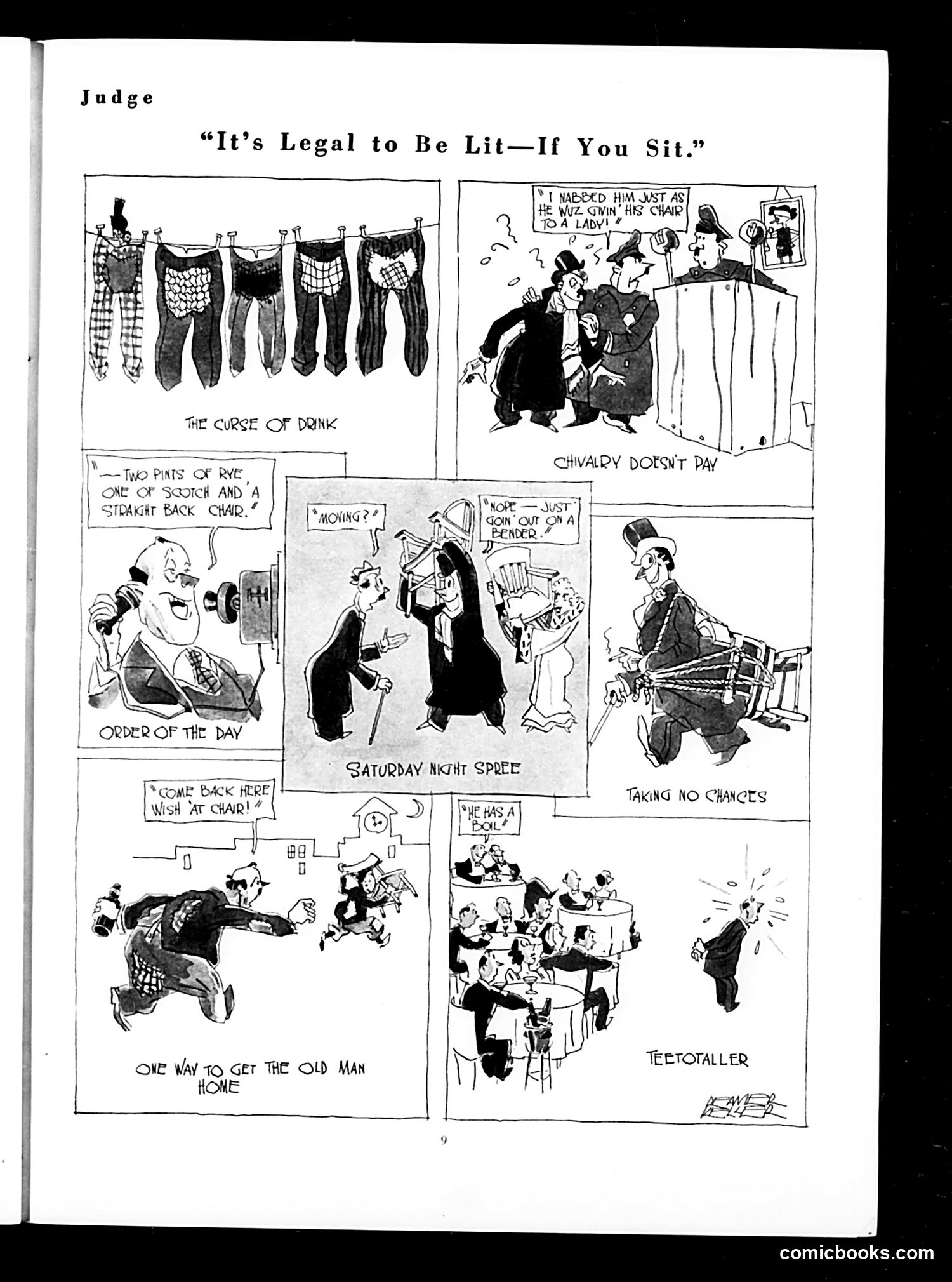
# "It's Legal to Be Lit—If You Sit": Prohibition-Era Satire This Judge page satirizes Prohibition enforcement through the legal loophole that intoxication was illegal only while *standing*—if you sat down while drinking, you were technically within the law. The six panels mock various scenarios exploiting this absurdity: - **"Curse of Drink"**: Hung laundry suggests a drunk's deteriorated state - **"Order of the Day"**: A man orders multiple drinks, sitting in a chair - **"Chivalry Doesn't Pay"**: A drunk man being arrested after offering his chair to a lady - **"Saturday Night Spree"**: Men drinking while seated, staying "legal" - **"One Way to Get the Old Man Home"**: A drunk man forcibly removed from his chair - **"Teetotaler"**: A sober man jumping with energy (implying sobriety as unnatural excitement) The satire targets Prohibition's impractical enforcement and the ridiculous loopholes people exploited. The humor assumes readers know this sitting-while-drunk "technicality" was a real workaround during the dry era.
# The Theatre of George Jean Nathan — Judge Magazine Review Page This is a theatre criticism column by prominent drama critic George Jean Nathan. The page reviews several Broadway productions from what appears to be the 1930s (based on references to Kern-Harbach musicals like "Roberta"). Nathan critiques shows including a nautical melodrama and discusses the Kern-Harbach musical "Roberta," praising its score but faulting librettist Harbach's book. He also reviews "She Loves Me Not," a comedy adapted from an Edward Hope novel, which he found moderately funny but not exceptional—comparing it favorably to older comedies but finding its college-dormitory-hijinks plot predictable. The recurring criticism is that theatrical conventions (sudden song interruptions, contrived comedic devices) have become tiresome through repetition. Nathan's tone is sophisticated and dismissive of obvious techniques, characteristic of his influential but notoriously acerbic critical style. This is primarily text with no visible political cartoons on this page.