
Judge, 1934-01 · page 12 of 36
Judge — January 1934 — page 12: what you’re looking at
What you’re looking at
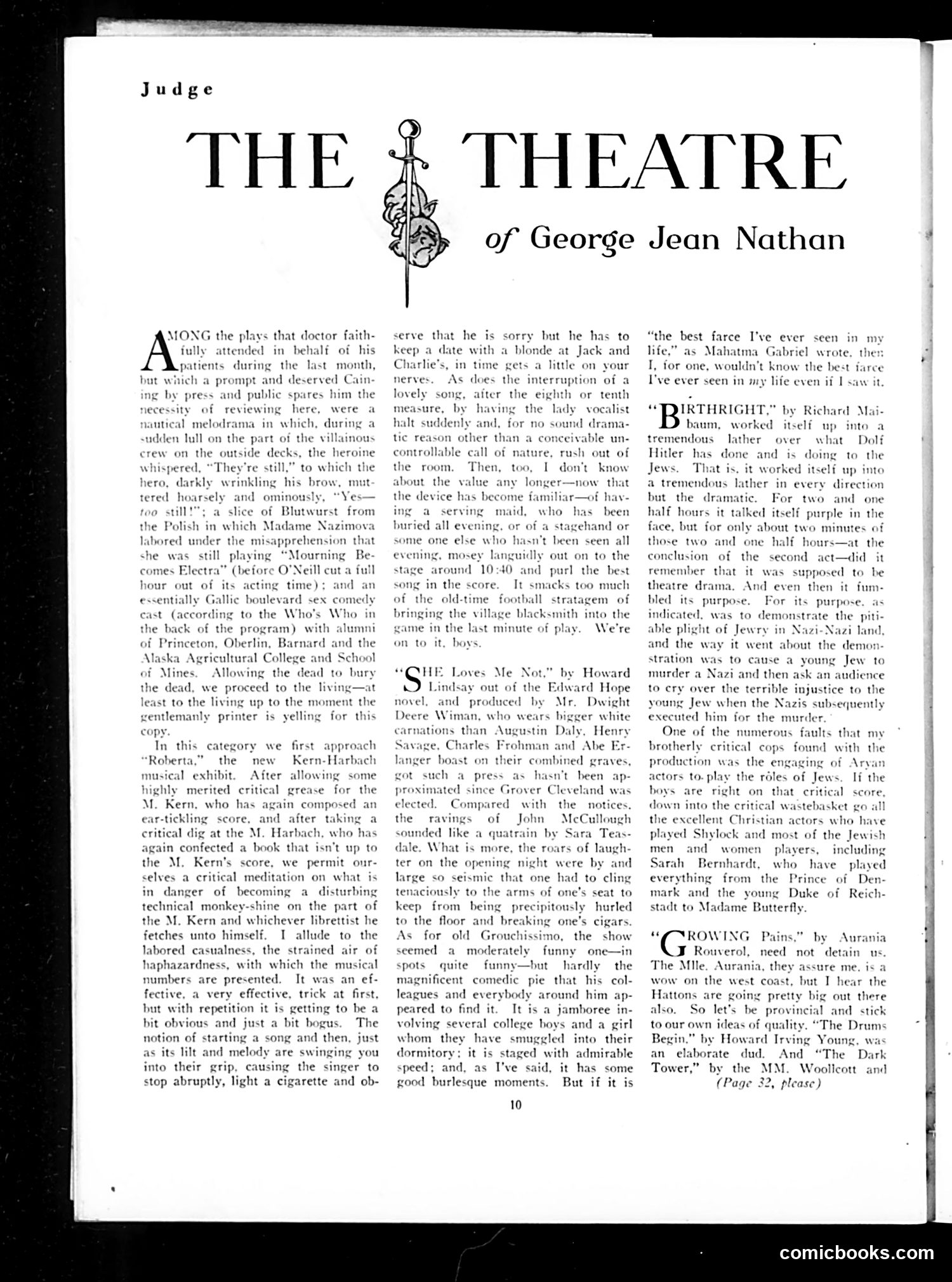
# The Theatre of George Jean Nathan — Judge Magazine Review Page This is a theatre criticism column by prominent drama critic George Jean Nathan. The page reviews several Broadway productions from what appears to be the 1930s (based on references to Kern-Harbach musicals like "Roberta"). Nathan critiques shows including a nautical melodrama and discusses the Kern-Harbach musical "Roberta," praising its score but faulting librettist Harbach's book. He also reviews "She Loves Me Not," a comedy adapted from an Edward Hope novel, which he found moderately funny but not exceptional—comparing it favorably to older comedies but finding its college-dormitory-hijinks plot predictable. The recurring criticism is that theatrical conventions (sudden song interruptions, contrived comedic devices) have become tiresome through repetition. Nathan's tone is sophisticated and dismissive of obvious techniques, characteristic of his influential but notoriously acerbic critical style. This is primarily text with no visible political cartoons on this page.
📄 Transcribed text from this page (OCR, searchable)
Machine-transcribed from the original scan — historical spelling and the odd misread are preserved.
THE MONG the plays that doctor faith- fully attended in behalf of his patients during the last- month, a prompt and deserved Cain- and public spares } necessity of reviewing here, were a iautical melodrama in which, during a udden lull on the part of the vill rew on the outside decks, the he hispered, “They're still,” to which hero, darkly wrinkling his brow, mt “Yes— a slice of Blutwurst hin which Madame Nazim I tered hoarsely and ominous om va at playing “Mourning Be- O'Neill cut a full ur out of its acting ti entially Gallic boulevard sex comedy cast (according to the Who's Who the back of the program) with al of Princeton, Oberlin, Barnard ka Agricultural Colle of Mines. Allowin; dead, we p ert 1 labored ur € misapprehension t she was st omes Electra” (befor je); and an imni nd the and School the d id to bury xeed to the livin t t the ¢ for this yy. In this category we first approach Kern-Harbach After allowing some highly merited critical gr M. Kern, who has again com “Roberta,” the new musical exhibit ase for the l nosed an r-tickling score, and after taking a critical dig at the M. Harbach, who has again confected a book that isn’t up to the M. Kern's score, we permit our- selves a critical meditation on what is in danger of becoming a disturbir technical monkey-shine on the part of the M. Kern and whichever librettist he fetches unto himself. I allude to the labored casualness, the strained air of haphazardness, with which the musical numbers are presented. It was an ef- fective, a very effective, trick at first, but with repetition it is getting to be a bit obvious and just a bit bogus. The notion of starting a song and then, just as its lilt and melody are swinging you into their grip, causing the singer to stop abruptly, light a cigarette and ob- THEATRE of George Jean Nathan serve that he is sorry but he has to keep a date with a blonde at Jack and Charlie's, in time gets a little on your nerves As does the interruption of a lovely song, aiter the eighth or ten having the lady vocalist halt suddenly and, for no sound drama- other than a conceivable un- controllable call of n: measure, by tic reason . Tush out of the room. Then, too, I don't know about the value any longer—now that the device has become familiar—of hav- i a serv “ v1 has been all evening, or of a stagehand or ne else who hasn't been seen all evening, mosey langui stage around 10 song in the score. of brir ly out on to the and purl the best It smacks too much he old-time foc ball stratagem of ig the village blacksmith into the game in the We're ast minute of play on to it, boys HE Loves Me Ne by Howard S Lindsay out of the Edward Hope and produced by Mr, Dwight Wiman, who wears bigger white ions than Augustin Daly, Henry Frohman and Abe Er- heir cc got such a press as | nbined graves, isn’t been ap- oximated since Grover Cleveland was elected. Compared with the the ravings of John 1 like a qu dale. What is mor ter on the openi notices. McCullough ain by Sara Tea soun . the roars of laug’ g night were by and large so seismic that one had to cling tenaciously to the arms ¢ one’s seat to keep from being precipitously hurled to the floor and breaking one’s cigars. As for old Grouchissimo, the show seemed one—in spots quite funny—but ardly — the magnificent comedic pie that his col- leagues and everybody around him moderately funny ip- peared to find it. It is a jamboree in- volving several college boys and a girl whom they have smuggled into their dormitory; it is staged with admirable speed; and, as I've said, it has some good burlesque moments. But if it is 10 he best farce I've ever seen in my life, I, for one, wouldn't know the best farce I've ever seen in my life even if | as Mahatma Gabriel wrote, ther st IRTHRIGHT,” by Richard Mai- baum, worked itself 1 tremendous lather over what Hitler has done and is de Jews That is, it worked itself up into a tremendous |: but the dramat her in every direction c. For two and one half hours it talked itself purple in the face, but for only about two minute those two and one half hours—at clusion of the second act—did remen er that it was supp theatre drama sed to be And even then it fum- bled its purpose. For its purpose. as indicated able p! was to demonstrate the piti- ght of Jewry in Nazi-Nazi lan and the way it went about he demor stration was to cause a young Jew to murder a Nazi and then ask an audi to cry over the terrible injustice to the young Jew when the Nazis subsequently executed him for the murd One of the numerous faults that my brotherly critical cops found with the production was the ¢ Ts roles of Jews. If the boys are right on that critical scor gagin; irs to. play th down into the eri al wastebasket go all t Christian actors who have played Shylock and most of the Jewish men and the excelle women _ players, arah Bernhardt, who everything fr including have played m the Prince of Den- mark and the young Duke of Reich- stadt to M me Butterfly. a ROWING Pains,” by Rouverol, need not det The Mile. wow on the west coast, but I hear the Hattons are going pretty big out there also. So let’s be provincial and stick to our own ideas of quality. “The Drums Bi ." by Howard Irving You an elaborate dud. And “The Tower,” by the MM (Page Aurania in’ us. Aurania, they assure me. is a wi Dark Woolleott and 32, please) comicbooks.com