
Judge, 1934-01 · page 3 of 36
Judge — January 1934 — page 3: what you’re looking at
What you’re looking at
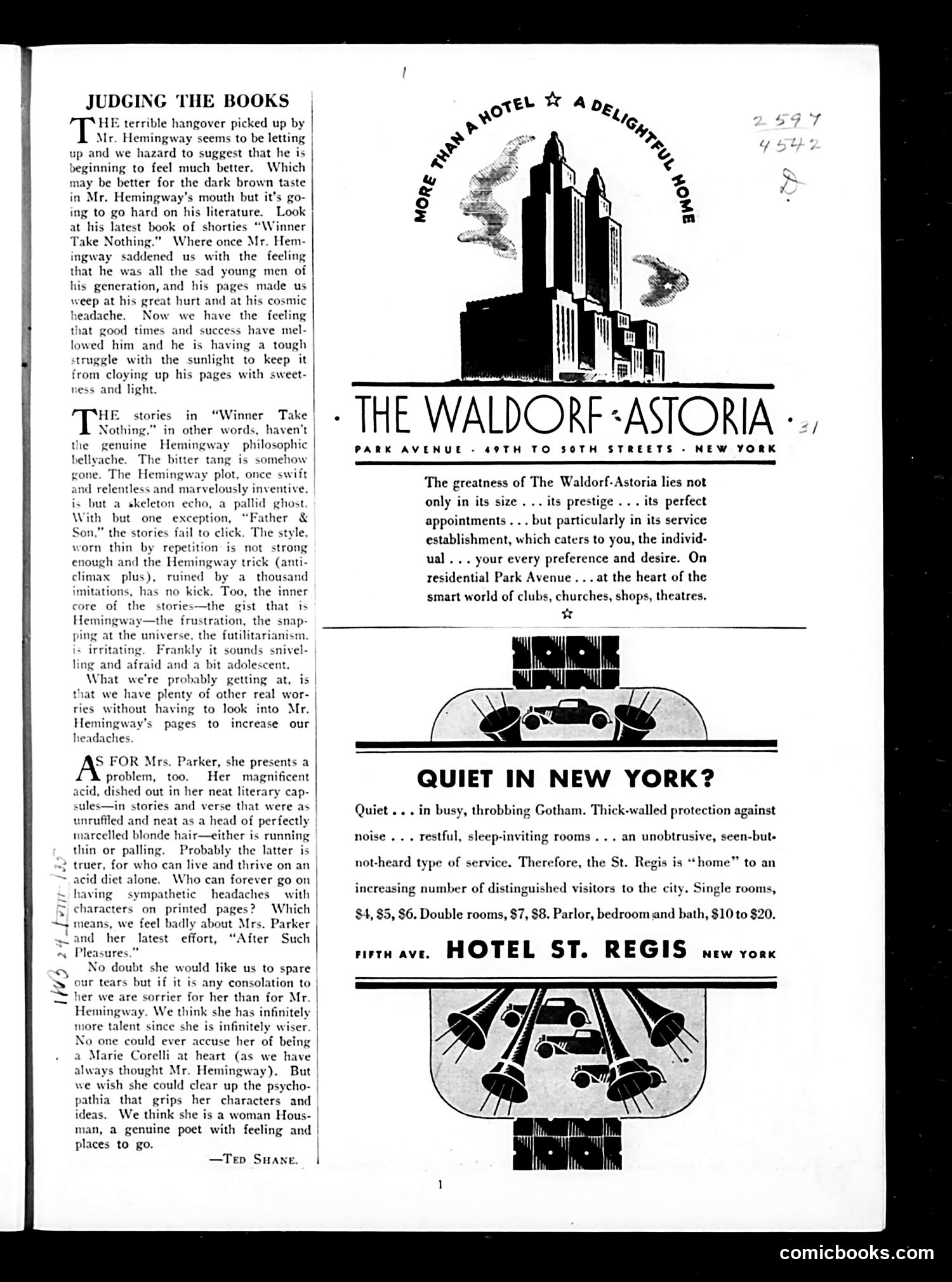
# Analysis This page is primarily **advertising rather than political satire**. The left column contains a book review titled "Judging the Books" by Ted Shane, critiquing Ernest Hemingway's short story collection "Winner Take Nothing" and Dorothy Parker's work. Shane argues Hemingway's stories lack the philosophical depth of his earlier work, though he acknowledges Parker's superior talent. The right side features two hotel advertisements—The Waldorf-Astoria and Hotel St. Regis—both emphasizing luxury accommodations in New York City. The ads use Art Deco design typical of the era and target wealthy travelers seeking quiet, refined lodging. There is **no political cartoon** on this page. It represents Judge's mixed content format combining literary criticism with upscale advertising.
📄 Transcribed text from this page (OCR, searchable)
Machine-transcribed from the original scan — historical spelling and the odd misread are preserved.
JUDGING THE BOOKS HE terrible hangover picked up by Mr. Hemingway seems to be letting | up and we hazard to suggest that he is beginning to feel much better. Which may be better for the dark brown taste in Mr. Hemingway's mouth but it’s go- ing to go hard on his literature. Look at his latest book of shorties “Winner e Nothing.” Where once Mr. Hem- ingway saddened us with the feeling that he was all the sad young men of his generation, and his pages made us weep at his great hurt and at his cosmic headache. Now we have the feeling that good times and success have mel- lowed him and he is having a tough struggle with the sunlight to keep it from cloying up his pages with sweet- ness and light. HE stories in “Winner Take Nothing.” in other words, haven't the genuine Hemingway _ philosophic bellyache. The bitter tang is somehow | gone. The Hemingway plot, once swift and relentless and marvelously inventive, is but a skeleton echo, a pallid ghost With but one exception, “Father & Son,” the stories fail to click. The style, worn thin by repetition is not strong enough and the Hemingway trick (anti- climax plus), ruined by a thousand imitations, has no kick. Too, the inner core of the stories—the gist that is Hemingway—the frustration, the snap- ping at the universe, the futilitarianism, s irritating. Frankly it sounds snivel- ling and afraid and a bit adoles: What we're probably getting at, is that we have plenty of other real wor- ries without having to look into Mr. | Hemingway's pages to increase our headaches. S FOR Mrs. Parker, she presents a problem, too. Her magnificent acid, dished out in her neat literary cap- sules—in stories and verse that were as unrufiled and neat as a head of perfectly marcelled blonde hair—either is running thin or palling. Probably the latter is 2 truer, for who can live and thrive on an ~ acid diet alone. Who can forever go on | ~ having sympathetic headaches with characters on printed pages? Which means, we feel badly about Mrs, Parker ~and her latest effort, “After Such Pleasures.” No doubt she would like us to spare ’ our tears but if it is any consolation to her we are sorrier for her than for Mr. Hemingway. We think she has infinitely more talent since she is infinitely wiser. | one could ever accuse her of being a Marie Corelli at heart (as we have always thought Mr. Hemingway). But we wish she could clear up the psycho- pathia that grips her characters and ideas. We think she is a woman Hous- man, a genuine poet with feeling and places to go. —Tep Sane. THE WALDORE A °2/ PARK AVENUE - 49TH TO SOTH STREETS - NEW YORK The greatness of The Waldorf-Astoria lies not only in its size... its prestige ... its perfect appointments . .. but particularly in its service establishment, which caters to you, the individ- ual... your every preference and desire. On residential Park Avenue... at the heart of the smart world of clubs, churches, shops, theatres. Md ym eras. QUIET IN NEW YORK? Quiet ... in busy, throbbing Gotham. Thick-walled protection against noise . . . restful, sleep-inviting rooms . . . an unobtrusive, seen-but- not-heard type of service. Therefore, the St. Regis is “‘home” to an increasing number of distinguished visitors to the city. Single rooms, $4, $5, $6. Double rooms, $7, $8. Parlor, bedroom and bath, $10 to $20. FIFTH AVE, HOTEL ST. REGIS NEW YORK comicbooks.com