
Judge, 1934-01 · page 22 of 36
Judge — January 1934 — page 22: what you’re looking at
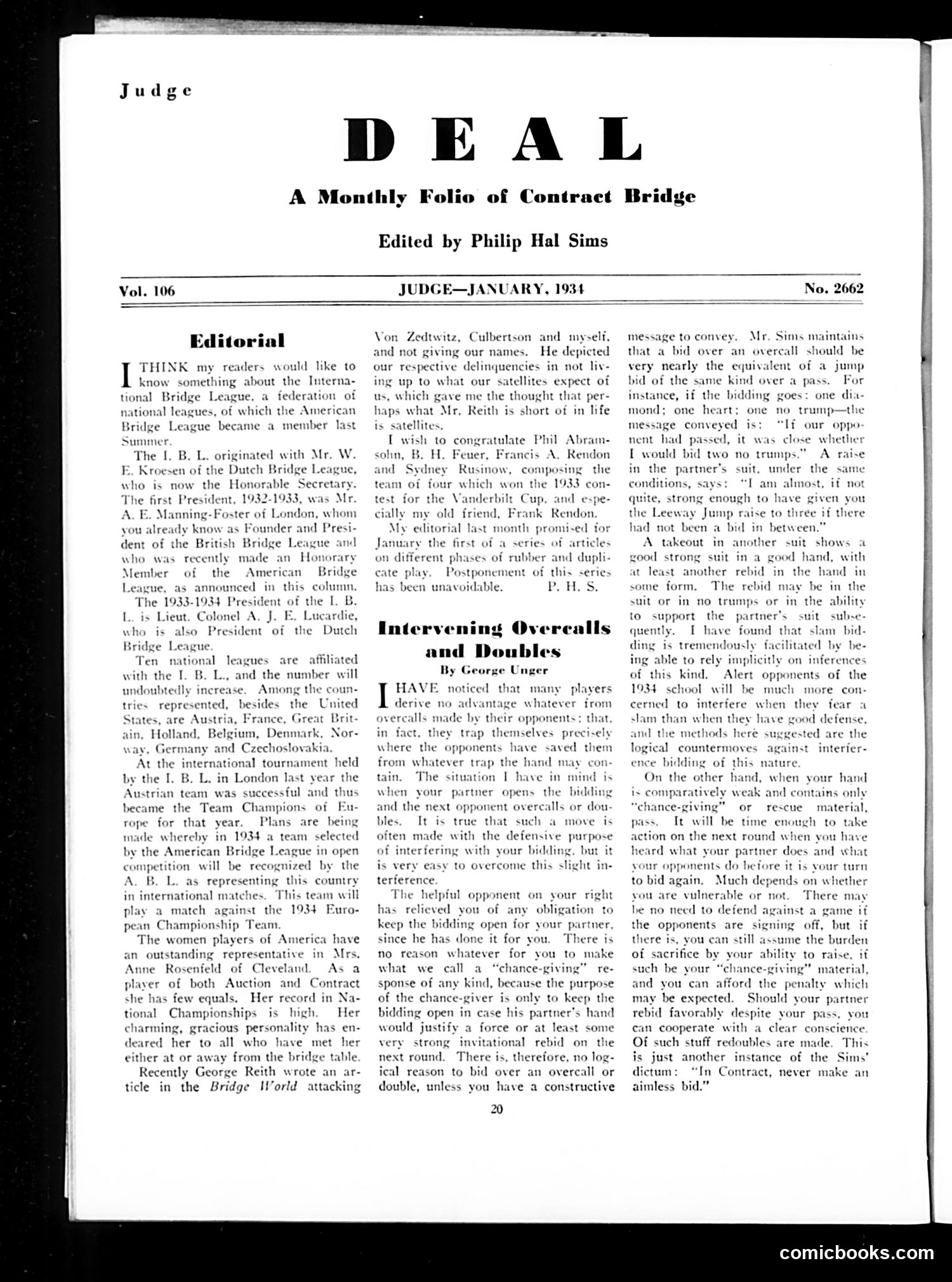
A restored page from Judge, 1934-01. Page through the whole issue in the reader above.
📄 Transcribed text from this page (OCR, searchable)
Machine-transcribed from the original scan — historical spelling and the odd misread are preserved.
DEAL A Monthly Folio of Contract Edited by Philip Hal Sims Bri Vol. 106 JUDGE—JANUARY, 1934 (0. 2662 Editoriz THINK my readers would like to know something about the Interna- tional Bridge League, a federation of national leagues, of which the American Bridge League became a member last Summer. The B. L. originated with Mr. W. Kroesen of the Dutch Bridge League, vho is now the Honorable Secretary. 1932-1933, was Mr. ‘oster of London, whom 1 Pres Bridge League and Honorary A. E. Manning- you already know as Founder ¢ British who was recently made an Member of the American Bridge League, as announced in this column. The 1933-1934 Presi of the L. B, L. is Lieut. Colonel A. J. E. Lucardie, who is President of the Dutch Bridge League. Ten national leagues are affiliated with the I. B. L., and the number will undou Among the cou! tries represented, besides the United States, are Austria, France, ¢ Brit- n, Holland, Belgium, Denmark, Nor- ay, Germany and Czechoslovakia At the ir al tournament held by the I. B. L. in London 1 Austrian team was successful and thus Team Champions of Eu- rope for that year. Plans are being made whereby in 1934 a team selected by the American Bridge League in open will be recognized by the as representing this country dent of also «ily increase. reat st year the became th competition A. BLL in international matches. play match against the pean Championship Team The women players of America have an outstanding representati Mrs. Anne Rosenfeld of Cleveland. As a player of both Auction and Contract she has few equals. Her record in N tional Championships is high. Her charming, gracious personality has en- leared her to all who have met her either at or away from the bridge table Recently George Reith wrote an ar- icle in the Bridge World attacking This team will 1934 Euro- Von Zedtwitz, Culbertson and myself, and not giving our names. He depicted our respective delinquencies in not liv- ing up to what our satellites expect of us, which gave me the thought that per- haps what Mr. Reith is short of in life is satellites. I wish to congratula Phil 3. He ft} cis A and Sydney Rusinow, Abram- sohn, Rendon nposing the t of four which won the 1933 con- st © Vanderbilt Cup, and « cially my old friend, Frank Rendon. My editorial last month promised for January the first of a series of articl different phases of rubber and dupli- this series P...H.. Si cate play p ‘ostponement of has been unavoidable. Intervening Overcalls ar ubles By George l HAVE no! that ma players derive no advantage whatever overcalls made by their opponents ger iced from that hey trap themselves. precisely where the opponents have saved th from whatever trap the hand may con- tain. The situation I len your have in mind is bidding and the next opponent overcalls or do bles. It is often made with the defensive purpose of interfering with your bidding. but it partner opens the true that such a move is very easy to overcome this ht ine terference The helpful opponent on your right has relieved you of any obligation to keep the bidding open for your partner, since he has done it for you no reason whatever for you to make what we call a “chance-givir sponse of any kind, because the purpose of the chance is only to keep the bidding open in case his partner's hand would justify a force or at least very strong invitational rebid on the next round. There is, therefore, no log- ical reason to bid over an overcall or double, unless you have a constructive There is giver some message to convey. Mr. Sims maintains hould be very nearly the equivalent of a jump id of the same kind over a pass. For one dia- one heart; one no trump—the conveyed is: “If our oppo nent had passed, it was close whether I would bid two no trumps.” A raise in the partner’s suit, under the sar conditions, says: “I am almost, if not x enough to have je Leeway J that a bid over an overcall instance, if the bidding goes mond messag! stror ven you p raise to three i had not been a bid in between.” A takeout in another suit strong suit in a good hand, with t another rebid in some form. shows a the hand in The rebid may be in the suit or in no trumps or in the ability to support. the quently. [ have found that slam bid- ding is tremendously facilitated by ing able to rely implicitly on inference of this kind. Alert 1934 school will be cerned to partner's suit subse- opponents of the much con- fear a have good defense, gested are the gainst more interfere when they slam than when they and the methods here logical ence bidding of this On the other hand, when your hand is comparatively weak and cor “chance-giving” or rescue material, It will be time enow to take action on the next round when you have heard what your partner does and what your opponents do before it i to bid again. you are vulnerabl countermoves interier- sins only your turn Much depends on whether or not. There may he no need to defend against a game it the opponents are signing off, but if there is, you can still assume the burden of sacrifice by your ability to raise. if such be your “chance material, and you can afford the penalty which may be expected. Should your partner rebid favorably despite your pass, you can cooperate with a clear conscience Of such stuff redoubles are made. This just another instance of the Sims’ ctum: “In Contract, never make an aimless bid.” iving” comicbooks.com