
Judge, 1934-01 · page 23 of 36
Judge — January 1934 — page 23: what you’re looking at
A restored page from Judge, 1934-01. Page through the whole issue in the reader above.
📄 Transcribed text from this page (OCR, searchable)
Machine-transcribed from the original scan — historical spelling and the odd misread are preserved.
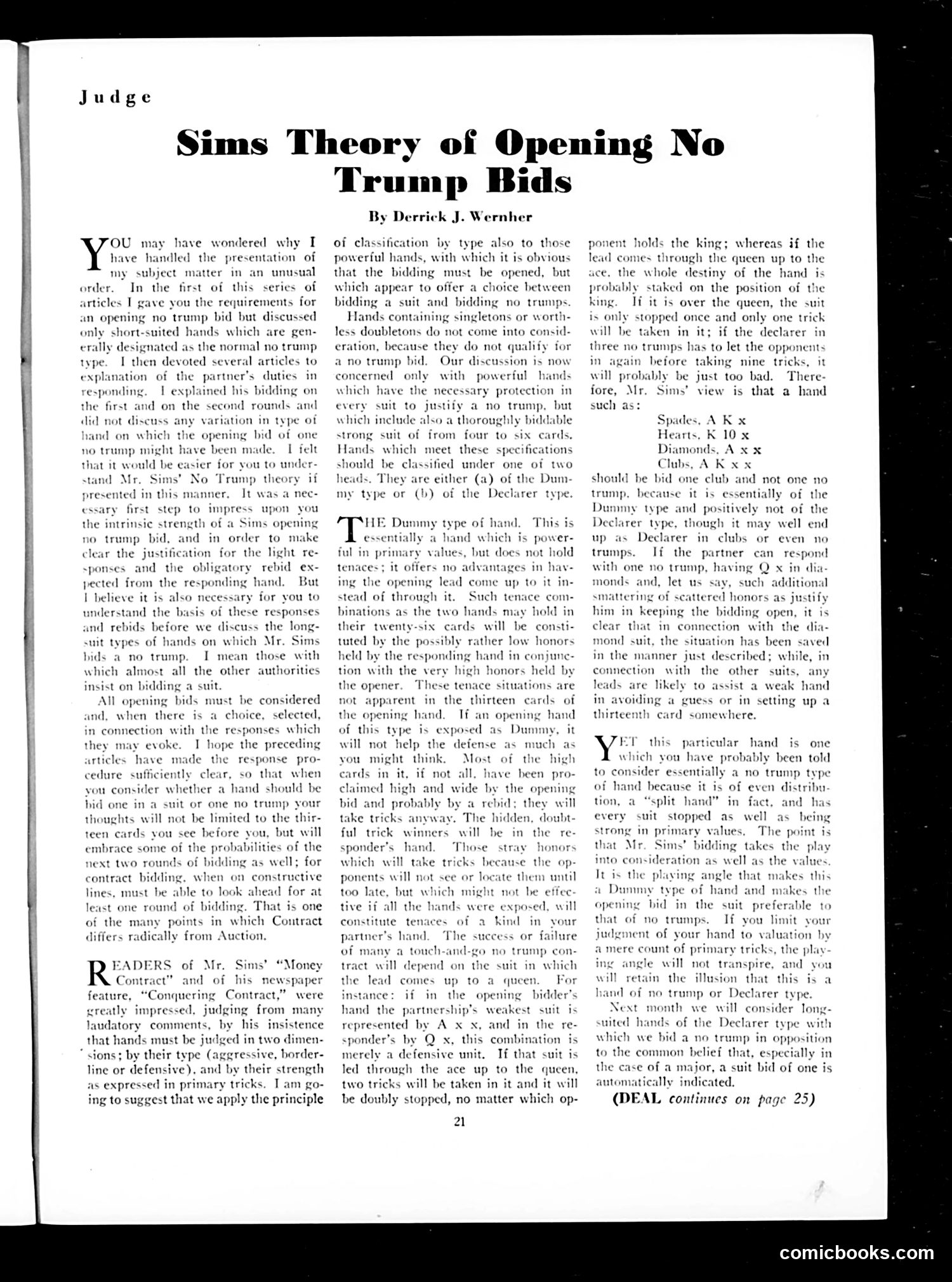
* sions; by their type ave wondered why I have handled the presentation of my subject matter in an unusual order. In the first of this series of articles I gave you the requirements for an opening no trump bid but discussed only short-suited hands which are gen- erally designated as the normal no trump type. I then devoted several articles to explanation of the partner's duties in responding 1 explained his bidding on the first and on the second rounds and cuss any variation in type of did not di and on which the opening bid of one wt have been made. I felt that it would be easier for you to under- stand Mr. Sims’ No Trump theory if presented in this manner. no trump mis It was a nec- essary first step to impress upon you the intrinsic strength of a Sims openi no trump bid, and in order to make clear the justification for the light re- sponses and the atory rebid ex- pected from the respon and. E I believe it is also necessary for you to nderstand the basis of these responses 1 rebids before we discuss the long- suit types of hands on which Mr. Sims bids a no trump. I mean those with which almost all the other authorities insist on bidding a suit. All opening bids must be considered and, when there is a choice, selected, in connection with the responses which I hope the preceding urticles have made the response pro- they nay evoke. cedure sufficiently clear, so that when you consider whether a hand should be bid one in a suit or one no trump your thoughts will not be limited to the thir- ards you see before you, but will abilities of the next two rounds of bidding as well; for contract bidding, when on constructive lines, must be able to look ad for at least of bidding. That is one of the many points in which Contract differs radically from Auction. teen embrace some of the pr: ne rour Sims’ “Money EADERS of Mr. Contract” and of ure, “Conquer Contract,” were atly impressed, judging from many laudatory comments, by his insistence that hands must be juc is newspaper te; gr ged in two dimen- ggressive, border- line or defensive), and by their strength as expressed in primary tricks. Tam go- ing to suggest that we apply the principle Sims Theory Trump Bids By Derrick J. Wernher of classification by type also to those powerful hands, with which it is obvious that the bidding must be opened, but which appear to offer a choi bidding a suit and bidding between no trumps Hands containing singletons or worth- less doubletons do not come into consid- eration, be ‘ause they do not qualify for a no trump bid. concerned Our discussion is now y with powerful hands which have the necessary protection in every suit to justify a no trump, but which include ya thoroughly bid dle strong suit of from four to six cards. Hands which meet these specifications should be classified under one ot two heads. They are either (a) of the Dum. my type or (b) of the Declarer type. HE Dummy type of hand. This is ssentially a hand which is power- ful in primary values, but does not hold tenace it offers no advantages in hav- ing the opening lead come up to it in- stead of through it. Such tenace com- binations as the two hands may hold it th twenty-six cards will be consti- tuted by the possibly rather low honors held by the responding hand in conjune tion with the very high honors held by the opener These tenace situations are not apparent in the thirteen cards of the opening hand. If an opening hand of this type is exposed as Dummy, it will not help the defense as much you might think. Most of the hi cards in it, if not all. have been pro- claimed high and wide by the opening bid and probably by a rebid; they will take tricks anyway, The hidden, doubt- ful trick winners will be in’ the re- sponder’s hand. Tho: uy honors which will take tricks because tl ponents will r op- t see or locate them until too late, but which m tive if all the hands were exposed. constitute tenaces of ki partner’s hand it not be effec: ill in your The success or failure of many a touch-and-go no trump con- don the suit in which the lead comes up to a queen. For in if in the opening bidder's nd the partnership's weakest suit represented by A x x, and in the re- sponder’s by Q_ x, this combination is merely a defensive unit. If that sui led through the ace up to the queen, two tricks will be taken in it and it will be doubly stopped, no matter which op- 2 tract will depe ance of Opening No ponent holds the k whereas if the lead comes through the queen up to the ace. the whole destiny of the hand pr king. If it is over the queen, the sui nly stopped once and only one trick will be taken in it; i three no trumps ably staked on the position of the the declarer in as to let the opponents in again before taking nine tricks, it will probably be just too bad. TI fore, Mr. Sims’ view is that a hand such as: Spades, A K x Hearts, K 10 Diamonds, A x x Clubs, A K x x should he bid one club and not one no trump. bec ly of Dunmy type and positively not of the Declarer type, thou se it is essentia h it may well end up as Declarer in clubs or even no trumps. If the partner can respond with one no trump, having Q x in dia- monds and, let us say, such of scattered h additional smattering him i clear mors as justify keeping the bidding open, it is at in connection with mond suit, the situation has been saved in the manner just described; while, in connection with the other suits, any leads are likely to assist a weak hand in avoiding a guess or in setting up a thirteenth card somewhere, ET this particular hand is one which you have probably been told to consider essentially a no trump type f hand because it is of even distribu tion, “split hand” in fact, and has every suit stopped as wel strong in primary values, fi as be The poi Mr. Sims’ bidding takes the playi It angle that makes this a Dummy type of hand and makes the opening bid in the suit preferable to that of no trumps. If you 1 judgment of your hand to valuation hy i mere count of primary tricks, the play angle will not transpire, and you tain the illusion that this is a of no trump or Declarer tyy Next month we will consider long d hands of the De larer type w which we bid a no trump in opposition to the common belief that, especially in the case of a major, a suit bid of one is automatically indicated, (DEAL continues on page 25) comicbooks.com