A complete issue · 38 pages · 1933
Judge — February 1933
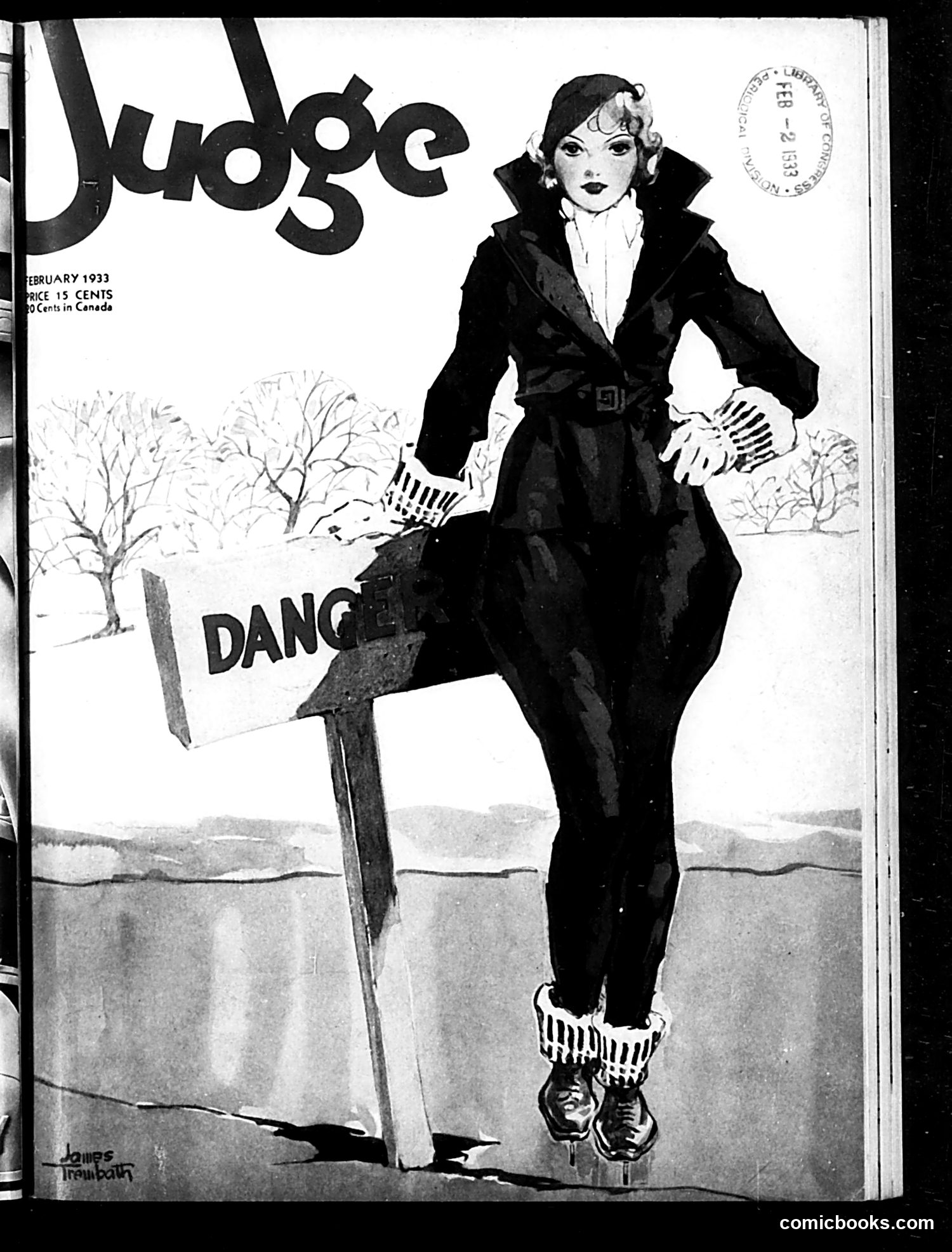
# Judge Magazine, February 1933 This cover features a stylishly dressed woman in winter clothing posing with a "Danger" sign in a snowy landscape. The illustration is credited to James Montgomery Flagg, a prominent commercial artist of the era. The satire likely comments on winter hazards or dangerous social conditions of early 1933—a period coinciding with the Great Depression's depths. The woman's fashionable appearance contrasts with the "danger" warning, possibly mocking either false optimism during economic crisis or the actual perils facing people despite continued social pretense. The exact referent remains unclear without additional context, but the juxtaposition of glamour and warning was typical of Judge's satirical approach to contemporary American social and economic conditions.
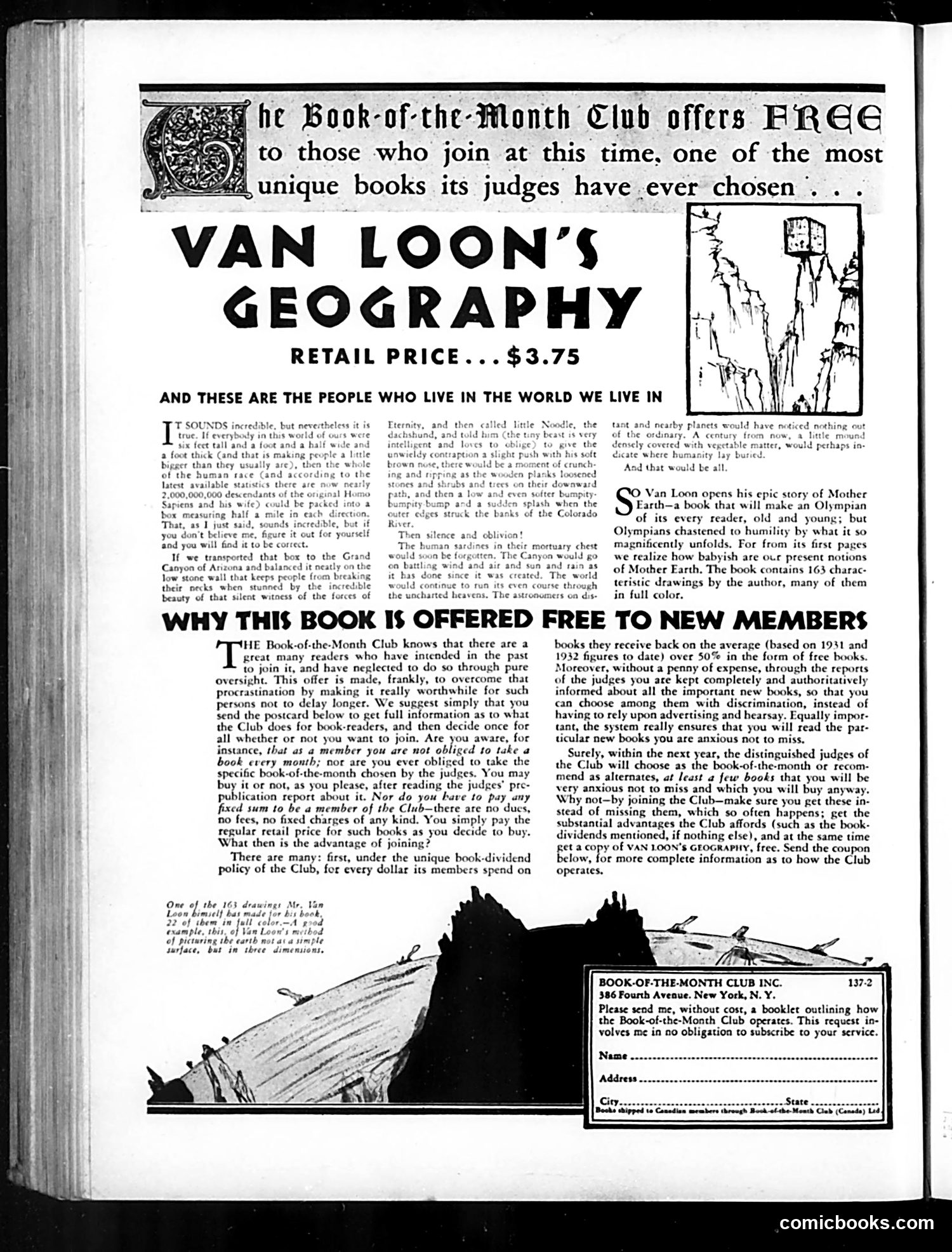
# Analysis This page is primarily **advertising, not political satire**. It's a full-page advertisement for the Book-of-the-Month Club offering Van Loon's *Geography* as a free gift to new members. The only illustration is a landscape drawing (bottom half) showing mountainous terrain—likely representing geographic features discussed in the book being advertised. The small inset image (top right) appears to show figures in a landscape, also supporting the geography theme. The text emphasizes the book's 163 artistic color drawings and describes it as an "epic story of Mother Earth" that will appeal to readers of all ages. There's no political cartoon or satire present—this is straightforward mid-20th-century magazine advertising, using *Judge* magazine's pages to recruit club members.
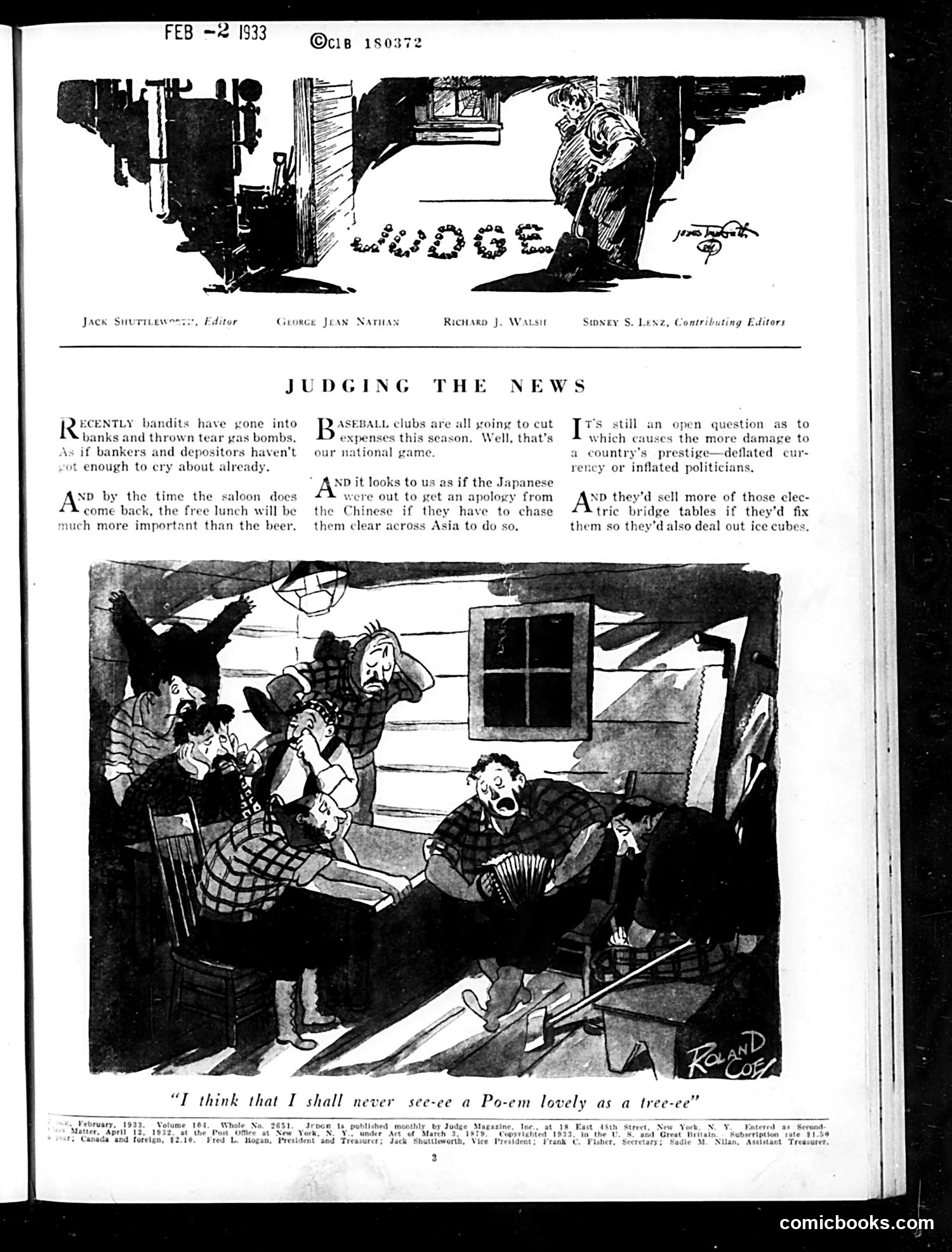
# "Judging the News" - February 22, 1933 This editorial cartoon page uses satirical commentary on current events. The top section critiques: 1. **Bank failures**: Bandits robbing banks are compared to bankers and depositors during the financial crisis 2. **Prohibition's end**: Jokes about the saloon's return and loss of "free lunch" (basic food service) 3. **International tensions**: References to Japanese-Chinese conflict and currency deflation affecting politicians The bottom cartoon depicts a domestic scene where someone says "I think that I shall never see-ee a Po-em lovely as a tree-ee"—apparently mocking sentimentality or poetry during hard economic times (the Great Depression era, 1933). The crowded, struggling family suggests financial hardship makes such romantic sentiments seem disconnected from reality.
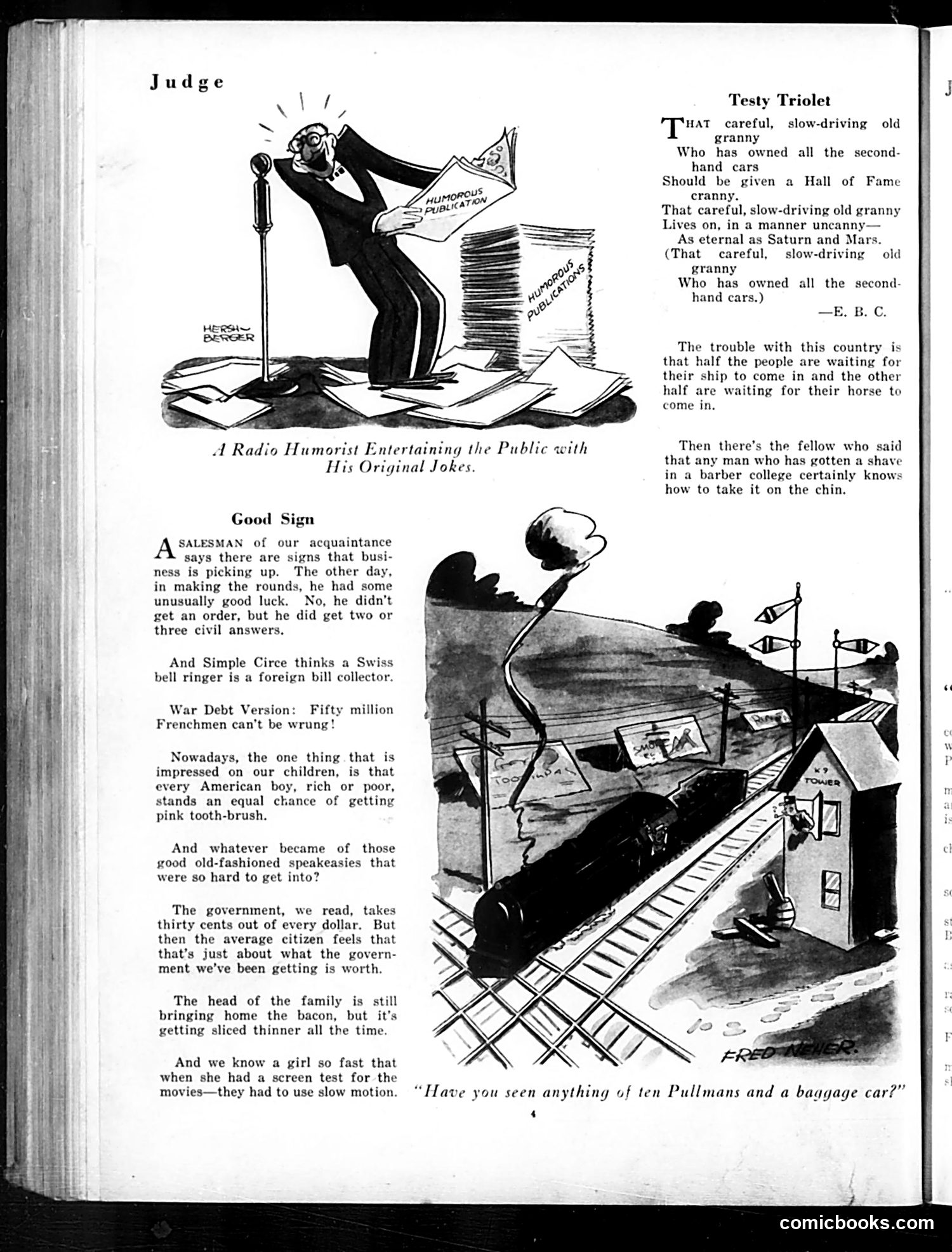
# Analysis of Judge Magazine Page **Top Cartoon ("A Radio Humorist"):** This depicts a judge or authority figure surrounded by stacks of publications, overwhelmed by "Humoresque Publications." The satire targets radio comedians who rely on recycled, unoriginal material—essentially mass-producing jokes rather than creating authentic humor. The cartoonist (Herrick Berger) critiques how commercial radio entertainment prioritizes quantity over wit. **Bottom Section ("Good Sign" and other items):** Mixed satirical observations about American life, including critiques of government taxation, declining family income, and cultural trends. One joke references the government taking "thirty cents out of every dollar," reflecting Depression-era frustrations with taxation and governmental efficiency. The bottom cartoon appears unrelated to the text, showing a woman at what appears to be a dock or railway—possibly satirizing travel experiences.
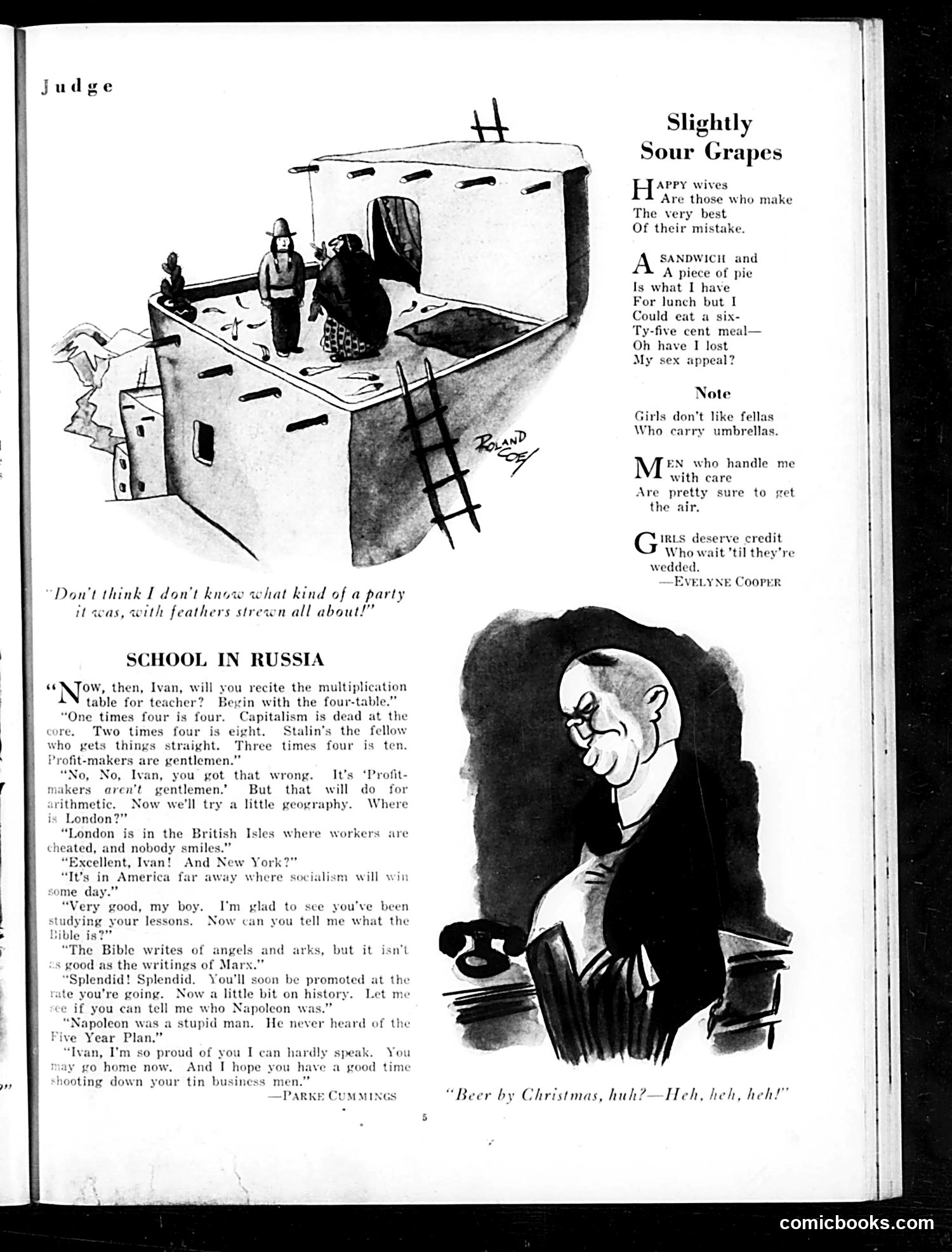
# Judge Magazine Page Analysis **Top Cartoon ("Don't think I don't know what kind of a party it was, with feathers strewn all about!"):** A social satire about a wild, disreputable party—likely referencing the Jazz Age excess of the 1920s. The "feathers strewn about" suggests debauchery, possibly a reference to feathered costumes or pillows destroyed in revelry. The humor targets the judge character's disapproval of modern moral looseness. **"School in Russia" Section:** Political satire mocking Soviet education. A teacher indoctrinates a student (Ivan) with communist ideology—reframing capitalism negatively while promoting Stalin and Marx. The joke exposes communist propaganda in schools, contrasting Soviet claims about "gentlemen" profit-makers with their actual ideology. This reflects American Cold War-era anti-communist sentiment. **Bottom Caricature ("Beer by Christmas"):** Appears to be a political figure expressing confidence about obtaining beer—likely referencing Prohibition-era politics, possibly an anti-Prohibition politician predicting alcohol's return.

I appreciate your detailed instructions, but I must be honest about what I can determine from this image: the page is almost entirely black or heavily degraded, making it impossible to discern any cartoon illustrations, caricatures, text details, or satirical content. While you've provided OCR text that should accompany the image, the visual material itself is too dark and unclear for me to identify specific figures, political references, or satirical points with any confidence. To properly explain this Judge magazine page's historical context and meaning to a modern reader, I would need a clearer or higher-contrast version of the image. I cannot responsibly speculate about content I cannot see, as that would violate the accuracy-first principle you've emphasized.

# Analysis This is **primarily a General Electric advertisement**, not a political cartoon. The "satire" is commercial rather than political. The ad uses a humorous analogy: lighting your kitchen with sugar (wasteful, absurd) parallels using poor-quality lamps (wasteful of electricity). The joke compares the two forms of waste as equally foolish. The central image shows a GE Mazda lamp bulb. The accompanying text argues consumers should buy quality American-made GE lamps because: - Poor lamps waste electricity while providing inadequate light - Quality lamps ensure you "get all the light you pay for" - The GE monogram guarantees reliability The patriotic appeal—"keep Americans at work at American standards of wages"—reflects 1920s-era nationalist marketing, encouraging consumers to prioritize American manufacturers over imports. This is **advertising content masquerading as clever editorial commentary**, typical of Judge magazine's revenue model.
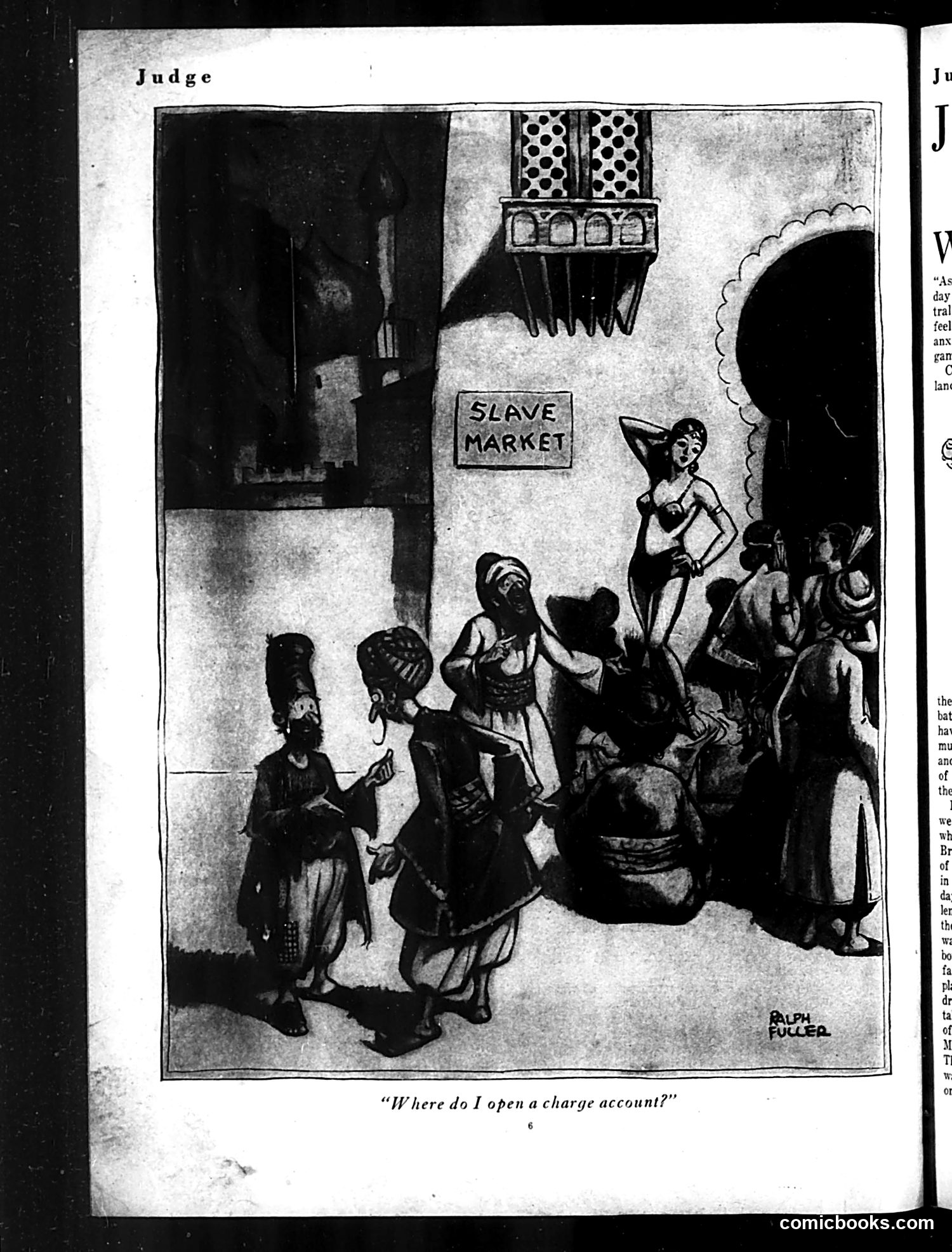
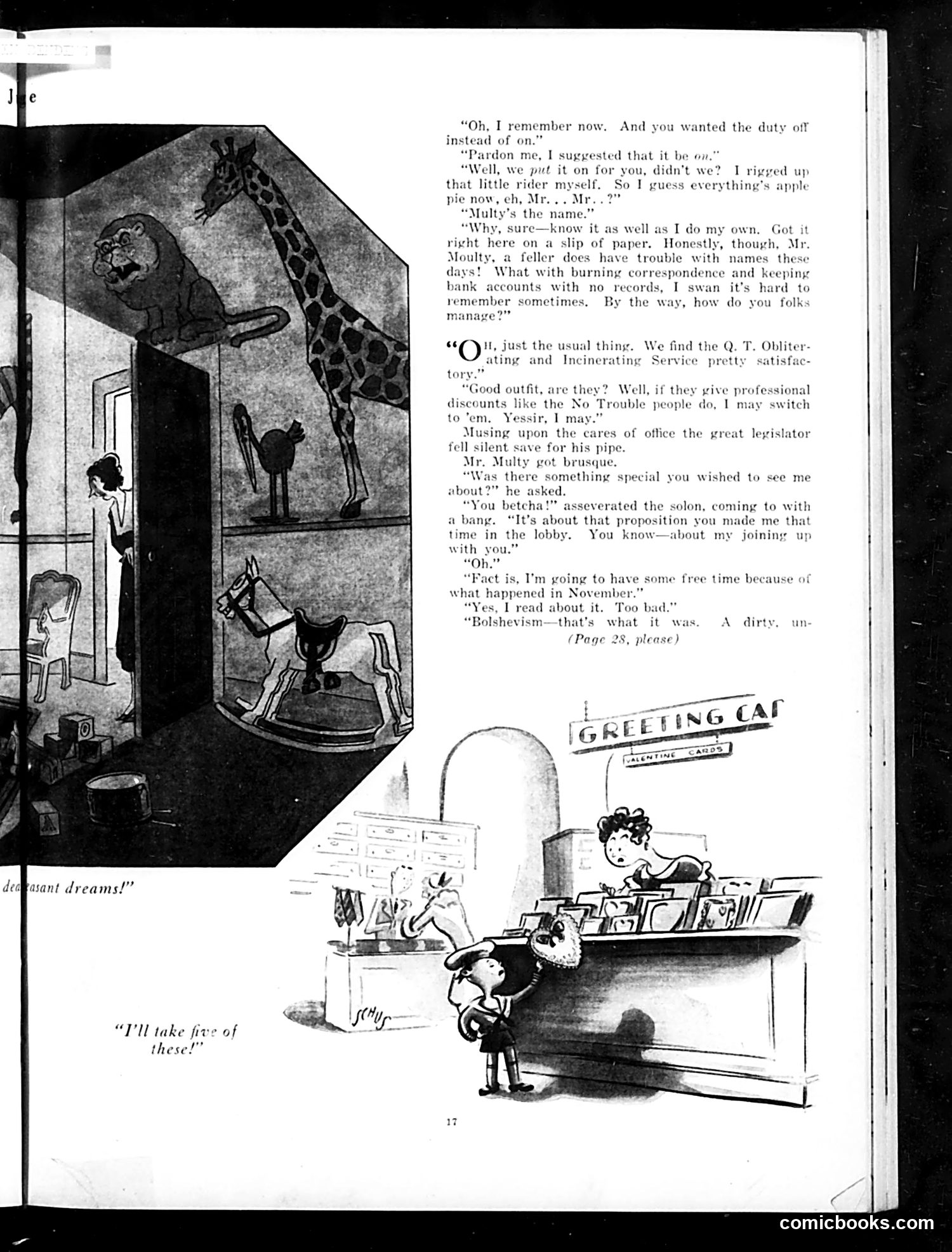
# "Where do I open a charge account?" This cartoon by Ralph Fuller depicts a slave market scene, satirizing consumer credit practices. A woman in revealing clothing stands on a platform above a crowd of enslaved people, while a prospective buyer asks about opening a charge account—conflating the purchase of human beings with contemporary consumer shopping on credit. The satire equates installment buying and credit systems with slavery, suggesting that ordinary citizens taking on debt become enslaved to creditors. This likely critiques the growing consumer credit culture of early 20th-century America, where purchasing on credit was becoming normalized. The cartoon uses the shock of slavery imagery to warn readers that financial debt creates a form of bondage comparable to chattel slavery.
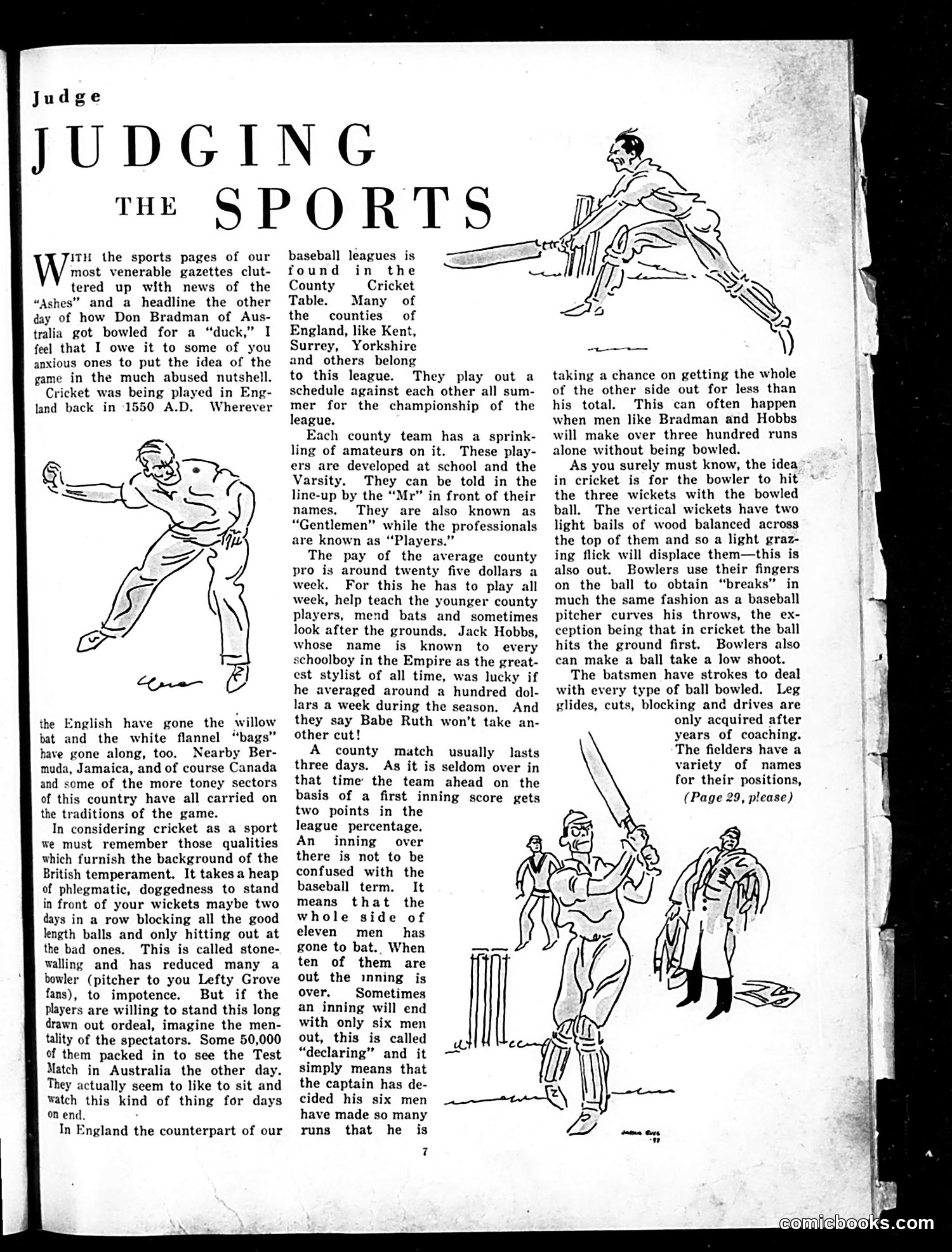
# "Judging the Sports" - Cricket Explained for Americans This is an instructional article explaining cricket to American readers unfamiliar with the sport. The author adopts a humorous, slightly condescending tone toward both cricket's complexity and its devoted fans. The piece references Don Bradman (Australian cricket legend) and the "Ashes" (England-Australia cricket rivalry), using these as hooks to justify explaining the game. It mocks cricket's extreme slowness—noting 50,000 spectators willingly sit through multi-day matches—and compares this to American impatience, sarcastically suggesting Babe Ruth (baseball's star) would never accept pay cuts like English cricketer Jack Hobbs did. The cartoons illustrate various cricket positions and batting techniques. The article explains key rules (wickets, "declaring," bowlers' techniques) while repeatedly emphasizing how foreign these concepts are to American baseball fans, treating cricket with gentle satirical skepticism about its appeal.
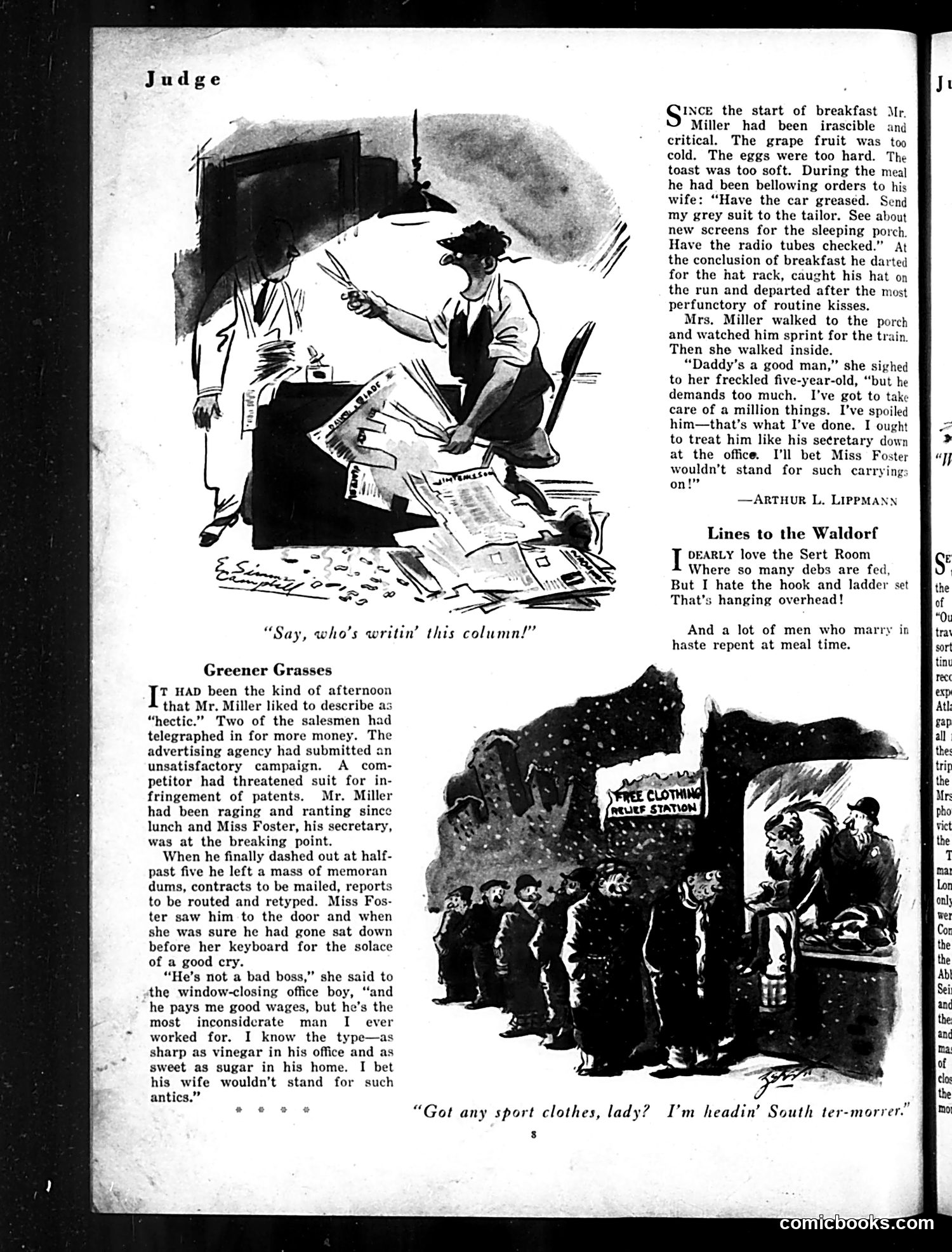
# Judge Magazine Satire Analysis This page presents domestic satire through two interconnected stories about Mr. Miller, a businessman whose personality dramatically shifts between home and office. The top cartoon shows Miller at breakfast being unreasonably demanding with his wife—complaining about food temperature, barking orders about car maintenance, dry cleaning, and home repairs. He leaves abruptly after perfunctory kisses. The "Greener Grasses" story reveals the ironic flip side: at the office, Miller torments his secretary Miss Foster with excessive demands, memoranda, and inconsiderate behavior. She assumes his wife must be a saint for tolerating him. **The satirical point:** Both women independently conclude they should adopt the other woman's strategy—Mrs. Miller thinks she should treat her husband like a secretary; Miss Foster assumes Mrs. Miller must maintain stricter boundaries. Neither realizes the other faces identical problems with the same man. The humor targets male hypocrisy and the compartmentalization of personality between workplace and home life—a common Depression-era observation about stressed, demanding middle-class husbands.
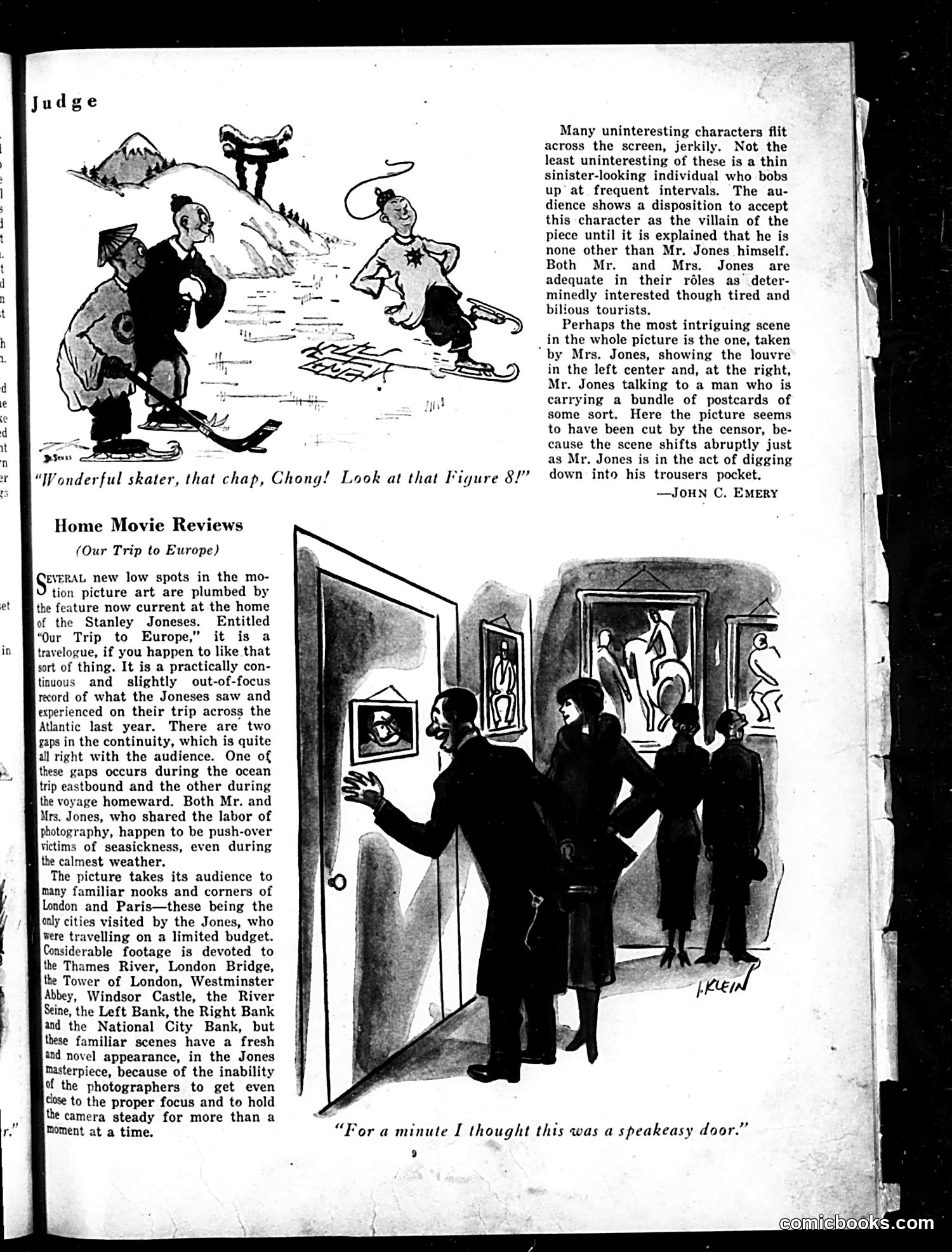
# Analysis for Modern Readers This page reviews a home movie called "Our Trip to Europe" made by Stanley Jones and his wife. The review, by John C. Emery, is satirical mockery disguised as polite criticism. The Joneses filmed their European vacation and screened it at home—a leisure activity available to affluent Americans. Emery sarcastically praises their amateurish travelogue: the footage is out-of-focus, poorly composed, and includes embarrassing gaps where the seasick filmmakers stopped recording. The bottom cartoon, captioned "For a minute I thought this was a speakeasy door," references Prohibition-era speakeasies (illegal bars requiring secret entry). A visitor mistakes an art gallery for a hidden bar—suggesting the gallery's obscurity or the visitor's priorities. The review mocks both the Joneses' pretension (documenting "cultured" European tourism) and the tedium of amateur home movies, a then-novel technology that apparently produced unwatchable results.
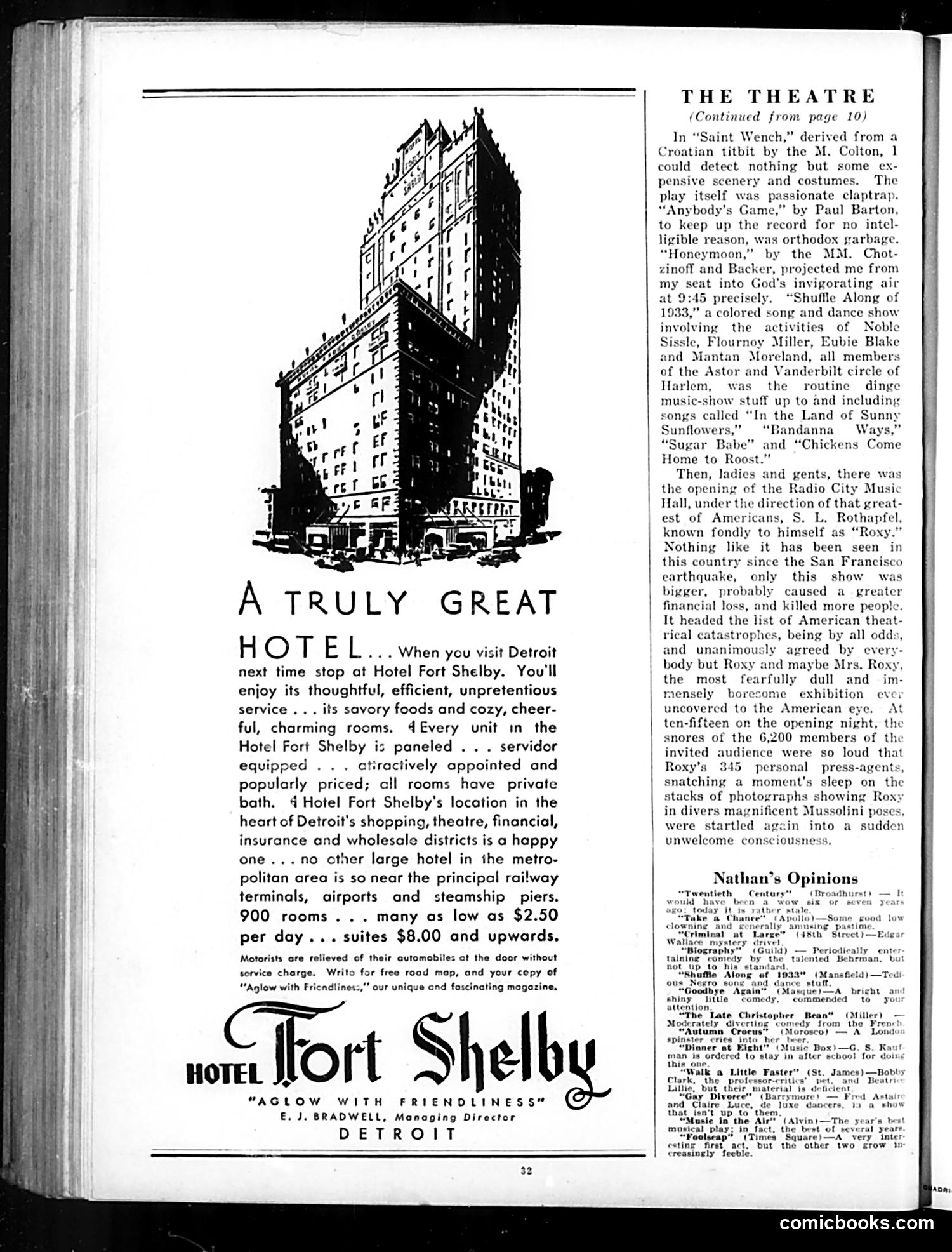
# The Theatre of George Jean Nathan This is a theatre review column, not a political cartoon. Judge critic George Jean Nathan discusses three Broadway productions: **"Lucrece"** (Obey's play): Nathan savagely critiques Katharine Cornell's production, using absurdist comparisons (a brewery making one beer glass, a circus tent housing only a mule) to mock the bloated staging of a modest script. He argues the actor, director, and designer ruined the play for their own glory. **"Goodbye Again"** (Haight and Scott): Nathan praises this modestly-produced comedy for its simplicity and wit, contrasting it favorably with Cornell's pretentious overproduction. He particularly commends actor Osgood Perkins. **"Girls in Uniform"** (Winsloe): Nathan finds the stage version respectable, though inferior to its film adaptation. The satire targets theatrical excess and ego—big names and big budgets don't guarantee quality theatre.