
Judge, 1933-02 · page 10 of 38
Judge — February 1933 — page 10: what you’re looking at
What you’re looking at
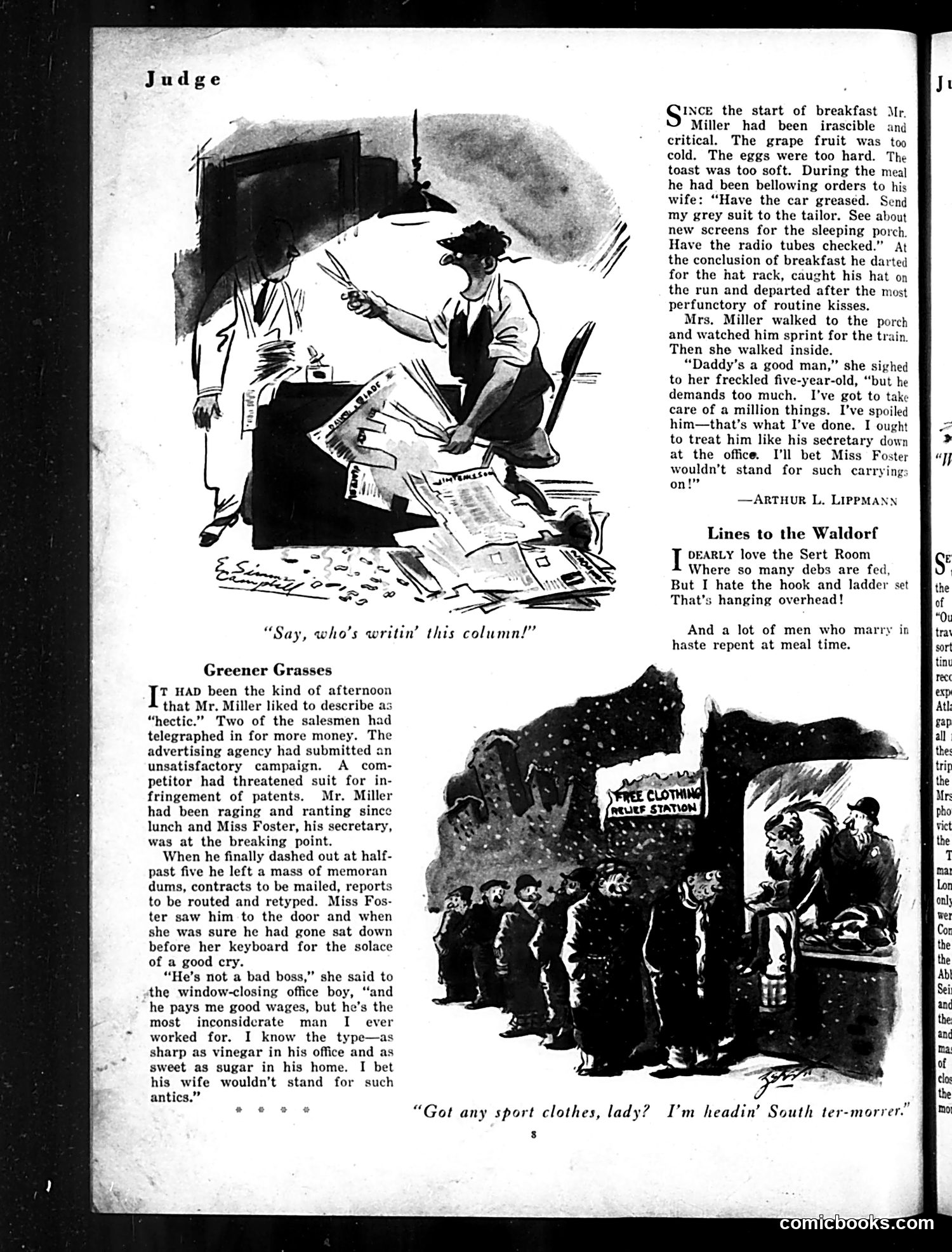
# Judge Magazine Satire Analysis This page presents domestic satire through two interconnected stories about Mr. Miller, a businessman whose personality dramatically shifts between home and office. The top cartoon shows Miller at breakfast being unreasonably demanding with his wife—complaining about food temperature, barking orders about car maintenance, dry cleaning, and home repairs. He leaves abruptly after perfunctory kisses. The "Greener Grasses" story reveals the ironic flip side: at the office, Miller torments his secretary Miss Foster with excessive demands, memoranda, and inconsiderate behavior. She assumes his wife must be a saint for tolerating him. **The satirical point:** Both women independently conclude they should adopt the other woman's strategy—Mrs. Miller thinks she should treat her husband like a secretary; Miss Foster assumes Mrs. Miller must maintain stricter boundaries. Neither realizes the other faces identical problems with the same man. The humor targets male hypocrisy and the compartmentalization of personality between workplace and home life—a common Depression-era observation about stressed, demanding middle-class husbands.
📄 Transcribed text from this page (OCR, searchable)
Machine-transcribed from the original scan — historical spelling and the odd misread are preserved.
INCE the start of breakfast Mr, Miller had been irascible and critical. The grape fruit was too cold. The eggs were too hard. The toast was too soft. During the meal he had been bellowing orders to his wife: “Have the car greased. Send my grey suit to the tailor. See about new screens for the sleeping porch. Have the radio tubes checked.” At the conclusion of breakfast he darted for the hat rack, caught his hat on the run and departed after the most perfunctory of routine kisses. Mrs. Miller walked to the porch and watched him sprint for the train, Then she walked inside. “Daddy’s a good man,” she sighed to her freckled five-year-old, “but he demands too much. I’ve got to take care of a million things. I’ve spoiled him—that’s what I’ve done. I ought to treat him like his se¢retary down at the office. I'll bet Miss Foster wouldn’t stand for such carrying; on!” —ARTHUR L, LIPPMANN Lines to the Waldorf DEARLY love the Sert Room Where so many debs are fed, But I hate the hook and ladder set That’s hanging overhead! “Say, who's writin’ this column!” And a lot of men who marry in haste repent at meal time. Greener Grasses T HAD been the kind of afternoon that Mr. Miller liked to describe as “hectic.” Two of the salesmen had telegraphed in for more money. The advertising agency had submitted an unsatisfactory campaign. A com- petitor had threatened suit for in- fringement of patents. Mr. Miller had been raging and ranting since lunch and Miss Foster, his secretary, was at the breaking point. When he finally dashed out at half- past five he left a mass of memoran dums, contracts to be mailed, reports to be routed and retyped. Miss Fos- ter saw him to the door and when she was sure he had gone sat down before her keyboard for the solace of a good cry. “He’s not a bad boss,” she said to the window-closing office boy, “and he pays me good wages, but he’s the most inconsiderate man I ever worked for. I know the type—as sharp as vinegar in his office and as sweet as sugar in his home. I bet his wife wouldn't stand for such antics.” 8