
Judge, 1933-02 · page 14 of 38
Judge — February 1933 — page 14: what you’re looking at
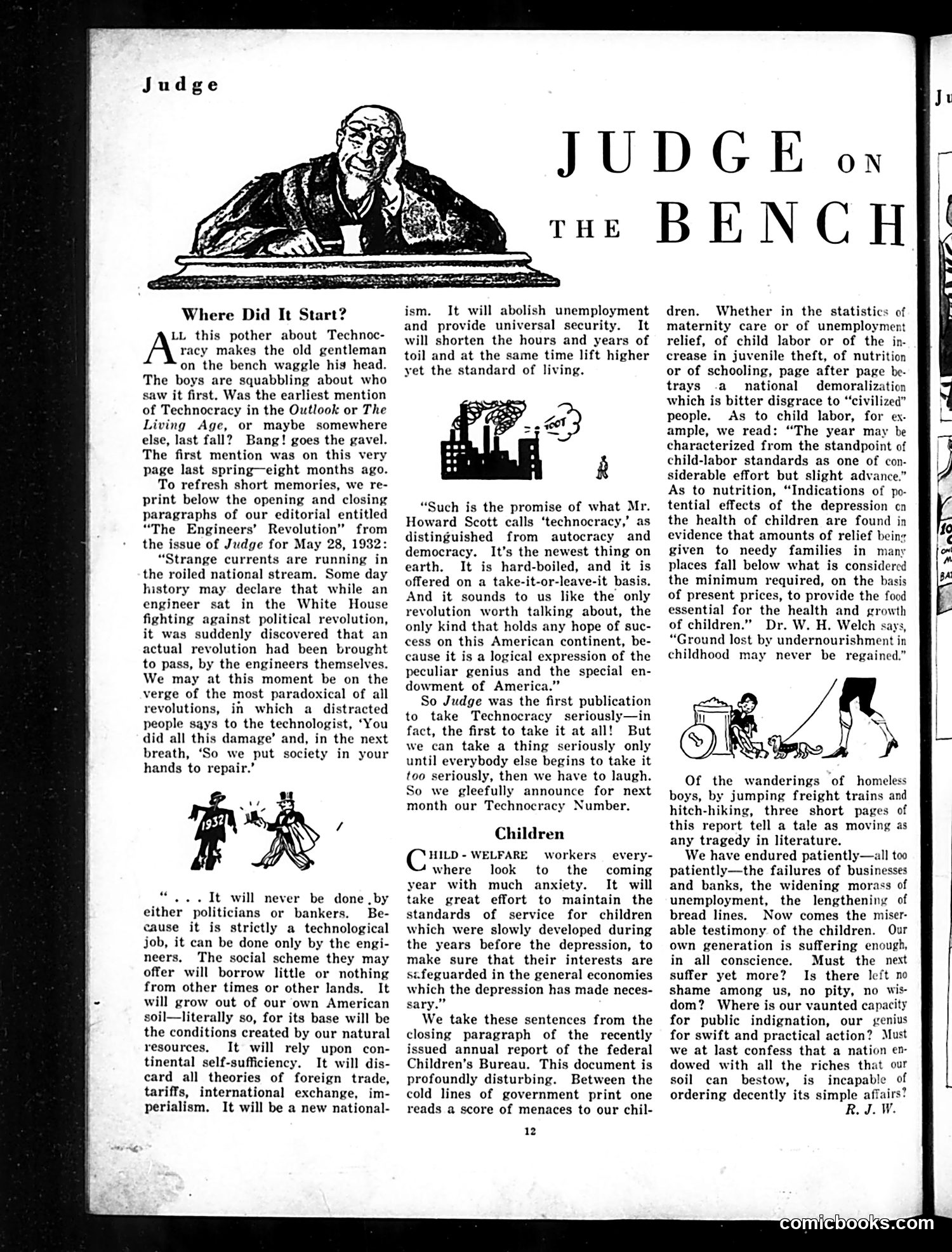
A restored page from Judge, 1933-02. Page through the whole issue in the reader above.
📄 Transcribed text from this page (OCR, searchable)
Machine-transcribed from the original scan — historical spelling and the odd misread are preserved.
Where Did It Start? LL this pother about Technoc- A y makes the old gentleman on the bench waggle his head. The boys are squabbling about who saw it first. Was the earliest mention of Technocracy in the Outlook or The Living Age, or maybe somewhere else, last fall? Bang! goes the gavel. The first mention was on this very page last spring—eight months ago. To refresh short memories, we re- print below the opening and closing paragraphs of our editorial entitled “The Engineers’ Revolution” from the issue of Judge for May 28, 1932: “Strange currents are running in the roiled national stream. Some day history may declare that while an engineer sat in the White House fighting against political revolution, it was suddenly discovered that an actual revolution had been brought to pass, by the engineers themselves. We may at this moment be on the verge of the most paradoxical of all revolutions, in which a distracted people says to the technologist, ‘You did all this damage’ and, in the next breath, ‘So we put society in your hands to repair.’ “... It will never be done .by either politicians or bankers. Be- cause it is strictly a technological job, it can be done only by the engi- neers. The social scheme they may offer will borrow little or nothing from other times or other lands. It will grow out of our own American soil—literally so, for its base will be the conditions created by our natural resources. It will rely upon con- tinental self-sufficiency. It will dis- card all theories of foreign trade, tariffs, international exchange, im- perialism. It will be a new national- JUDGE on tHe BENCH ism. It will abolish unemployment and provide universal security. It will shorten the hours and years of toil and at the same time lift higher yet the standard of living. “Such is the promise of what Mr. Howard Scott calls ‘technocracy,’ as distinguished from autocracy and democracy. It’s the newest thing on earth. It is hard-boiled, and it is offered on a take-it-or-leave-it basis. And it sounds to us like the only revolution worth talking about, the only kind that holds any hope of suc- cess on this American continent, be- cause it is a logical expression of the peculiar genius and the special en- dowment of America.” So Judge was the first publication to take Technocracy seriously—in fact, the first to take it at all! But we can take a thing seriously only until everybody else begins to take it too seriously, then we have to laugh. So we gleefully announce for next month our Technocracy Number. Children HILD- WELFARE workers. where look to the coming year with much anxiety. It will take great effort to maintain the standards of service for children which were slowly developed during the years before the depression, to make sure that their interests are sefeguarded in the general economies which the depression has made neces- sary.” We take these sentences from the closing paragraph of the recently issued annual report of the federal Children’s Bureau. This document is profoundly disturbing. Between the cold lines of government print one reads a score of menaces to our chil- 12 every- dren. Whether in the statistics of maternity care or of unemployment relief, of child labor or of the in- crease in juvenile theft, of nutrition or of schooling, page after page be- trays .a national demoralization which is bitter disgrace to “civilized” people. As to child labor, for ex- ample, we read: “The year may be characterized from the standpoint of child-labor standards as one of con- siderable effort but slight advance.” As to nutrition, “Indications of po- tential effects of the depression cn the health of children are found in evidence that amounts of relief beinz given to needy families in many places fall below what is considered the minimum required, on the basis of present prices, to provide the food essential for the health and growth of children.” Dr. W. H. Welch “Ground lost by undernourishment in never be regai Of the wanderings of homeless boys, by jumping freight trains and hitch-hiking, three short pages of this report tell a tale as moving as any tragedy in literature. We have endured patiently—all too patiently—the failures of businesses and banks, the widening morass of unemployment, the lengthening of bread lines. Now comes the miser- able testimony of the children. Our own generation is suffering enough, in all conscience. Must the next suffer yet more? Is there left no shame among us, no pity, no wis- dom? Where is our vaunted capacity for public indignation, our genius for swift and practical action? Must we at last confess that a nation en- dowed with all the riches that our soil can bestow, is incapable of ordering decently its simple affairs? R. J. W.