
Judge, 1933-02 · page 12 of 38
Judge — February 1933 — page 12: what you’re looking at
What you’re looking at
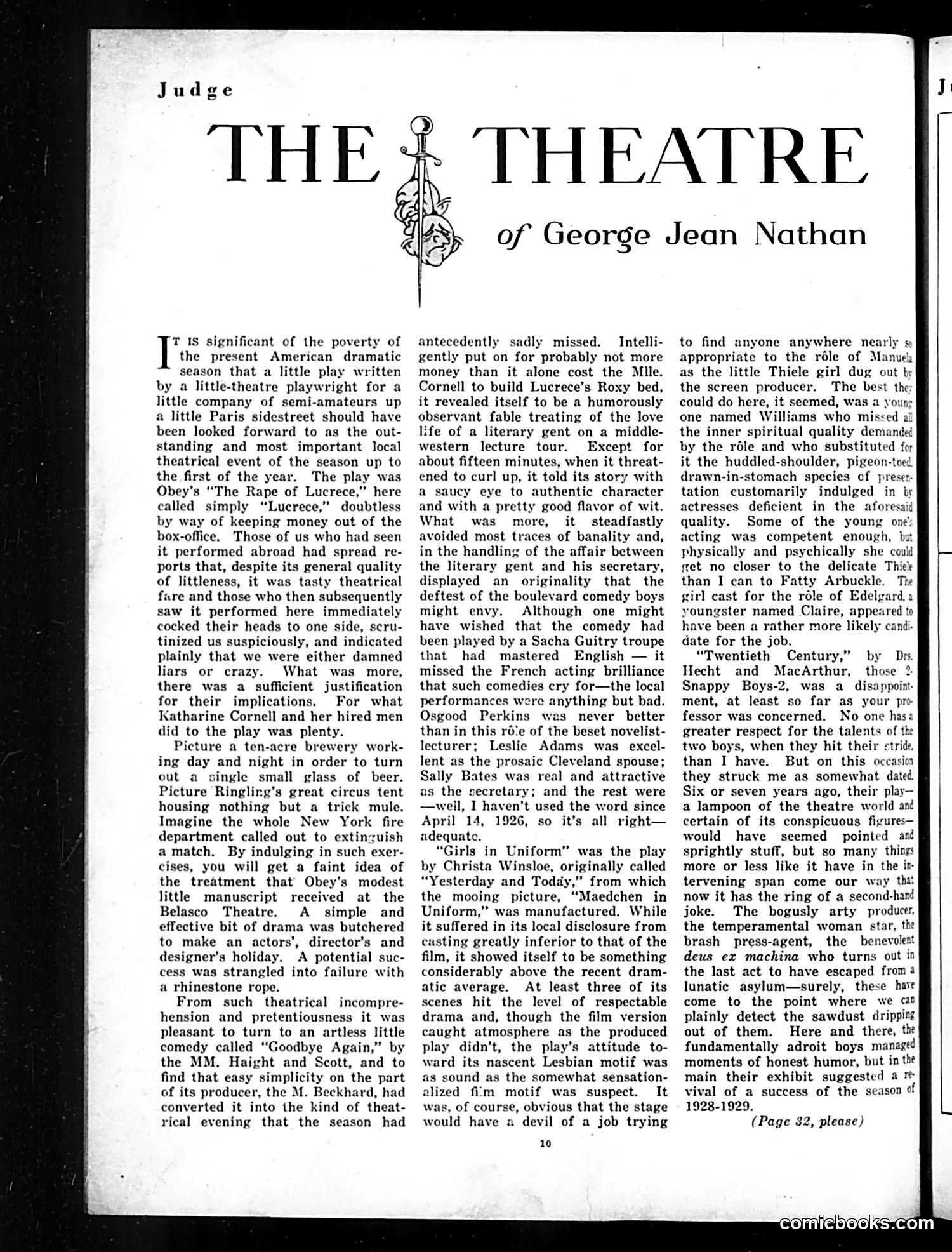
# The Theatre of George Jean Nathan This is a theatre review column, not a political cartoon. Judge critic George Jean Nathan discusses three Broadway productions: **"Lucrece"** (Obey's play): Nathan savagely critiques Katharine Cornell's production, using absurdist comparisons (a brewery making one beer glass, a circus tent housing only a mule) to mock the bloated staging of a modest script. He argues the actor, director, and designer ruined the play for their own glory. **"Goodbye Again"** (Haight and Scott): Nathan praises this modestly-produced comedy for its simplicity and wit, contrasting it favorably with Cornell's pretentious overproduction. He particularly commends actor Osgood Perkins. **"Girls in Uniform"** (Winsloe): Nathan finds the stage version respectable, though inferior to its film adaptation. The satire targets theatrical excess and ego—big names and big budgets don't guarantee quality theatre.
📄 Transcribed text from this page (OCR, searchable)
Machine-transcribed from the original scan — historical spelling and the odd misread are preserved.
THE T Is significant of the poverty of the present American dramatic season that a little play written by a little-theatre playwright for a little company of semi-amateurs up a little Paris sidestreet should have been looked forward to as the out- standing and most important local theatrical event of the season up to the first of the year. The play was Obey’s “The Rape of Lucrece,” here called simply “Lucrece,” doubtless by way of keeping money out of the box-office. Those of us who had seen it performed abroad had spread re- ports that, despite its general quality of littleness, it was tasty theatrical fare and those who then subsequently saw it performed here immediately cocked their heads to one side, scru- tinized us suspiciously, and indicated plainly that we were either damned liars or crazy. What was more, there was a sufficient justification for their implications. For what Katharine Cornell and her hired men did to the play was plenty. Picture a ten-acre brewery work- ing day and night in order to turn out a single small glass of beer. Picture Ringling’s great circus tent housing nothing but a trick mule. Imagine the whole New York fire department called out to extin-uish a match. By indulging in such exer- cises, you will get a faint idea of the treatment that’ Obey’s modest little manuscript received at the Belasco Theatre. A simple and effective bit of drama was butchered to make an actors’, director’s and designer’s holiday. A potential suc- cess was strangled into failure with a rhinestone rope. From such theatrical incompre- hension and pretentiousness it was pleasant to turn to an artless little comedy called “Goodbye Again,” by the MM. Haight and Scott, and to find that easy simplicity on the part of its producer, the M. Beckhard, had converted it into the kind of theat- rical evening that the season had THEATRE of George Jean Nathan antecedently sadly missed. Intelli- gently put on for probably not more money than it alone cost the Mlle. Cornell to build Lucrece’s Roxy bed, it revealed itself to be a humorously observant fable treating of the love life of a literary gent on a middle- western lecture tour. Except for about fifteen minutes, when it threat- ened to curl up, it told its story with a saucy eye to authentic character and with a pretty good flavor of wit. What was more, it steadfastly avoided most traces of banality and, in the handling of the affair between the literary gent and his secretary, displayed an originality that the deftest of the boulevard comedy boys might envy. Although one might have wished that the comedy had been played by a Sacha Guitry troupe that had mastered English — it missed the French acting brilliance that such comedies cry for—the local performances were anything but bad. Osgood Perkins was never better than in this ré‘e of the beset novelist- lecturer; Leslie Adams was excel- lent as the prosaic Cleveland spouse; Sally Bates was real and attractive as the secretary; and the rest were —well, I haven't used the word since April 14, 1926, so it’s all right— adequate. “Girls in Uniform” was the play by Christa Winsloe, originally called “Yesterday and Today,” from which the mooing picture, ‘“Maedchen in Uniform,” was manufactured. While it suffered in its local disclosure from casting greatly inferior to that of the film, it showed itself to be something considerably above the recent dram- atic average. At least three of its scenes hit the level of respectable drama and, though the film version caught atmosphere as the produced play didn’t, the play’s attitude to- ward its nascent Lesbian motif was as sound as the somewhat sensation- alized fiim motif was suspect. It was, of course, obvious that the stage would have a devil of a job trying 10 to find anyone anywhere nearly » appropriate to the réle of Manueh as the little Thiele girl dug out tr the screen producer. The best the: could do here, it seemed, was a y one named Williams who mis. the inner spiritual quality demanded by the réle and who substituted for it the huddled-shoulder, pigeon-toed. drawn-in-stomach species of prese tation customarily indulged in actresses deficient in the afor quality. Some of the young one’ acting was competent enough, b: physically and psychically she cou fret no closer to the delicate Thic'e than I can to Fatty Arbuckle. The girl cast for the rdle of Edelgard, youngster named Claire, apy ed have been a rather more likely candi- date for the job. “Twentieth Century,” by Dr. Hecht and MacArthur, those 2 Snappy Boys-2, was a_ disappoint ment, at least so far as your pro fessor was concerned. No one has greater respect for the talents of the two boys, when they hit their stri than I have. But on this occasiea they struck me as somewhat dated Six or seven years ago, their play— a lampoon of the theatre world ani certain of its conspicuous figures— would have seemed pointed and sprightly stuff, but so many things more or less like it have in the it- tervening span come our way thi now it has the ring of a second-hand joke. The bogusly arty producer, the temperamental woman star, th brash press-agent, the benevolent deus ex machina who turns out in the last act to have escaped froma lunatic asylum—surely, these have come to the point where we cat plainly detect the sawdust dripping out of them. Here and there, the fundamentally adroit boys managed moments of honest humor, but in the main their exhibit suggested a 1 vival of a success of the season of 1928-1929. (Page 32, please)