
Judge, 1933-02 · page 9 of 38
Judge — February 1933 — page 9: what you’re looking at
What you’re looking at
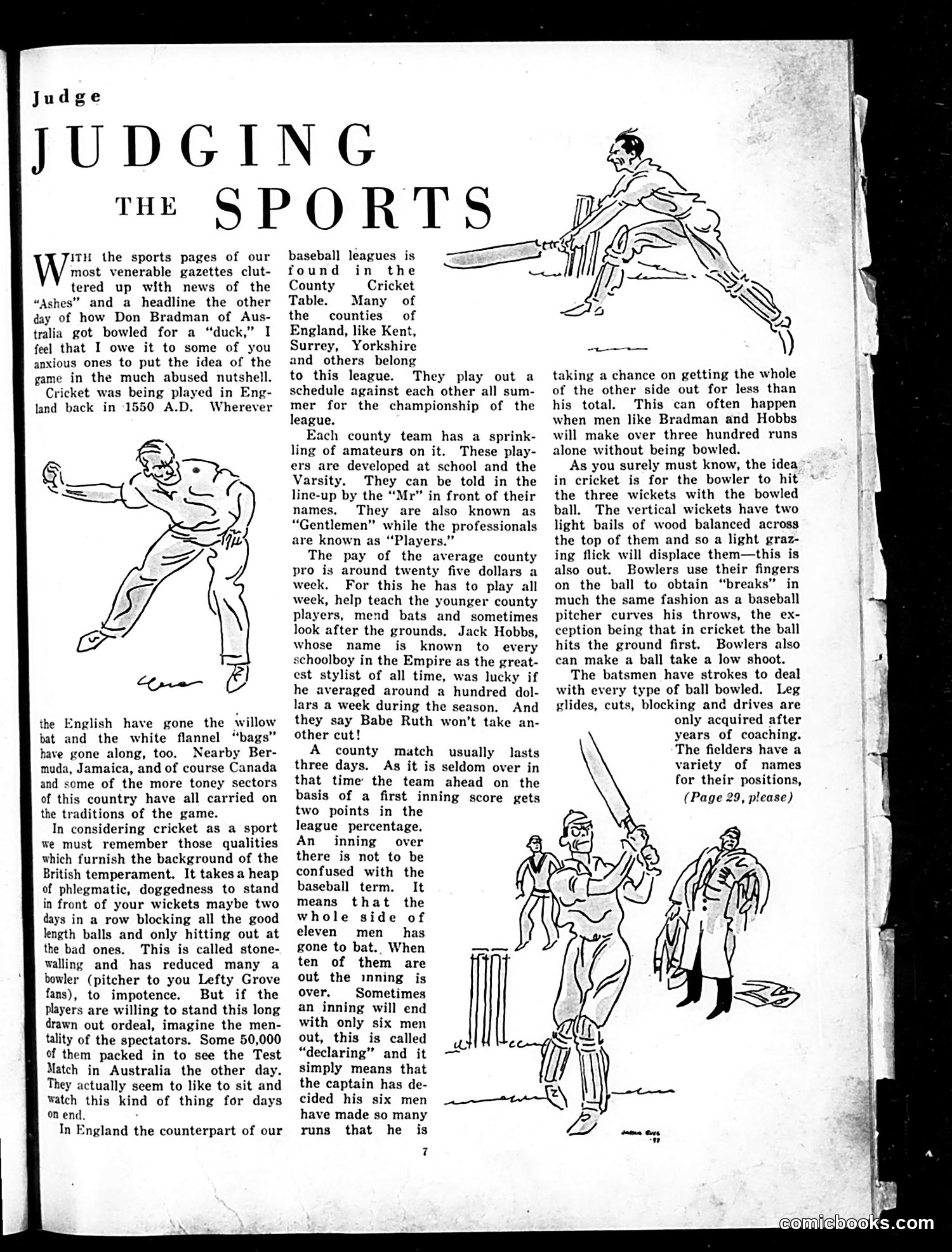
# "Judging the Sports" - Cricket Explained for Americans This is an instructional article explaining cricket to American readers unfamiliar with the sport. The author adopts a humorous, slightly condescending tone toward both cricket's complexity and its devoted fans. The piece references Don Bradman (Australian cricket legend) and the "Ashes" (England-Australia cricket rivalry), using these as hooks to justify explaining the game. It mocks cricket's extreme slowness—noting 50,000 spectators willingly sit through multi-day matches—and compares this to American impatience, sarcastically suggesting Babe Ruth (baseball's star) would never accept pay cuts like English cricketer Jack Hobbs did. The cartoons illustrate various cricket positions and batting techniques. The article explains key rules (wickets, "declaring," bowlers' techniques) while repeatedly emphasizing how foreign these concepts are to American baseball fans, treating cricket with gentle satirical skepticism about its appeal.
📄 Transcribed text from this page (OCR, searchable)
Machine-transcribed from the original scan — historical spelling and the odd misread are preserved.
Judge JUDGING mar SPORTS ITH the sports pages of our Wirrose venerable gazettes clut- tered up with news of the “Ashes” and a headline the other day of how Don Bradman of Aus- tralia got bowled for a “duck,” I feel that I owe it to some of you anxious ones to put the idea of the game in the much abused nutshell. Cricket was being played in Eng- land back in 1550 A.D. Wherever ) ey CRs, SNS a Cre the English have gone the willow bat and the white flannel “bags” have gone along, too. Nearby Ber- muda, Jamaica, and of course Canada and some of the more toney sectors of this country have all carried on the traditions of the game. In considering cricket as a sport we must remember those qualities which furnish the background of the British temperament. It takes a heap of phlegmatic, doggedness to stand in front of your wickets maybe two days in a row blocking all the good length balls and only hitting out at the bad ones. This is called stone- walling and has reduced many a bowler (pitcher to you Lefty Grove fans), to impotence. But if the players are willing to stand this long drawn out ordeal, imagine the men- tality of the spectators. Some 50,000 of them packed in to see the Test Match in Australia the other day. They actually seem to like to sit and watch this kind of thing for days on end. . In England the counterpart of our baseball leagues is found in the County Cricket Table. Many of the counties of England, like Kent, Surrey, Yorkshire and others belong to this league. They play out a schedule against each other all sum- mer for the championship of the league. Each county team has a sprink- ling of amateurs on it. These play- ers are developed at school and the Varsity. They can be told in the line-up by the “Mr” in front of their names. They are also known as “Gentlemen” while the professionals are known as “Players.” The pay of the average county pro is around twenty five dollars a week. For this he has to play all week, help teach the younger county players, mend bats and sometimes look after the grounds. Jack Hobbs, whose name is known to every schoolboy in the Empire as the great- est stylist of all time, was lucky if he averaged around a hundred dol- lars a week during the season. And they say Babe Ruth won't take an- other cut! A county match usually lasts three days. As it is seldom over in that time the team ahead on the basis of a first inning score gets two points in the league percentage. An inning over there is not to be confused with the baseball term. It means that the whole side of eleven men has gone to bat.. When ten of them are out the imning is over. Sometimes an inning will end with only six men out, this is called “declaring” and it simply means that the captain has de- cided his six men have made so many runs that he is 7 taking a chance on getting the whole of the other side out for less than his total. This can often happen when men like Bradman and Hobbs will make over three hundred runs alone without being bowled. As you surely must know, the idea in cricket is for the bowler to hit the three wickets with the bowled ball. The vertical wickets have two light bails of wood balanced across the top of them and so a light graz- ing flick will displace them—this is also out. Bowlers use their fingers on the ball to obtain “breaks” in much the same fashion as a baseball pitcher curves his throws, the ex- ception being that in cricket the ball hits the ground first. Bowlers also can make a ball take a low shoot. The batsmen have strokes to deal with every type of ball bowled. Leg glides, cuts, blocking and drives are only acquired after years of coaching. The fielders have a variety of names for their positions, (Page 29, please)