A complete issue · 36 pages · 1932
Judge — March 19, 1932
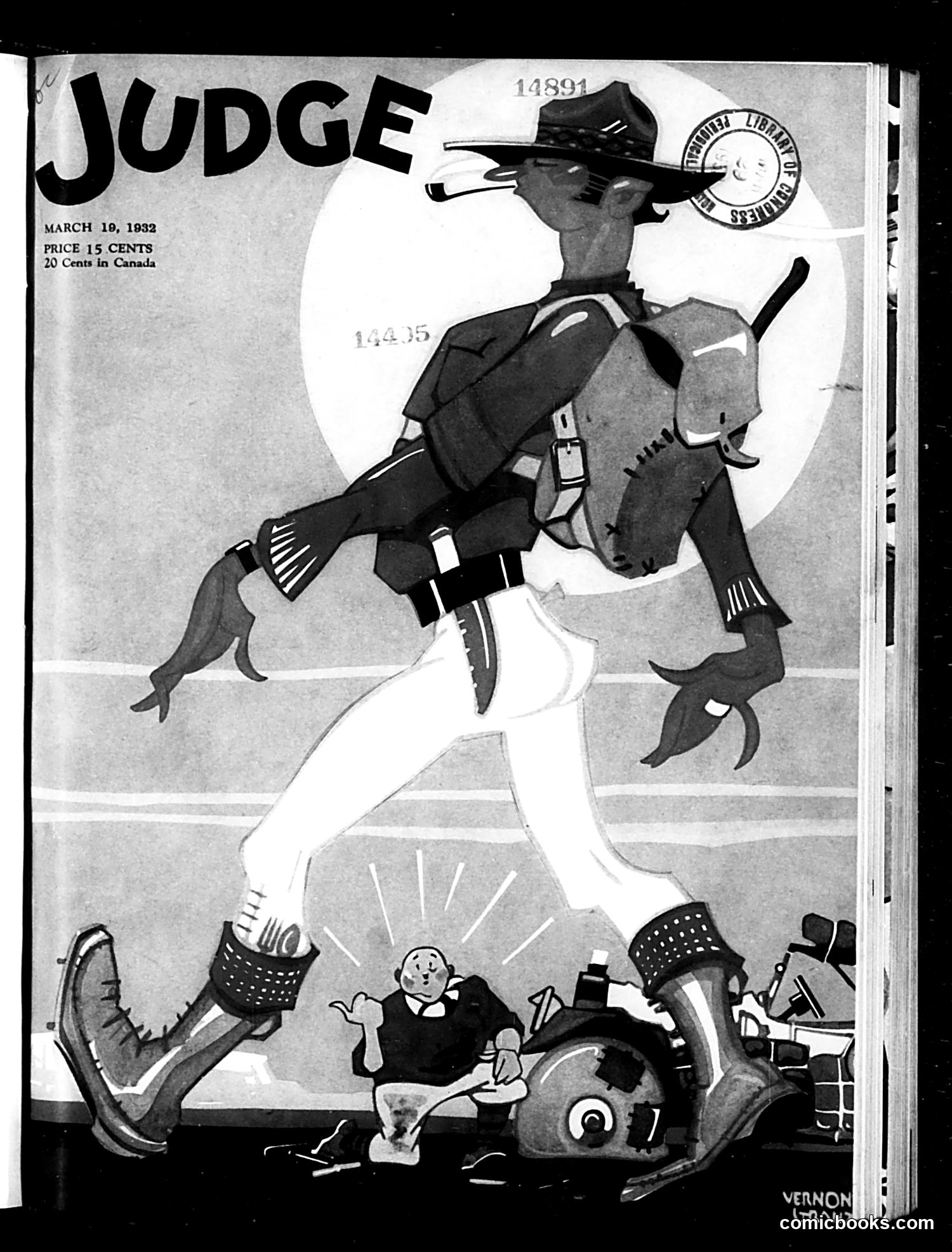
# Judge Magazine Cover - March 10, 1932 This satirical cover depicts a caricatured cowboy or military figure leaping over small figures below, likely representing common citizens or politicians. The exaggerated proportions and dynamic pose suggest someone acting recklessly or overstepping their authority. Given the March 1932 date—during the Great Depression and Hooverville crisis—this appears to mock either President Hoover's inadequate response to economic catastrophe, or a political figure dismissing public suffering. The tiny figures being trampled or evaded represent ordinary Americans struggling with poverty and unemployment. The "Judge" publication was known for sharp political satire targeting government leaders. The cartoonist (signed "Vernon") uses the cowboy archetype to suggest wild, uncontrolled action disconnected from the real hardships below.
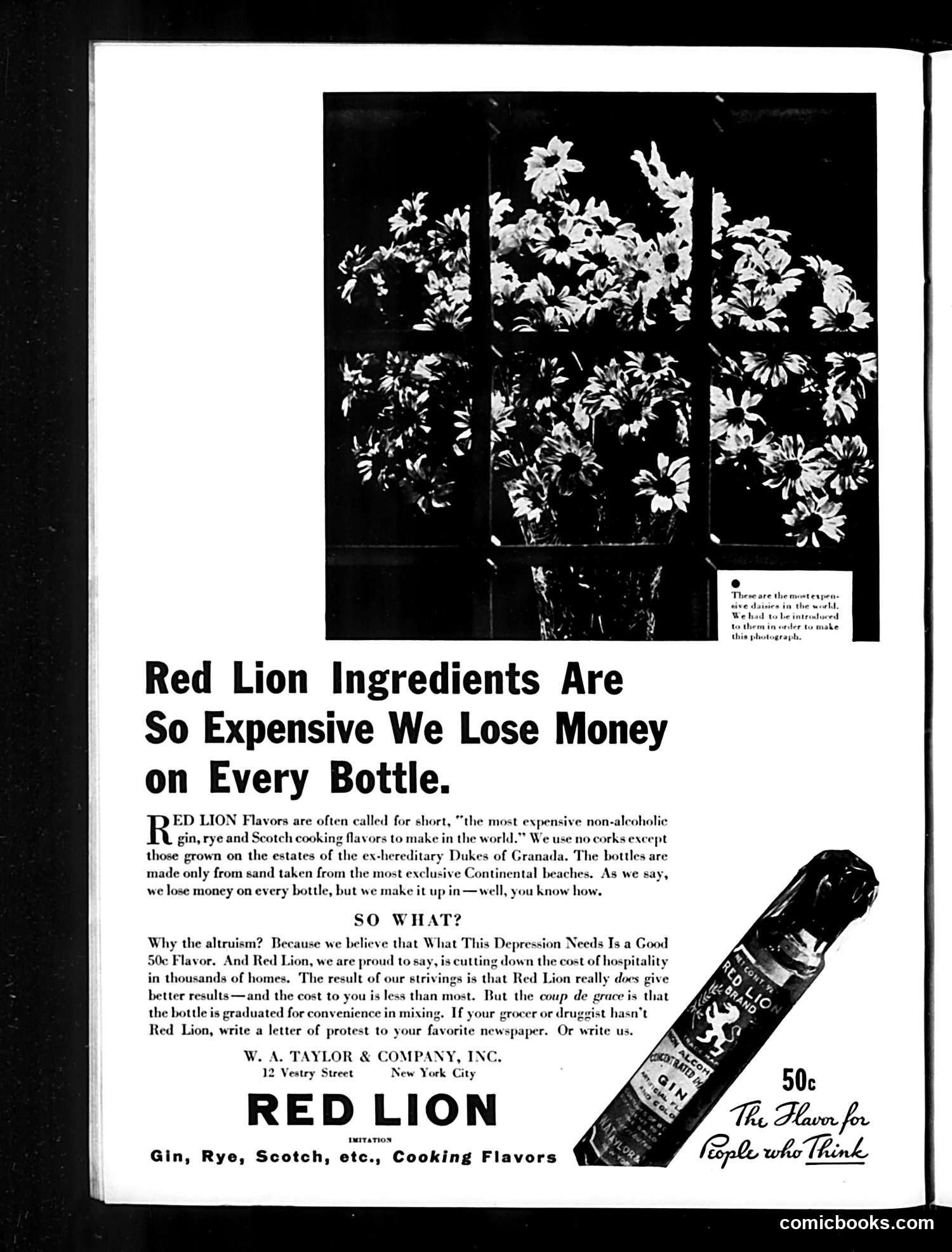
# Red Lion Advertisement with Depression-Era Commentary This is primarily a **product advertisement** for Red Lion cooking flavors (gin, rye, Scotch imitation extracts), priced at 50¢. However, it includes social commentary disguised as marketing copy. The "SO WHAT?" section addresses the Great Depression directly. Red Lion claims their expensive ingredients justify the high cost, but they're "cutting down the cost of hospitality in thousands of homes" during "This Depression." The pitch frames buying cheap imitation flavoring as patriotic sacrifice—helping people maintain social entertaining despite economic hardship. The photograph of expensive dahlias in a window reinforces this: beauty and elegance remain accessible through affordable substitutes. The ad targets Depression-era consumers who want to appear prosperous while actually economizing.
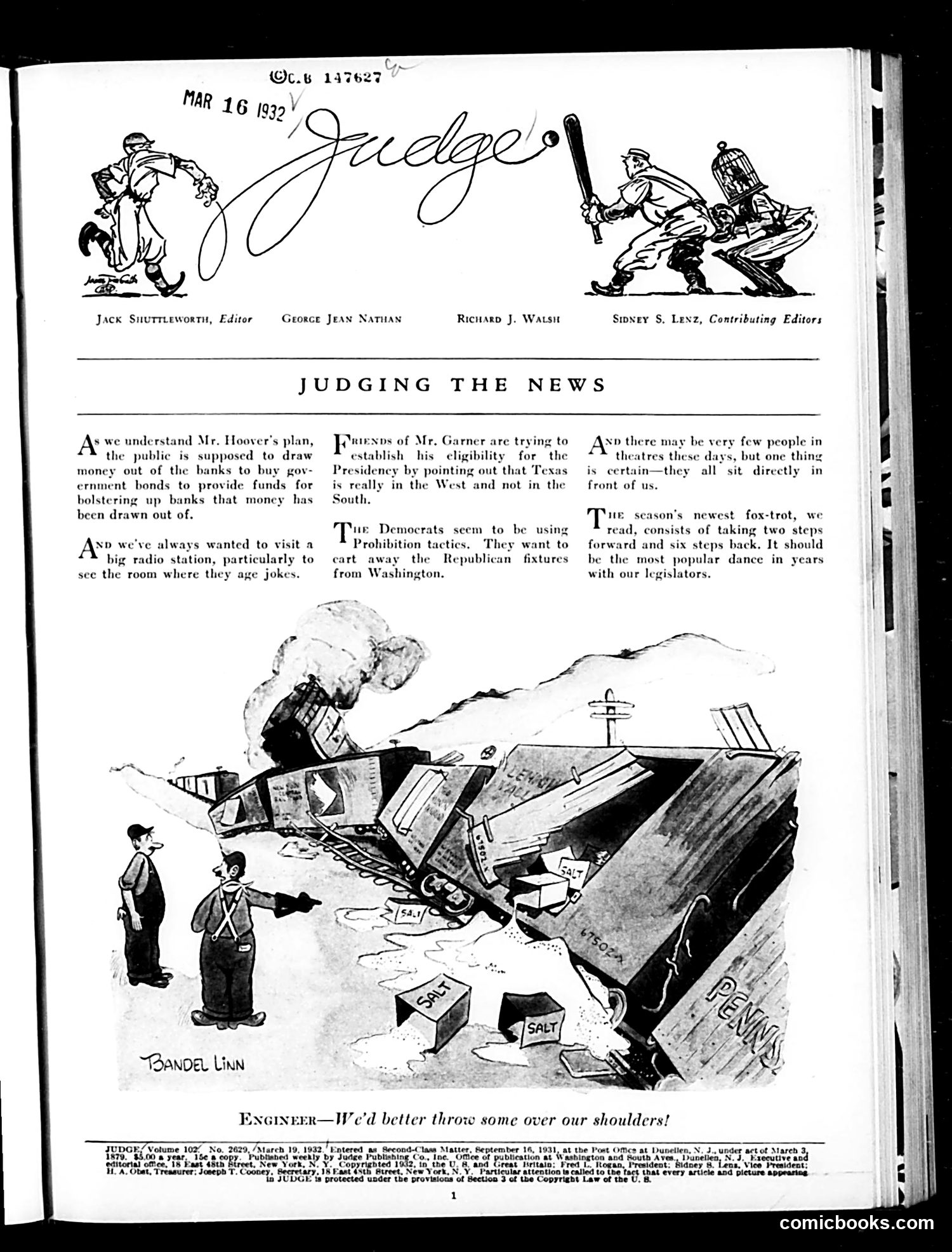
# "Judge" Magazine - March 16, 1932 This page satirizes early Depression-era politics and social concerns through four brief editorial commentaries and a cartoon by Bandel Linn. The main cartoon depicts an overturned cargo ship spilling salt, with two figures observing the disaster. The caption reads: "Engineer—We'd better throw some over our shoulders!" This is a dark joke referencing the superstition that spilling salt brings bad luck, which can be reversed by throwing salt over one's shoulder. In 1932 Depression context, it mocks the helplessness Americans felt facing economic catastrophe—suggesting even ritualistic gestures couldn't fix such massive problems. The editorial snippets criticize Hoover's banking policies, Republican political tactics, and current dance trends, representing typical satirical commentary from this period.
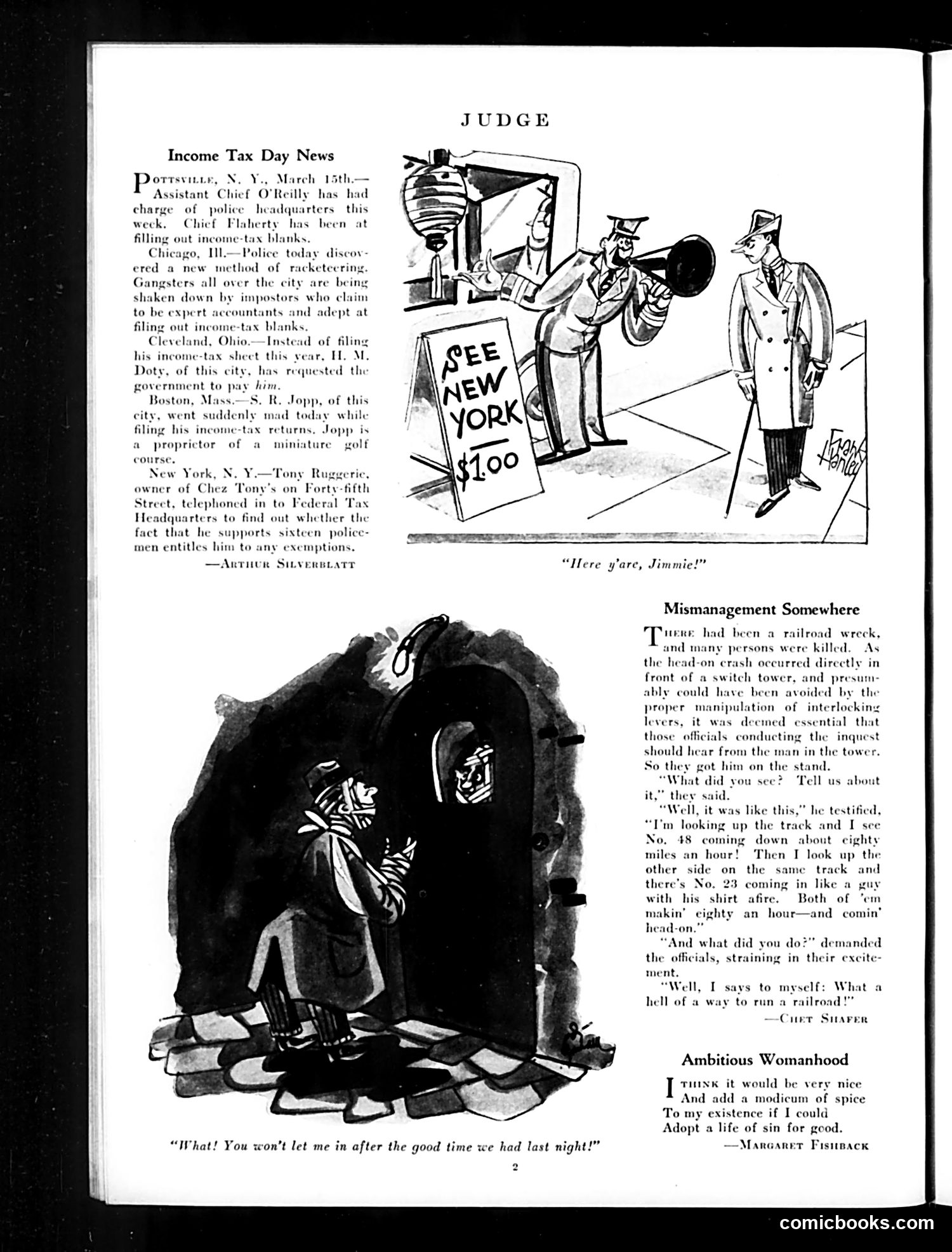
# Judge Magazine Page Analysis **Top Cartoon - "Here gare, Jimmie!"** This satirizes Income Tax Day (March 15th). A con artist runs a "See New York $1.00" tourist scam while a policeman approaches. The joke: during tax season, when citizens are being squeezed by the government for income taxes, petty criminals exploit the same victims with tourist schemes. It's social commentary on vulnerability and predatory behavior coinciding with tax obligations. **Bottom Cartoon - "Mismanagement Somewhere"** This illustrates a railroad wreck caused by operator error. The accompanying article explains that a man in a tower failed to properly manipulate interlocking levers, causing two trains to collide head-on. The satire criticizes bureaucratic negligence and institutional mismanagement—suggesting preventable disasters result from incompetent officials rather than unavoidable accidents.
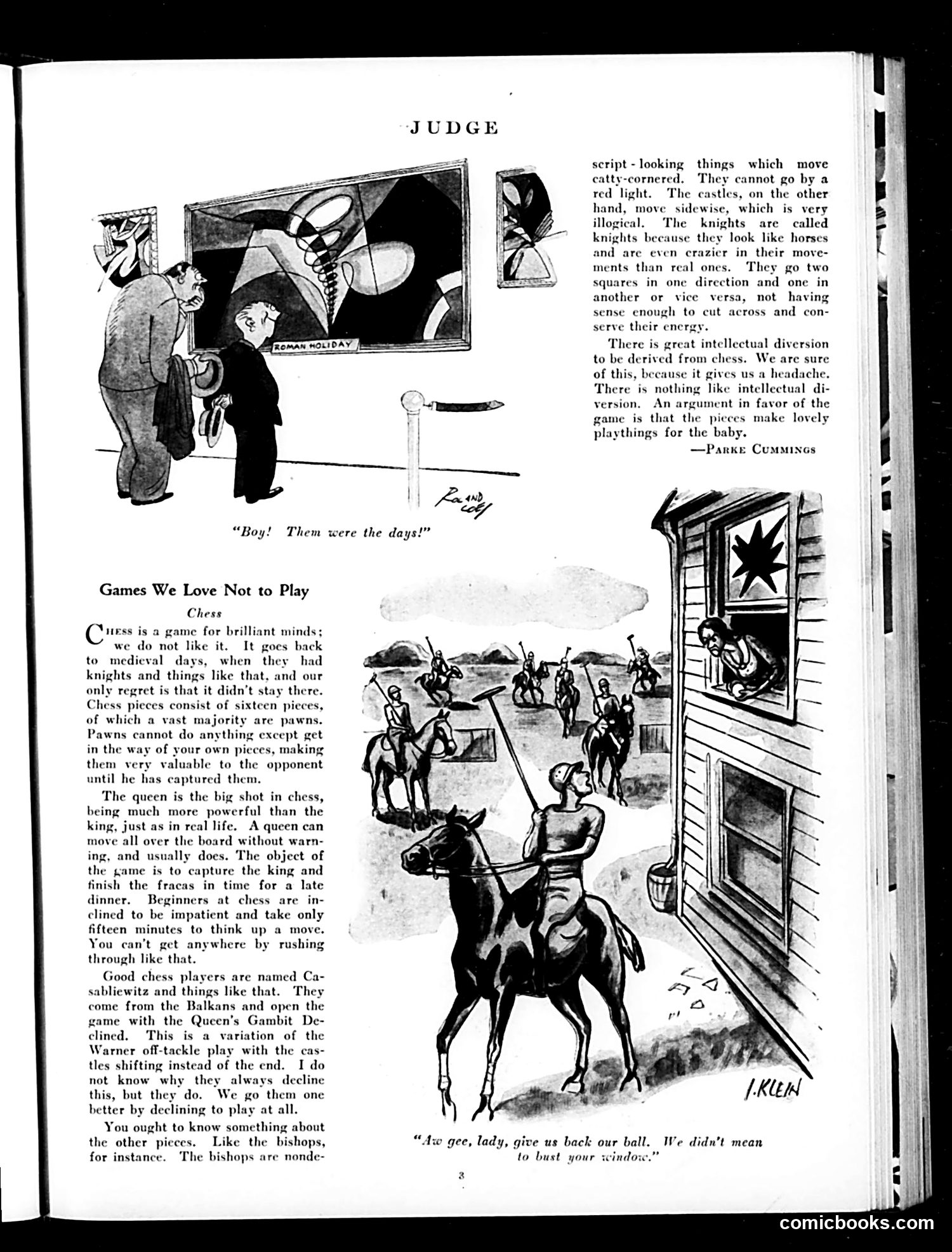
# Analysis This page from *Judge* magazine contains two distinct pieces: **Top cartoon**: Shows two men viewing what appears to be a film or screen labeled "ROMAN HOLIDAY." The caption "Boy! Them were the days!" suggests nostalgic commentary on Roman civilization, likely satirizing contemporary fascination with ancient Rome during a period when such imagery held cultural appeal. **Main article**: "Games We Love Not to Play" critiques chess as overly intellectual and tedious. The author argues chess lacks the appeal of more dynamic games—its complexity and slow pace make it unsuitable for casual play. The article dismisses chess variants like "Casabliewitz" from the Balkans as equally unappealing. **Bottom illustration**: Shows mounted soldiers attacking a building, accompanying the article's discussion of game variations with a humorous caption about a lost ball. The page's overall theme mocks intellectual pursuits and cultural pretension.
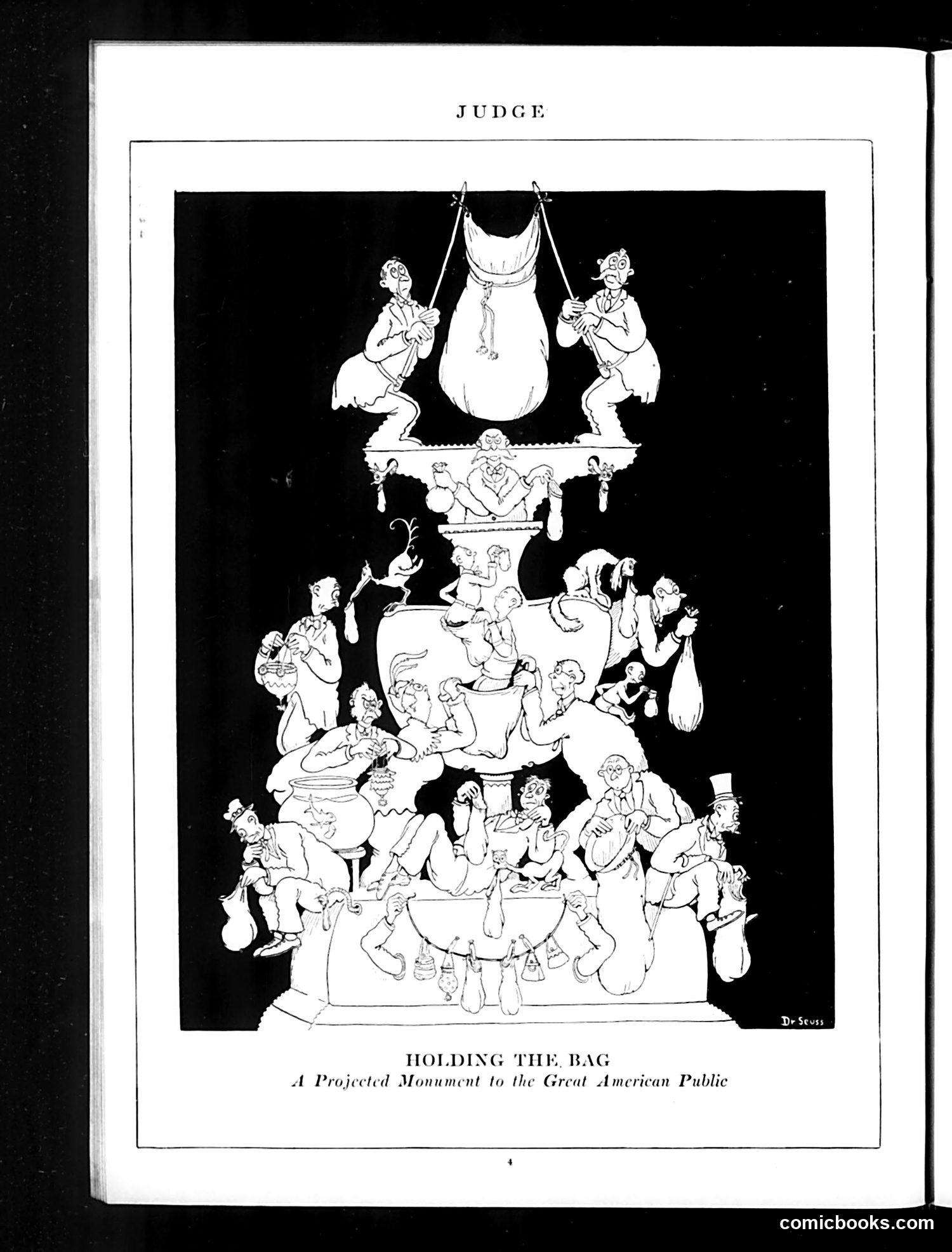
# Analysis This Dr. Seuss cartoon satirizes American judicial corruption. The image depicts a massive, tiered monument made of figures—judges, lawyers, and politicians—stacked precariously atop one another. Two cherubs at the top struggle to hold an enormous bag, suggesting the weight of accumulated bribes or ill-gotten gains. The subtitle "Holding the Bag" is a period idiom meaning taking blame for others' crimes. The cartoon critiques the interconnected corruption between the judiciary and political establishment, portraying the legal system as an unstable pyramid scheme where lower-level figures literally support the corrupt weight above them. This reflects early 20th-century Progressive-era concerns about institutional corruption, suggesting the entire judicial system rests on questionable foundations—a visual metaphor for systemic graft.
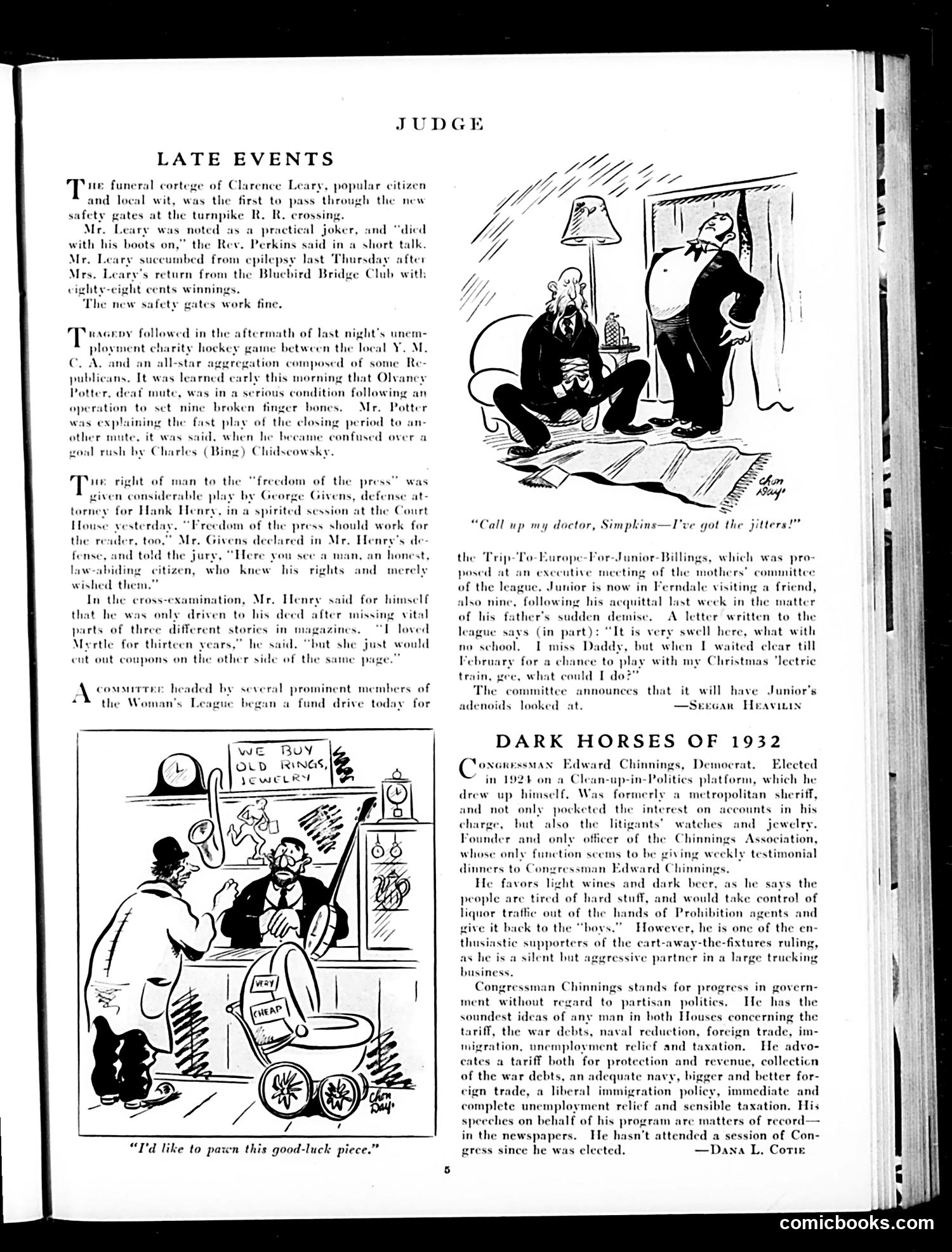
# Political Cartoon Analysis: Judge Magazine Page **Top Cartoon ("Call up my doctor, Simpkins"):** A man experiencing illness (likely "the jitters") calls for a doctor. This appears to satirize anxiety or nervousness, possibly related to economic or social conditions of the early 1930s era. **Bottom Cartoon ("I'd like to pawn this good-luck piece"):** Shows a pawn shop scene where customers attempt to sell items, including what appears to be jewelry or valuables. The sign reads "WE BUY OLD RINGS, JEWELRY." This satirizes Depression-era financial desperation, when people pawned possessions for survival. **Context:** Both cartoons reflect the 1932 economic crisis, mocking how widespread financial hardship drove citizens to desperate measures—both psychological strain and literal asset liquidation.
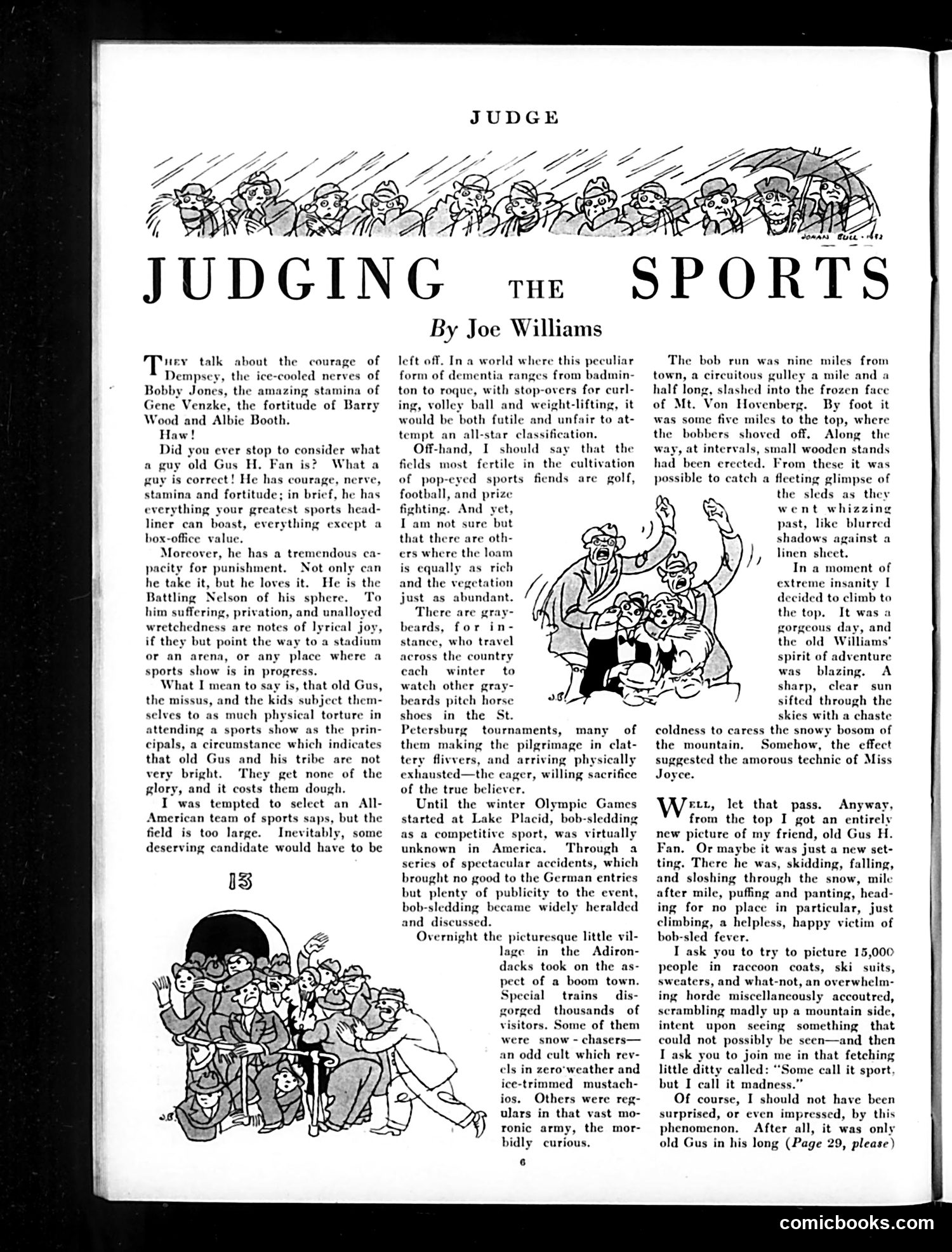
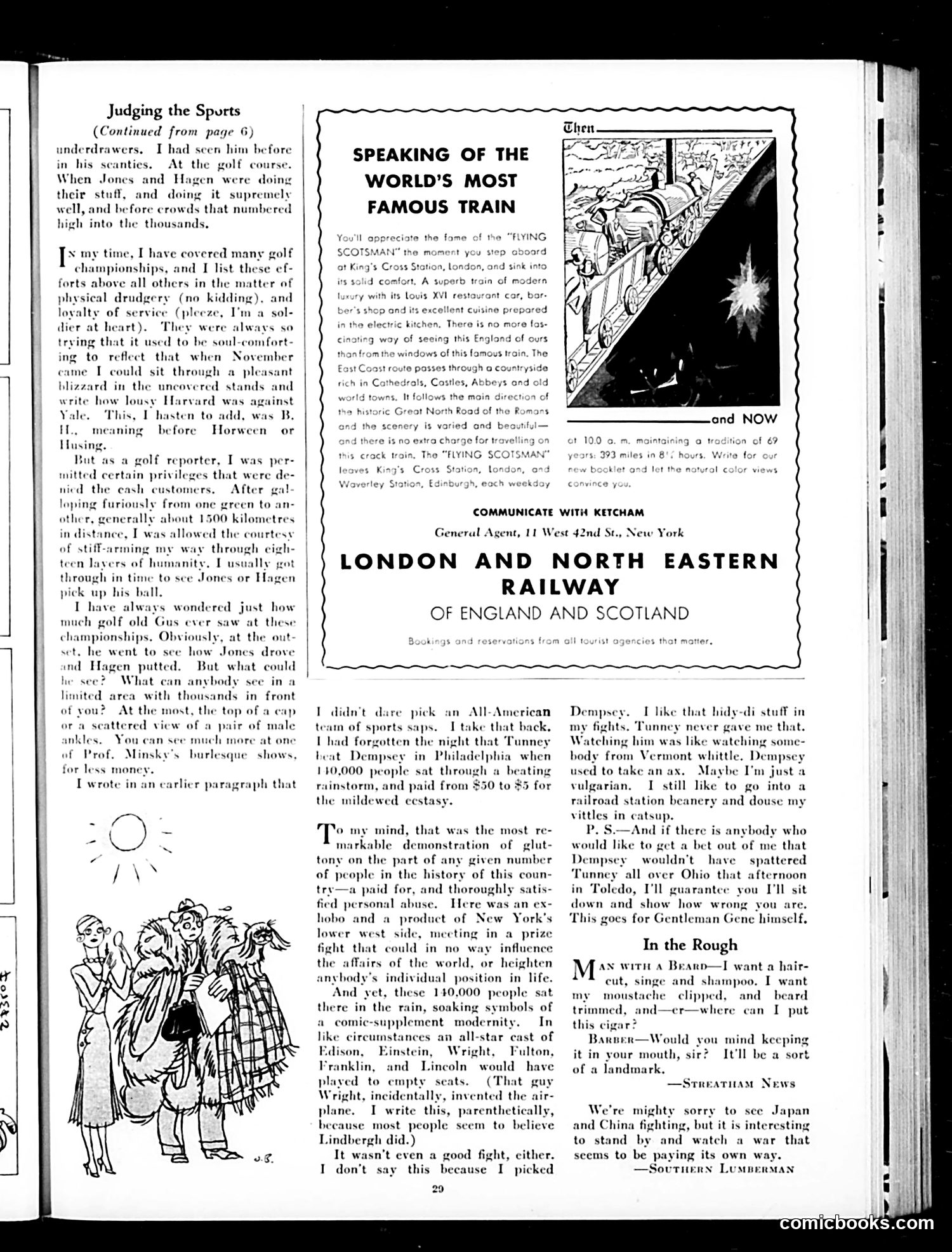
# "Judging the Sports" by Joe Williams This satirical essay mocks the excessive enthusiasm and questionable judgment of sports fans and journalists. The article critiques figures like Dempsey (likely boxer Jack Dempsey), Bobby Jones (golf), and various sports personalities, questioning whether they truly deserve their exalted status. The cartoons illustrate spectators at winter sports events—sledding and bobsledding—showing crowds of bundled-up enthusiasts in snowy conditions. Williams sarcastically suggests these activities barely qualify as "sport" despite their popularity. He contrasts the reverence sports journalism grants to athletic figures against the sometimes mundane reality of what people actually watch, lampooning both the sports establishment's grandiose claims and fans' uncritical adulation.
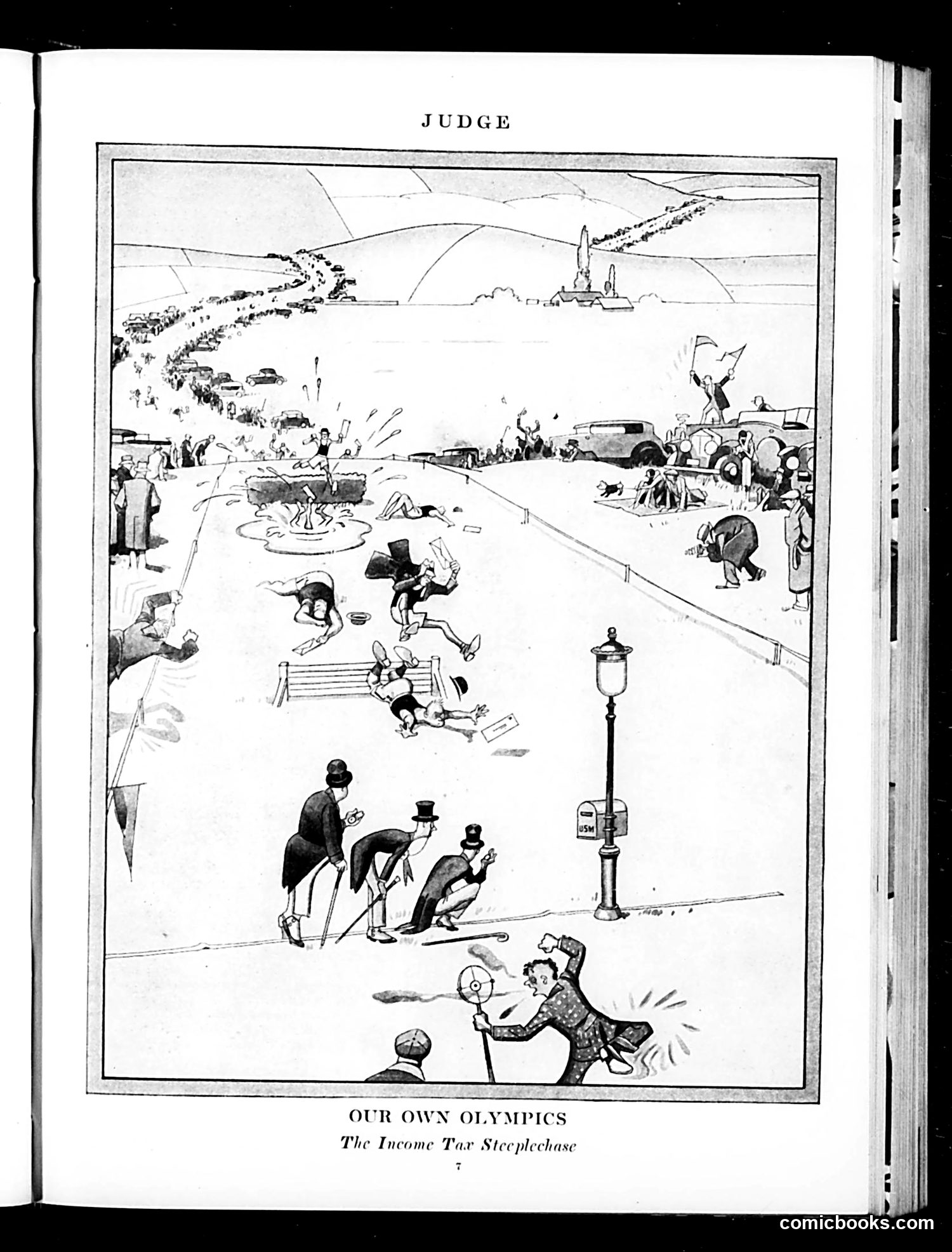
This satirical cartoon from *Judge* magazine depicts "The Income Tax Steeplechase"—a competitive race metaphor for dealing with income taxes. Various figures navigate obstacles and challenges across a landscape, suggesting taxpayers struggling through a complex, difficult process. The steeplechase format (an equestrian race with jumps) humorously parallels navigating tax requirements. The cartoon satirizes the burden and confusion of income tax compliance, treating it as an exhausting obstacle course rather than a straightforward civic duty. The "Our Own Olympics" title frames taxation as an absurd competitive event. The numerous participants and scattered activity suggest widespread public frustration with tax complexity during what appears to be the early-to-mid 20th century, when income tax systems were still relatively new and frequently modified in America.
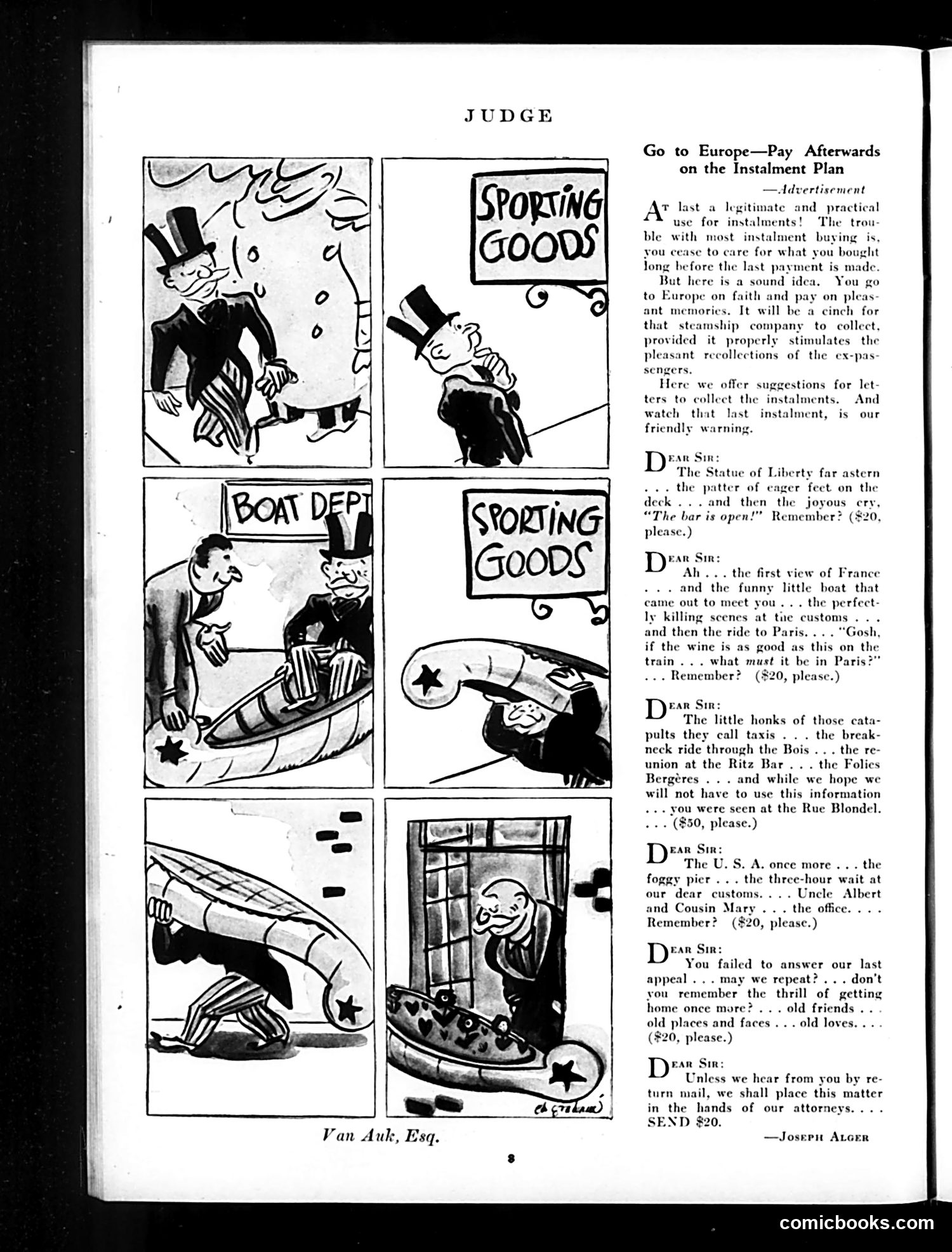
# "Go to Europe—Pay Afterwards on the Instalment Plan" This is a satirical advertisement by Joseph Alger proposing that steamship companies let passengers travel to Europe on credit, paying installments afterward based on fond memories of the trip. The comic strip shows a collection agent pursuing a passenger named Van Auk through increasingly aggressive "Dear Sir" letters, each referencing specific travel experiences (the Statue of Liberty, French customs, Parisian bars, taxis, homecoming) meant to emotionally manipulate payment. The final letter threatens legal action. The satire targets two things: the then-popular installment buying system (buying goods on credit) and the assumed reliability of nostalgia as a payment incentive. The joke is that steamship companies would cynically exploit travelers' pleasant memories to extract payment—and that collectors would resort to emotional appeals and threats if sentiment failed.
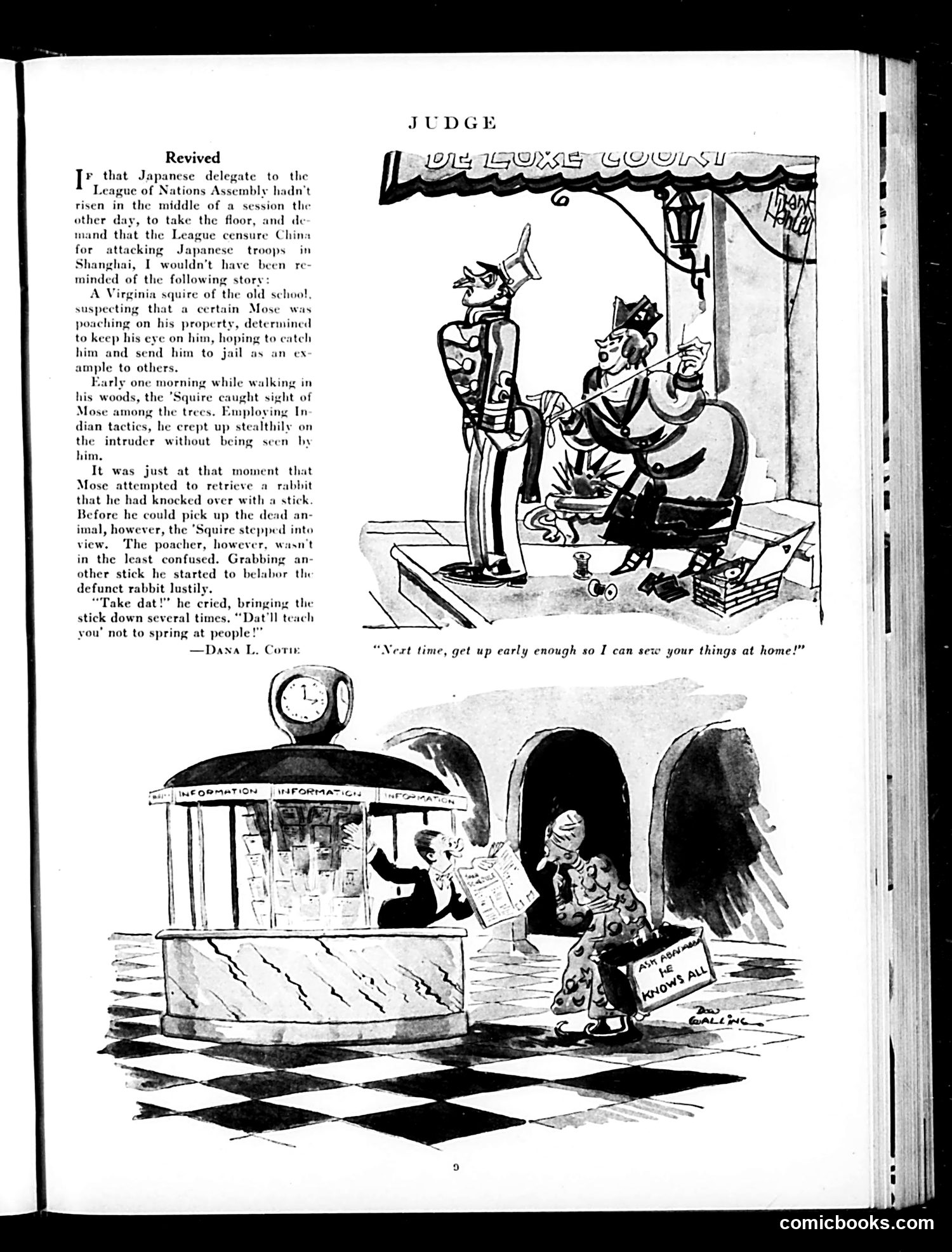
# Analysis: "Revived" from Judge Magazine **The Political Context:** This page satirizes a Japanese delegate's complaint to the League of Nations about Chinese attacks on Japanese troops in Shanghai. Judge uses this to mock the hypocrisy of the aggressor claiming victimhood. **The Two Cartoons:** **Top cartoon:** Illustrates Dana L. Cotte's accompanying story—a Virginia squire catches an enslaved man named Mose poaching. When confronted, Mose frantically beats a dead rabbit, claiming it attacked him unprovoked. The parallel is clear: Japan is "Mose," falsely claiming self-defense against provocation. **Bottom cartoon:** Shows a kiosk labeled "Information" with a woman holding a sign reading "Americans Follow All." She addresses someone seeking information, saying they should come home earlier so she can mend their clothes—a domestic non-sequitur that suggests the absurdity of the League's response to obvious aggression. **The Satire's Point:** Japan's demand for League censure of China mirrors Mose's absurd claim of victimhood. Judge ridicules the League for even entertaining such transparent bad-faith complaints.
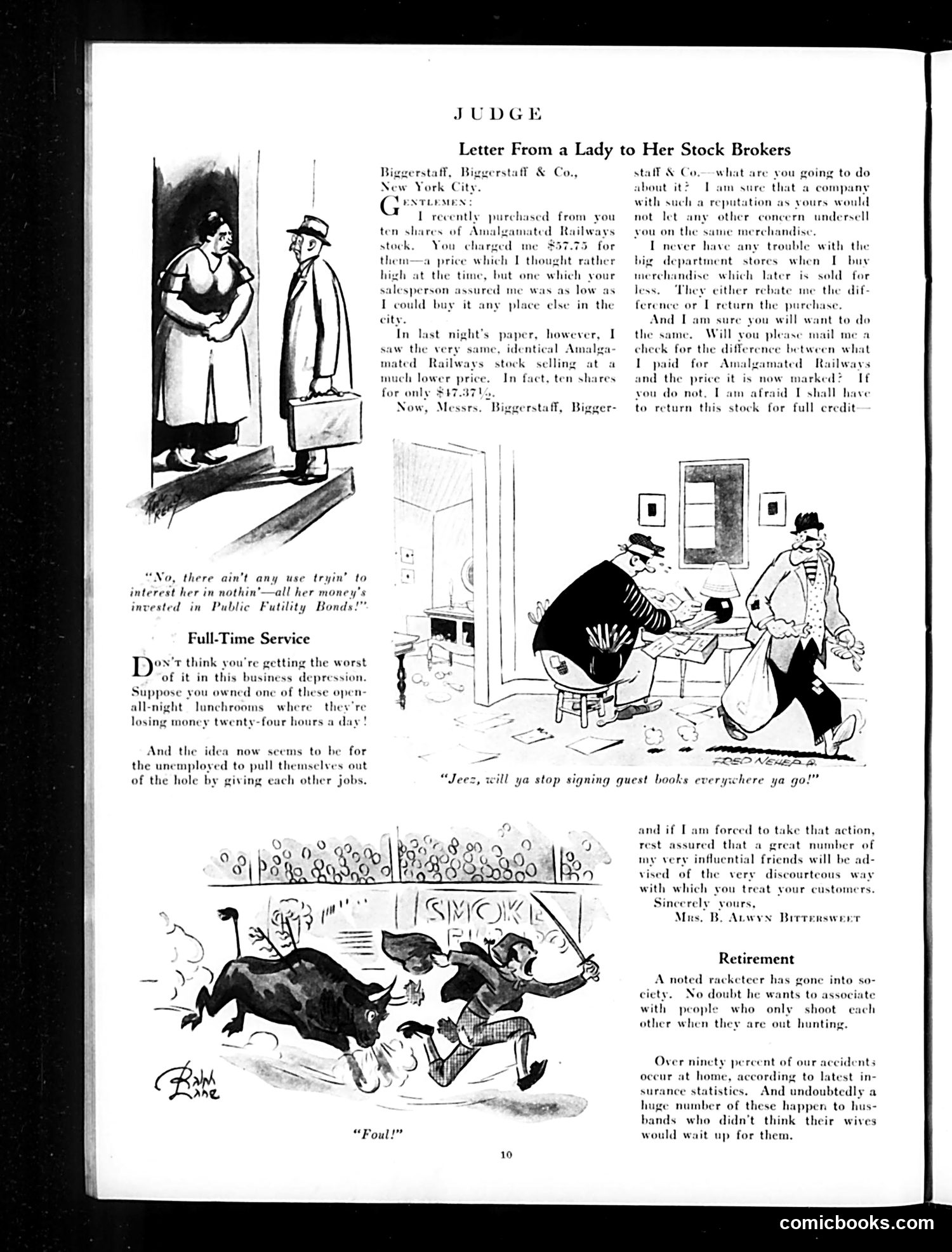
# Judge Magazine Page Analysis This page contains three separate satirical pieces about Depression-era financial and social issues: **"Letter From a Lady to Her Stock Brokers"** mocks both incompetent brokers and entitled wealthy customers. A woman paid $57.57 per share for Amalgamated Railways stock, then found identical shares selling for $47.37. She demands a refund like a department store would offer, threatening to return the stock and damage their reputation through her "influential friends." The satire targets: (1) broker dishonesty in selling overpriced securities, and (2) the obliviousness of wealthy investors during the Depression. **"Full-Time Service"** jokes darkly about Depression unemployment. It suggests the unemployed should "give each other jobs"—implying a circular, pointless economy where no real wealth is created. **"Foul!"** depicts chaos at what appears to be a public gathering, possibly satirizing overcrowded venues or chaotic public behavior during hard times. The cartoons reflect 1930s anxieties: financial fraud, economic collapse, and social disorder during the Great Depression.