
Judge, 1932-03-19 · page 5 of 36
Judge — March 19, 1932 — page 5: what you’re looking at
What you’re looking at
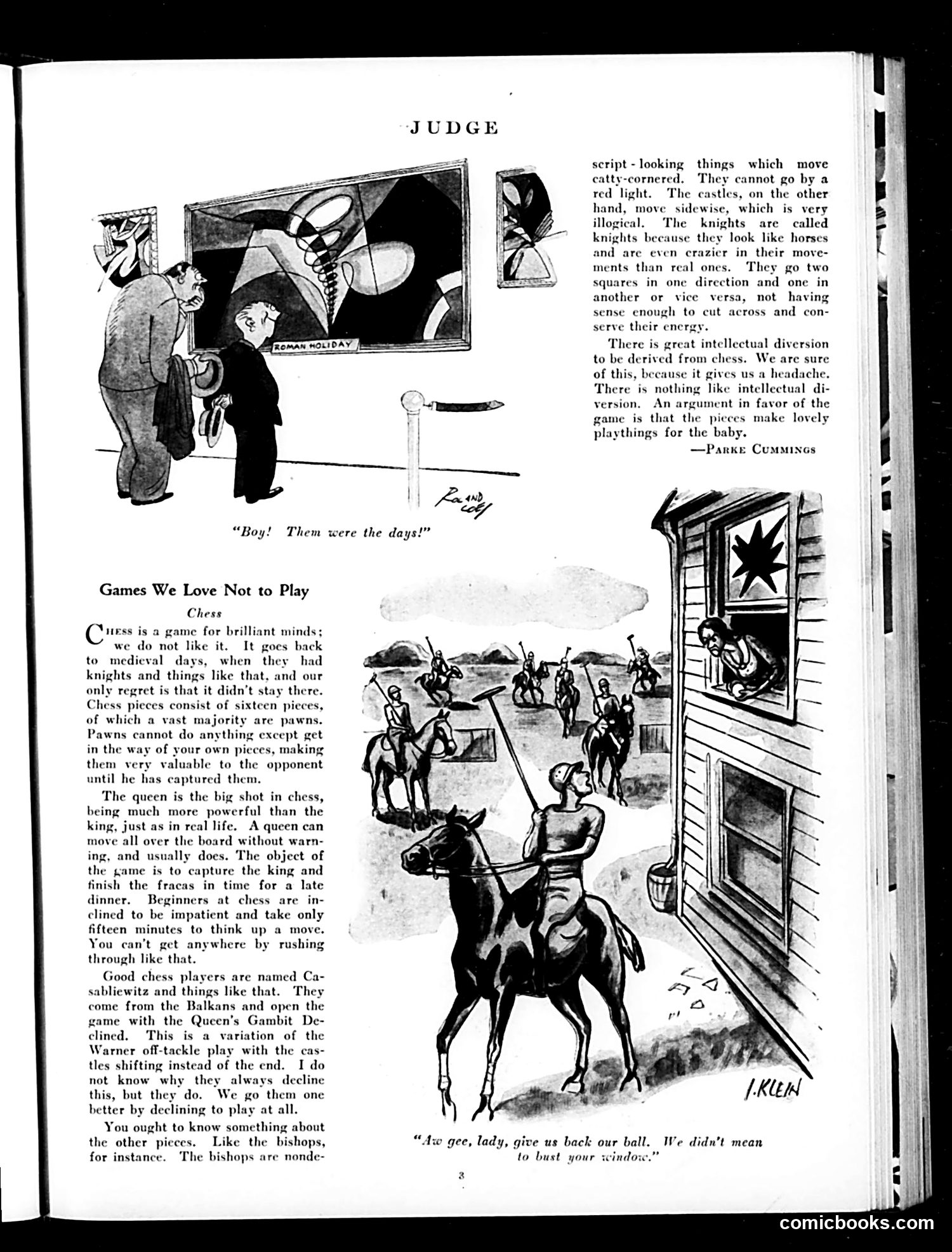
# Analysis This page from *Judge* magazine contains two distinct pieces: **Top cartoon**: Shows two men viewing what appears to be a film or screen labeled "ROMAN HOLIDAY." The caption "Boy! Them were the days!" suggests nostalgic commentary on Roman civilization, likely satirizing contemporary fascination with ancient Rome during a period when such imagery held cultural appeal. **Main article**: "Games We Love Not to Play" critiques chess as overly intellectual and tedious. The author argues chess lacks the appeal of more dynamic games—its complexity and slow pace make it unsuitable for casual play. The article dismisses chess variants like "Casabliewitz" from the Balkans as equally unappealing. **Bottom illustration**: Shows mounted soldiers attacking a building, accompanying the article's discussion of game variations with a humorous caption about a lost ball. The page's overall theme mocks intellectual pursuits and cultural pretension.
📄 Transcribed text from this page (OCR, searchable)
Machine-transcribed from the original scan — historical spelling and the odd misread are preserved.
“Boy! Games We Love Not to Play Chess ness is a game for brilliant minds; we do not like it. It goes back to medieval days, when they had knights and things like that, and our only regret is that it didn’t stay there. Chess pieces consist of sixtcen pieces of which a vast majo y are pawns. Pawns cannot do anything except get in the way of your own pieces, making valuable to the opponent until he has captured them. The queen is the big shot in chess, being much more powerful than the king, just as in real life. A queen can move all over the board without warn- ing, and usually does. The object of the game is to capture the king and finish the fracas in time for a late dinner. Beginners at chess are in- clined to be impatient and take only fifteen minutes to think up a mov You can't get anywhere by rushing through like that. Good chess players are named Ca- sabliewitz and things like that. They come from the Balkans and open the game with the Queen’s Gambit De- clined. This is a variation of the Warner off-tackle play with the cas- tles shifting instead of the end. I do not know why they always declin this, but they do. We go them one better by declining to play at all. You ought to know something about the other pieces. Like the bishops, for instance. The bishops are nonde- JUDGE Them were the days!” “Aw gee, lady, give us back our ball. to bust your window script-looking things which move catty-cornered. They cannot go by a red light. The castles, on the other hand, move sidewise, which is very illogical. The knights are called knights because they look like horses and are even ¢ r in their move- ments than real ones. They go two squares in one direction and one in another or vice versa, not having sense enough to cut across and con- serve their ci . There is great intellectual diversion to be derived from chess. We are sure of this, because it gives us a headache. There is nothing like intellectual di- version, An argument in favor of the game is that the pieces make lovely playthings for the baby. —Parke Cumminos We didn’t mean comicbooks.com