
Judge, 1932-03-19 · page 15 of 36
Judge — March 19, 1932 — page 15: what you’re looking at
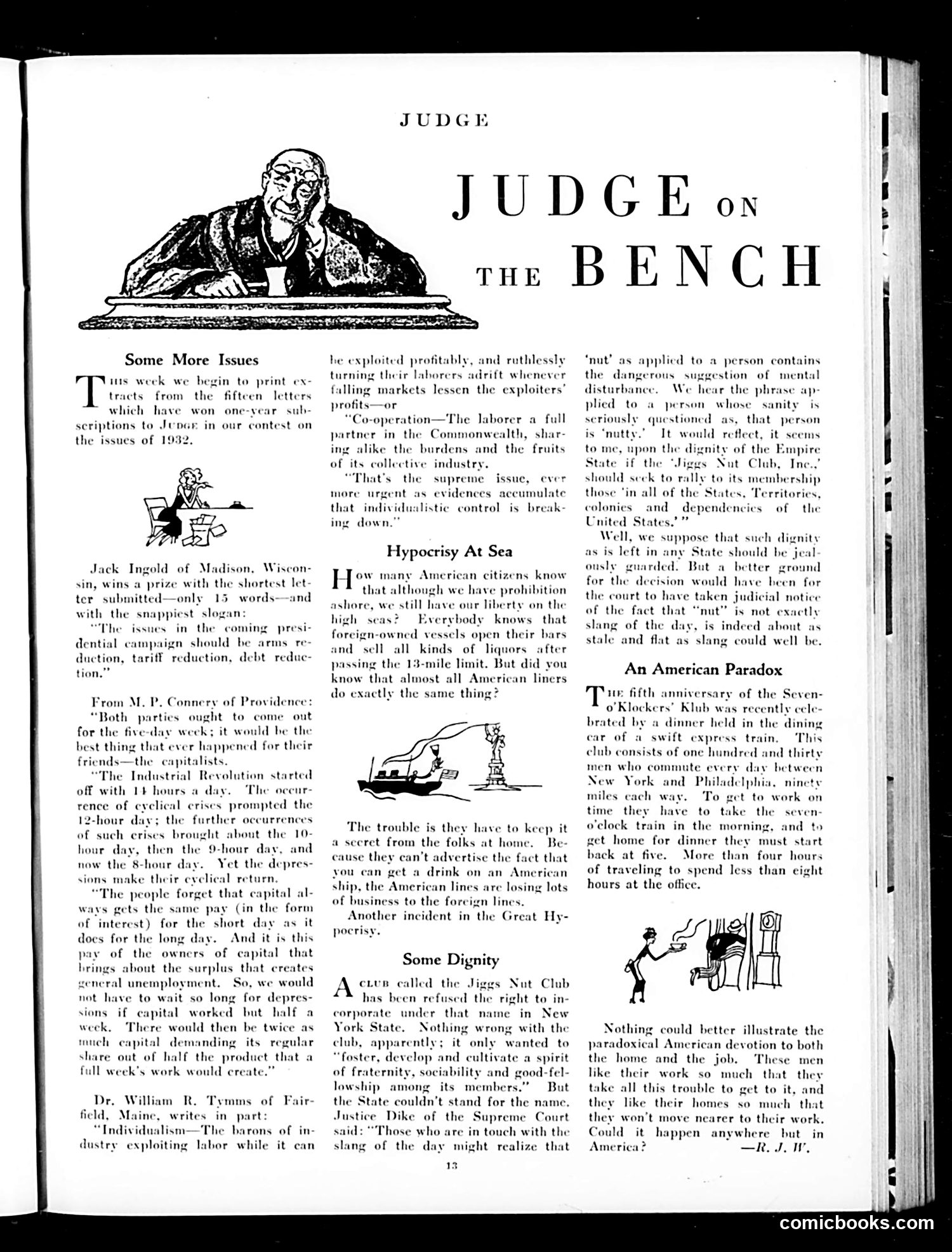
A restored page from Judge, 1932-03-19. Page through the whole issue in the reader above.
📄 Transcribed text from this page (OCR, searchable)
Machine-transcribed from the original scan — historical spelling and the odd misread are preserved.
Some More Issues its week we b from the won Tenge in to print ex- fifteen letters one-year in our contest on tracts which scriptions to the issues of 1932, sub- 5° Jack Ingold of Madison, Wiscon- sin, wins a prize with the shortest let- ter submitted—only 15 and with the snappiest slog words n: “The issues inthe coming presi- dential campaign should be duction, taritf reduction, debt reduc- rms re tion.” From M. P. Connery of Providence: “Both parties ought to come out for the five-« week; it would be the best thing that ever | friends—the capitalists. “The Industrial Revolution started off with It hours a day. ‘The rence of cyclical crises prompted the ppened for their oceur- 12-hour day; the further occurrences of such crises brought about the 10- hour day, then the 9-hour day, and now the 8-hour day. Yet the depres- sions make their cyclical return, “The people forget that capital al- ways gets the same pay (in the form of interest) for the short day as it does for the long day. And it is this pay of the owners of capital that brings about the surplus that creates neral unemployment. we would t have to wait so long for depres- sions if capital worked but half a week. There would then be twice as much capital demanding its regular share out of half the product that a full week's work would create.” Dr. William R. field, Maine, “Individual dustry exploi Tymms of Fair writes in) part: rons of in vor while it can JUDGE JUDGE ox he exploited profitably, and ruthlessly turning their laborers adrift whenever falling markets lessen the exploiters’ profits—or “Co-operation—The laborer a full partner in the Commonwealth, shar- ing alike the burdens and the fruits of its collective industry. “That's the more that ing down supreme issue, ever urgent as evidences accumulate individualistic control is break- Hypocrisy At Sea How many American citizens know that although we have prohibition ashore, we still © our liberty on the Everybody knows. that n-owned vessels open their bars and sell all kinds of liquors after the 13-mile limit. But did you know that almost all An do exactly the same thing? high seas? forei, passir rican liners The trouble is they have to keep it a seeret from the folks at home. Be- cause they can’t advertise the fact that you can get a drink on an American ship, the American lines are losing lots of business to the fore lines. Another incident in the Great Hy- pocrisy. Some Dignity A eLup called the Jiggs Nut Club has been refused the right to in- corporate under that in New York State. wz with the club, apparently; it only wanted to “foster, develop and cultivate a spirit of fraternity, sociability and good-fel- lowship among its members.” But the State couldn't stand for the name. Justice Dike of the Supreme Court ‘Those who are in touch with the ze that name Nothing wro said: slang of the day might real 13 ‘nut’ as applied to a person contains the d US suggestion of mental disturbance. We hear the phrase ap- plied to a person whose sanity is seriously questioned as, that person is ‘nutty.’ It would reflect, it seems to me, upon the dignity of the Empire State if the “Jiggs Nut Club, Ine..’ should seek to rally to its membership those ‘in all of the States, Territories, colonies and dependencies of — the United States.’ ” Well, we suppose that such dignity as is left in any State should be ously guarded. But a better ground for the decision would have been for the court to have taken judicial n of the fact that “nut” is not exactly slang of the day, is indeed about as stale and flat as slang could well be. An American Paradox Tt fifth anniversary of the Seven- o’Klockers’ Klub was recently brated by a dinner held in the dining car of a swift express train, This club consists of one hundred and thirty men who commute every day between New York and Ph miles cach way. To get to work on time they have to take the seven- o'clock train in the morning, and to get home for dinner they must start back at five. More than four hours of traveling to spend less than hours at the office. fils Nothing could better illustrate the paradoxical American devotion to both the home and the job. These men like their work so much that they ¢ all this trouble to get to it, and they like their homes so much that they won't move nearer to their work. Could it happen anywhere but in Americ RIL W. adelphia, ninety comicbooks.com