
Judge, 1932-03-19 · page 18 of 36
Judge — March 19, 1932 — page 18: what you’re looking at
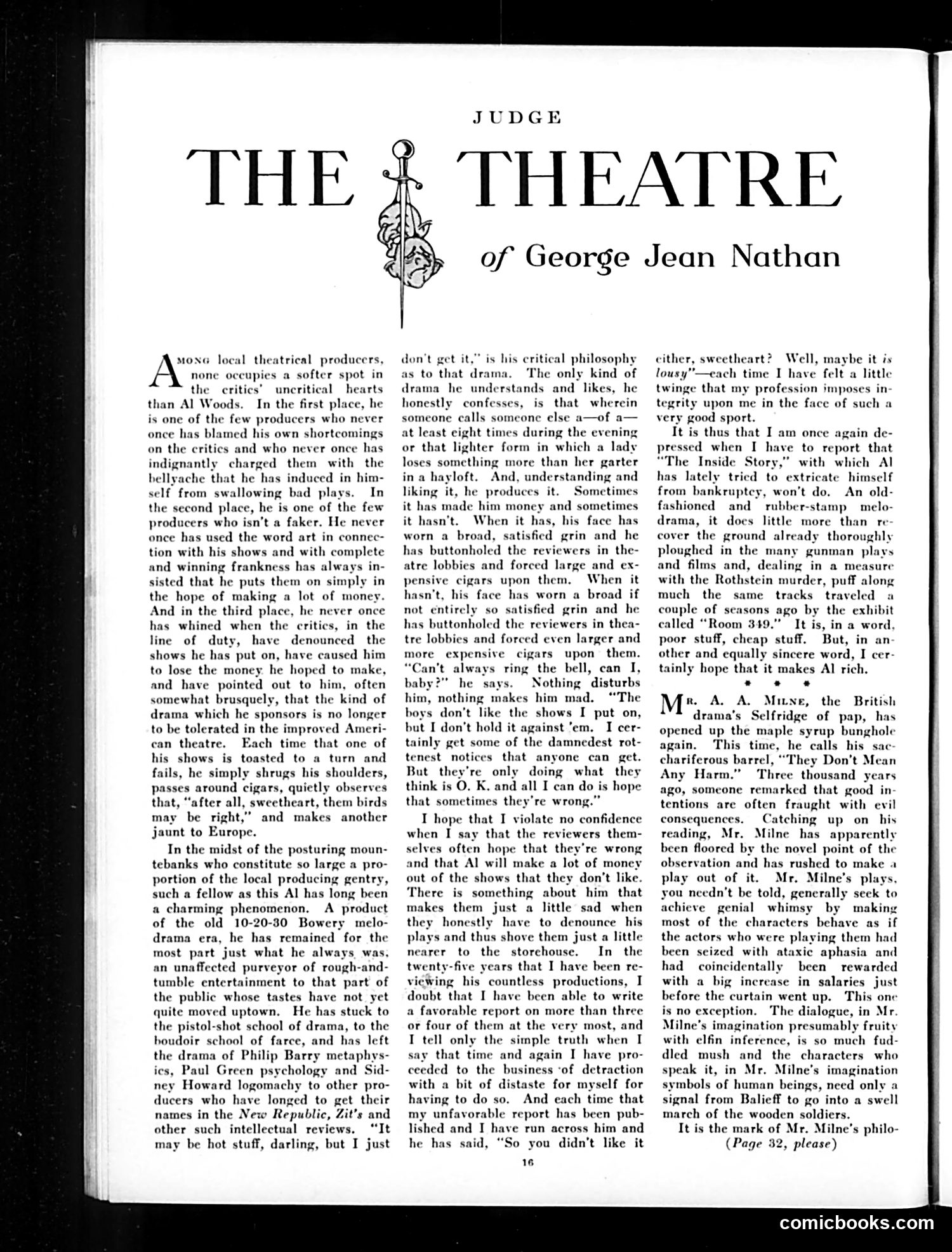
A restored page from Judge, 1932-03-19. Page through the whole issue in the reader above.
📄 Transcribed text from this page (OCR, searchable)
Machine-transcribed from the original scan — historical spelling and the odd misread are preserved.
soxo local theatrical producers, A none occupies a softer spot in the critics’ uncritical hearts than Al Woods. In the first plac is one of the few producers who never once has blamed his own shortcomings on the critics and who never once has indignantly charged them with the bellyache that he has induced in him- self from swallowing bad plays. In the second place, he is one of the few producers who isn’t a faker. He never once has used the word art in connec- tion with his shows and with complete and winning frankness has always in- sisted that he puts them on simply in the hope of making a lot of money. And in the third place, he never onc has whined when the critics, in the line of duty, have denounced the shows he has put on, have caused him to lose the money he hoped to make, and have pointed out to him, often somewhat brusquely, that the kind of drama which he sponsors is no longe to be tolerated in the improved Ameri- can theatre. Each time that one of his shows is toasted to a turn and fails, he simply shrugs his shoulders, passes around cigars, quietly observes that, “after all, sweetheart, them birds may be right,” and makes another jaunt to Europe. In the midst of the posturing moun- tebanks who constitute so large a pro- portion of the local producing gentry, such a fellow as this Al has long been a charming phenomenon. A product of the old 10-20-30 Bowery melo- drama era, he has remained for the most part just what he always was, an unaffected purveyor of rough-and- tumble entertainment to that part of the public whose tastes have not yet quite moved uptown. He has stuck to the pistol-shot school of drama, to the boudoir school of farce, and has left the drama of Philip Barry metaphys- Paul Green psychology and Sid- ney Howard logomachy to other pro- ducers who have longed to get their names in the New Republic, Zit’s and other such intellectual reviews. “It may be hot stuff, darling, but I just JUDGE THEATRE of George Jean Nathan don't get it,” is his critical philosophy as to that drama. The only kind of drama he understands and likes, he honestly confesses, is that wherein someone calls someone else a—of a— at least eight times during the evening or that lighter form in which a lady loses something more than her garter ina hayloft. And, understanding and liking it, he produces it. Sometimes it has made him money and sometimes it hasn't. When it has, his face has worn a broad, satisfied grin and he has buttonholed the reviewers in the- atre lobbies and forced large and ex- pensive cigars upon them. When it hasn't, his face has worn a broad if not entirely so satisfied grin and he has buttonholed the reviewers in th tre lobbies and forced even larger and more expensive cigars upon them. “Can't always ring the bell, can I, baby?” he says. Nothing disturbs him, nothing makes him mad. “The boys don’t like the shows I put on, but I don’t hold it against em. I cer- tainly get some of the damnedest rot- tenest notices that anyone can get. But they're only doing what they think is O. K. and all I can do is hope that sometimes they're wrong.” I hope that I violate no confidence when I say that the reviewers them- selves often hope that they're wrong and that Al will make a lot of money out of the shows that they don’t like. There is something about him that makes them just a little sad when they honestly have to denounce his plays and thus shove them just a little nearer to the storehouse. In_ the twenty-five years that I have been re- viewing his countless productions, I doubt that I have been able to write a favorable report on more than three or four of them at the very most, and T tell only the simple truth when I ay that time and again I have pro- ceeded to the business ‘of detraction with a bit of distaste for myself for having to do so. And each time that my unfavorable report has been pub- shed and I have run across him and he has said, “So you didn’t like it 16 cither, sweetheart? Well, maybe it is lousy”—each time I have felt a little twinge that my profession imposes in tegrity upon me in the face of such a very good sport. It is thus that I am once again de- pressed when I have to report that “The Inside Story,” with which Al has lately tried to extricate himself from bankruptey, won't do. An old- fashioned and’ rubber-stamp melo- drama, it does little more than re- cover the ground already thoroughly ploughed in the many gunman plays and films and, dealing in a measure with the Rothstein murder, puff along much the same tracks traveled a couple of seasons ago by the exhibit called “Room 349.” It is, in a word, poor stuff, cheap stuff. But, in an other and equally sincere word, I cer- tainly hope that it makes Al rich. * * « rn. A. A. Minne, the British drama’s Selfridge of pap, has opened up the maple syrup bunghole again. This time, he calls his sac- chariferous barrel, “They Don't Mean Any Harm.” Three thousand years ago, someone remarked that good in tentions are often fraught with evil consequences. Catching up on_ his reading, Mr. Milne has apparently been floored by the novel point of the observation and has rushed to make a play out of it. Mr. Milne’s plays, you needn't be told, generally seek to achieve genial whimsy by making most of the characters behave as if the actors who were playing them had been seized with ataxic aphasia and had coincidentally been rewarded with a big increase in salaries just before the curtain went up. This one is no exception. The dialogue, in Mr Milne’s imagination presumably fruity with elfin inference, is so much fud- dled mush and the characters who speak it, in Mr. Milne’s imagination mbols of human beings, need only a signal from Balieff to go into a swell march of the wooden soldiers. It is the mark of Mr. Milne’s philo- (Page 32, please) comicbooks.com