A complete issue · 36 pages · 1931
Judge — August 8, 1931
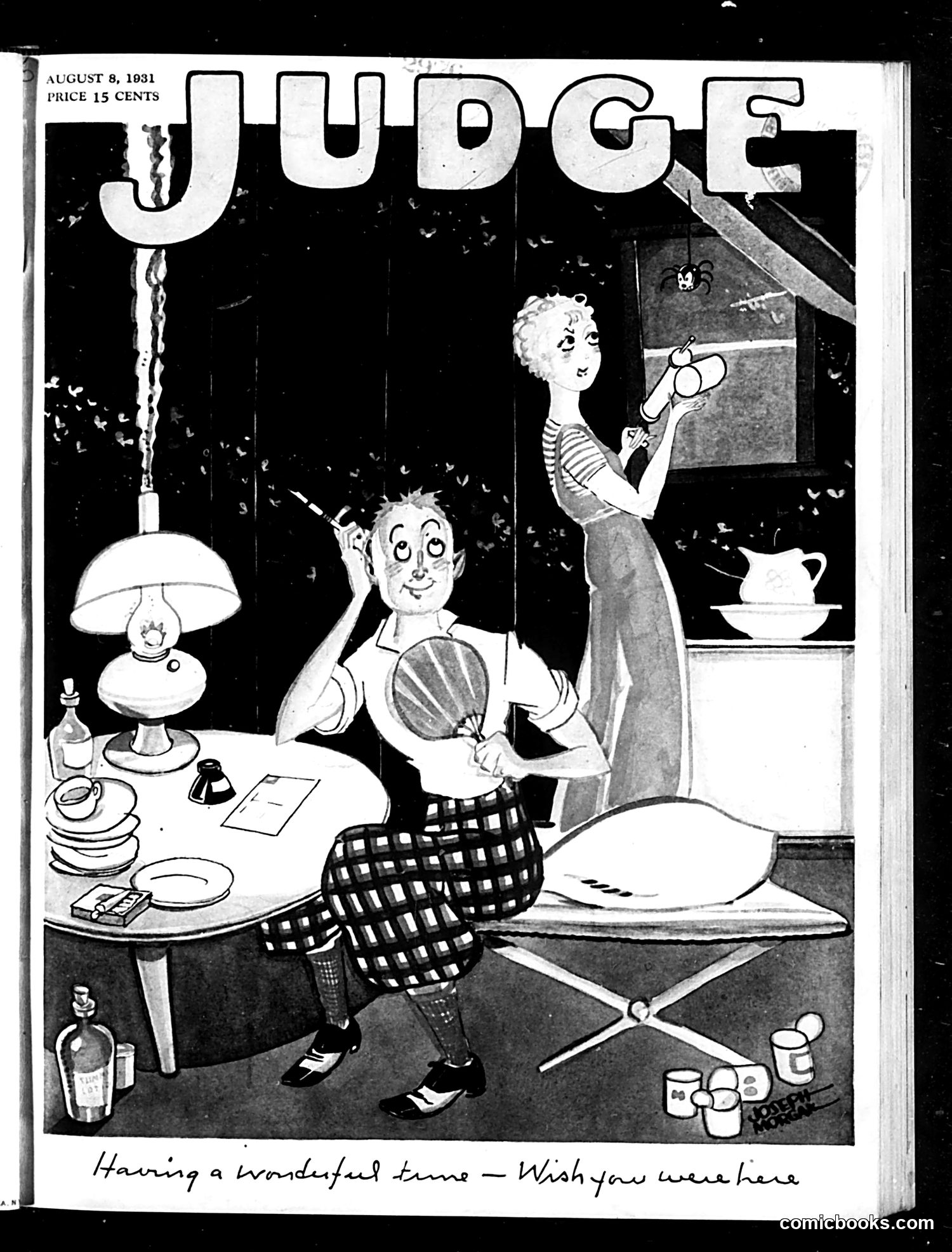
# Judge Magazine Cover Analysis (August 8, 1931) This cover depicts a domestic humor scene typical of early 1930s Judge magazine. A man sits at a vanity mirror, admiring himself while holding what appears to be a hand mirror, wearing checkered pants. A woman stands nearby holding cosmetic items, seemingly preparing for grooming or beauty treatments. The scene satirizes vanity and personal grooming habits, likely poking fun at men's increasing attention to appearance and grooming products—a relatively newer phenomenon in the early Depression era. The caption reads "Having a wonderful time—Wish you were here," suggesting this is meant as a humorous postcard-style commentary on leisure activities and domestic life. The joke appears to target vanity and self-absorption during an era when such behavior might have been considered frivolous or amusing.
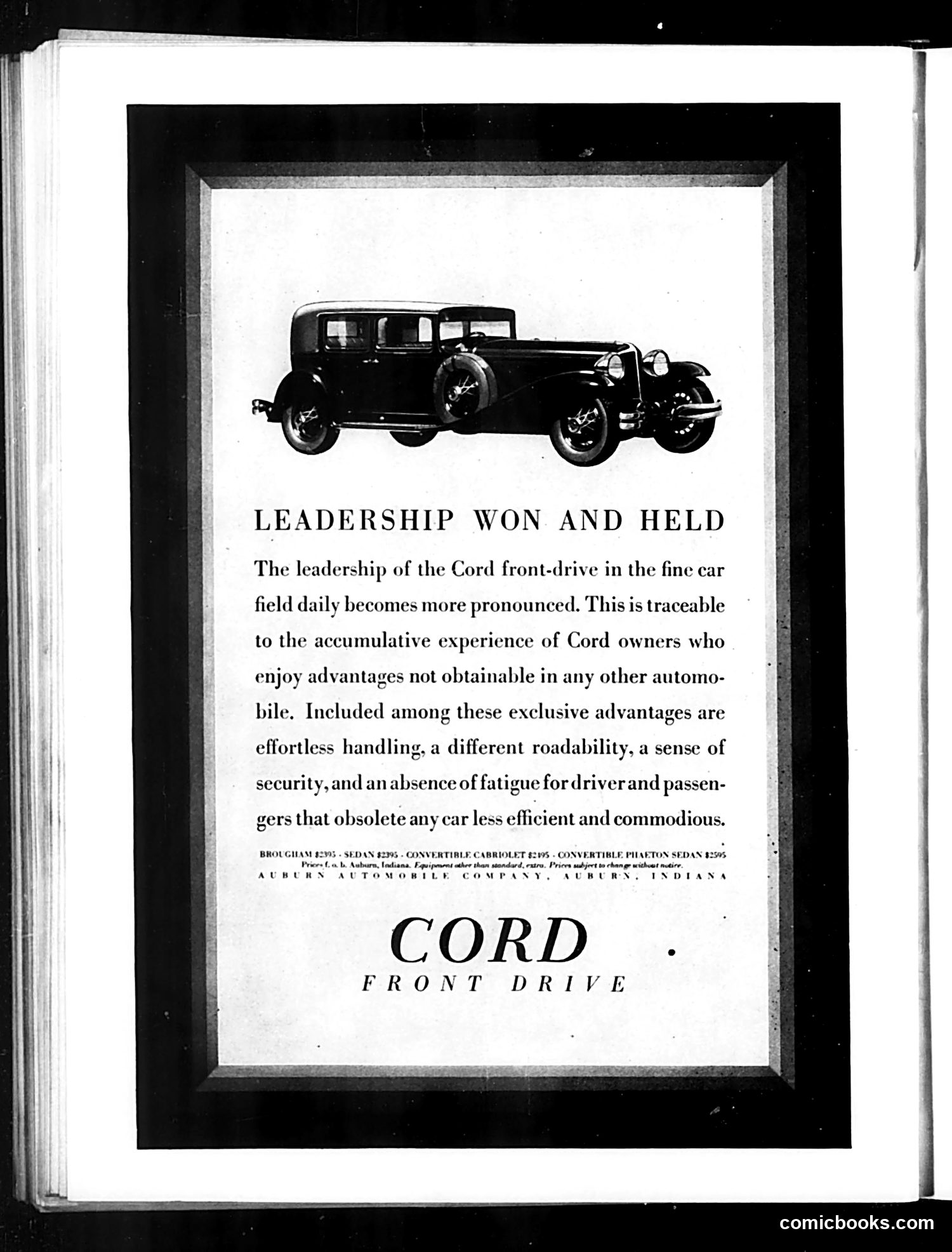
# Analysis This page is **not a cartoon or satirical content** — it's a **vintage automobile advertisement** for Cord front-drive vehicles, placed in Judge magazine. The ad features illustrations of two Cord models and promotes the brand's "front-drive" technology as a market-leading innovation. The text claims Cord owners enjoy exclusive advantages: effortless handling, superior roadability, reduced driver fatigue, and passenger comfort unavailable in competing automobiles. The small print lists specific models (Brougham, Sedan, Convertible Cabriolet, Phaeton Sedan) and identifies the manufacturer as Auburn Automobile Company, Auburn, Indiana. This represents Judge's commercial content rather than editorial satire — a common revenue source for magazines of this era.
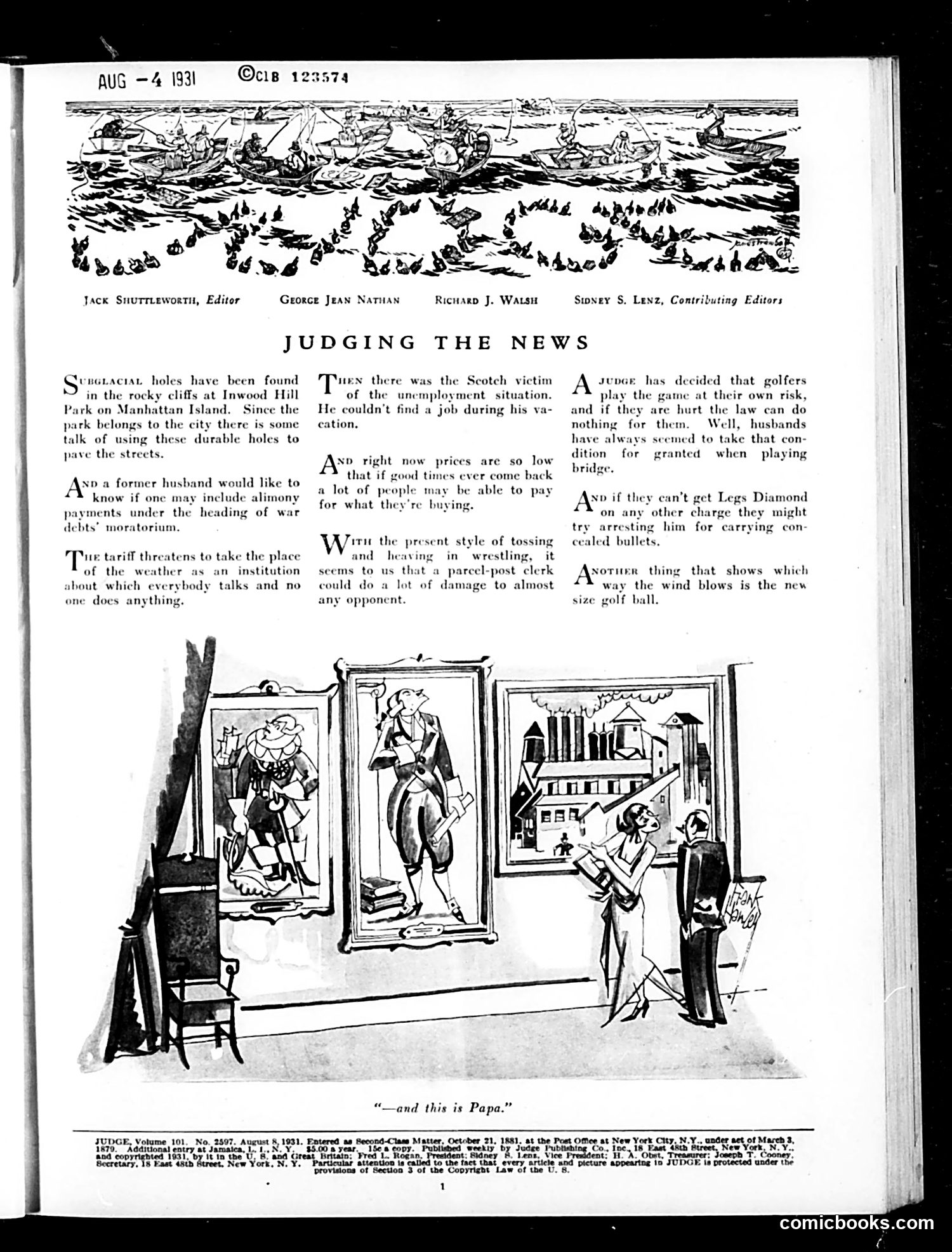
# "Judging the News" - August 4, 1931 This page presents brief satirical commentary on current events alongside a cartoon titled "—and this is Papa." The cartoon depicts a museum or gallery scene where a man shows his young son various framed artworks. The joke appears to play on the phrase "and this is Papa"—suggesting the father is presenting himself as another artwork or exhibit, likely mocking paternal pride or the pretentiousness of art appreciation. The accompanying text comments on various topics: subglacial holes at Inwood Hill Park; unemployment and war debts; weather as conversation; wrestling techniques; low prices; golf; and a new size golf ball. These brief satirical notes represent Judge magazine's typical format of quick social and economic commentary on 1931 Depression-era concerns and contemporary absurdities.
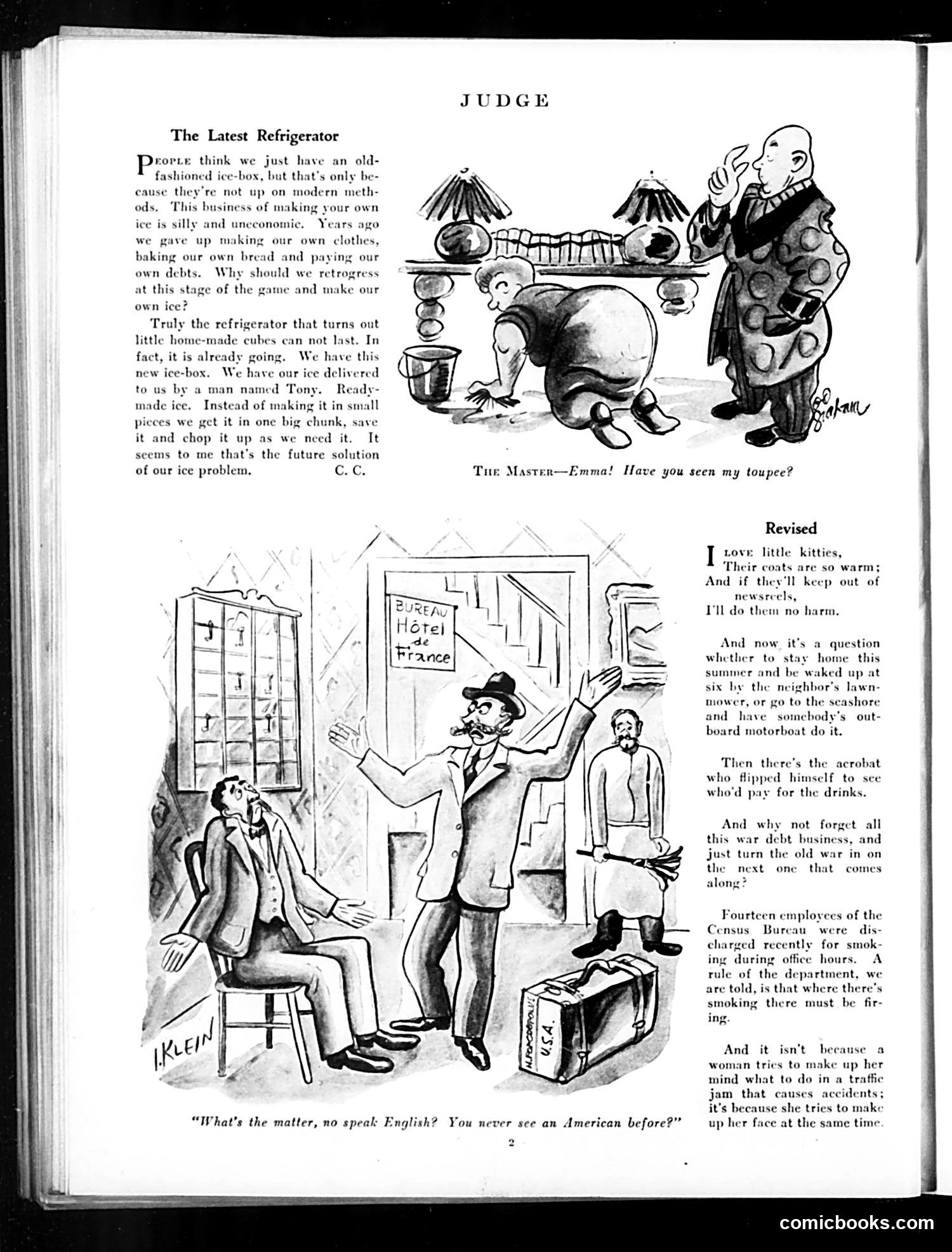
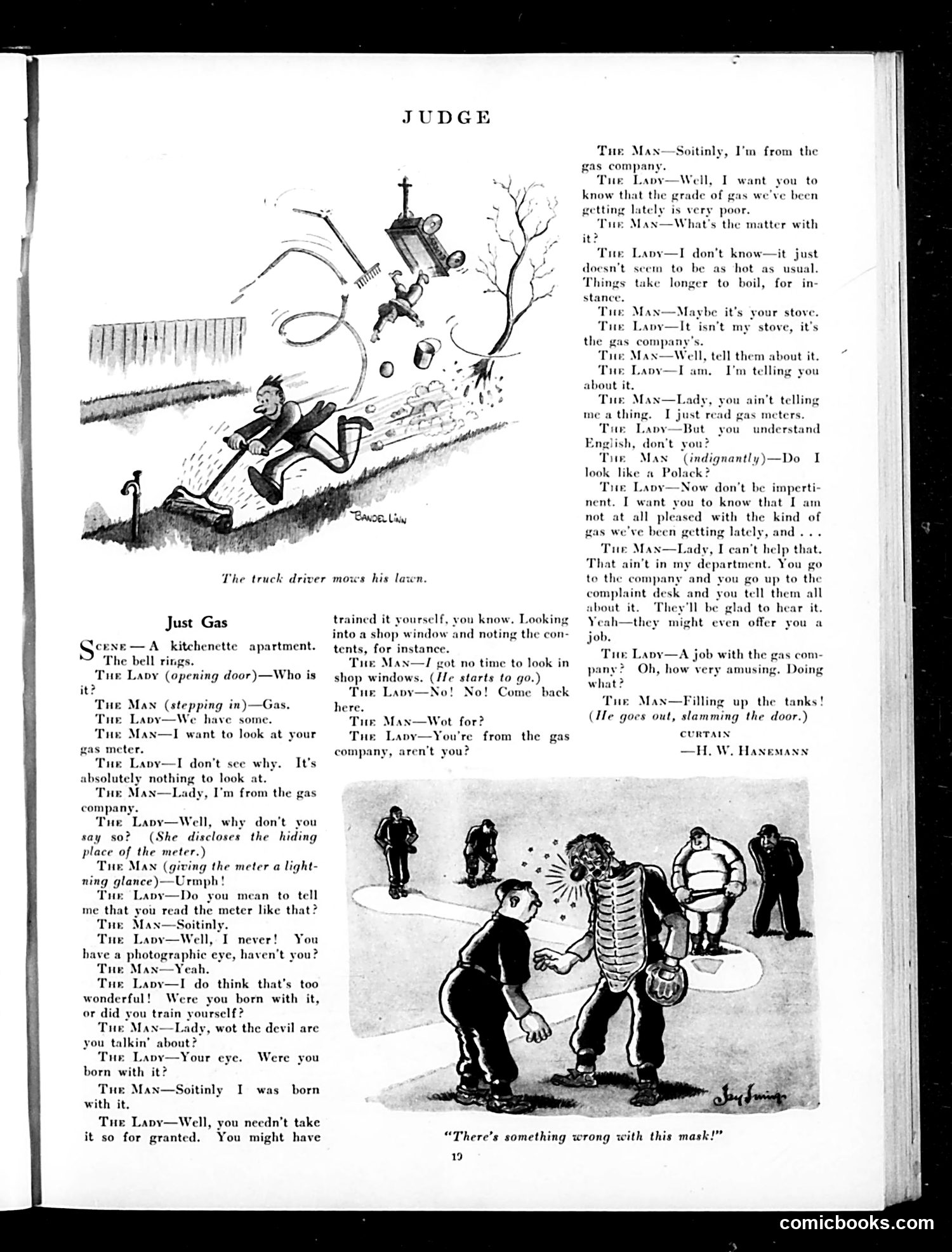
# Analysis of Judge Page This page contains two distinct cartoons and commentary from an early 20th-century issue of Judge magazine. **"The Latest Refrigerator"** (top): Satirizes modern convenience culture. The cartoon shows a man proudly displaying a large block of ice as a "refrigerator," mocking people's embrace of new technology without questioning practicality. The accompanying text by C.C. argues this is silly—people should return to self-sufficiency like making their own ice rather than relying on modern delivery services. **"Revised"** (bottom cartoon and text): The sketch depicts a confused foreign hotel guest unable to communicate in English, captioned "What's the matter, no speak English? You never see an American before?" The sidebar commentary humorously lists summer annoyances (lawn mowers, motorboats, war debt) and office smoking violations, showing Judge's satirical take on contemporary American social irritations.
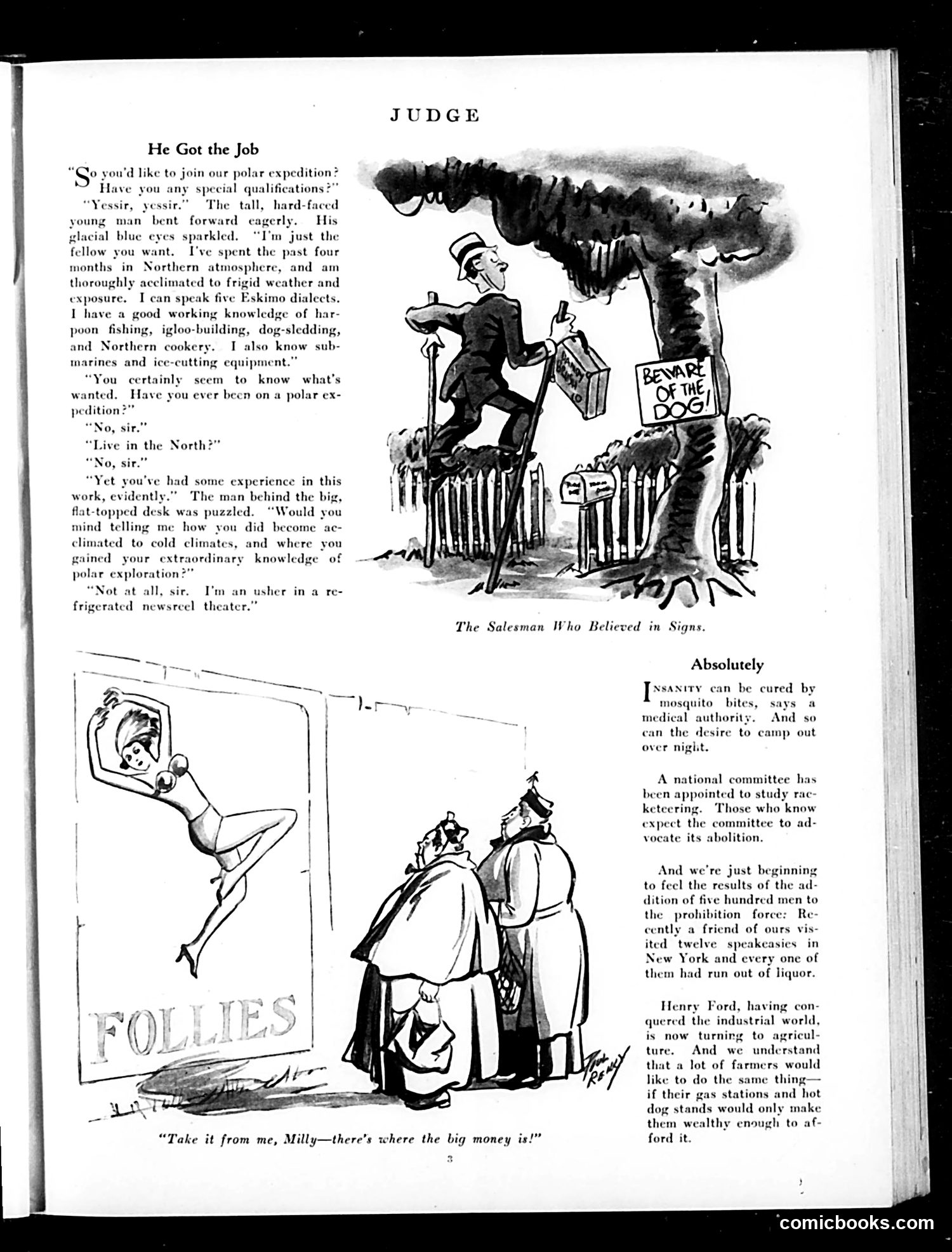
# Analysis of Judge Magazine Page **"He Got the Job"** (top): A job applicant claims Arctic expedition experience—harpoon fishing, igloo-building, dog-sledding—to impress an expedition leader. The punchline reveals he's merely an usher in a refrigerated movie theater. The satire mocks exaggeration and bluffing in job interviews. **"The Salesman Who Believed in Signs"** (top right): A traveling salesman ignores a "Beware of the Dog" sign, apparently with negative consequences. This is straightforward visual humor about ignoring warnings. **"Take it from me, Milly"** (bottom): Two women discuss prohibition's effects—speakeasies and liquor scarcity. The cartoon satirizes Prohibition's failure, referencing the era's widespread black-market alcohol trade and social consequences following the 1920 ban.
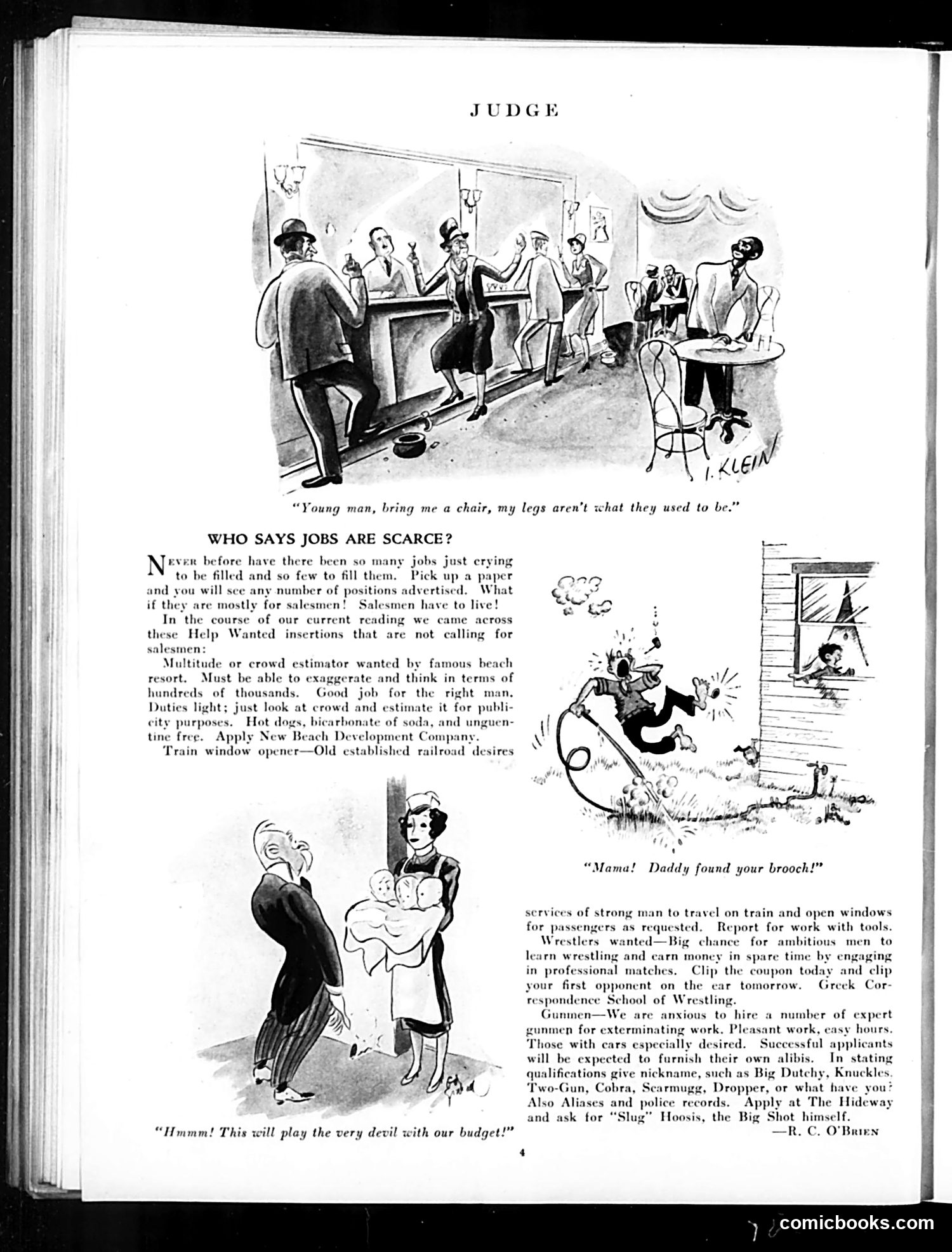
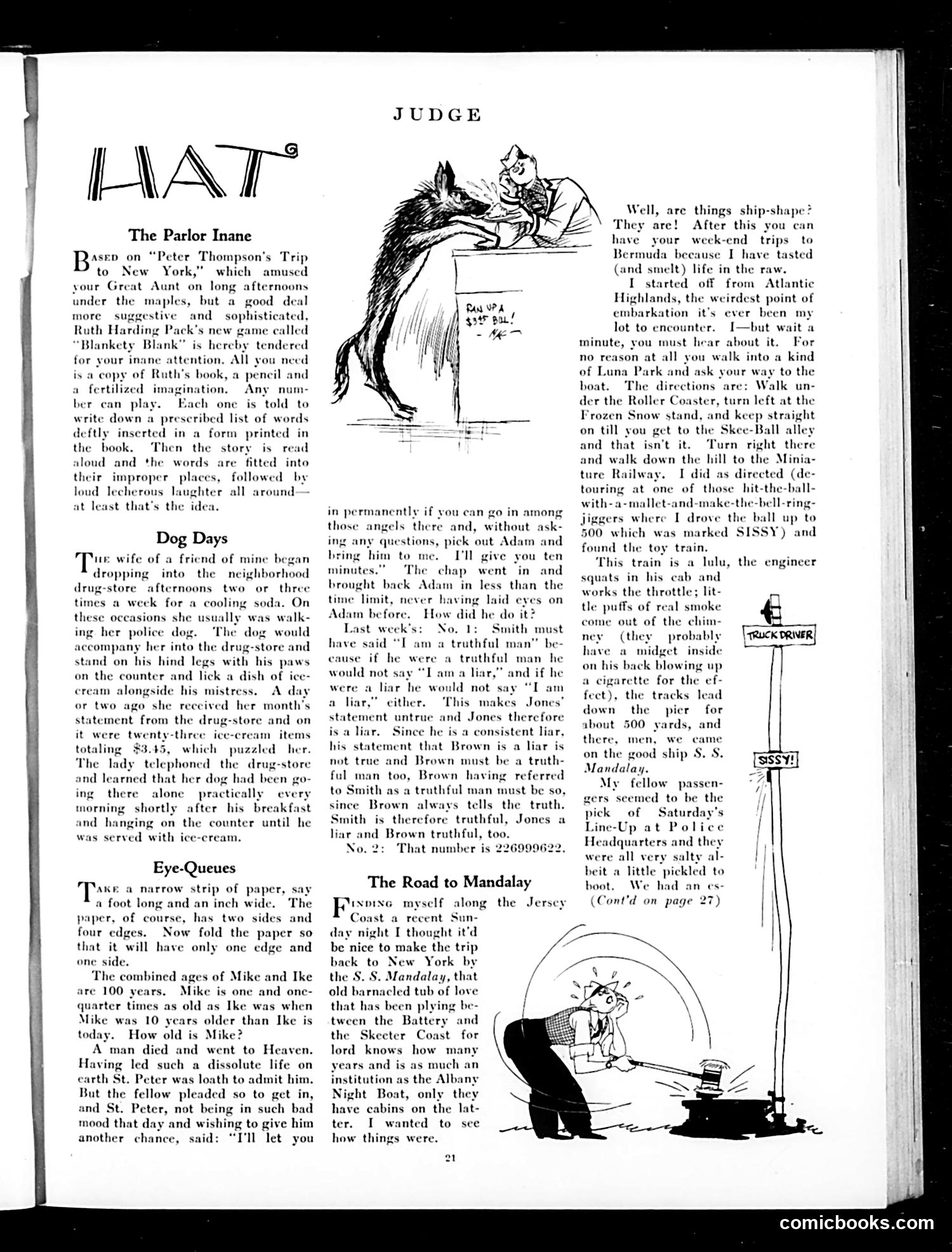
# "Judge" Magazine Page: "Who Says Jobs Are Scarce?" This satirical page mocks job advertisements from the 1920s-1930s era. The top cartoon shows a courtroom scene titled "JUDGE," depicting absurd job listings as a form of justice. Below, the text presents real help-wanted ads with exaggerated, exploitative job descriptions: - A beach resort seeking a "crowd estimator" willing to exaggerate attendance - A railroad hiring a train window opener - A wrestling school offering to teach professionals - Gunmen wanted for "exterminating work"—applicants encouraged to provide aliases and criminal records The satire exposes how desperation during economic hardship drove people to accept dangerous, demeaning, or outright illegal employment. The accompanying cartoons show physical mishaps resulting from these ridiculous jobs, reinforcing how foolish and unsafe these "opportunities" actually were.
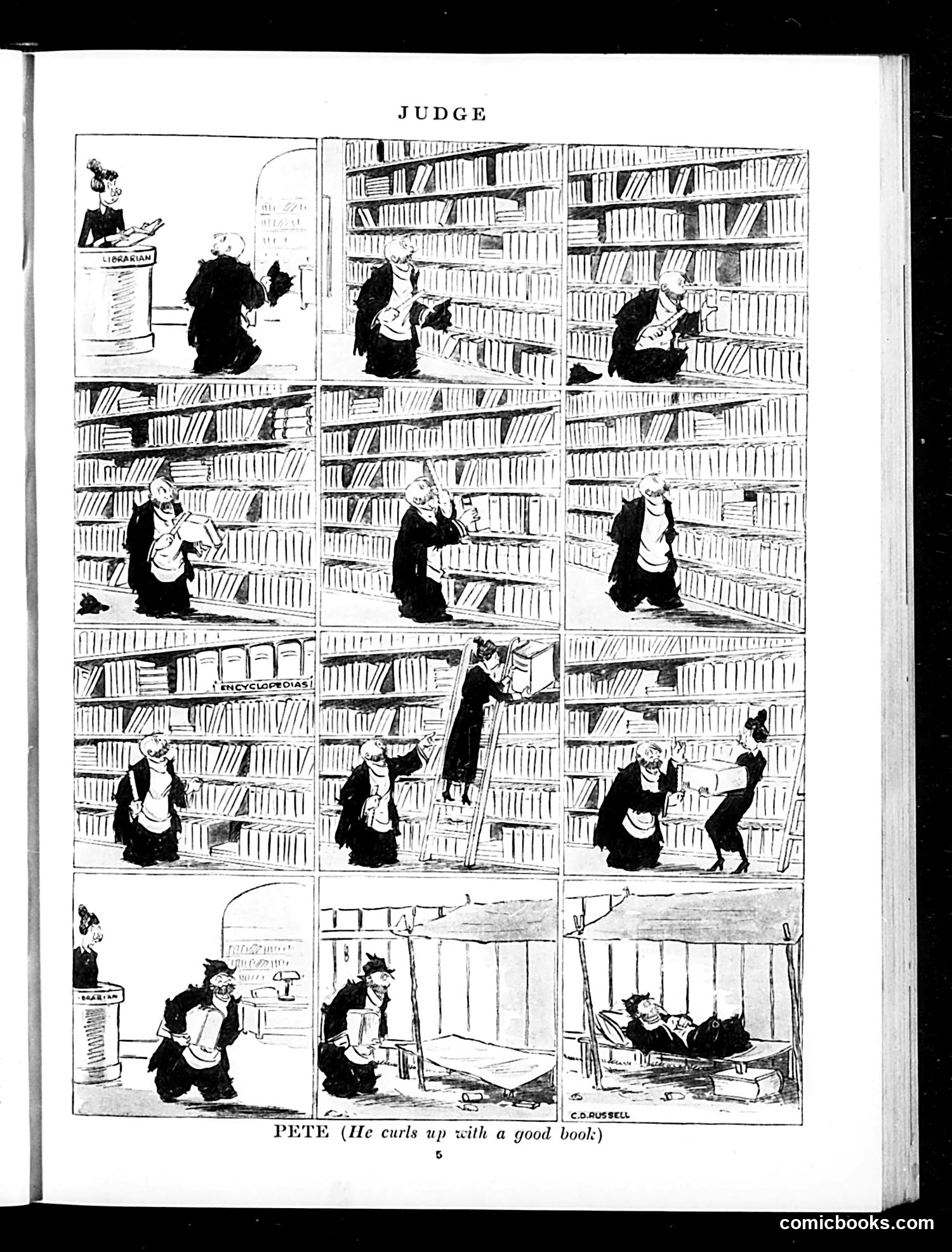
# "Judge" Page Analysis This page contains a comic strip titled "PETE (He curls up with a good book)" by C.D. Russell, depicting a character's journey through a library. The strip shows Pete searching library shelves, struggling to select books, and eventually finding one that captivates him so thoroughly he becomes completely absorbed—curling up comfortably to read it. The final panels show him in a relaxed, reclined position, fully immersed in his book. The humor appears to center on the contrast between the effort of finding the *right* book in a vast library versus the reward of discovering an engrossing read that transports the reader. It's gentle satire about literary escapism and the comfort books provide—a relatable theme for *Judge* magazine's educated, literate audience.
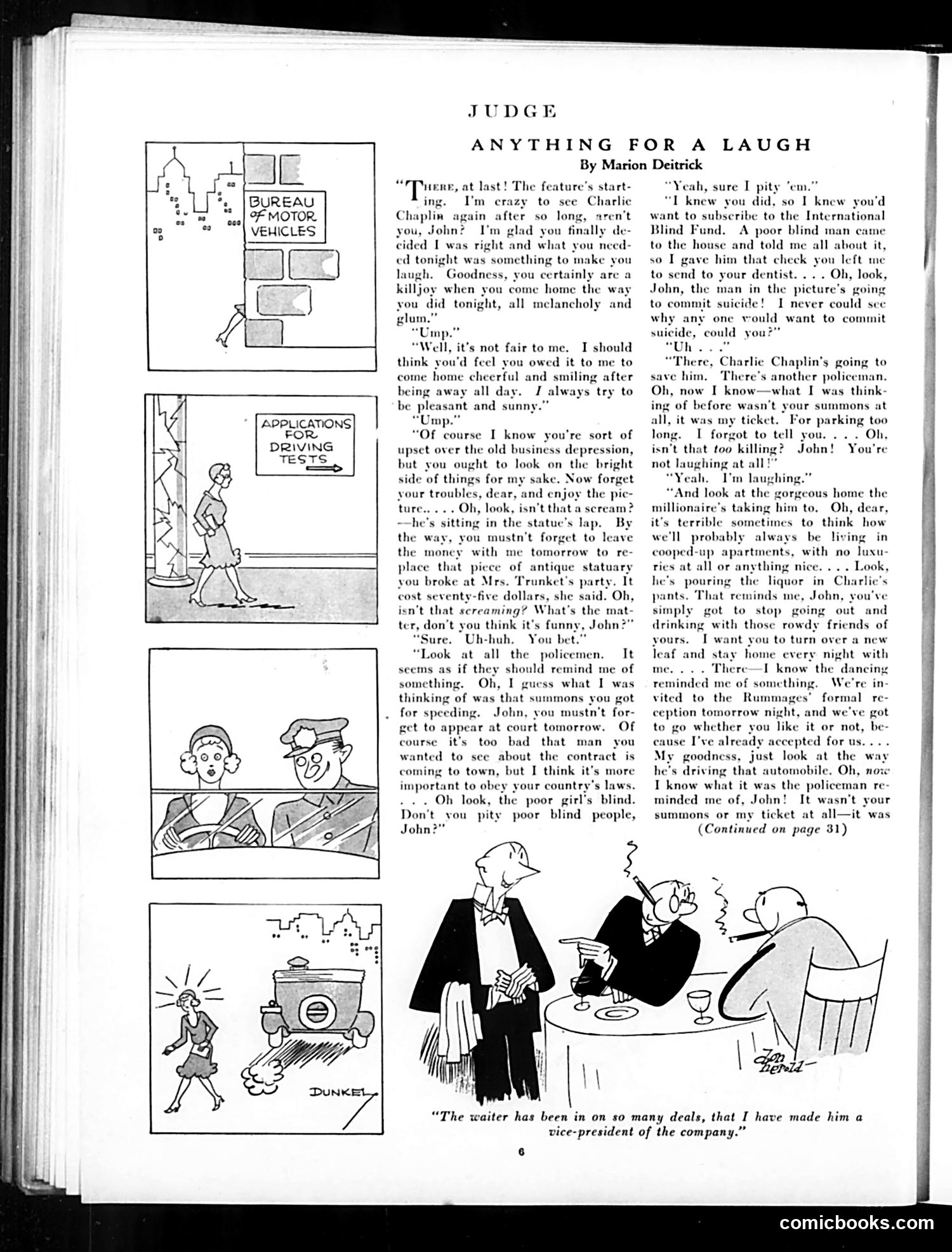
# "Anything for a Laugh" — Judge Magazine Analysis This page satirizes wealthy society's indifference to social problems during economic hardship. The main story depicts a wealthy woman ("Charlie Chaplin" reference unclear) dismissing her husband's concerns about poverty and lawbreaking by focusing instead on trivial matters: a statuary purchase, social events, and superficial entertainment. The scattered comic panels mock bureaucratic absurdity (driving tests office) and working-class situations. The final illustration shows men in formal wear at dinner, with a caption about a waiter becoming "vice-president" through repeated dealings—satirizing both corporate nepotism and the notion that any exposure to wealth automatically elevates one's status. The overall message: society's upper classes ignore serious issues in favor of frivolous amusement.
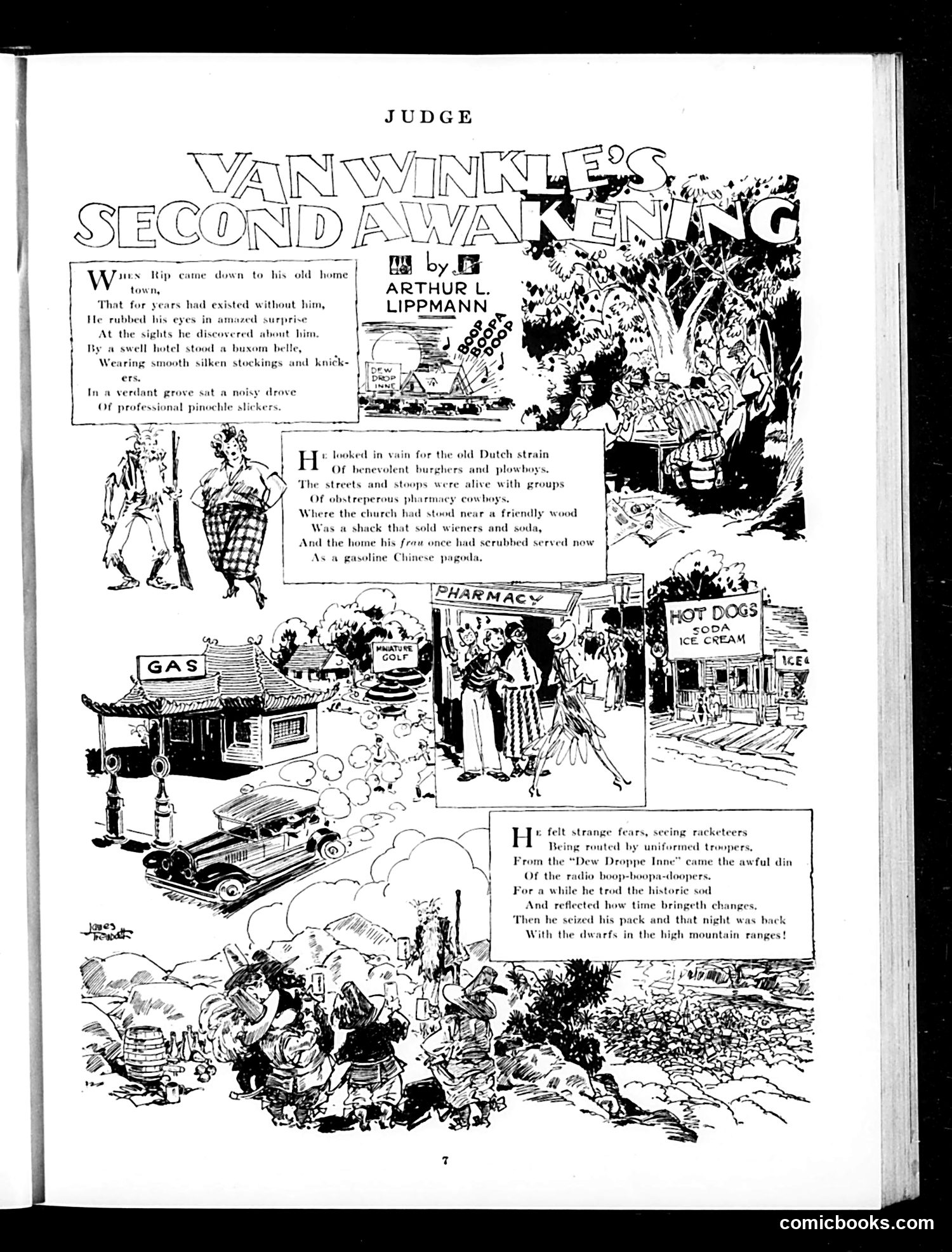
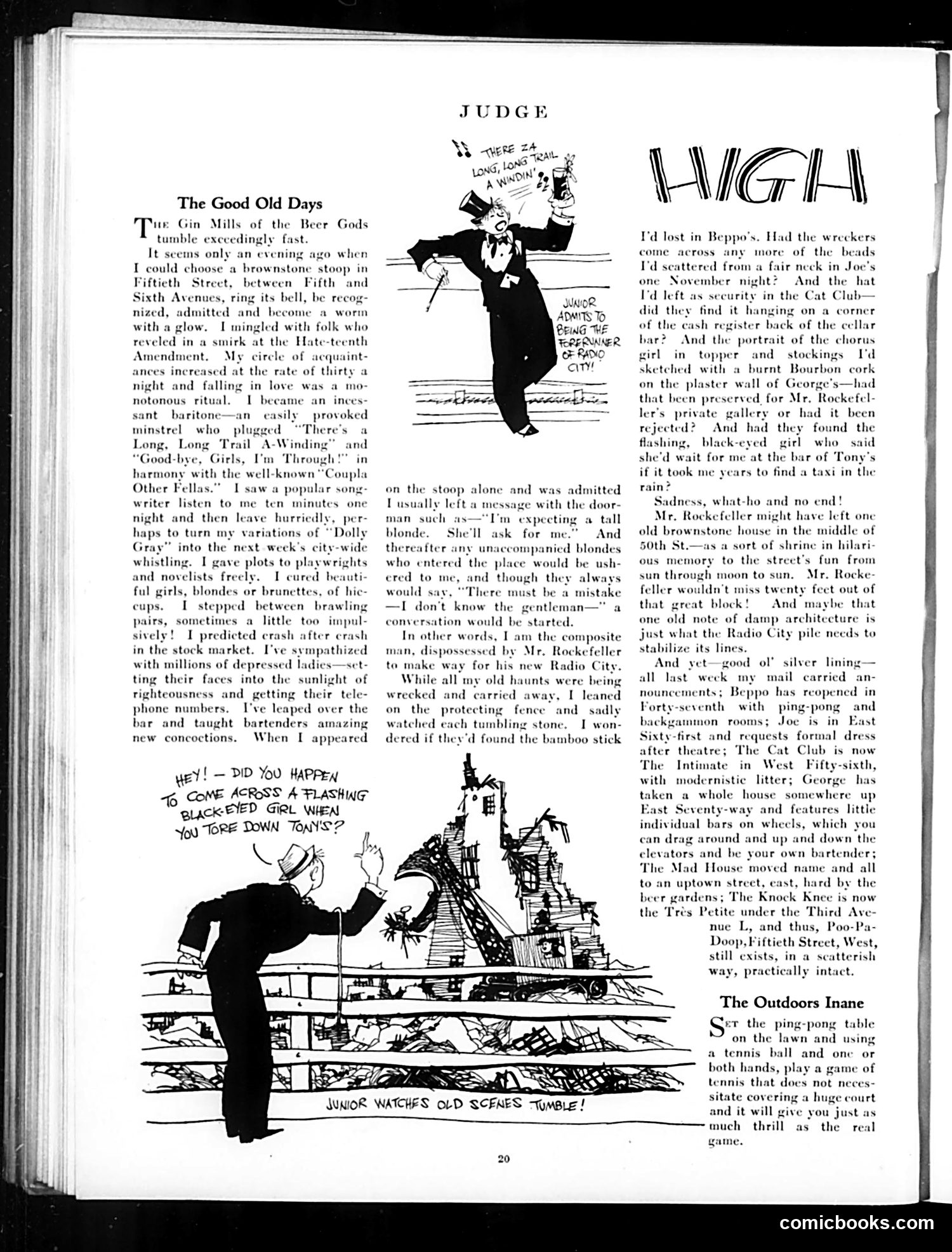
# "Judge Vanwinkle's Second Awakening" Analysis This is a satirical story by Arthur L. Lippmann depicting a character (clearly referencing Rip Van Winkle) returning to his hometown after years away, only to find it utterly transformed by modernization and urban decay. The satire targets early 20th-century American social changes: the disappearance of traditional Dutch colonial character, replacement of churches and homes with commercial establishments (gas stations, pharmacies depicted as "cowboys," Chinese pagodas), the rise of organized crime ("racketeers"), and Prohibition-era concerns ("Dew Droppe Inn," radio references). The protagonist finds the changes so disturbing that he flees back to nature ("dwarfs in the high mountain ranges"). The comic's point: rapid modernization has destroyed America's pastoral past and replaced it with commercialism, vice, and lawlessness. It's fundamentally nostalgic criticism of contemporary urban America, lamenting what industrialization had cost.
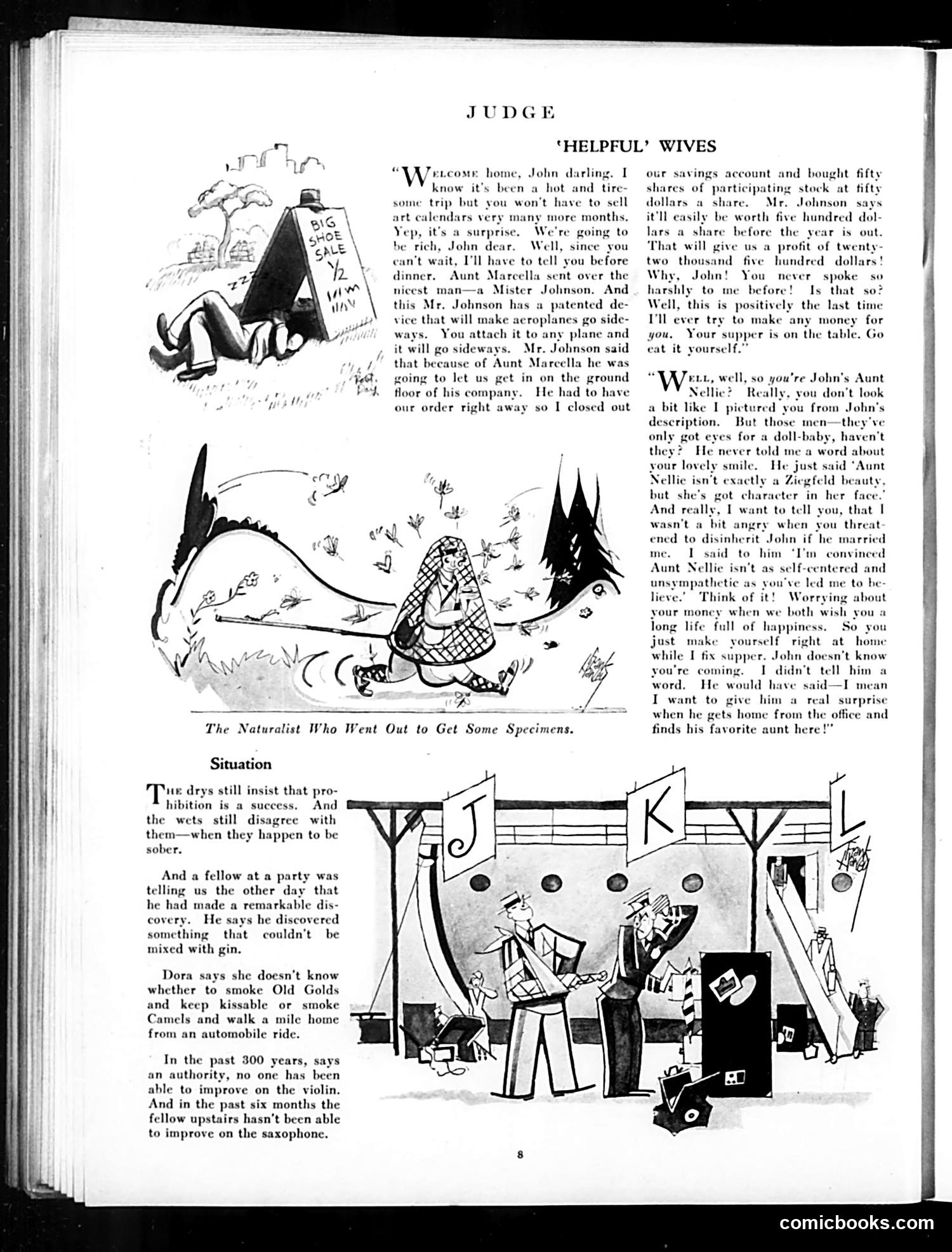
# Judge Magazine Content Analysis This page contains two satirical pieces mocking wives' financial decisions and prohibition-era social hypocrisy. **"Helpful Wives"** depicts a wife who invested their savings in a dubious scheme: an "aeroplanes go sideways" device from a man introduced by her aunt. She excitedly announces they've bought stock expecting massive profits, oblivious to having made a foolish investment. John's angry response suggests the scheme is obviously fraudulent. The satire targets wives who make reckless financial decisions while believing themselves helpful. **"Situation"** section offers brief commentary on contemporary issues: prohibition's failure (drys claim success; wets disagree), a substance that "couldn't be mixed with gin" (likely mocking gin's ubiquity during Prohibition), cigarette advertising's sexual appeals ("kissable" vs. walking home), and instrumental music (the saxophone emerging as popular but unskilled players annoyed neighbors). The cartoons reflect 1920s anxieties about wives' newfound financial independence, Prohibition enforcement, and changing social customs.
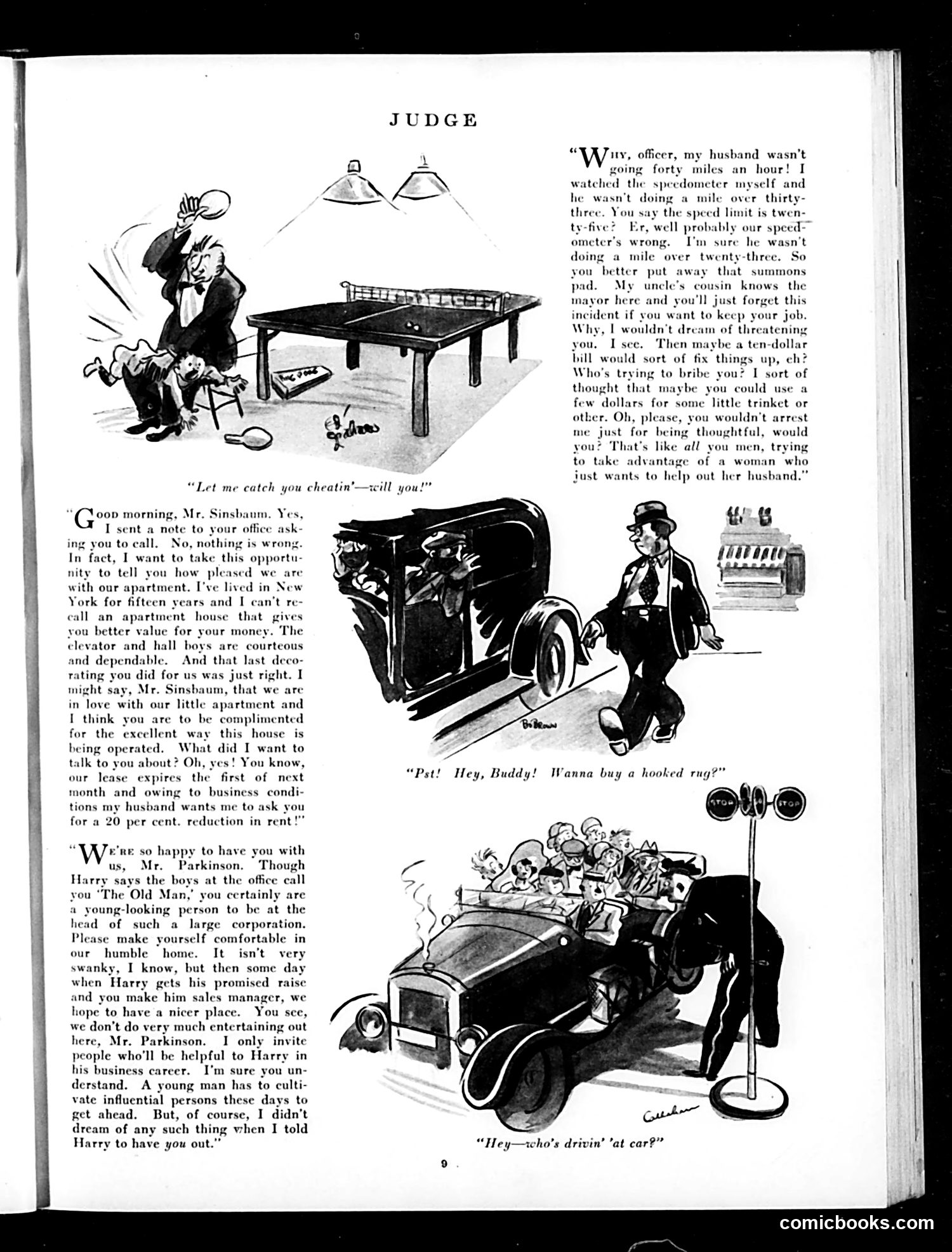
# Judge Magazine Satire Analysis This page presents three interconnected satirical scenarios mocking social manipulation and hypocrisy: 1. **The traffic stop (top)**: A woman caught speeding attempts to bribe a police officer by flattering him, claiming her speedometer is wrong, threatening his job through her uncle's connections, and finally offering money—all while maintaining she's "just being thoughtful." The satire targets women's perceived manipulation tactics and corruption of law enforcement. 2. **The landlord visit (middle left)**: A tenant lavishes praise on her landlord's apartment management, then requests a 20% rent reduction. The satire exposes transparent flattery as a negotiation tactic—praising every detail before making a financial demand. 3. **The boss dinner (bottom)**: A wife hosts her husband's boss while strategically complimenting his youth and position, subtly reminding him of promised raises and promotions. The satire reveals calculated social climbing disguised as innocent hospitality. Each scenario illustrates the same theme: people (particularly women, in Judge's perspective) using charm, flattery, and veiled threats to achieve selfish ends while maintaining false innocence.
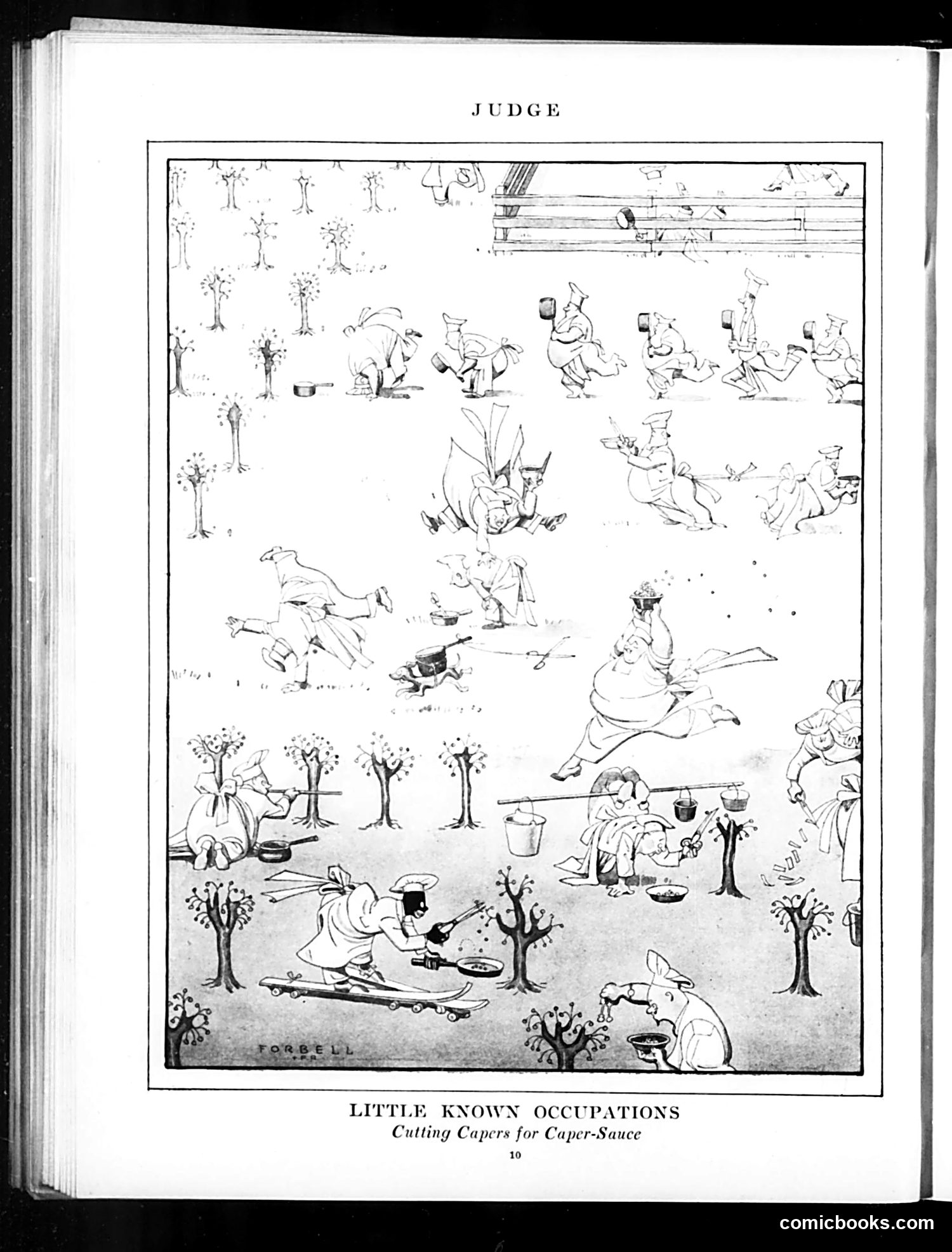
This Judge cartoon presents a visual pun on the phrase "cutting capers"—a idiom meaning to act playfully or mischievously. The illustration literally depicts people *cutting capers* (the plant used to make caper sauce, a condiment). The satire plays on the double meaning: various figures throughout a pastoral landscape are shown harvesting, preparing, and processing caper plants using exaggerated, comedic physical actions—chopping, carrying, cooking—as if engaged in an absurdly elaborate "occupation." The joke's appeal lies in the unexpected literalization of familiar language and the tongue-in-cheek suggestion that such a mundane agricultural task deserves recognition as a distinct, noteworthy profession. It's characteristic of early-20th-century magazine humor that relied on wordplay and visual puns.