
Judge, 1931-08-08 · page 24 of 36
Judge — August 8, 1931 — page 24: what you’re looking at
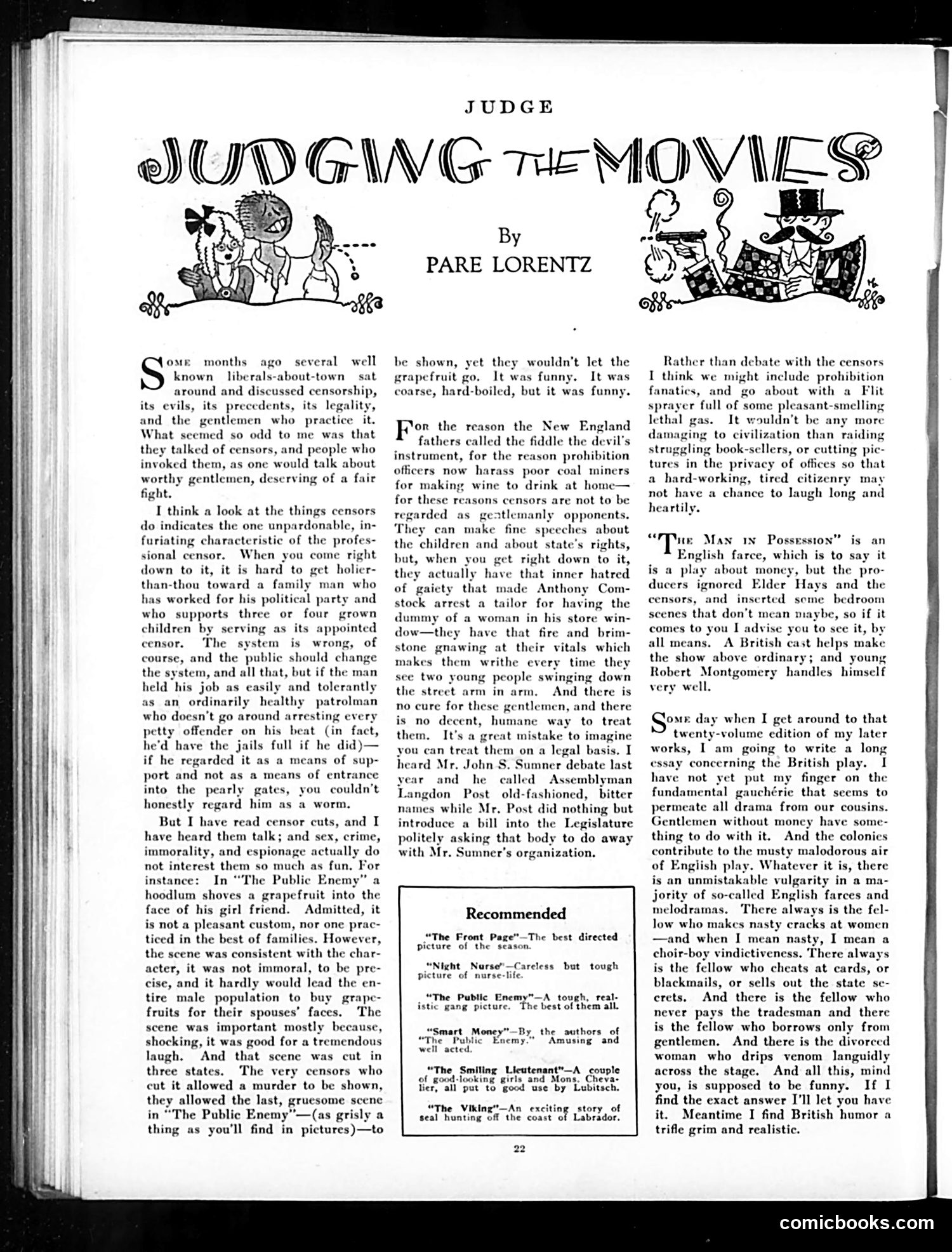
A restored page from Judge, 1931-08-08. Page through the whole issue in the reader above.
📄 Transcribed text from this page (OCR, searchable)
Machine-transcribed from the original scan — historical spelling and the odd misread are preserved.
JUVGING TEMON ome months ago several well known liberals-about-town ss around and discussed censorship, evils, its precedents, its le nd the gentlemen who p' What seemed so odd to me was that they talked of censors, and people who invoked them, as one would talk about worthy gentlemen, deserving of a fair fight. I think a look at the things censors do indicates the one unpardonable, in- furiating characteristic of the profes- sional censor. When you come right down to it, it is hard to get holier- than-thou toward a family man who has worked for his political party and who supports three or four grown children by serving as its appointed censor. The system is wrong, of course, and the public should change the system, and all that, but if the man held his job as easily and tolerantly as an ordinarily healthy patrolma who doesn’t go around arresting every petty offender on his beat (in fact, he'd have the jails full if he did)— if he regarded it as a means of sup- port and not as a means of entrance into the pearly gates, you couldn't honestly regard him as a worm. But I have read censor cuts, and I have heard them talk; and sex, crime, immorality, and espionage actually do not interest th so much as fun, instance: In ne Public Enemy hoodlum shoves a grapefruit into the face of his girl friend. Admitted, it is not a pleasant custom, nor one prac- ticed in the best of families. However, the scene was consistent with the char- acter, it was not immoral, to be pre- cise, and it hardly would lead the en- tire male population to buy grape- fruits for their spouses’ faces. The scene was important mostly because, shocking, it was good for a tremendous laugh. And that scene was cut in three states. The very censors who cut it allowed a murder to be shown, they allowed the last, in “The Public Enemy thing as you'll find in pictures) JUDGE By PARE LORENTZ be shown, yet they wouldn't let the grapefruit go. It was funny. It wa coarse, hard-boiled, but it was funny. yor the reason the New England fathers called the fiddle the devil's instrument, for the reason prohibition officers now harass poor coal miners for mak wine to drink at home— for these reasons censors are not to be regarded as geatlemanly opponents. They can make fine speeches about the children and about state's rights, but, when you get right down to it, actuall have that inner hatred Anthony Com- stock arrest a tailor for having the dummy of a woman in his store win- dow—they have that fi stone gnawing at th makes them writhe every time they see two young people swinging down the street arm in arm. And there is they is no decent, humane way to tre them, It’s a great mistake to imagine you can treat them on a legal basis. I ard Mr. John S. Sumner debate last r and he called Assemblyman Langdon Post old-fashioned, bitter nes while Mr. Post did nothing but introduce a bill into the Legislature politely asking that body to do away with Mr. Sumner’s organization. Recommended “The Front Page”—The best directed picture of the season “Night Nurse”—Careless but tough picture of nurse-life “The Public Enemy”—A tough, real- istic gang picture. The best of them all. ‘Smart Money”—By the authors of The Public Enemy.” Amusing and well acted “The Smiling Licutenant"—A couple of good-looking girls and Mons. Cheva- lier, all put to good use by Lubitsch, “The Viking"—An exciting story of seal hunting off the coast of Labrador. 8 8 LS Rather than debate with the censors I think we might include prohibition fanatics, and go about with a Flit sprayer full of some pleasant-smelling lethal gas. It wouldn’t be any more damaging to civilization than raid struggling book-sellers, or cutting pi tures in the privacy of offices so that a hard-working, tired citizenry may not have a chance to laugh long and heartily. fue Man In Possesston” is an English farce, which is to say it is a play about moncy, but the pro- ducers ignored Elder Hays and the censors, and inserted seme bedroom nes that don’t mean maybe, so if it comes to you I advise you to sce it, by all means. A British cast helps make the show above ordinary; and young Robert Montgomery handles himself very well, S™ ® day when I get around to that twenty-volume edition of my later works, I am going to write a long y concerning the British play. I have not yet put my finger on the fundamental gauchérie that seems to permeate all drama from our cousins. Gentlemen without money have some- thing to do with it. And the colonics contribute to the musty malodorous air of English play. Whatever it is, there is an unmistakable vulgarity in a ma- jority of so-called English farces and melodramas. There always is the fel- low who makes nasty cracks at women —and when I mean nasty, I mean a choir-boy vindictiveness. There always is the fellow who cheats at cards, or blackmails, or sells out the state se- erets. And there is the fellow who never pays the tradesman and there is the fellow who borrows only from gentlemen. And there is the divorced woman who drips venom languidly across the stage. And all this, mind you, is supposed to be funny. If I find the exact answer I'll let you have it. Meantime I find British humor a trifle grim and realistic. comicbooks.com