
Judge, 1931-08-08 · page 15 of 36
Judge — August 8, 1931 — page 15: what you’re looking at
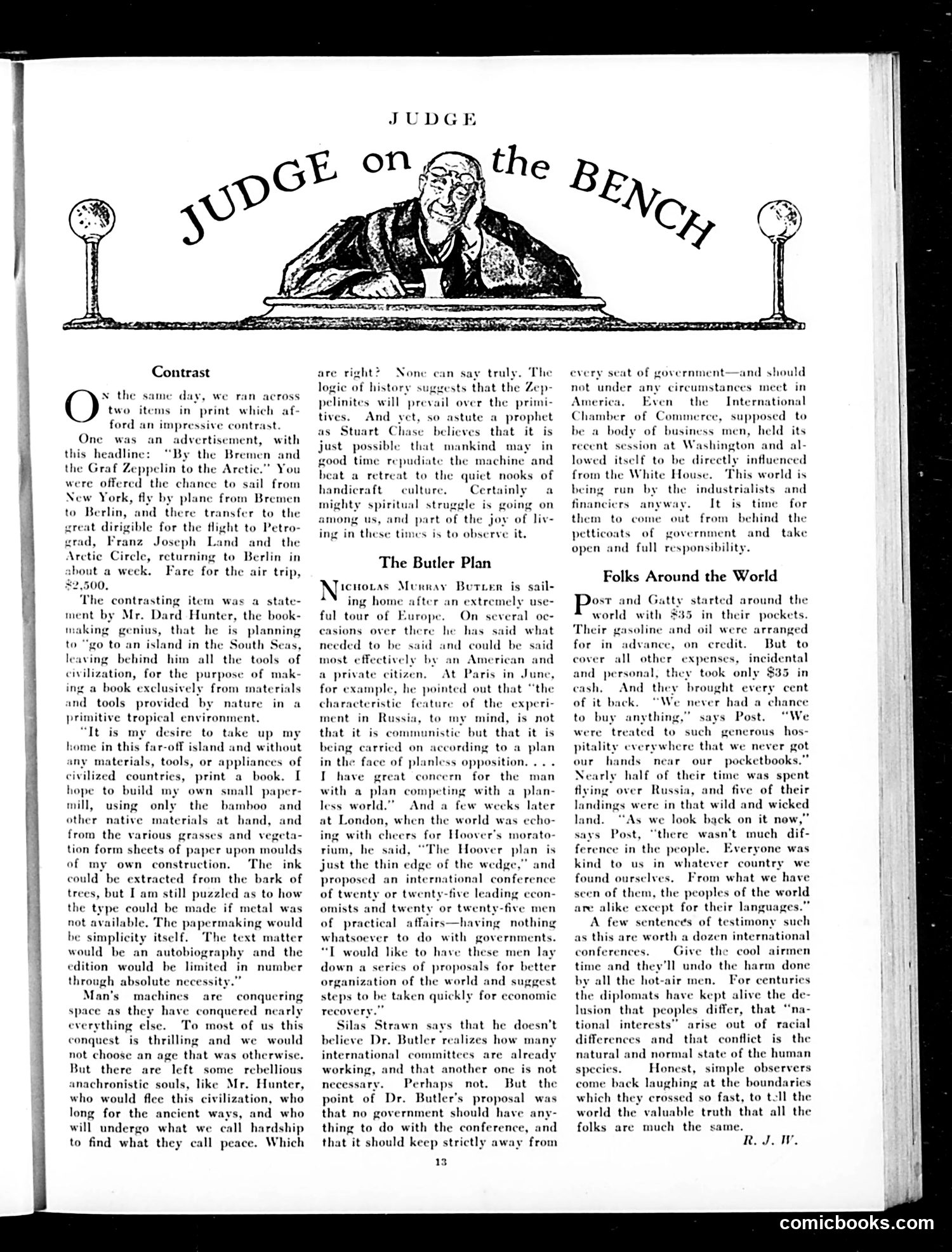
A restored page from Judge, 1931-08-08. Page through the whole issue in the reader above.
📄 Transcribed text from this page (OCR, searchable)
Machine-transcribed from the original scan — historical spelling and the odd misread are preserved.
| | Contrast across x the same day, we ran O two items in print which af- ford an impressive contrast. One was an advertisement, with this headline: “By the Bremen and the Graf »pelin to the Arctic.” You were offered the chance to sail from New York, fly by plane from Bremen to Berlin, and there transfer to the great dirigible for the flight to Petro- grad, Franz Joseph Land and the Arctic Circle, returning to Berlin in out a week. Fare for the air trip, 2,500. The contrasting item was a state- ment by Mr. Dard Hunter, the book- making genius, that he is’ planning to “go to an island in the South Seas, leaving behind him all the tools of civilization, for the purpose of mak- ing a book exclusively from materials and tools provided by nature in a primitive tropical environment. “It is my desire to take up my home in this far-off island and without any materials, tools, or appliances of civilized countries, print a book. [ hope to build my own small paper- mill, using only the bamboo and other native materials at hand, and from the various grasses and vegeta- tion form sheets of paper upon moulds of my own construction. The ink could be extracted from the bark of trees, but I am still puzzled as to how the type could be made if metal was not available. The papermaking would be simplicity itself. The text matter would be an autobiography and the edition would be limited in number through absolute necessity Man's machines are space as they have everything else. To most of us this conquest is thrilling and we would not choose an age that was otherwise. But there are left some rebellious anachronistic souls, like Mr. Hunter, who would flee this civilization, who long for the ancient ways, and who will undergo what we call hardship to find what they call peace. Which conquering conquered nearly JUDGE are right? None can say truly, The logic of history suggests that the Zep- pelinites will ‘prevail over the primi- tives. And yet, so astute a prophet as Stuart Chase believes that it is just possible that mankind may in good time repudiate the machine and beat a retreat to the quiet nooks of handicraft culture. Certainly a mighty spiritual struggle is going on among us, and part of the joy of liv- ing in these times is to observe it, The Butler Plan Nicuozas Mernay Butcen is sail- ing home after an extremely use- ful tour of Europe. On several oc- casions over there he has said what needed to be said and could be said most effectively by an American and a private citizen. At Paris in June, for example, he pointed out that “the characteristic feature of the experi- ment in Russia, to my mind, is not that it is communistic but that it is being carried on according to a plan in the face of planless opposition. . . . I have great concern for the man with a plan competing with a plan- less world.” And a few weeks later at London, when the world was echo- ing with cheers for Hoover's morato- rium, he said, “The Hoover plan is just the thin edge of the wedge,” and proposed an international conference of twenty or twenty-five leading econ- omists and twenty or twenty-five men of practical affairs—having nothing whatsoever to do with governments. “L would like to have these men lay down a series of proposals for better organization of the world and suggest steps to bi n quickly for economic recovery Silas Strawn says that he doesn’t believe Dr. Butler realizes how many international committees are already working, and that another one is not necessary. Perhaps not. But the point of Dr. Butler's proposal was that no government should have any- thing to do with the conference, and that it should keep strictly away from 13 every seat of government—and should not under any circumstances meet in Ameri Even the — International Chamber of Commerce, supposed to be a body of business men, held its recent session at Washington and al- lowed itself to be directly influenced from the White House. This world is being run by the industrialists and financiers anyway. It is time for them to come out from behind the petticoats of yovernment and take open and full responsibility. Folks Around the World Pe and Gatty started around the world with $35 in their pockets. Their gasoline and oil were arranged for in advance, on credit. But to cover all other expenses, incidental nd personal, they took only $35 in ash, And they brought every cent of it back. “We never had a chance to buy anything,” Post. “We were treated to such generous hos- pitality everywhere that we never got our hands near our pocketbooks.” ‘arly half of their time was spent over Rus’ and five of their says and. “As we look back on it now, Post, “there wasn't much dif- ference in the people. Everyone was kind to us in whatever country we found ourselves. From what we have scen of them, the peoples of the world ar alike except for their languages.” A few sentences of testimony such as this are worth a dozen international conferences. Give the cool airmen time and they'll undo the harm done by all the hot-air men. For centuries the diplomats have kept alive the de- lusion that peoples differ, that ‘n tional interests” arise out of racial differences and that conflict is the natural and normal state of the human species. Honest, simple observers come back laughing at the boundaries which they crossed so fast, to tell the world the valuable truth that all the folks are much the same. R.JLW. says comicbooks.com