A complete issue · 36 pages · 1931
Judge — July 11, 1931
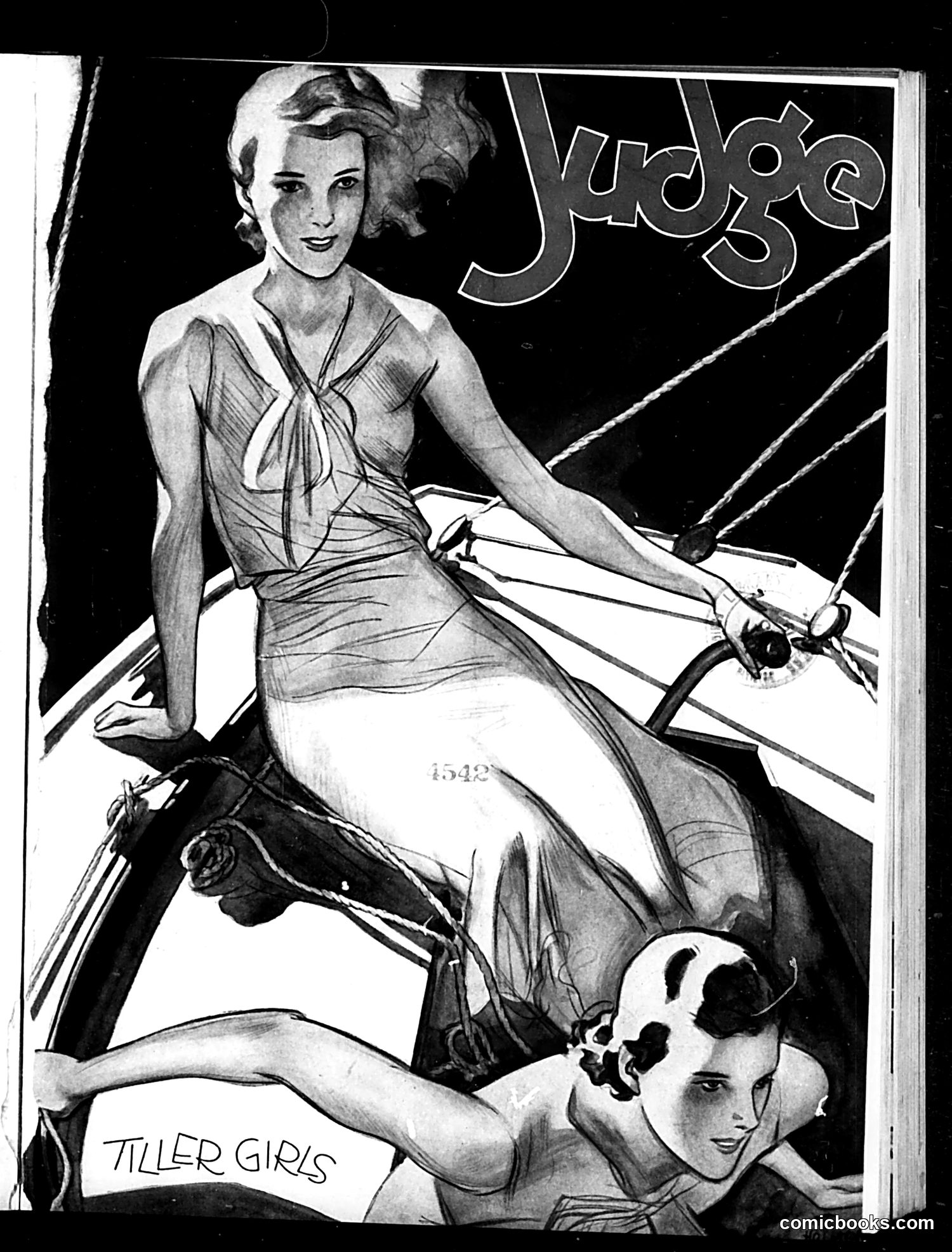
# Analysis This appears to be a cover or advertisement page from *Judge* magazine featuring an illustration labeled "Tiller Girls." The image shows two women in 1920s-style clothing posed with what appears to be an airplane or aircraft in the background. The "Tiller Girls" were a famous precision dance troupe from the 1920s-1930s known for synchronized choreography. The satire likely plays on the contrast between the modern, somewhat risqué femininity of the dancers (shown in their fashionable, form-fitting dress) and the technical/mechanical world of aviation visible behind them. The specific satirical point—whether commentary on modern women, aviation, entertainment, or some combination—remains unclear without additional context or readable body text from the page.

# Analysis This is a **straightforward advertisement**, not satire or political commentary. It's a vintage Dentyne chewing gum ad, likely from the 1920s-1930s based on styling and typography. The page features a smiling man's portrait endorsing Dentyne gum as a product that "keeps teeth white." The ad argues that white teeth are essential for success, claiming they win friends and charm. It emphasizes that Dentyne's special formulation helps maintain teeth whiteness while the gum's texture provides "healthful exercise" for gums. The tagline "Chew Dentyne...and smile!" is the core sales pitch. This represents typical early-20th-century advertising that linked personal grooming to social and professional success—a common marketing strategy of the era.
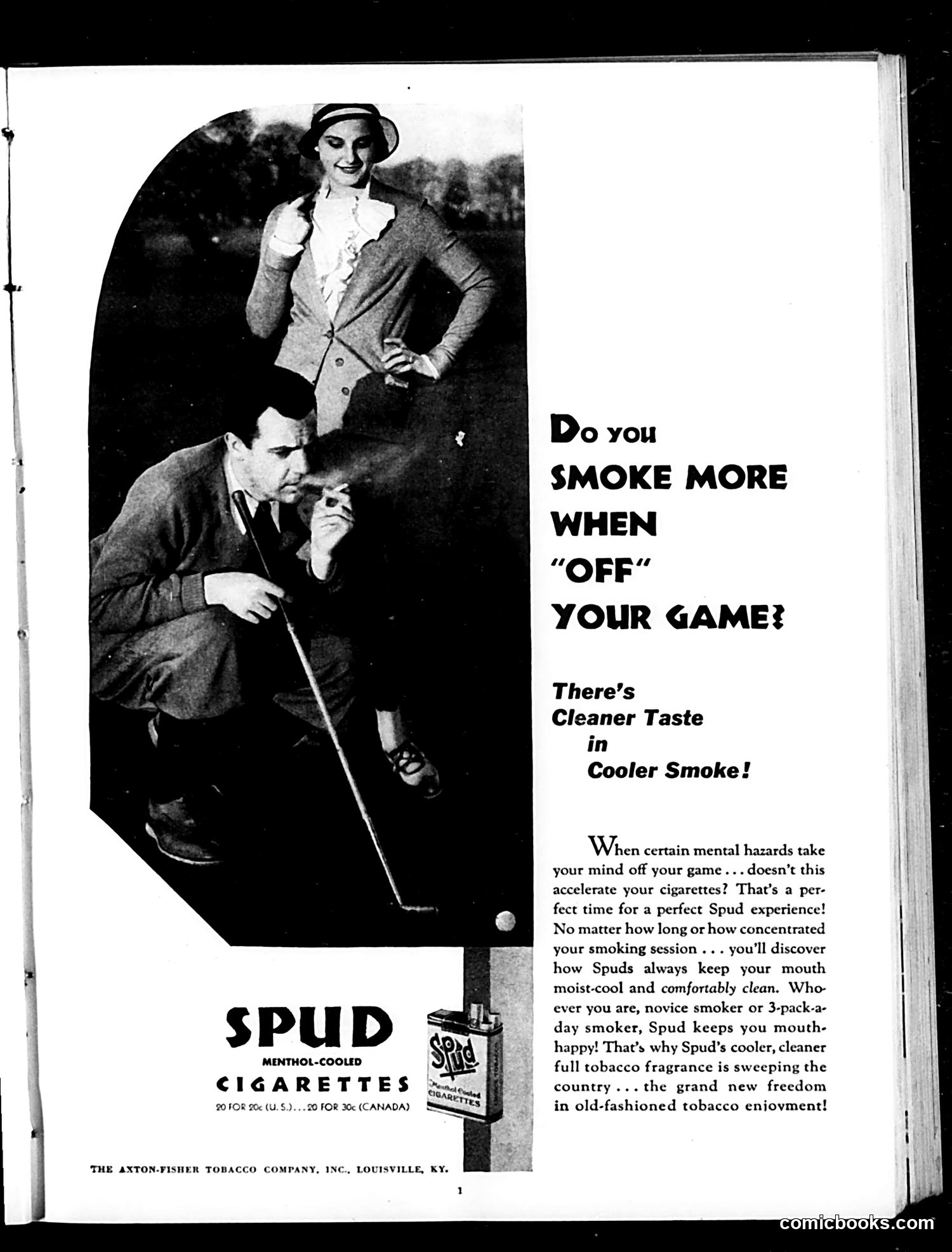
# Analysis This page is primarily a **cigarette advertisement**, not satire or political commentary. It advertises Spud menthol-cooled cigarettes, made by the Axton-Fisher Tobacco Company in Louisville, Kentucky. The ad features two figures—a man playing golf and a woman watching—illustrating the marketing pitch: smokers consuming more cigarettes during stressful moments (like a poor golf game) should switch to Spud's "cooler" menthol cigarettes for a "cleaner taste" and "moist-cool" comfort. The claim that Spud's "full tobacco fragrance is sweeping the country" appears designed to position the brand as modern and popular. This reflects early-20th-century tobacco marketing before health warnings were required. The ad targets both "novice" and heavy smokers.
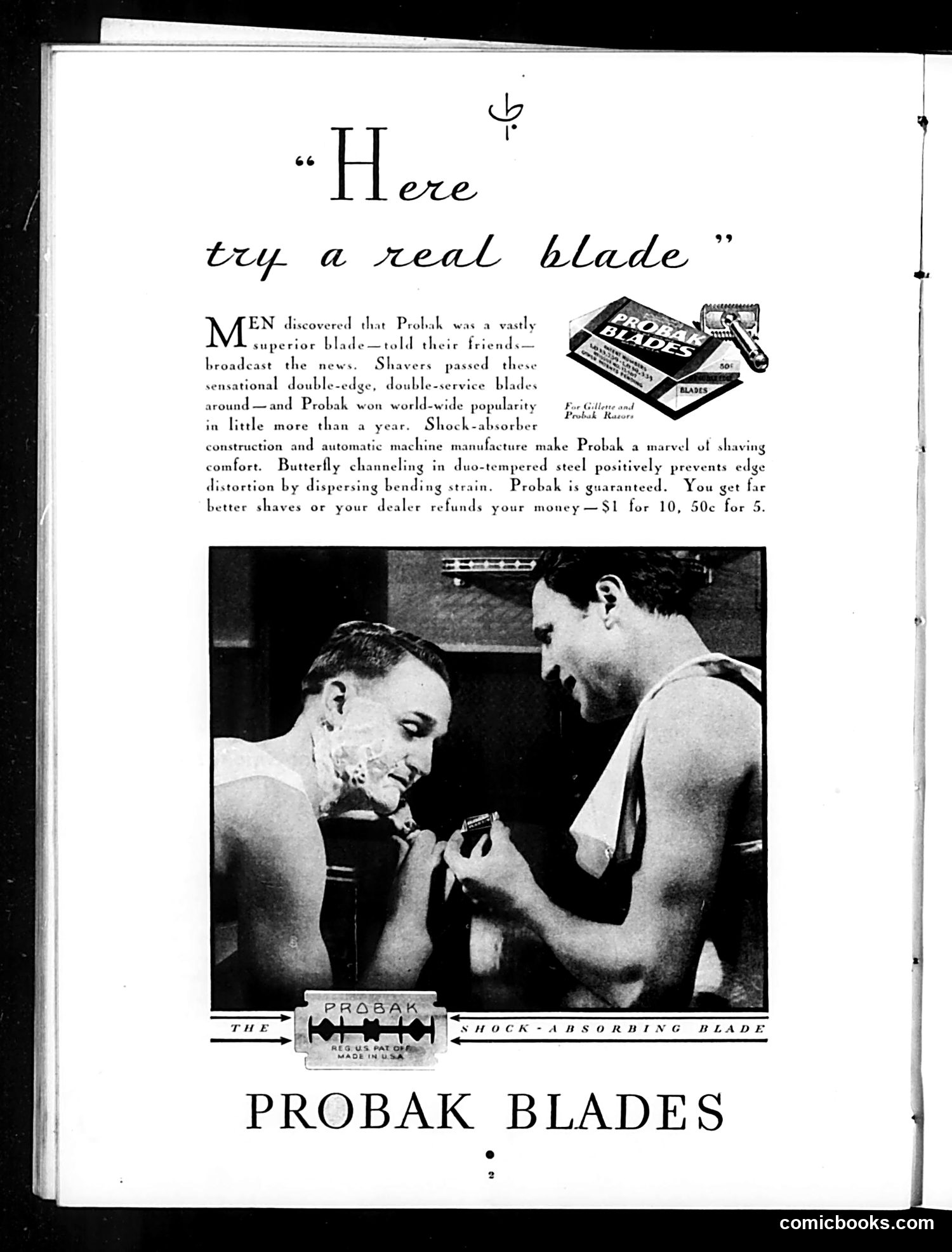
# Analysis This page is **primarily an advertisement**, not satire or a political cartoon. It advertises Probak razor blades, a real brand that achieved commercial success around the early 1920s. The ad's headline—"Here try a real blade"—emphasizes the product's superior quality. The text claims Probak blades won "world-wide popularity in little more than a year" due to their shock-absorbing construction and machine manufacture, which prevented edge distortion. The photograph shows two men in a barbershop setting, demonstrating the blade's performance. The pricing ($1 for 10 blades, 50¢ for 5) and guarantee ("You get far better shaves or your dealer refunds your money") were typical sales tactics of the era. This is straightforward product marketing, not editorial content requiring historical context for modern readers.
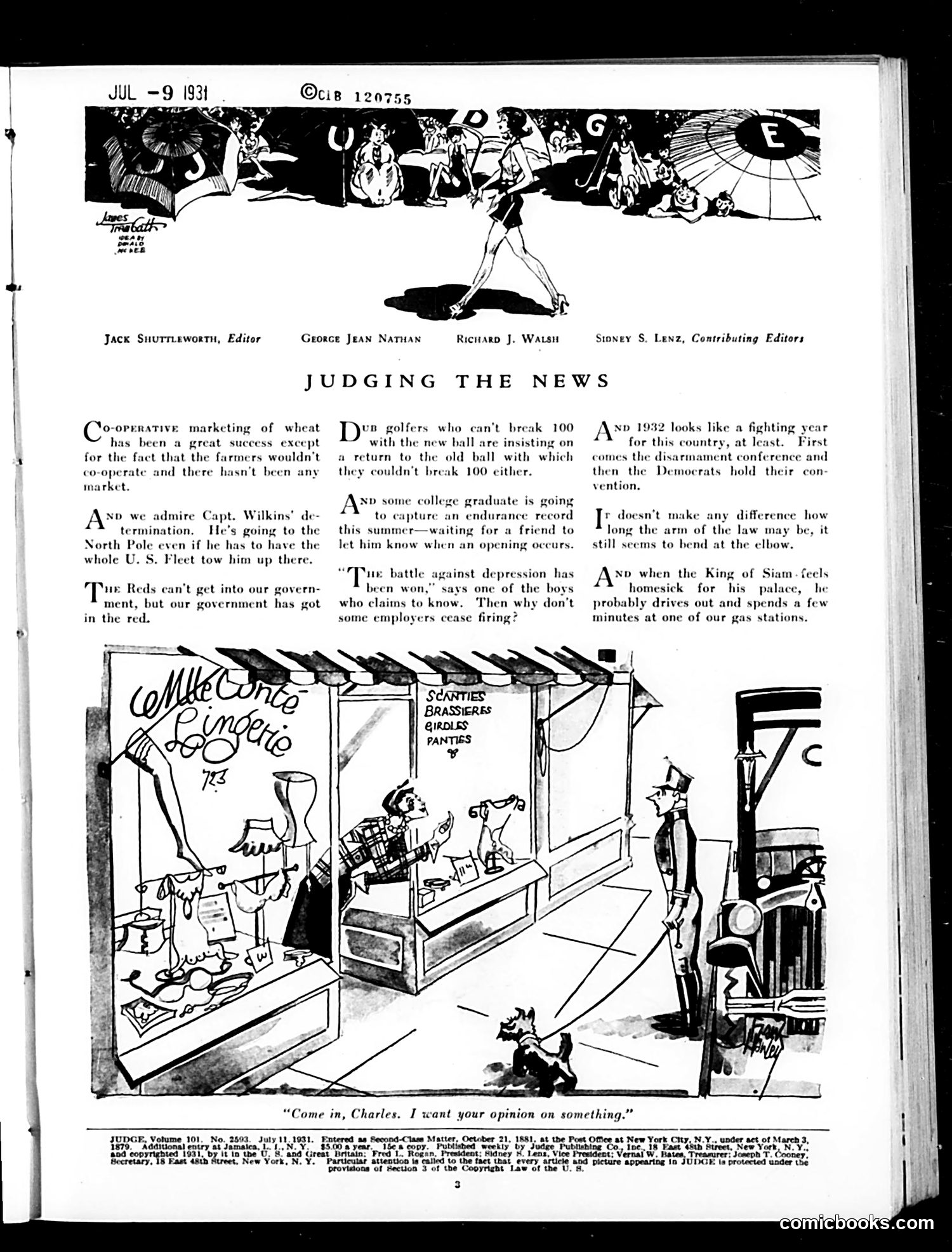
# Analysis of Judge Magazine, July 9, 1931 The main cartoon depicts a street scene with shop windows displaying women's intimate apparel ("Corsets, Brassières, Girdles, Panties"). A well-dressed man in a top hat and monocle stands outside, addressing a dog, saying "Come in, Charles. I want your opinion on something." The satire targets the absurdity of seeking a dog's opinion on women's lingerie—likely mocking either male fashion commentators of the era who presumed expertise on women's clothing despite having no legitimate basis for it, or more broadly, ridiculous consumer advice culture. The figure's exaggerated formal dress and monocle suggest pretension. The surrounding editorial section "Judging the News" contains brief political commentary typical of Judge's satirical content from the Depression era.
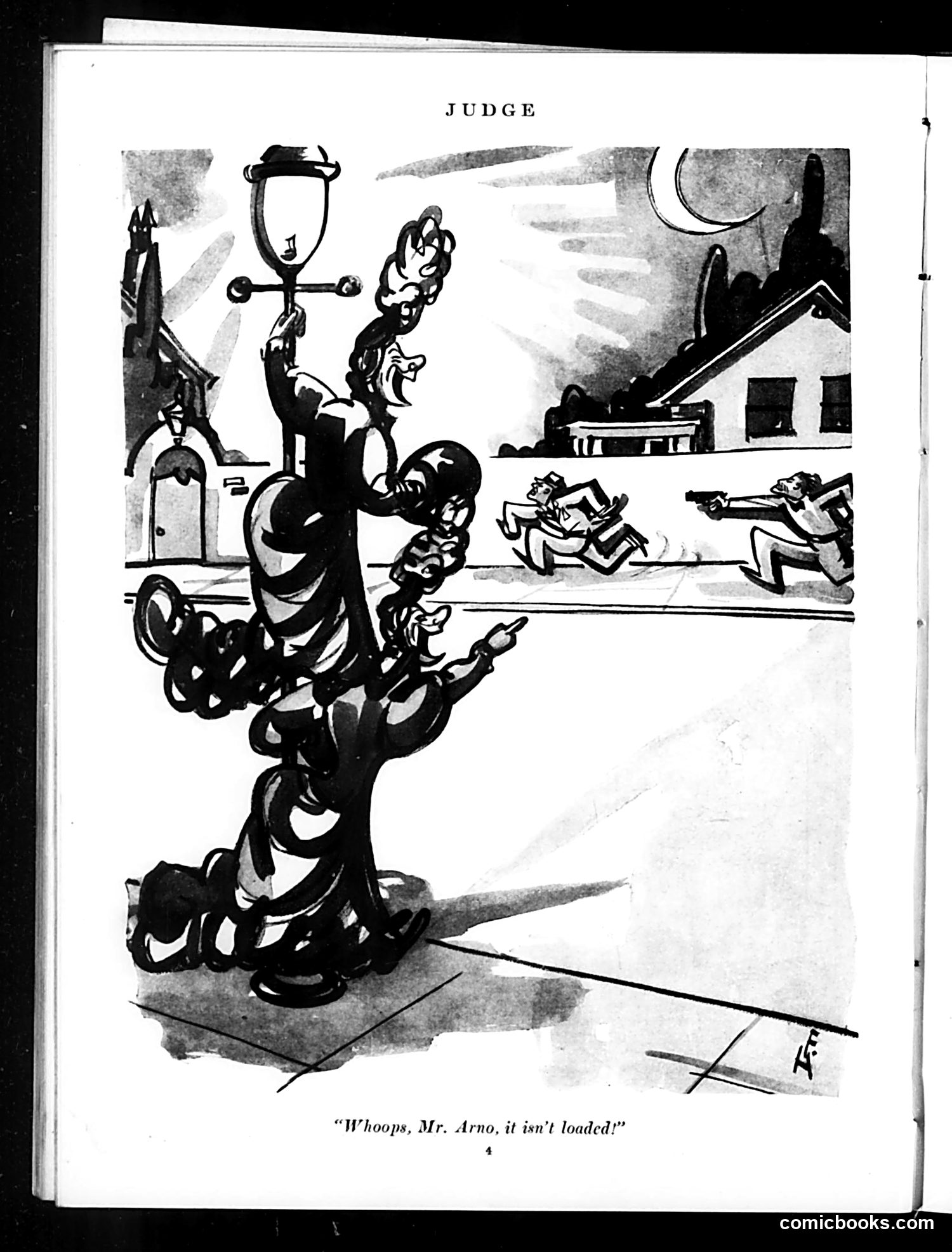
# Analysis of "Judge" Cartoon Page This satirical cartoon depicts a judge character juggling various implements of justice—including scales, a gavel, and what appears to be legal documents or warrants. The caption reads: "Whoops, Mr. Arno, it isn't loaded!" The joke appears to satirize judicial incompetence or the precarious state of law enforcement. The juggling act suggests the judge is barely managing his responsibilities, while the reference to something not being "loaded" (likely a weapon or tool) implies he's unprepared or ineffectual in administering justice. In the background, small figures appear to be fleeing or in distress, suggesting criminals escaping due to judicial failure. This reflects common Progressive Era critiques of corruption or incompetence in the legal system. Without specific dating, the exact target remains unclear, though it likely comments on contemporary judicial scandals or reform debates.
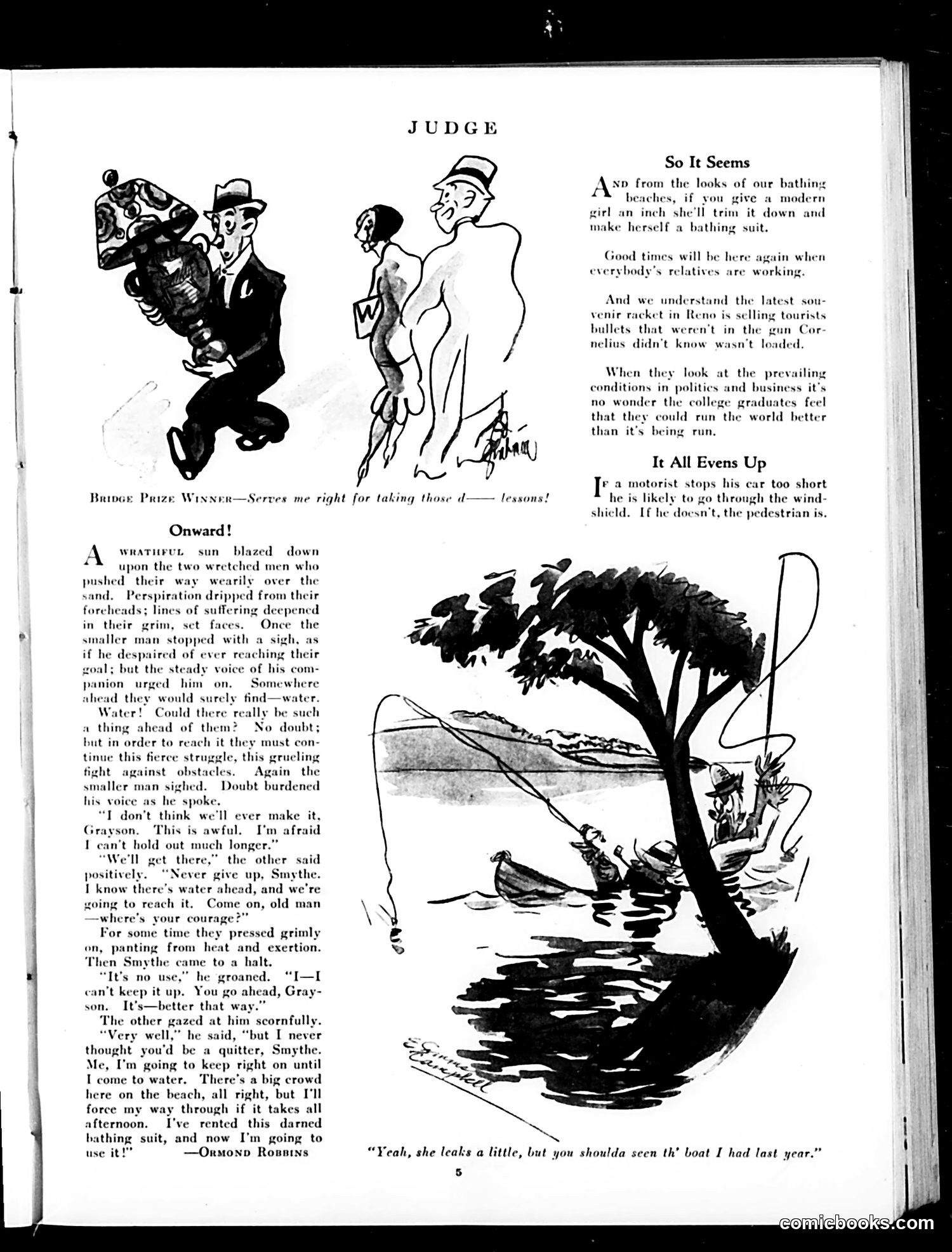
# Judge Magazine Page Analysis This page contains three separate humorous pieces: 1. **"Bridge Prize Winner"** (top): A cartoon showing two men struggling across sand, one carrying what appears to be a heavy object. The caption references "lessons," suggesting satire about bridge (the card game) competitions or prizes—likely mocking competitive bridge culture. 2. **"Onward!"** (left): A story excerpt about two men in a desert struggling toward water. This appears to be satirizing overly dramatic or melodramatic adventure fiction popular in the era. 3. **"It All Evens Up"** and **"So It Seems"** (right): Brief satirical commentary pieces on modern life—bathing suits, business conditions, and motorist behavior—typical of Judge's social commentary style. The bottom illustration shows a beach/water scene with boats, accompanying a caption about someone's boat from "last year," likely satirizing vacation mishaps or boasting.
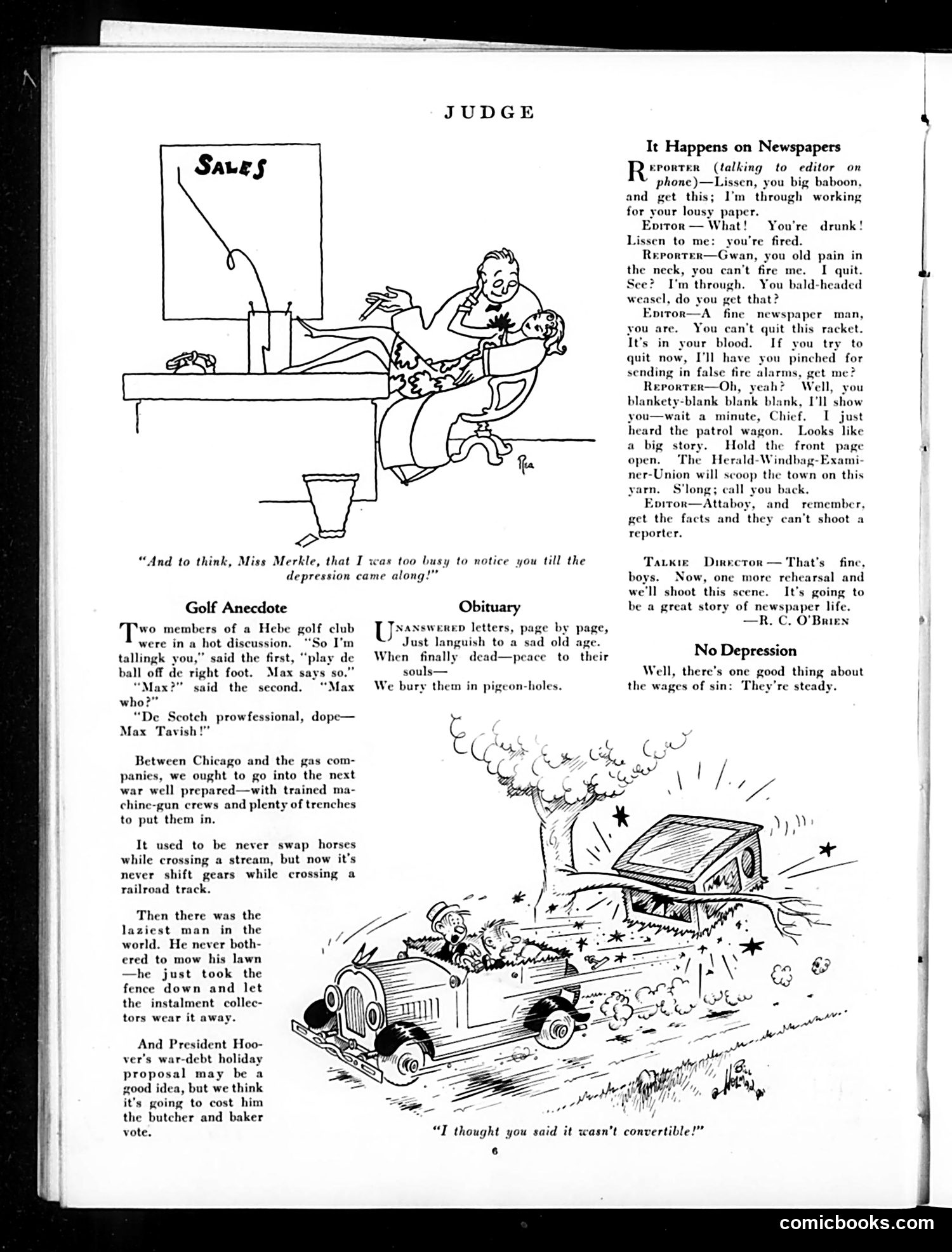
# Analysis of Judge Magazine Page This page contains three separate humor pieces: **"It Happens on Newspapers"** depicts a confrontation between a newspaper editor and reporter. The editor fires the reporter for being drunk, but the reporter refuses to quit, claiming newspaper work is "in your blood" and threatening to expose the editor's misconduct (false fire alarms, etc.). The satire mocks the chaotic, ethically-questionable nature of early newspaper operations and the combative relationships between editors and staff. **"Golf Anecdote"** is a brief joke about two golfers discussing who's the better player—it references "Max Tavish," likely a known golfer of the era. **"No Depression"** shows a car crashing into a house after hitting a tree, with the caption "I thought you said it wasn't convertible!" The humor plays on the word "convertible" (a car with a removable roof) versus the literal conversion of a closed vehicle into an open one through disaster.
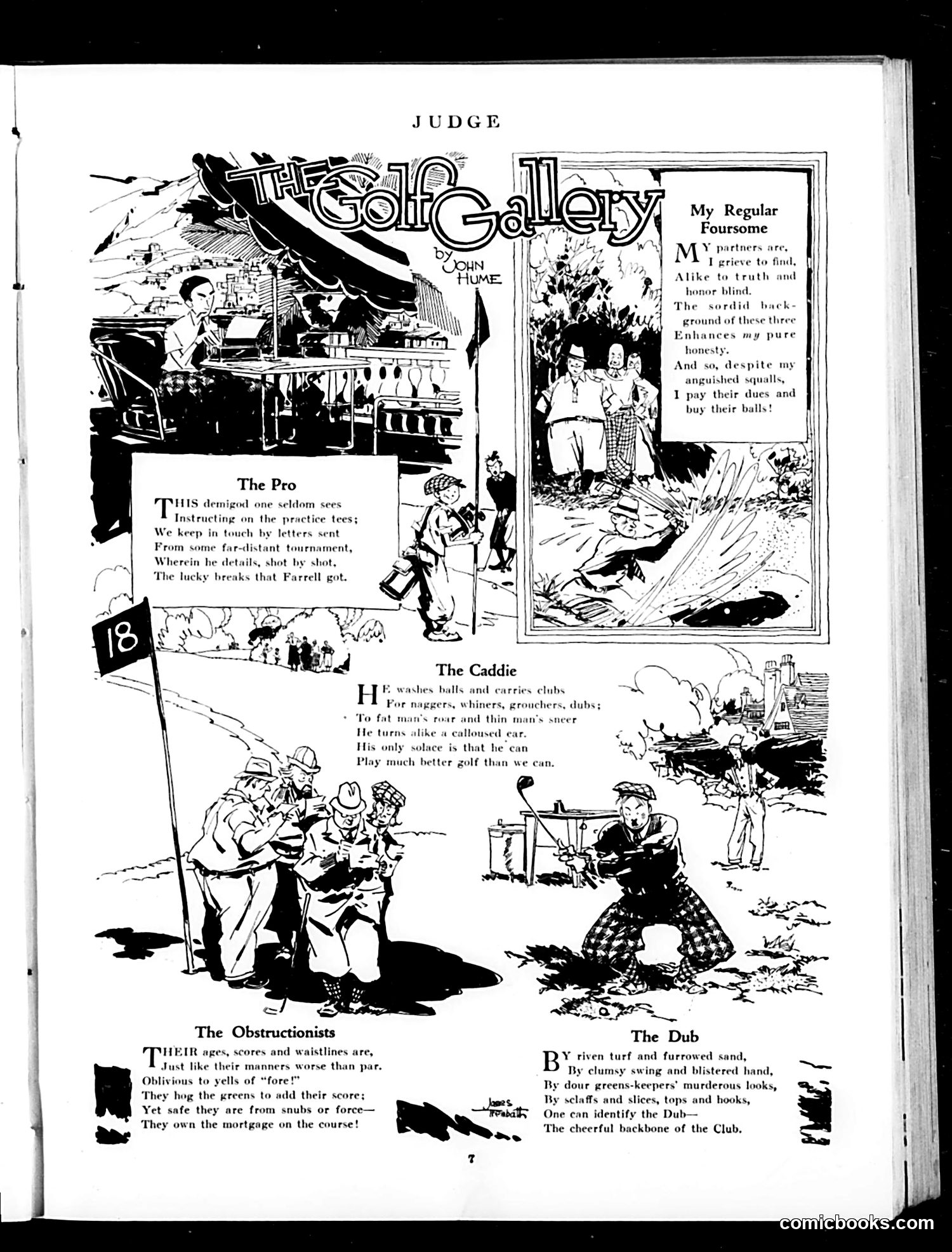
# "The Golf Gallery" by John Hume This page satirizes different types of golfers through character sketches. "The Pro" depicts golf instructors who rarely play but profit from lessons. "The Caddie" portrays the long-suffering caddy who watches incompetent players yet plays better himself. "The Obstructionists" mocks slow players who hog the greens and complain loudly. "The Dub" stereotypes the poor golfer with bad technique but good humor. The sidebar "My Regular Foursome" presents a narrator who acknowledges his playing partners are dishonest and dishonorable, yet he subsidizes them anyway—suggesting satirical commentary on social obligation and class dynamics in early 20th-century golf clubs, where membership often involved tolerating unpleasant companions for social standing.
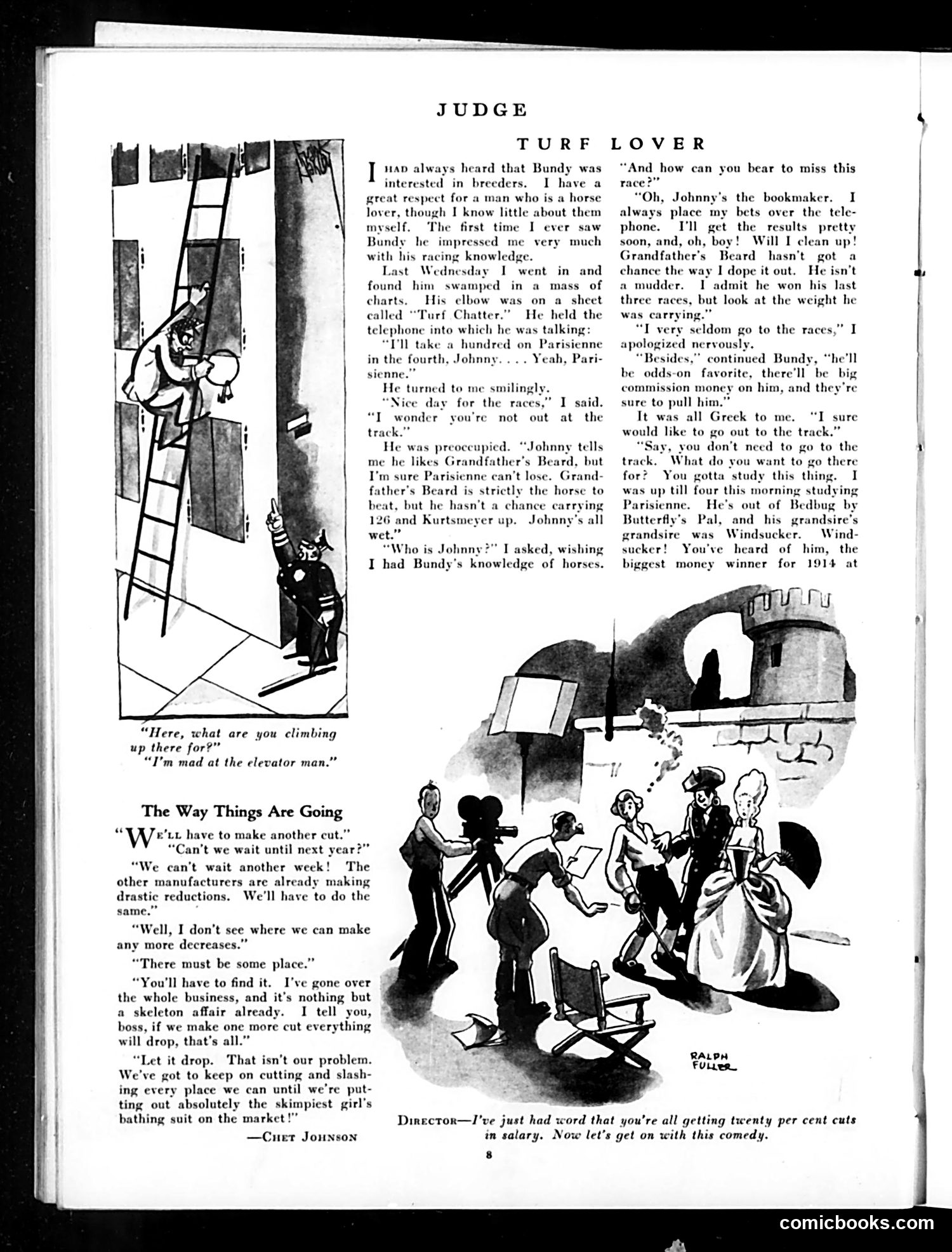
# Judge Magazine Page Analysis This page contains two satirical pieces typical of early 20th-century Judge magazine humor. **"Turf Lover"** mocks horse racing obsession and gambling. A character named Bundy, presented as a horse breeding enthusiast, is revealed to be placing bets through a bookmaker ("Johnny") via telephone. The narrator—initially impressed by Bundy's supposed expertise—discovers Bundy's "knowledge" is actually gambling jargon about odds, weights, and suspicious practices ("they're sure to pull him" suggests race-fixing). The joke: Bundy's respectable horse-lover persona masks compulsive gambling addiction. **"The Way Things Are Going"** satirizes Depression-era cost-cutting in manufacturing. Executives demand relentless budget reductions despite already operating at skeleton crew levels. The punchline—they'll eventually produce "the skimpiest girl's bathing suit on the market"—suggests absurd, counterproductive downsizing: cutting costs so aggressively that products become worthless. This reflects real economic pressures of the 1920s-30s period when manufacturers competed through cost reduction rather than innovation. Both pieces critique contemporary American business culture: gambling addiction masquerading as expertise, and corporate short-sightedness.
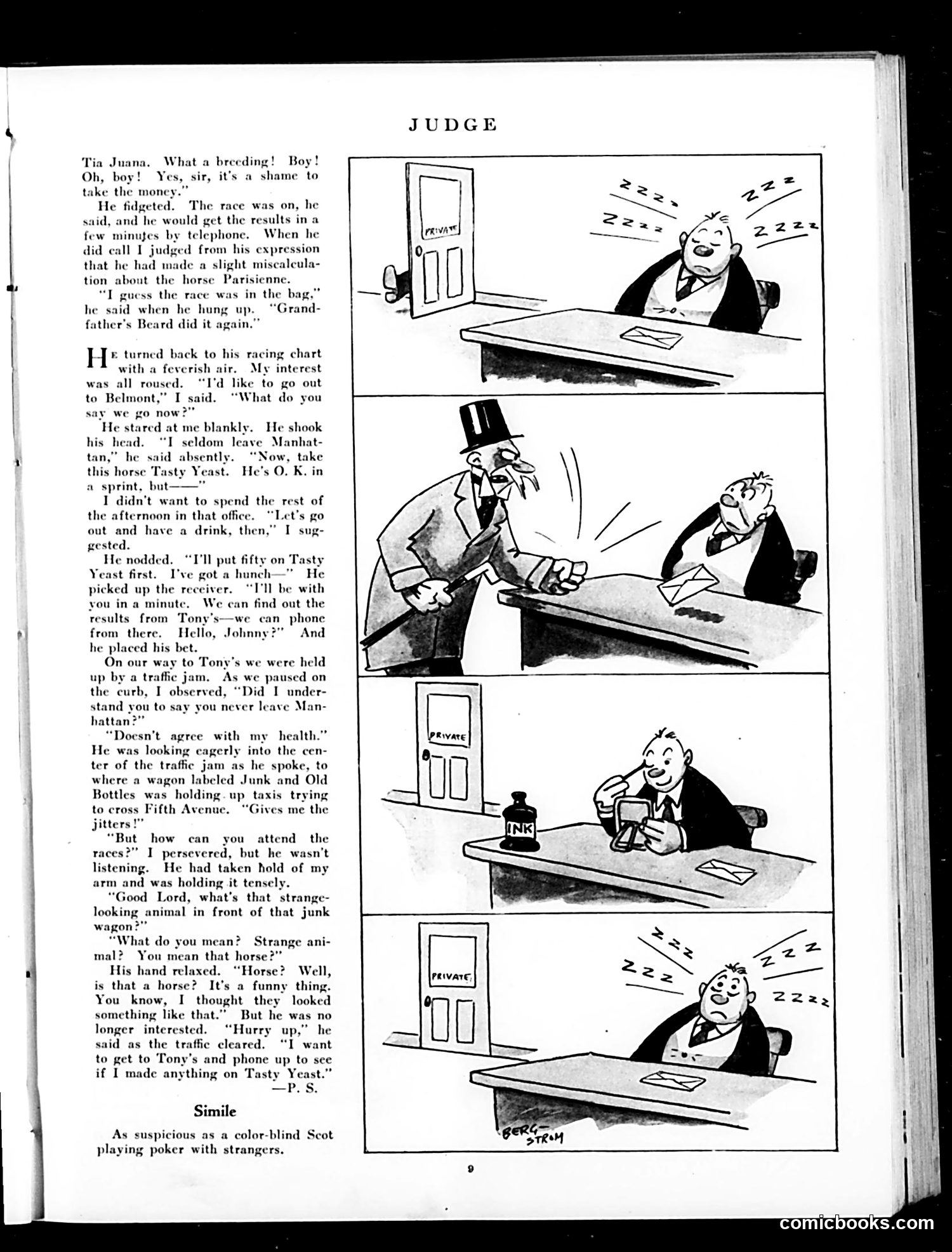
# Judge Magazine: "Judge" (Betting Obsession Satire) This page satirizes a compulsive horse-racing gambler through a humorous narrative and accompanying comic strip. The unnamed protagonist is so addicted to placing bets that he claims never leaving Manhattan due to health concerns—yet is obsessively glued to racing results, constantly phoning in bets and checking outcomes. The joke culminates when a decrepit junk wagon horse appears in a traffic jam. The gambler, initially alarmed by the "strange animal," relaxes upon learning it's a horse, revealing his singular focus: *only* racehorses register as interesting to him. Real horses pulling actual work are invisible; only racing horses matter. The closing simile compares his suspicious anxiety to "a color-blind Scot playing poker with strangers"—a period ethnic stereotype suggesting paranoid irrationality. The satire mocks the era's widespread gambling culture and its dehumanizing effect on addicts, rendering them oblivious to ordinary reality.
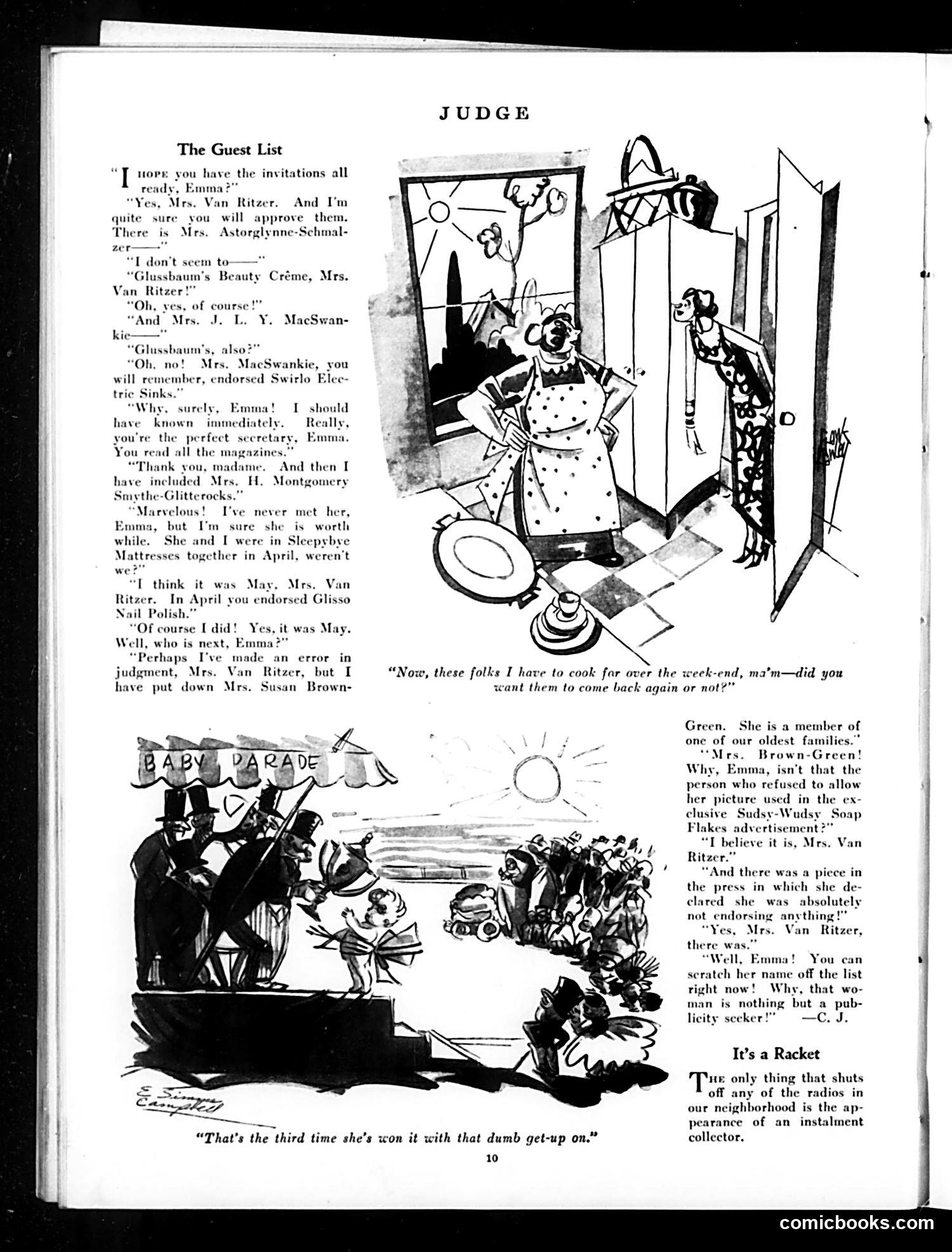
# Judge Magazine Satire Analysis This page satirizes **wealthy women's obsession with celebrity endorsements** in the 1920s-30s advertising era. **Main cartoon ("The Guest List"):** Mrs. Van Ritzer, a society matron, reviews her dinner guest list with her maid Emma. The humor centers on Van Ritzer's discovery that every potential guest is a product endorser—Glussbaum's Beauty Créme, Sudsy-Wudsy Soap Flakes, etc. When she learns Mrs. Susan Brown-Green *refused* to endorse a product, Van Ritzer calls her a "publicity seeker" and removes her from the list—ironically revealing that Van Ritzer herself judges people by their commercial value, not character. **Secondary cartoon ("Baby Parade"):** Shows a parade of endorsing women with products, emphasizing how ubiquitous celebrity testimonials had become. **"It's a Racket" sidebar:** Comments on installment collectors—suggesting these endorsement-obsessed women are living beyond their means on credit. The satire critiques how advertising had colonized social life and status, reducing society women to walking advertisements.