
Judge, 1931-07-11 · page 15 of 36
Judge — July 11, 1931 — page 15: what you’re looking at
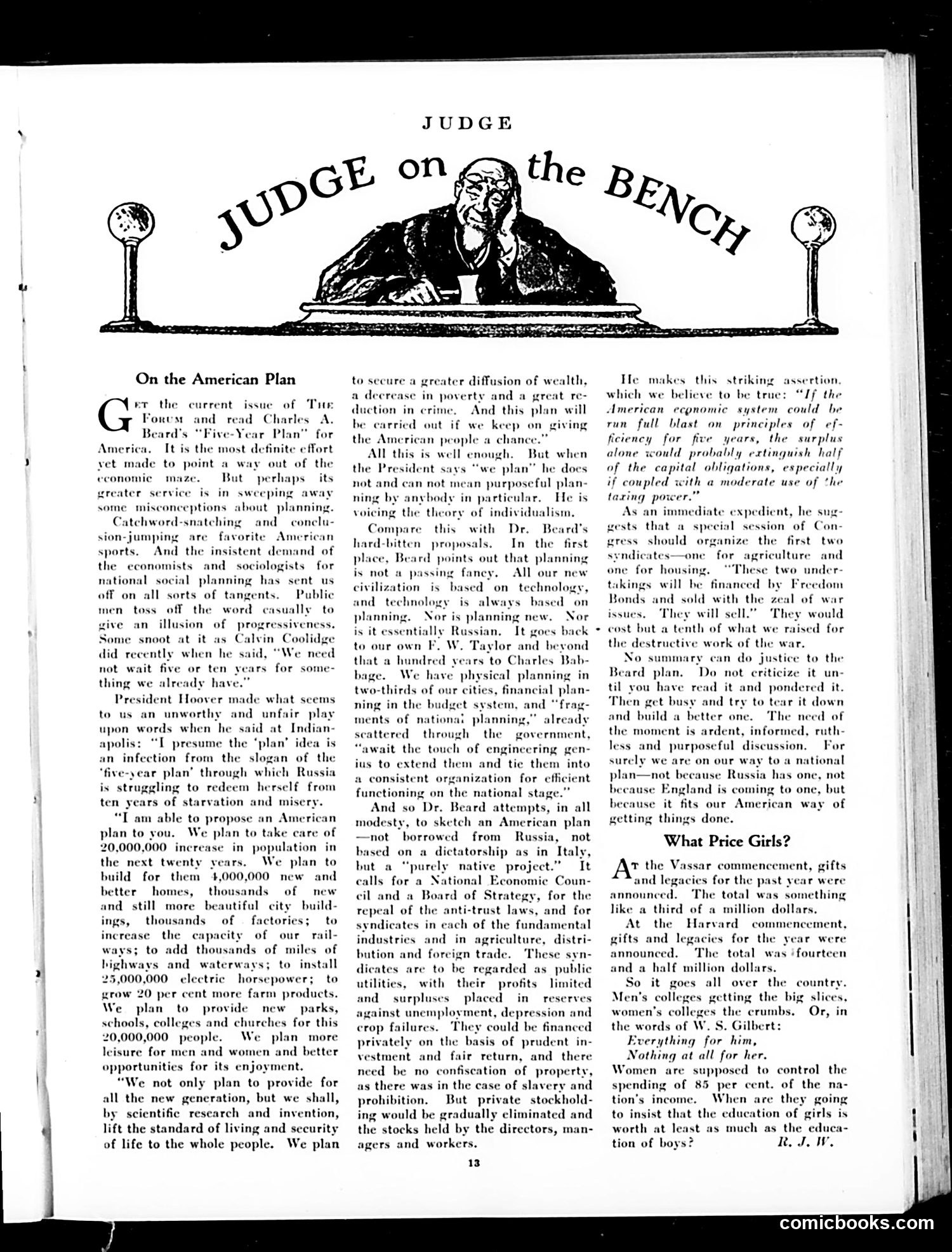
A restored page from Judge, 1931-07-11. Page through the whole issue in the reader above.
📄 Transcribed text from this page (OCR, searchable)
Machine-transcribed from the original scan — historical spelling and the odd misread are preserved.
On the American Plan “Five-Year PL It is the most definite effort yet made to p greater servic ptions about plan Catchword-snatching sion-jumping are And the insistent demand of national social planning has sent us off on all sorts of tangents. men toss off the word casually to tly when he said, “We need it five or ten years for some- lready have.’ President Hoover made what seems nd unfair play upon words whe ime the ‘plan’ id which Russia m herself from n and miser: -year plan’ throug! is struggling to rede ars of starva “T am able to propose an Ame n to take care plan to you. 20,000,000 incr the next twenty years. We plan to d still more beautiful city build- aps to add thous. highways and w ands of miles of horsepower; grow 20 per cent more farm products. schools, colleges and churches for this 20,000,000 people. leisure for men opportunities for its enjoy We plan more n and better “We not only plan to provide for all the new generation, but we shall, by scientific research and invention, lift the standard of living and security of life to the whole people. JUDGE a decrease in poverty and a grea duction in crime. And this pl ried out if we k » American peaple a chance.” All this is well enough. But when the President says “we plan” he de not and can not mean purposeful y ning by anybody in particular. I voicing the theory of individualism, this with Dr. B hard-bitten proposals. In the first place, Beard points out that planning is not a passing faney. All our new civilization is based’ on technology, t » will yon giving Compare ards and technology is always based on or is planning new. Nor is it essentially Russian. It goes back to our own F, W. Taylor and beyond that a hundred years to Charles Bab- We have physical plannin two-thirds of our cities, financial plan- bage. ning in the budget system, and “fr: ments of national planning,” already ttered through the government, ait the touch of engineering gen- ius to extend them and tie them into a consistent organiz for efficient functioning on the r al stage. And so Dr. Beard attempts, in a modesty, to sketch an American plan —not borrowed from Russia, not based on a dictatorship as in Italy, but a “purely nati j it ation io nd for nental and in agriculture, distri- bution and foreign trade. dicates are to be regarded as public utilities, with their profits limited and surpluses placed in reserves against unemployment, depression and crop failures. They could be financed privately on the basis of prudent in- vestment and fair return, and there need be no confiscation of property, as there was in the case of slavery and prohibition, But private stockhold- ing would be gradually eliminated and the stocks held by the directors, man- agers and workers. 13 These syn- He ma this striking assertion which we believe to be true: “Tf the American system could be run full blast on principles of ef- economic ficiency for five years, the surplus alone ould probably extinguish half of the capital obligations, esp if coupled ally ith a moderate use of the er. taxing po As an immedi. gests that a gress expedient, he sug- session of Con- nize the first: two for agriculture and speci should 0: syndicates—one one for housin “These two unde takings will be financed by Freedom Bonds and sold with the zeal of war They will sell.” They would cost but a tenth of what we raised for the destructive work of the war. No summary can do justice to the Beard plan. Do not criticize it un- til you have read it and pondered it. rn get bu nd try to tear it down and build a better on The need of the moment is ardent, informed, ruth- less and purposeful discussion. For we are on our way to a national not because Russia has one, not because England is coming to onc, but because it fits our American way of getti issues, things done. What Price Girls? tT the Vassar commencement, and legacies for the past year w announced. Th total was something like a third of a million dollars. At the Harvard commencement, gifts and legacies for the y announced. The total and a half million dollars. So it goes all over the country. Men's colleges getting the big slices, women’s colleges the crumbs. Or, in the words of W. S. Gilbert: verything for him, Nothing at all for her. Women are supposed to control the spending of 85 per cent. of the na- tion’s income. When are they going to insist that the education of girls is worth at least as much as the edu tion of boys RSW. ur wer fourteen was comicbooks.com