
Judge, 1931-07-11 · page 26 of 36
Judge — July 11, 1931 — page 26: what you’re looking at
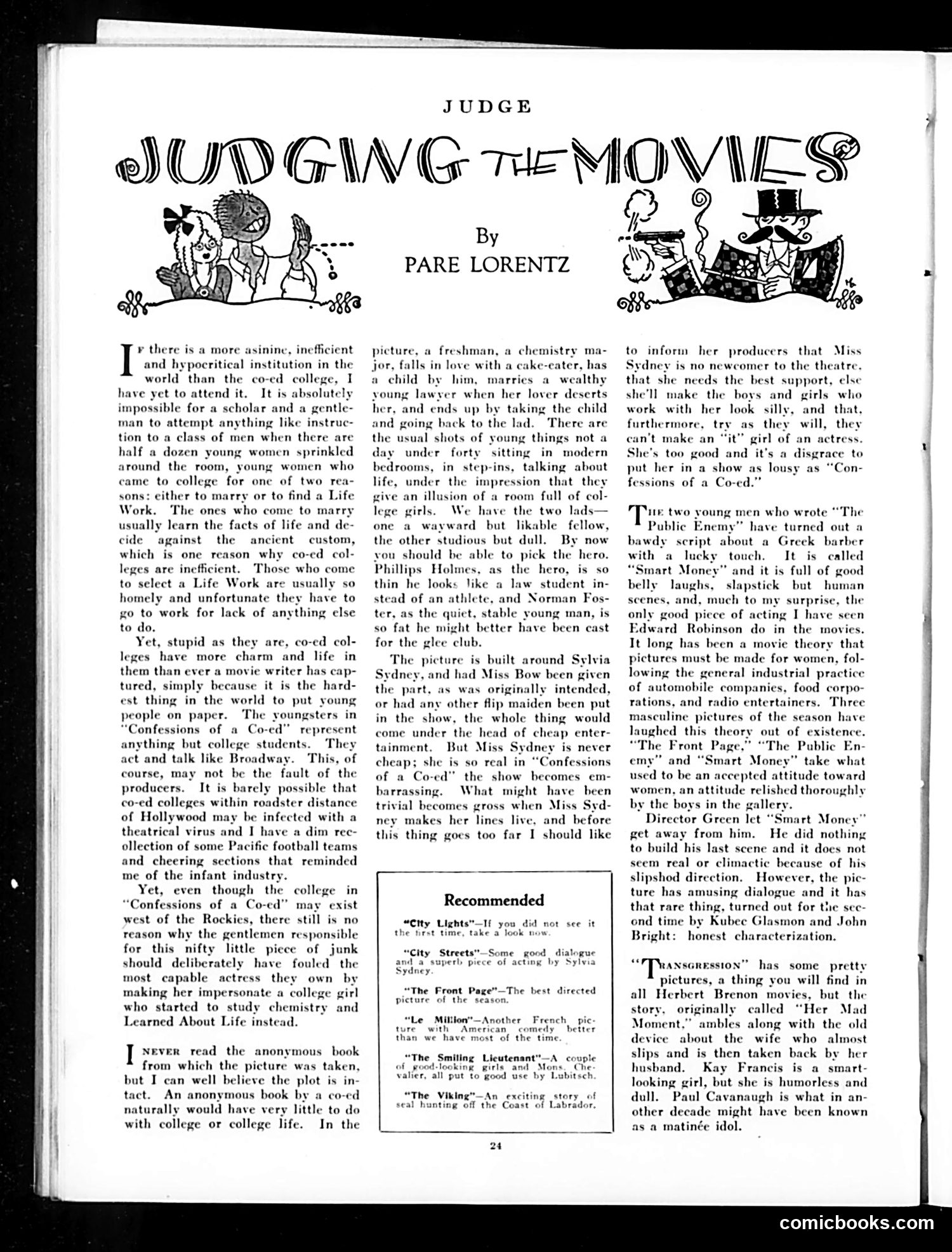
A restored page from Judge, 1931-07-11. Page through the whole issue in the reader above.
📄 Transcribed text from this page (OCR, searchable)
Machine-transcribed from the original scan — historical spelling and the odd misread are preserved.
¥ there is a more asinine, inefficient and hypocritical institution in the world than the co-ed college, I have yet to attend it. It is absolutely impossible for a scholar and a gentl man to attempt anything like instruc tion to a class of men when there are half a dozen young women sprinkled around the room, young women who me to colle for one of two r sons: either to marry or to find a Life Work. The ones who come to mar usually learn the facts of life and de- cide against the ancient custom, which is one reason why co-ed col- leges are inefficient. Those who come to select a Life Work are usually so homely and unfortunate the go to work for lack of any: to do. Yet, stupid as they are, co-ed col- leges have more charm and life them than ever a movie writer has cap- tured, simply because it is the hard- est thing in the world to put young people on paper. The youngsters in “Confessions of a Co-ed" represent anything but college students. They t and talk like Broadw This, of urse, may not be the fault of the producers. It is barely possible that co-ed colleges within roadster distance of Hollywood may be infected with theatrical virus and I have a dim rec- ollection of some Pacific football teams and cheering sections that reminded me of the infant industry. Yet, even though the college in “Confessions of a Co-ed” may exist west of the Rockies, there still is no reason why the gentlemen responsible for this nifty little piece of junk should deliberately have fouled the most capable actress they own by making her impersonate a college girl who started to study chemistry and Learned About Life instead. NeEveR read the anonymous book from which the picture was taken, but I can well believe the plot is in- act. An anonymous book by a co-ed € very little to do h college or college life. In the JUDGE By picture, a freshman, a chemistry ma- jor, falls in love with a cake-eater, has a child by him, marries a wealthy young lawyer when her lover deserts her, and ends up by x the child and going back to the lad. There are the usual shots of young things not a day under forty ‘sitting in’ modern bedrooms, in step-ins, talking about life, under the impression that they room full of col- give an illusion of a lege girls. We have the two lads— one a wayward but likable fellow, the other studious but dull. By now you should be able to pick the hero. Phillips Holmes, as the hero, is so thin he looks like a law student in- stead of an athlete, and Norman Fos- ter, as the quiet, stable young man, is so fat he might better have been cast for the glee club. The picture is built around Sylvia Sydney, and had Miss Bow been given the part, as was originally intended, or had any other flip maiden been put in the show, the whole thing would come under the head of cheap enter- tainment. But Miss Sydney is never cheap; she is so real in “Confessions of Co-ed" the show becomes em- barrassing. What might have been trivial becomes gross when Miss Syd- ney makes her lines live, and before this thing goes too far I should like Recommended J not see it “City Lights"—If you the first time, take a loo “City Streets"—Some good dialogue and a superb piece of acting by Sylvia Sydney “The Front Page"—The best directed picture of the season “Le Milllon—Another French pic ture with American comedy better than we have st of the time “The Smiling Licutenant"—A couple of good-looking gitls and Mons. Che valier, all put to good use by Lubitsch. “The Viking"—An exciting story of seal hunting off the Coast of Labr: G THE MOV ILS to inform her producers that Miss Sydney is no newcomer to the theatre. that she needs the best support, else she'll make the boys and girls who work with her look silly, and that, furthermore, try as they. will, they “it” girl of an actress. can't make an “i She's too good and it’s a disgrac to put her in a show as lousy fessions of a Co-ed.” ‘on- Tire two young men who wrote “The Public Enemy” have turned out a bawdy script about a Greek barber with a lucky touch. It is. called nart Money” and it is full of good belly laughs, slapstick but human scenes, and, much to my surprise, the only good piece of acting I have scen Edward Robinson do in the movies. It long has been a movie theory that pictures must be made for women, fol- lowing the general industrial practice of automobile companies, food corpo- rations, and radio entertainers. Three masculine pictures of the season have out of existence. “The Public En mart Money” take what used to be an accepted attitude toward women, an attitude relished thoroughly by the boys in the gallery. Director Green let “Smart Money” get away from him. He did nothing to build his last scene and it does not seem real or climactic because of his slipshod direction. However, the pic- ture has amusing dialogue and it has that rare thing, turned out for the sec- ond time by Kubec Glasmon and John Bright: honest characterization. laughed this theo “The ont Page, “rPeaxsanession” has some pretty pictures, a thing you will find in all Herbert Brenon movies, but the story. 0 ly called “Her Mad Moment,” ambles along with the old device about the wife who almost slips and is then taken back by her husband. Kay Francis is a smart- looking girl, but she is humorless and dull. Paul Cavanaugh is what in an- other decade might have been known as a matinée idol. comicbooks.com