A complete issue · 40 pages · 1930
Judge — July 5, 1930
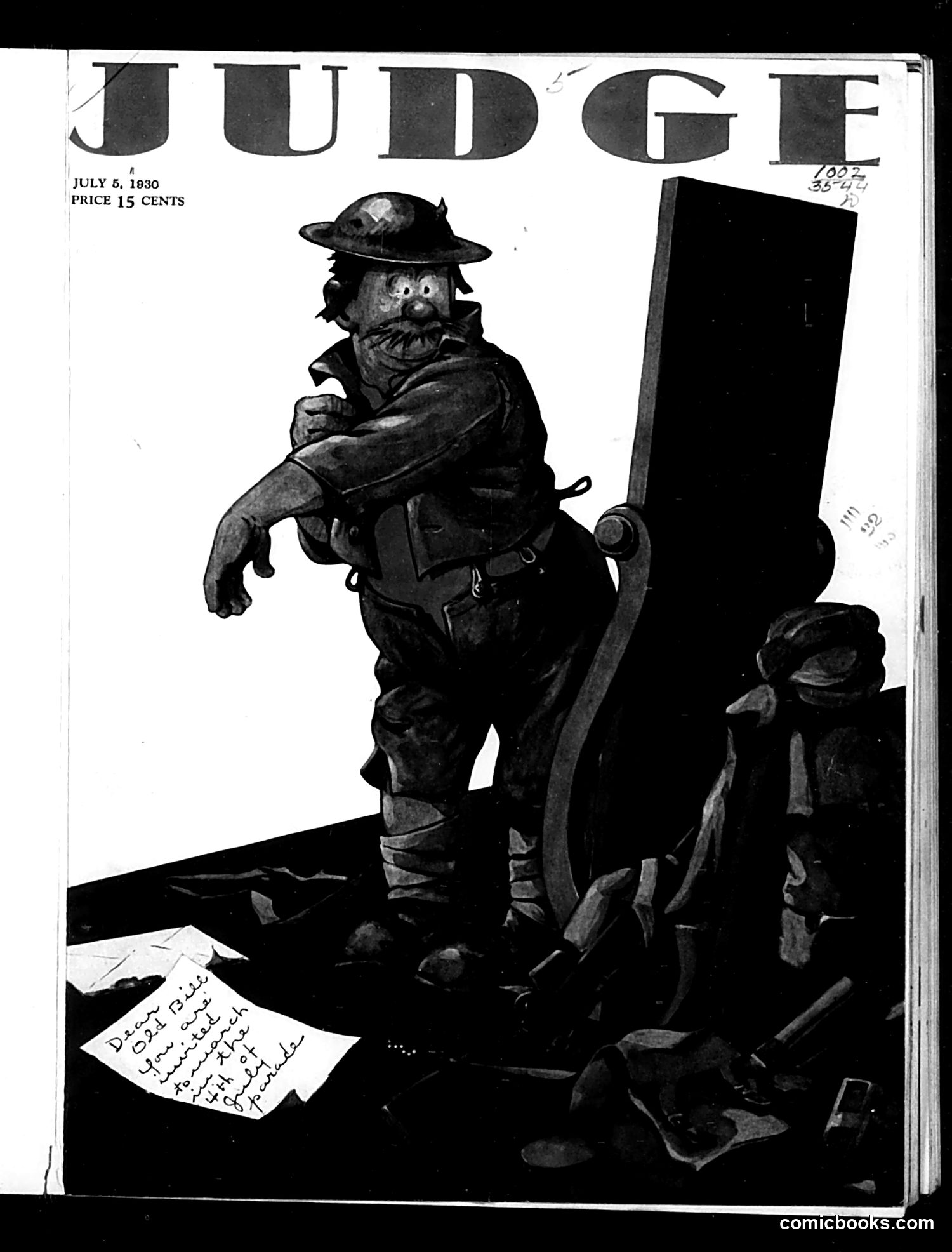
# Judge Magazine Cover Analysis (July 5, 1930) This cover depicts a disheveled hobo or vagrant character sitting atop what appears to be a large black block or structure, holding a rolled document. The figure wears tattered clothing, a wide-brimmed hat, and has an exaggerated, caricatured face typical of 1930s satirical illustration. Given the July 1930 date, this likely references the Great Depression, which had begun with the 1929 stock market crash. The hobo—a common symbol of economic hardship—appears triumphant or defiant while positioned above, perhaps suggesting how poverty or unemployment had become dominant forces in American society. The document in his hand's significance remains unclear from the image alone. The satire critiques the economic devastation affecting ordinary Americans during the Depression's early stages.
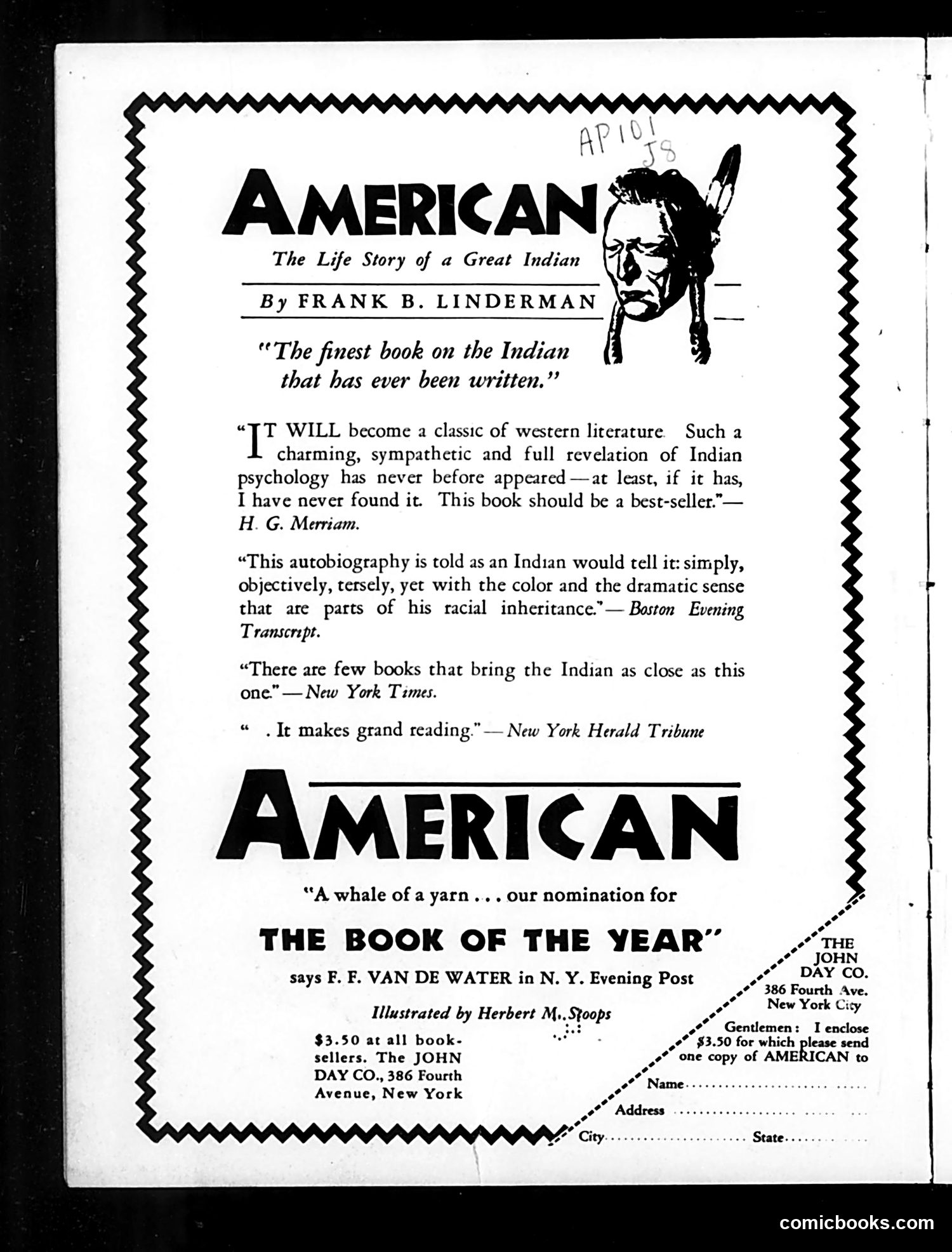
# Analysis This page is **primarily an advertisement**, not satire or political commentary. It promotes "American: The Life Story of a Great Indian" by Frank B. Linderman, published by The John Day Company. The advertisement features: - A portrait of what appears to be a Native American man with braided hair and a feather - Endorsements from publications (H.G. Merriam, Boston Evening Transcript, New York Times, New York Herald Tribune) - Claims the book is "charming, sympathetic" and reveals "Indian psychology" - Praise calling it a potential "classic of western literature" and "Book of the Year" - Price: $3.50 - An order form for readers The decorative border mimics Native American geometric patterns. This reflects early-20th-century publishing marketing that emphasized "authentic" perspectives on Indigenous life, though modern readers would recognize such framing as reflecting the period's problematic attitudes toward Native Americans.
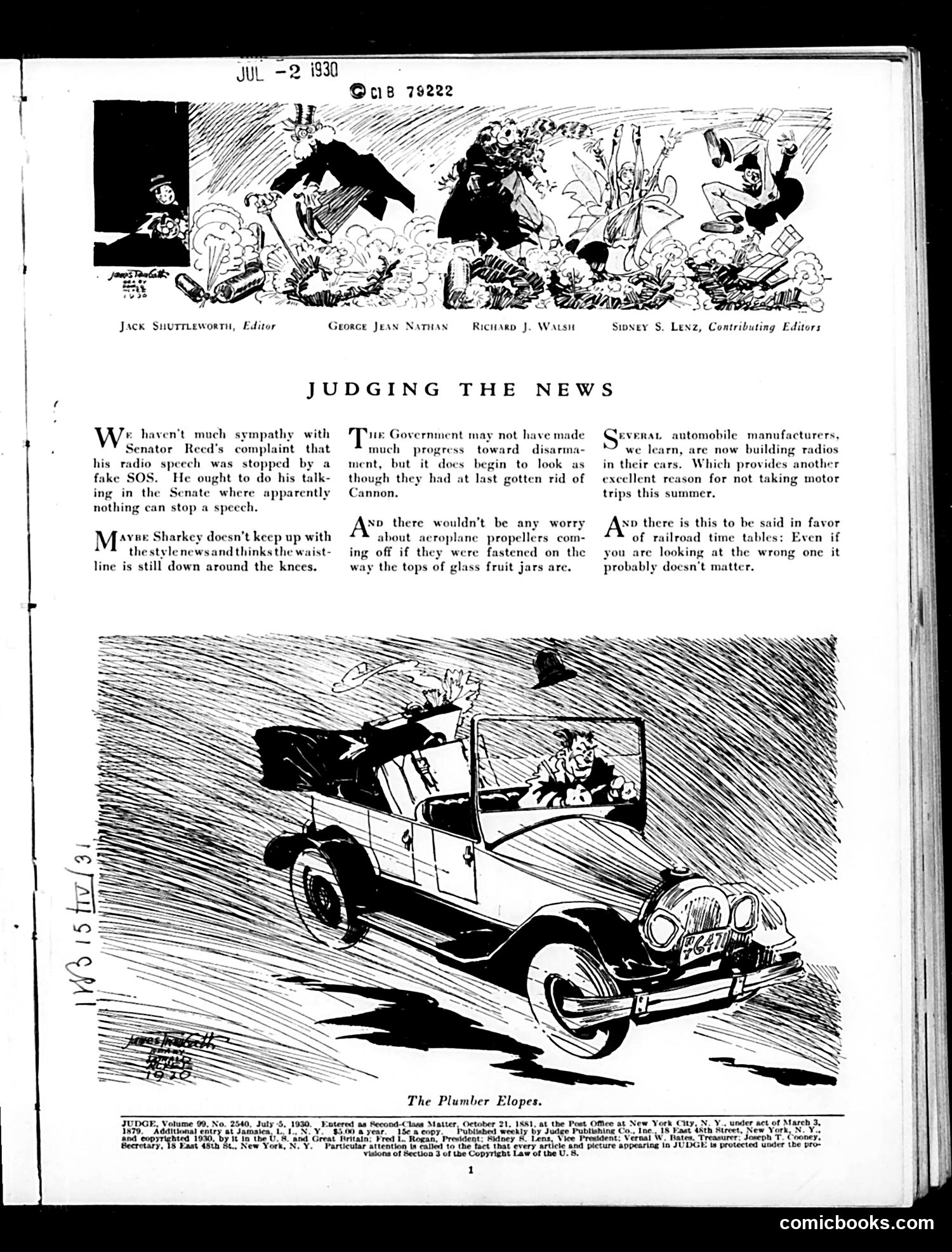
# "The Plumber Elopes" - Judge Magazine, July 2, 1930 This cartoon satirizes marital infidelity during the Depression era. The caption "The Plumber Elopes" depicts a working-class tradesman abandoning his family—shown as wife and children watching from a car window—to flee with another woman in a separate vehicle. The joke plays on class stereotypes: the "plumber" represents a manual laborer, and the cartoon mocks the notion that even working-class men might abandon domestic responsibilities for romantic escapades. The 1930 date places this during economic hardship, making the desertion seem particularly irresponsible. The accompanying editorial snippets ("Judging the News") address unrelated political and social topics of the period, including disarmament efforts and automobile safety—typical of Judge's satirical format mixing commentary with humor.
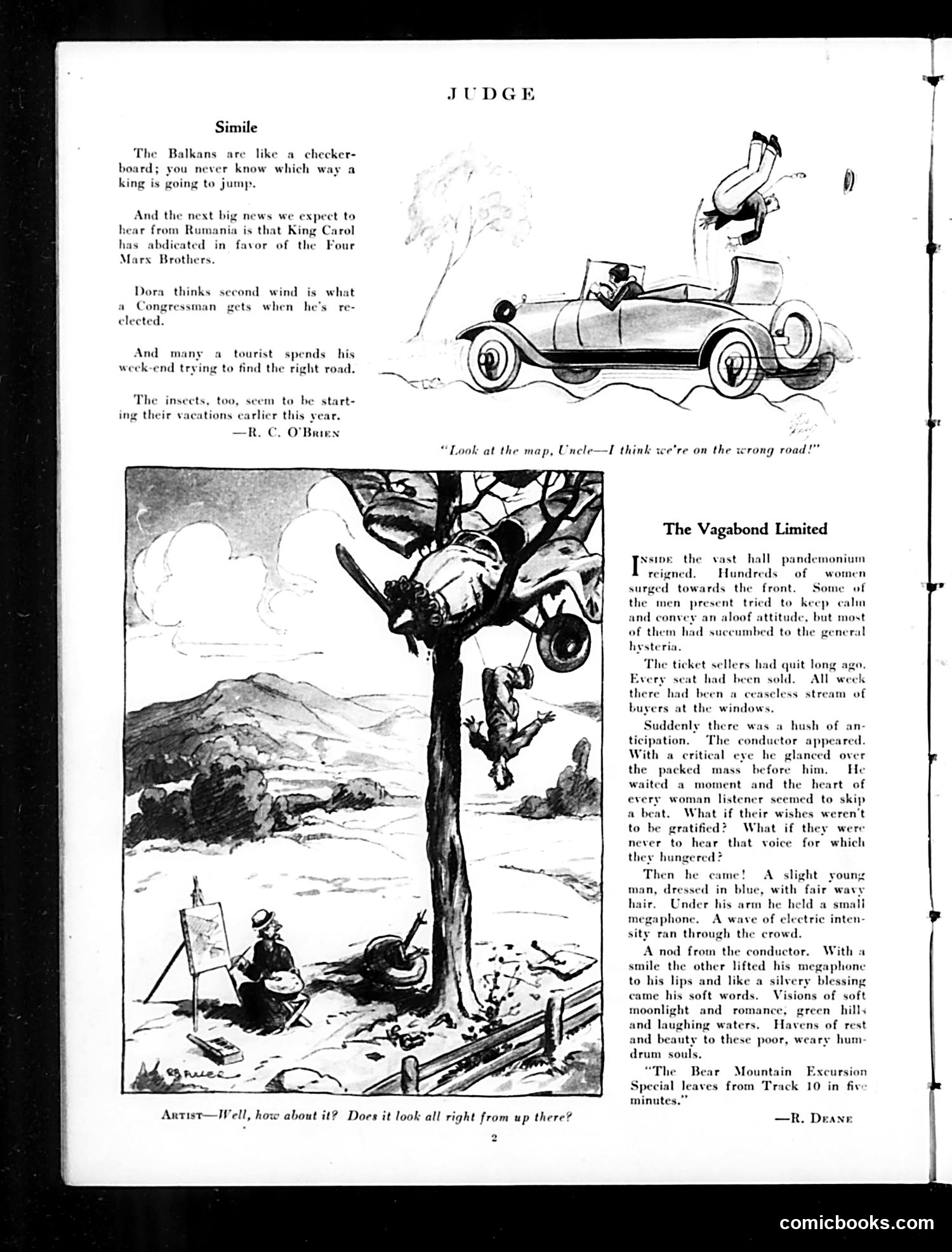
# Analysis of Judge Magazine Page This page contains two unrelated pieces: **"Simile" (top):** A brief humor column by R.C. O'Brien making light observations about the Balkans, Romanian King Carol, Congressional re-election, and tourist navigation—typical period satirical commentary on international instability and domestic politics, though without specific historical references that would clarify the exact date. **"The Vagabond Limited" (bottom):** A short story by R. Deane accompanying an illustration showing artists sketching outdoors. The narrative describes a crowd surging toward a voice—apparently a conductor announcing a special train excursion ("The Bear Mountain Excursion"). It's sentimental fiction emphasizing the transformative power of a young man's voice bringing hope to weary crowds, typical of Judge's mix of humor and genteel storytelling. Neither piece appears specifically topical to a particular political moment.
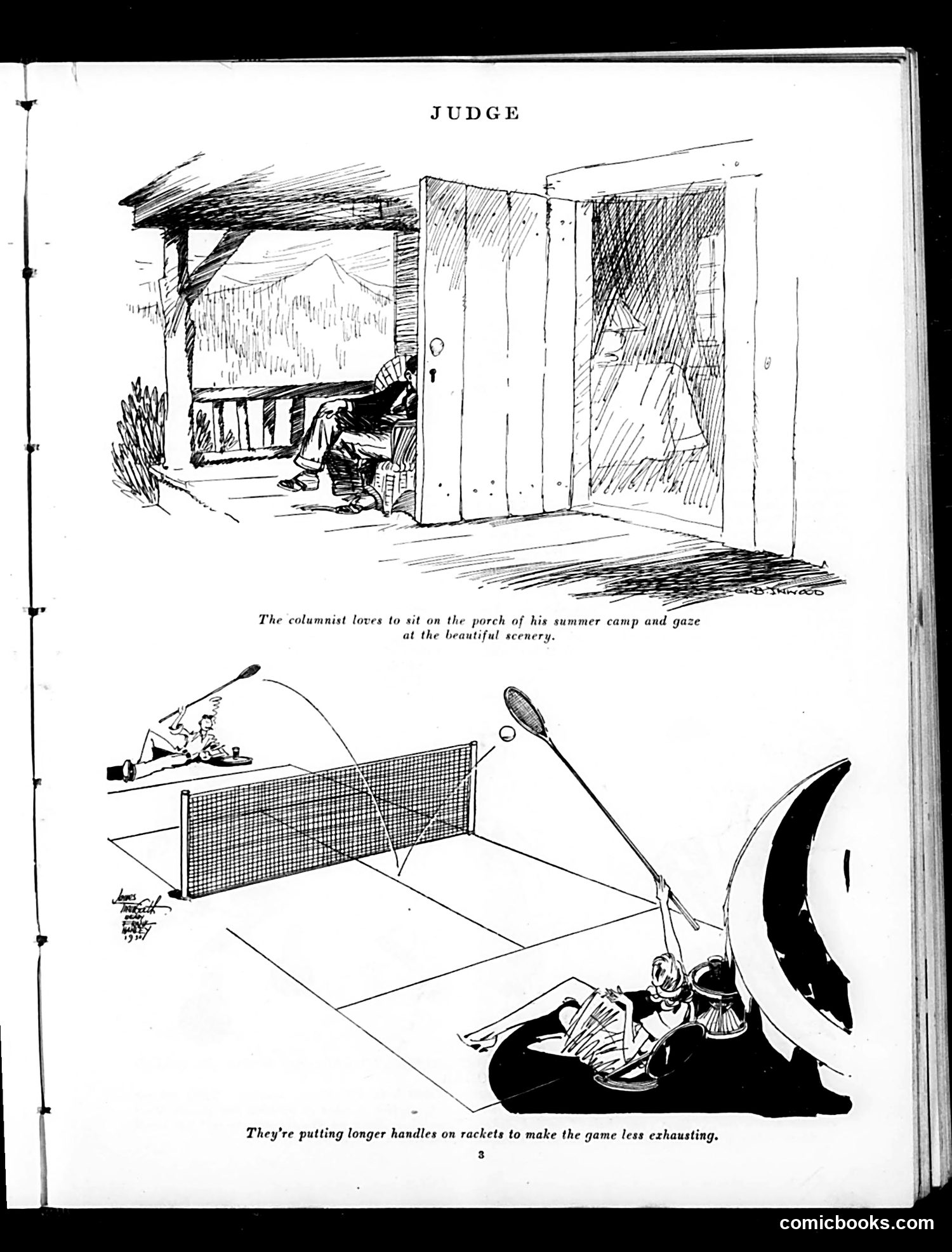
# Analysis This page from *Judge* contains two cartoons satirizing leisure activities: **Top cartoon:** Shows a man relaxing on a summer camp porch, gazing at scenery. The caption suggests columnists enjoy such peaceful retreats—likely satirizing how journalists romanticize vacation time or escape urban life while writing about it. **Bottom cartoon:** Depicts people playing tennis with longer-handled rackets. The caption jokes that longer handles make "the game less exhausting"—mocking the tendency to modify activities to reduce physical effort, or satirizing lazy recreationalists who want sport's appearance without its demands. Both cartoons target upper-class leisure culture and the shortcuts people take to avoid genuine exertion, common *Judge* themes lampooning American affluence and pretension.
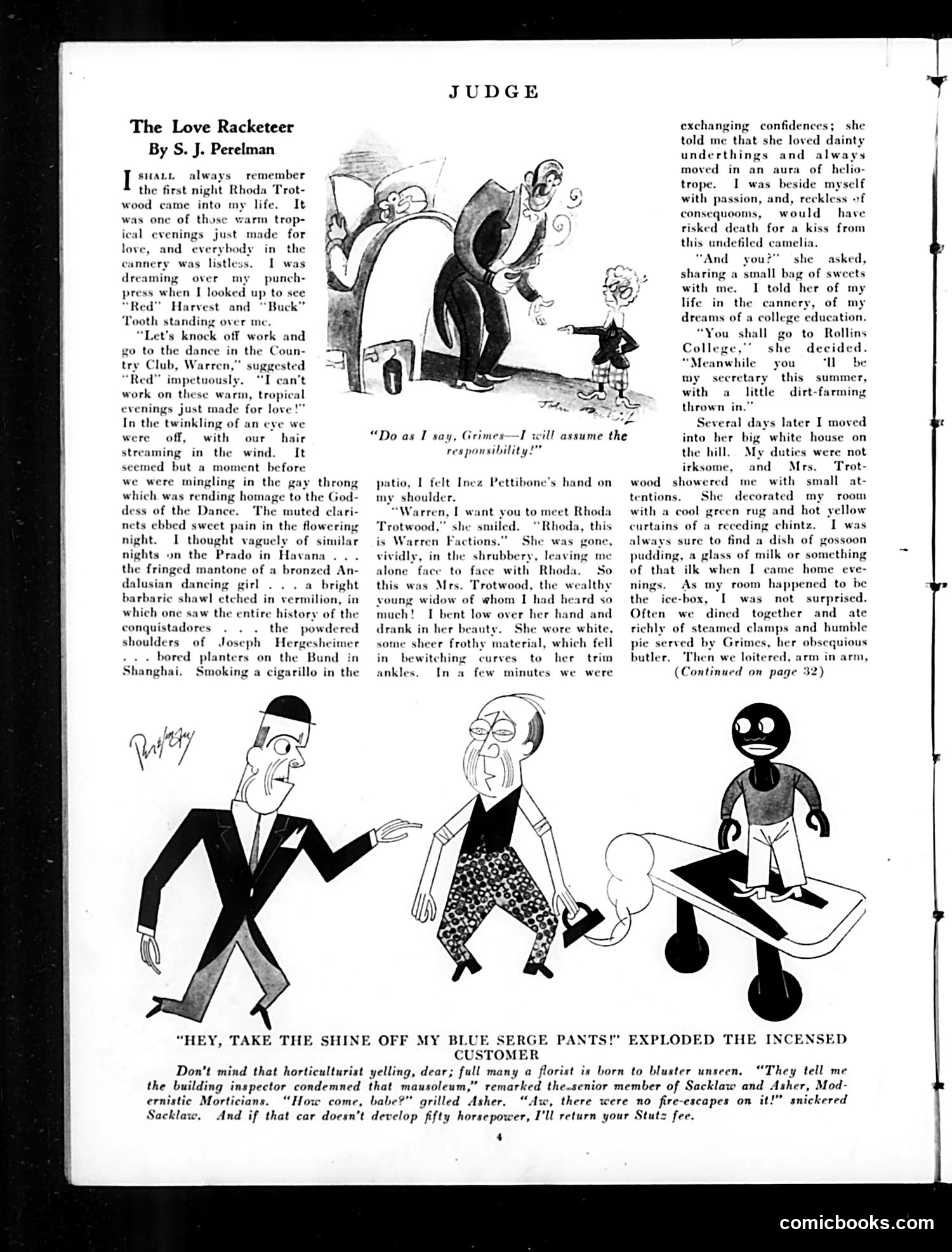
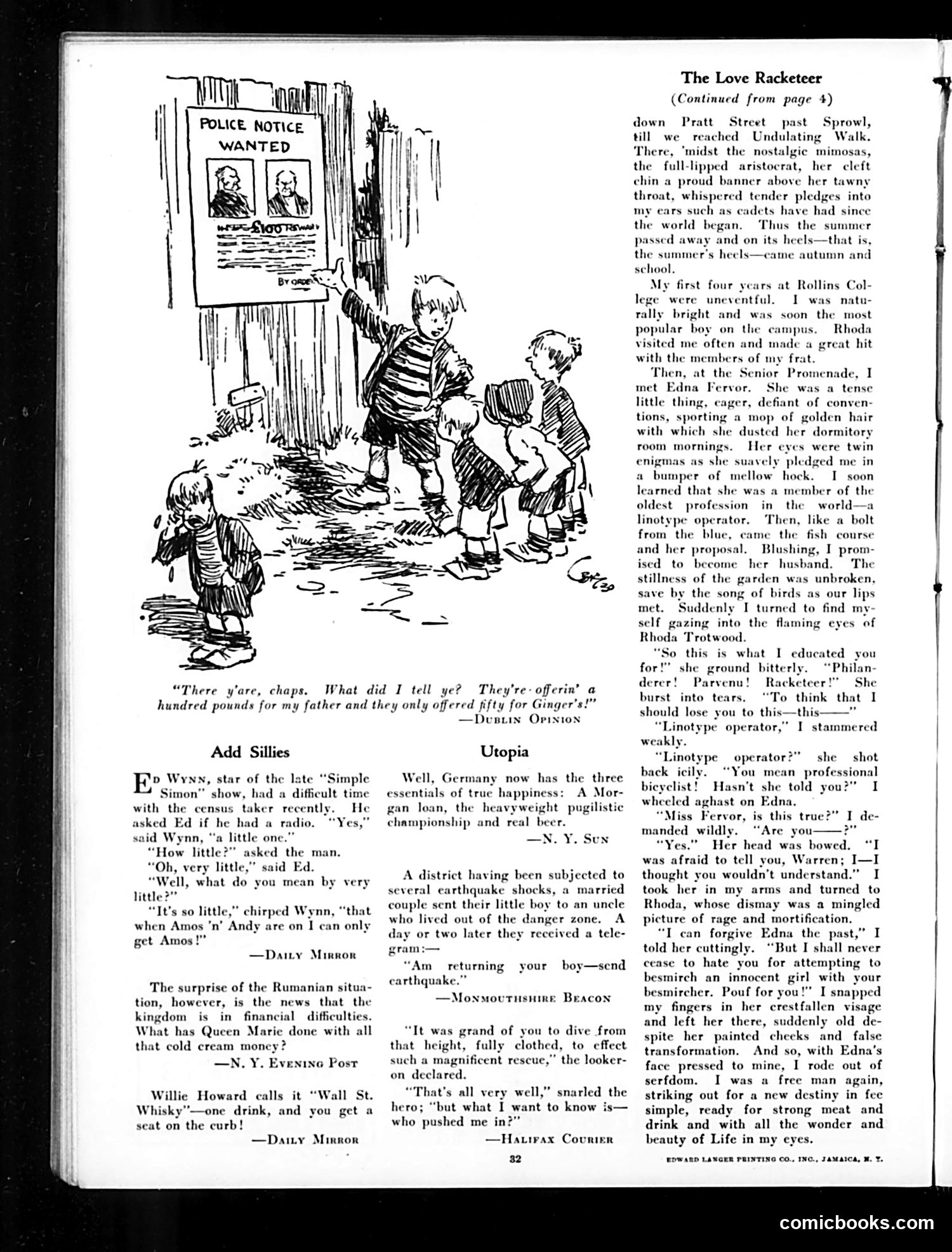
# "The Love Racketeer" by S. J. Perelman This page contains the opening of a humorous short story about a narrator who enters a romantic entanglement. The narrative describes visiting a country club where he meets "Red" Harvey and encounters a woman named Rhoda Trotwood, who is involved with someone named Warren. The accompanying cartoons below depict exaggerated caricatures of men in formal wear engaged in slapstick situations—one man gesturing dramatically, another appearing to stumble, and a third figure on what appears to be a seesaw. The final caption mocks a customer furious about the shine on his blue serge pants, satirizing petty consumer complaints and dry-cleaning disputes. The humor targets both romantic entanglements and trivial service industry grievances.
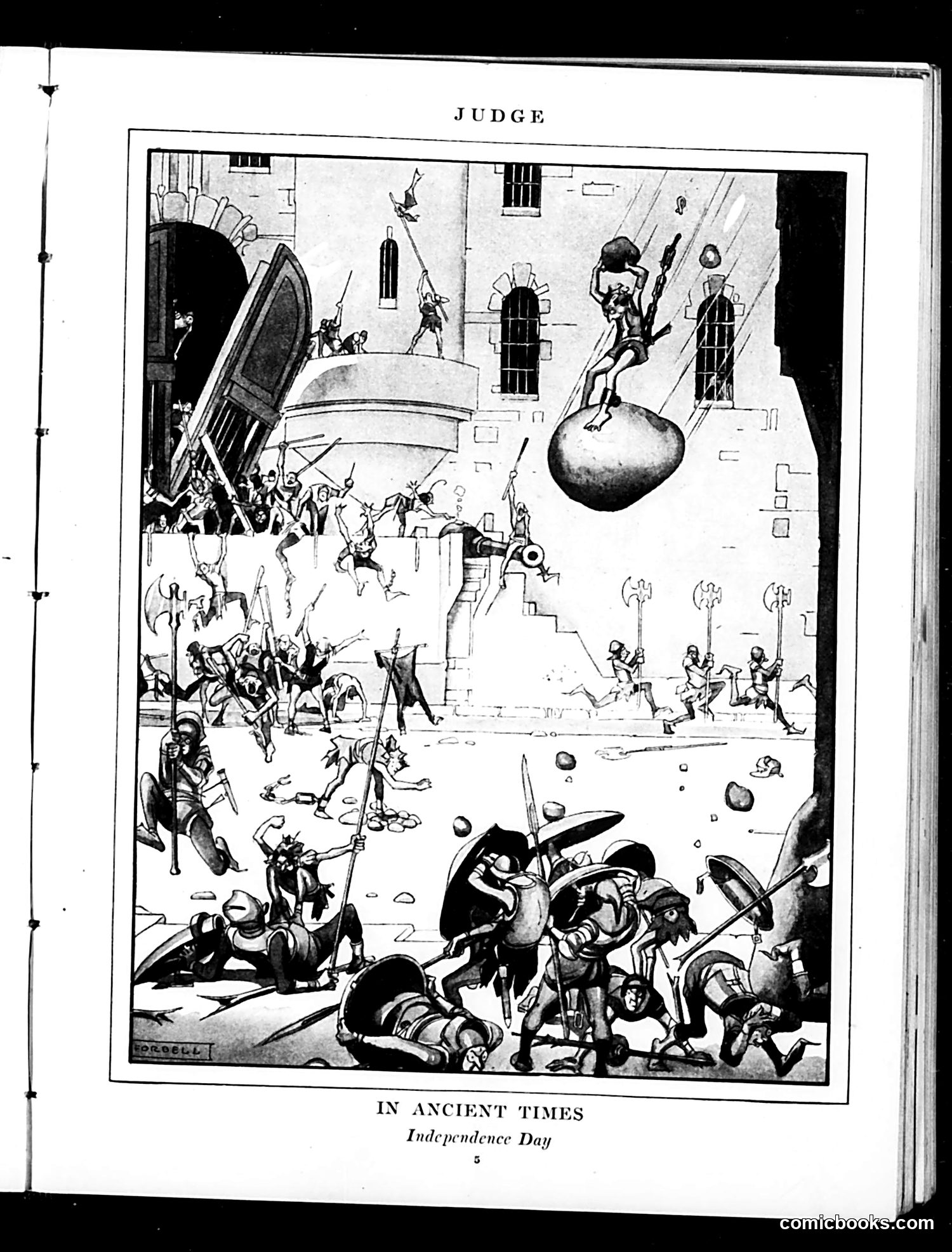
# "Judge in Ancient Times: Independence Day" This satirical cartoon depicts a chaotic ancient Roman or Greek scene labeled "Independence Day," imagining how early civilizations might have celebrated independence. The image shows gladiators and soldiers fighting in an arena while civilians above experience dangerous "entertainment"—a person bounces on a giant sphere suspended in air, others are struck by falling objects. The satire appears to contrast primitive, violent forms of celebration with modern American Independence Day festivities. By staging the concept in "ancient times," the cartoonist suggests that celebrating independence through chaos and violence is barbaric. The upside-down boat on the left and general disorder reinforce this critique of chaotic public celebration, likely commenting on rowdy or dangerous Independence Day observances in the artist's own era.
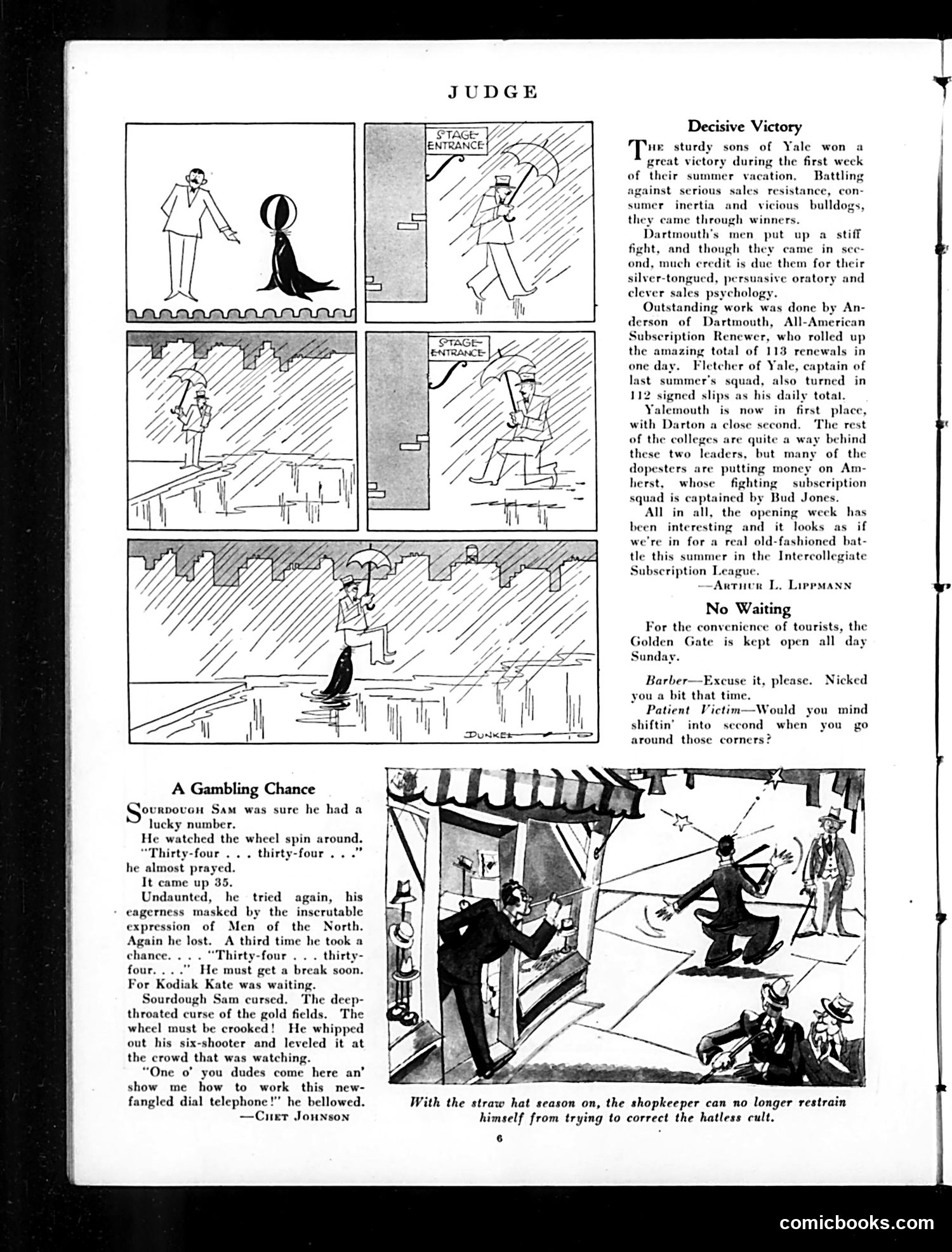
# Judge Magazine Page Analysis This page contains three distinct humorous pieces: **"Judge" comic strip** (top): A wordless visual gag about a man encountering what appears to be Death (the Grim Reaper figure in black). The man attempts to escape through various stage entrances, with Death pursuing him—likely satirizing theatrical melodrama or the inevitability of mortality through slapstick. **"Decisive Victory"** (right column): Text celebrating Yale's early summer fundraising success for subscriptions, humorously framed as a competitive "battle" against other colleges. **"A Gambling Chance"** (middle): A narrative joke about a gambler named Sourdough Sam trying his luck at a spinning wheel, repeatedly getting "thirty-four" while waiting for "Kodiak Kate." The humor lies in his superstitious persistence and the frontier-style dialect. **"No Waiting"** (bottom right): A cartoon depicting shopkeepers attempting to correct customers' behavior during the straw hat season, with the caption suggesting summer fashion creates workplace chaos.
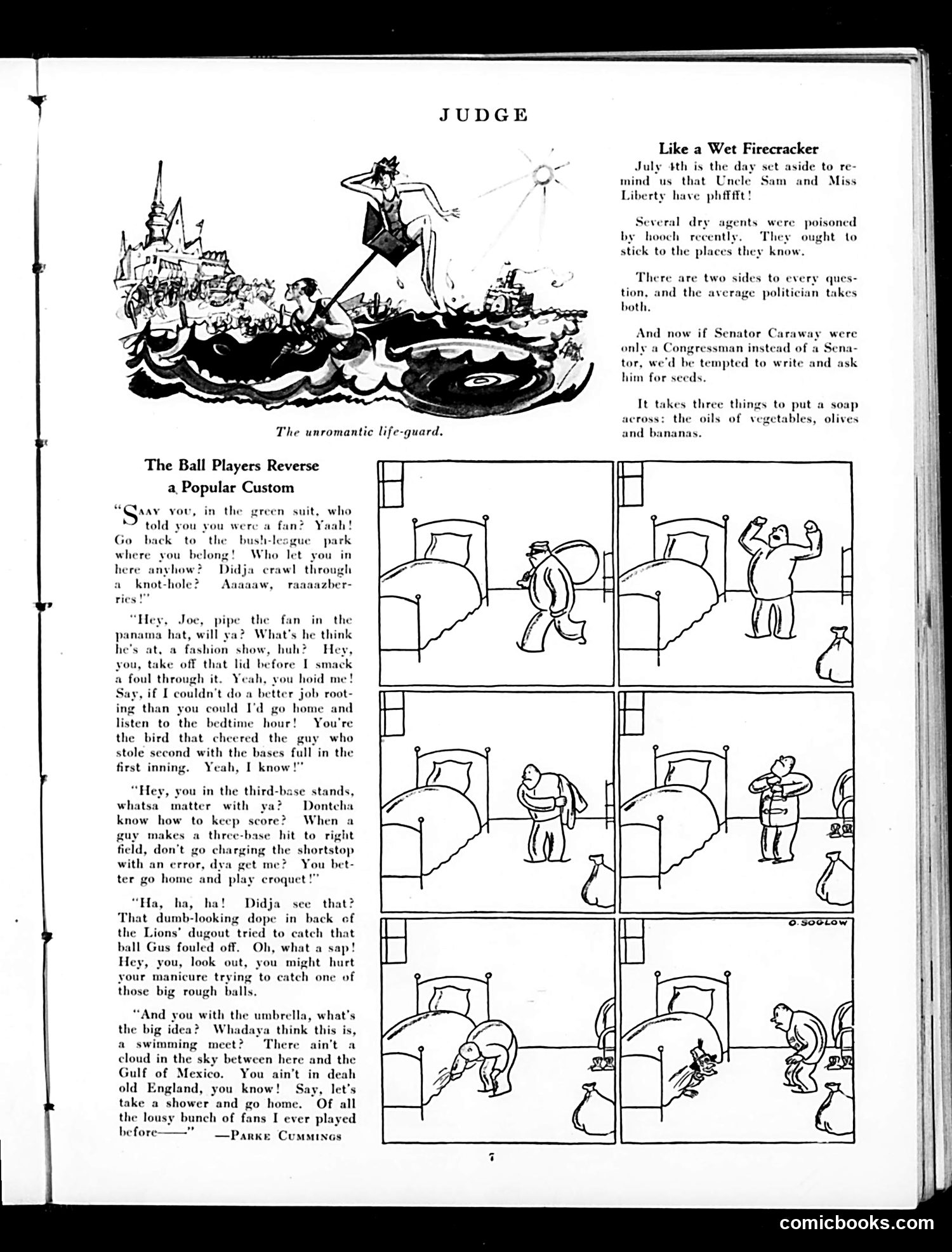
# Analysis for Modern Readers This page contains two separate satirical pieces from Judge magazine: **"Like a Wet Firecracker"** (top): A series of brief political jokes. Key reference: "Senator Caraway" (likely Thaddeus Caraway, a real senator) is mocked as ineffectual—the joke suggests he'd be better suited asking for seeds than legislation. The "dry agents poisoned by hooch" references Prohibition enforcement, sarcastically suggesting agents should stick to legal alcohol. The overall tone mocks politicians' hypocrisy and Prohibition's failures. **"The Ball Players Reverse a Popular Custom"** (bottom): A comic strip showing baseball fans being loudly insulted and ejected by players—reversing the typical dynamic where fans heckle players. The satire mocks rude, aggressive fans at games through exaggerated role reversal, using period slang ("hoid," "dya get me") and stereotypical fan behavior (criticizing plays, inappropriate dress, keeping score wrong). Both pieces reflect 1920s-30s concerns: Prohibition enforcement, political incompetence, and emerging mass entertainment culture.
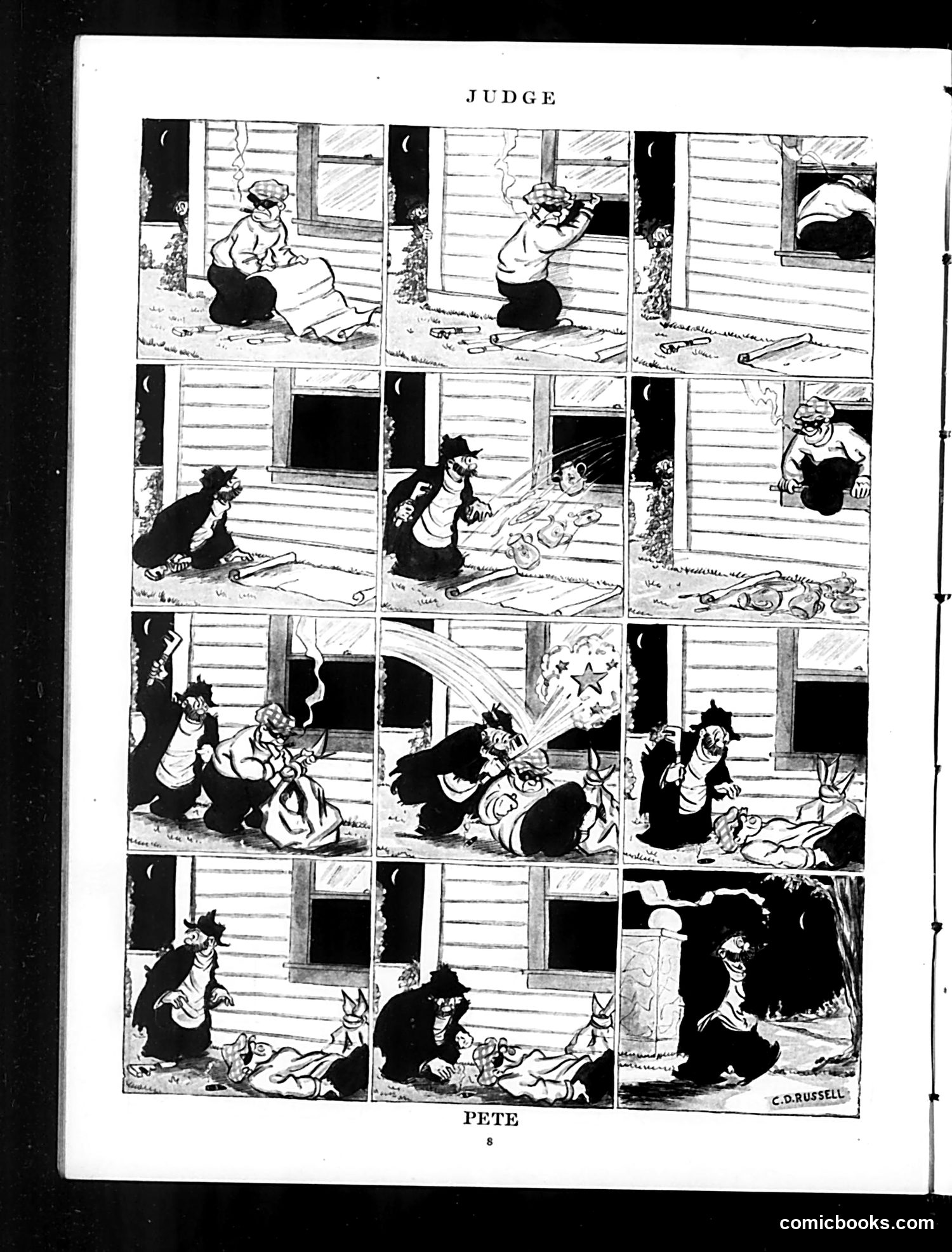
# "Judge Pete" Comic Strip Analysis This is a sequential comic strip by C.D. Russell titled "Judge Pete" showing a nighttime scene outside a wooden house. The narrative appears to depict someone (Pete) attempting to enter through a window while others react—suggesting a burglary or break-in scenario. The strip progresses from Pete's initial attempt through various confrontations with residents and what appears to be law enforcement or a judge figure (referenced in the title). The humor likely derives from slapstick consequences of the attempted crime, though without additional historical context, the specific satirical target remains unclear. The "Judge" reference in the title suggests legal/judicial mockery, possibly of 1920s-30s era criminal justice.
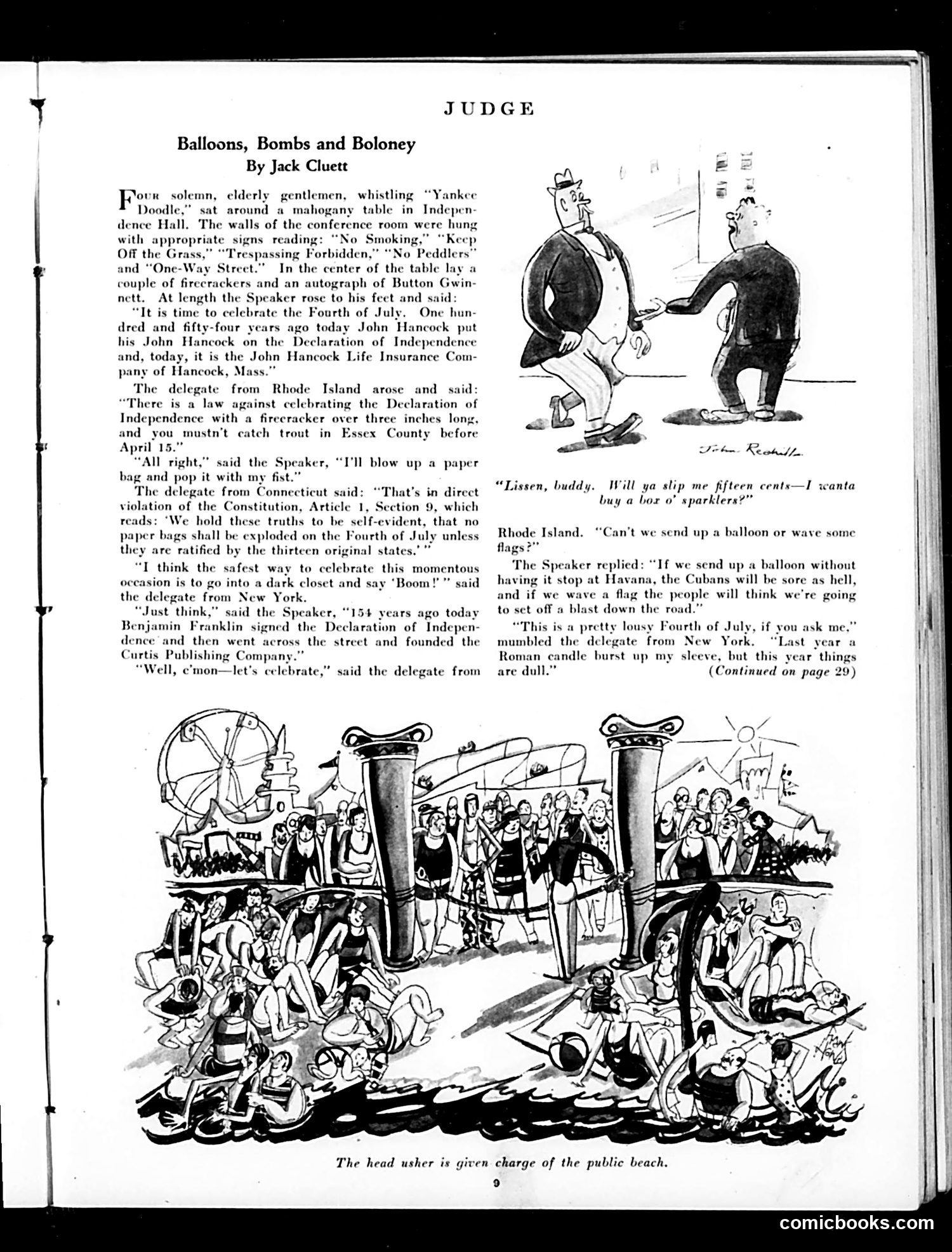
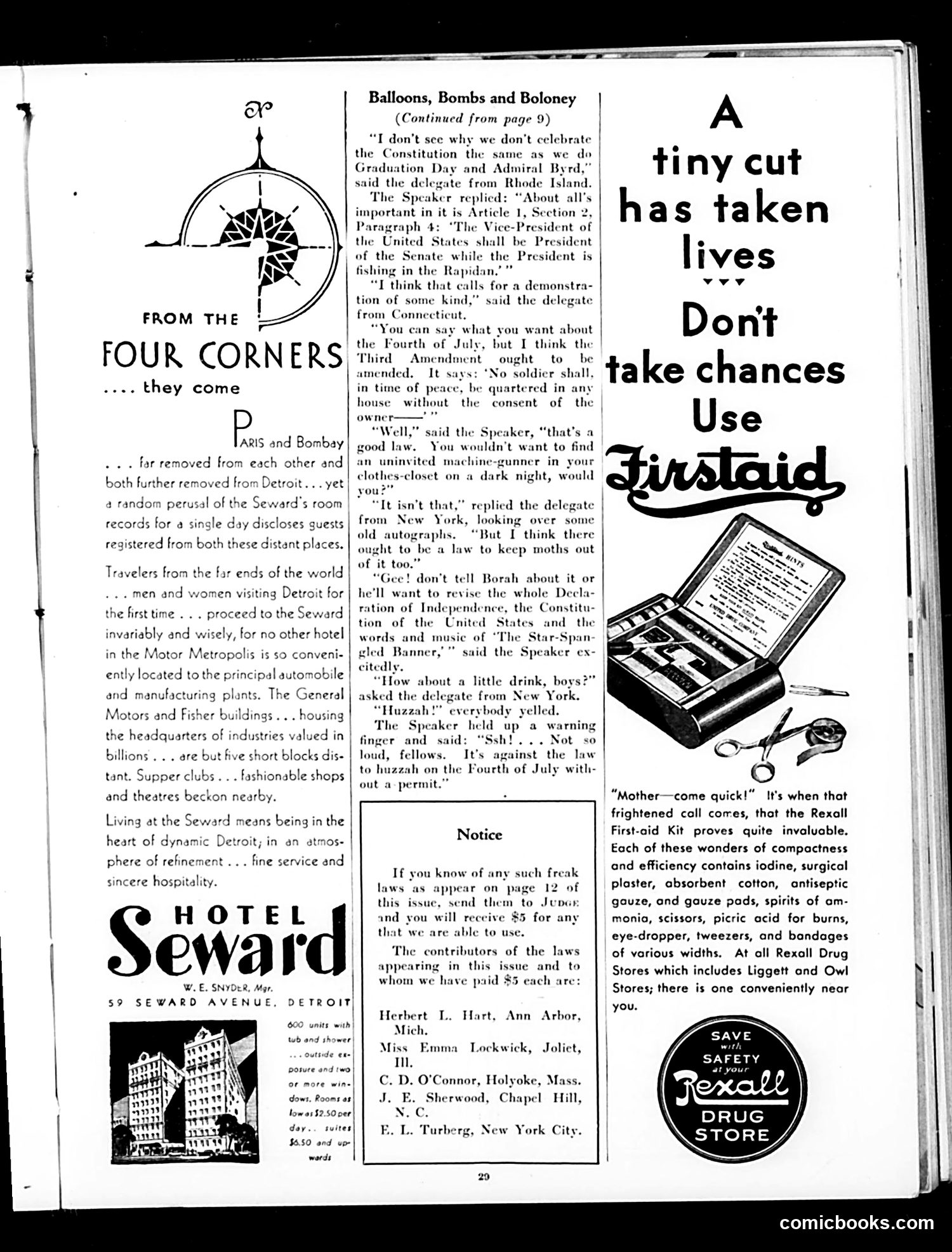
# "Balloons, Bombs and Boloney" Explained This 1920s-era satire mocks excessive government regulation stifling Fourth of July celebrations. Elderly founding fathers gather in Independence Hall to commemorate the Declaration, but modern bureaucratic restrictions prevent any festivities. The joke: delegates cite absurd laws—firecrackers over three inches are illegal, paper bags can't be popped without state ratification, balloons upset Cuba, and flags risk diplomatic incidents. The cartoon suggests government red tape has made celebrating American independence itself impossible. Key references include Button Gwinnett (actual Declaration signer), the Curtis Publishing Company (publisher of Saturday Evening Post), and contemporary anxieties about governmental overreach and foreign relations (Cuba). The beach illustration shows crowded, chaotic leisure—contrasting regulated chaos with uncontrolled freedom. The satire targets progressive-era regulation that Judge's conservative readership viewed as excessive and anti-American.
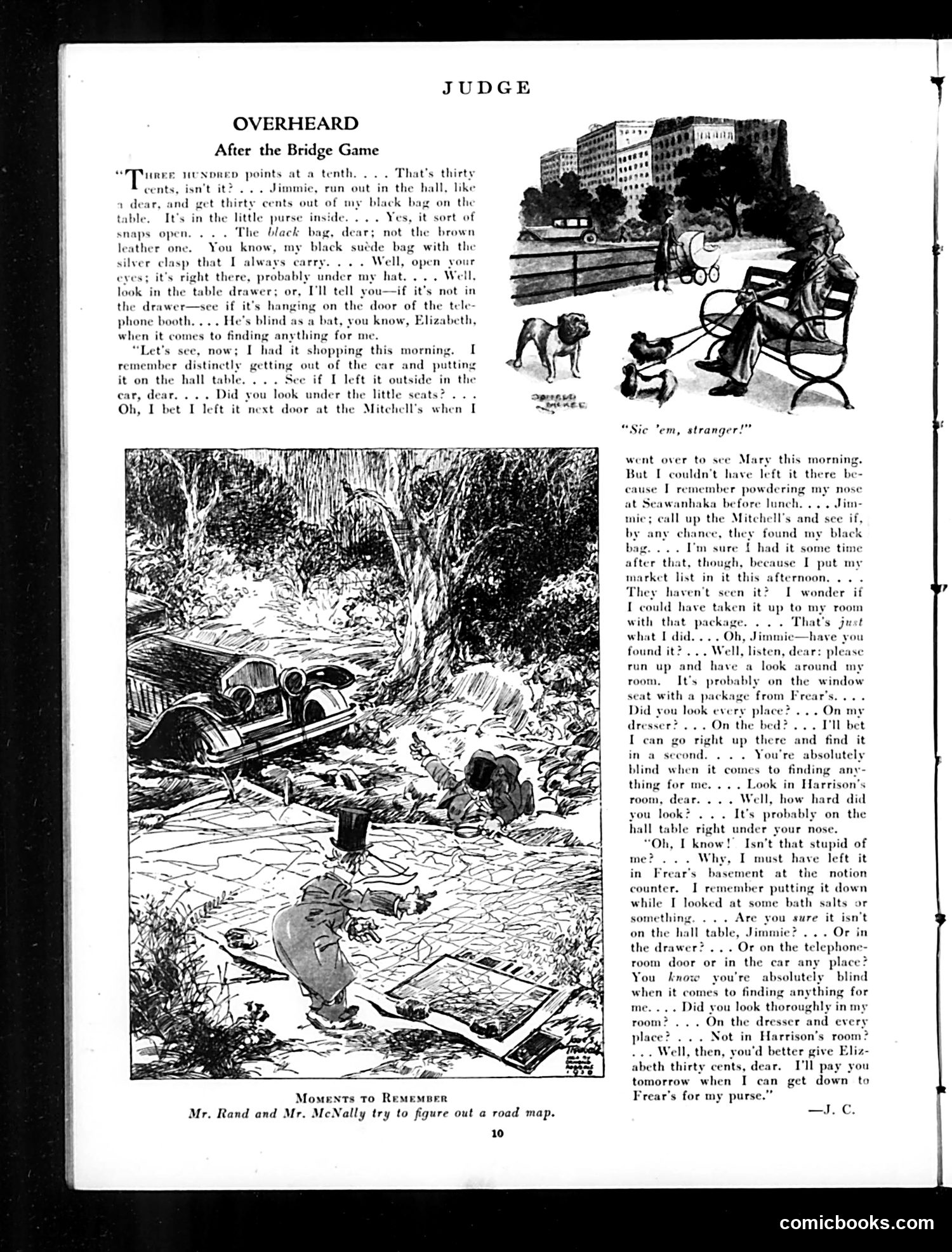
# Judge Magazine: "Overheard After the Bridge Game" This is a humorous domestic sketch satirizing upper-middle-class women's absent-mindedness and their tendency to delegate tasks to long-suffering male companions (likely husbands or servants named "Jimmie"). The joke: A woman has lost thirty cents—her bridge game winnings—and sends "Jimmie" on an exhausting search through her home and recent movements. She rambles about where it *might* be (the black bag, the purse, the car, the Mitchell's house, Frear's store), constantly second-guessing herself while criticizing Jimmie's incompetence at finding things. The satire targets: 1. **Female scatterbrainedness** regarding money and possessions 2. **Class dynamics**: wealthy women casually directing servants to do trivial searches 3. **Blame-shifting**: she lost the money but insists *he's* "blind" at finding things The accompanying illustration shows two men outdoors with a road map—likely a separate, unrelated domestic comedy about male incompetence, providing ironic contrast.