
Judge, 1930-07-05 · page 30 of 40
Judge — July 5, 1930 — page 30: what you’re looking at
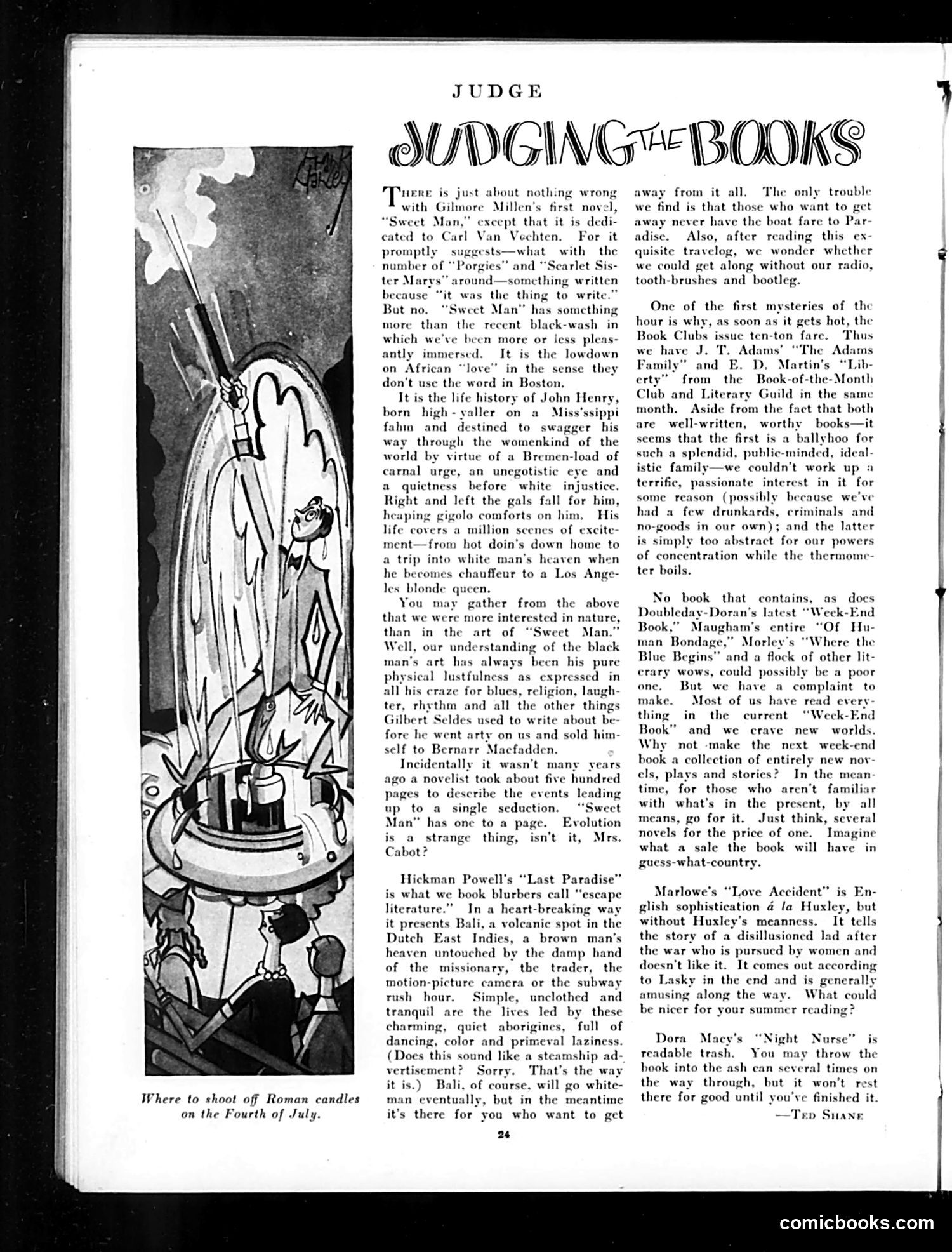
A restored page from Judge, 1930-07-05. Page through the whole issue in the reader above.
📄 Transcribed text from this page (OCR, searchable)
Machine-transcribed from the original scan — historical spelling and the odd misread are preserved.
Where to shoot off Roman candles on the Fourth of July. JUDGE WVGING BOOKS HERE is just about nothing wrong with Gilmore Millen’s first novel, weet Man,” except that it is dedi- cated to Carl Van Vechten. For it promptly suggests—what with the number of “Por, and “Scarlet Sis- ter Marys” around—something written because “it was the thing to writ But no. “Sweet Man" has something more than the recent black-wash in which we've been more or less pleas- antly immersed. It is the lowdown on African “love” in the sense they don’t use the word in Boston. It is the life history of John Henry, born high-yaller on a Miss'ssippi fahm and destined to swagger his way through the womenkind of the world by virtue of a Bremen-load of carnal urge, an unegotistic and a quictness before white injustice. Right and left the gals fall for him, heaping gigolo comforts on him. His life covers a million scenes of excite- ment—from hot doin’s down home to trip into white man’s heaven when he becomes chauffeur to a Los Ange- les blonde queen. You may her from the above that we were more interested in nature, than in the art of “Sweet Man.” 1, our understanding of the black man’s art has always been his pure physical lustfulness as expressed in all his craze for blues, religion, laugh- ter, rhythm and all the other things Gilbert Seldes used to write about be- fore he went arty on us and sold him- self to Bernarr Macfadden. Incidentally it wasn’t many years ago a novelist took about five hundred pages to describe the events leading up to a single seduction. Sweet Man" one to a page. Evolution is a strange thing, isn’t it, Mrs. Cabot? Hickman Powell's “Last Paradise” is what we book blurbers call “escape literature.” In a heart-breaking y it presents Bali, a volcanic spot in the Dutch East Indies, a brown man’s heaven untouched by the damp hand of the missionary, the trader, the motion-picture camera or the subway rush hour. Simple, unclothed and tranquil are the lives led by these charming, quict aborigines, full of dancing, color and primeval laziness. (Does this sound like a steamship ad- vertisement? Sorry. That's the way it is.) Bali, of course. will go white- man eventually, but in the meantime it’s there for you who want to get boy away from it all. The only trouble we find is that those who want to get away never have the boat fare to P. Also, after reading this ex- > travelog, we wonder whether we could get along without our radio, tooth-brushes and bootleg. One of the first mysteries of the hour is why, as soon as it gets hot, the Book Clubs issue ten-ton Thus we ha J.T. Adams’ “The Adams Family” and D. Martin’s “Lib- erty” from the Book-of-the-Month Club and Literary Guild in the same month. Aside from the fact that both are well-written, worthy books—it scems that the first is a ballyhoo for such a splendid, public-minded, ideal- istic family—we couldn't work up a terrific, sionate interest in it for some reason (possibly because we've had a few drunkards, criminals and no-goods in our own); and the latter is simply too abstract for our powers of concentration while the thermome- ter boils. No book that contains, as does Doubleday-Doran’s latest “Week-End Book,” Maugham’s entire “Of Hu- man Bondage,” Morley's “Where the Blue Begins” and a flock of other lit- erary wows, could possibly be a poor one. But we have a complaint to ma Most of us have read every- thing in the current “Weck-End Book” and we crave new worlds. Why not make the next week-end book a collection of entirely new nov- els, plays and stories? In the mean- time, for those who aren't familiar with what's in the present, by all means, go for it. Just think, several novels for the price of one. Imagine what a sale the book will have in guess-what-country. Love Accident” is En- glish sophistication @ la Huxley, but without Huxley's meanness. It tells the story of a disillusioned lad after the war who is pursucd by women and doesn’t like it. It comes out according to Lasky in the end and is gencrally amusing along the way. What could be nicer for your summer readi Marlowe’ Dora Macy’s “Night readable trash. You may throw the book into the ash can several times on the way through, but it won't rest there for good until you've finished it. Nurse” is —Trp Suanr comicbooks.com a oe