A complete issue · 36 pages · 1930
Judge — May 17, 1930
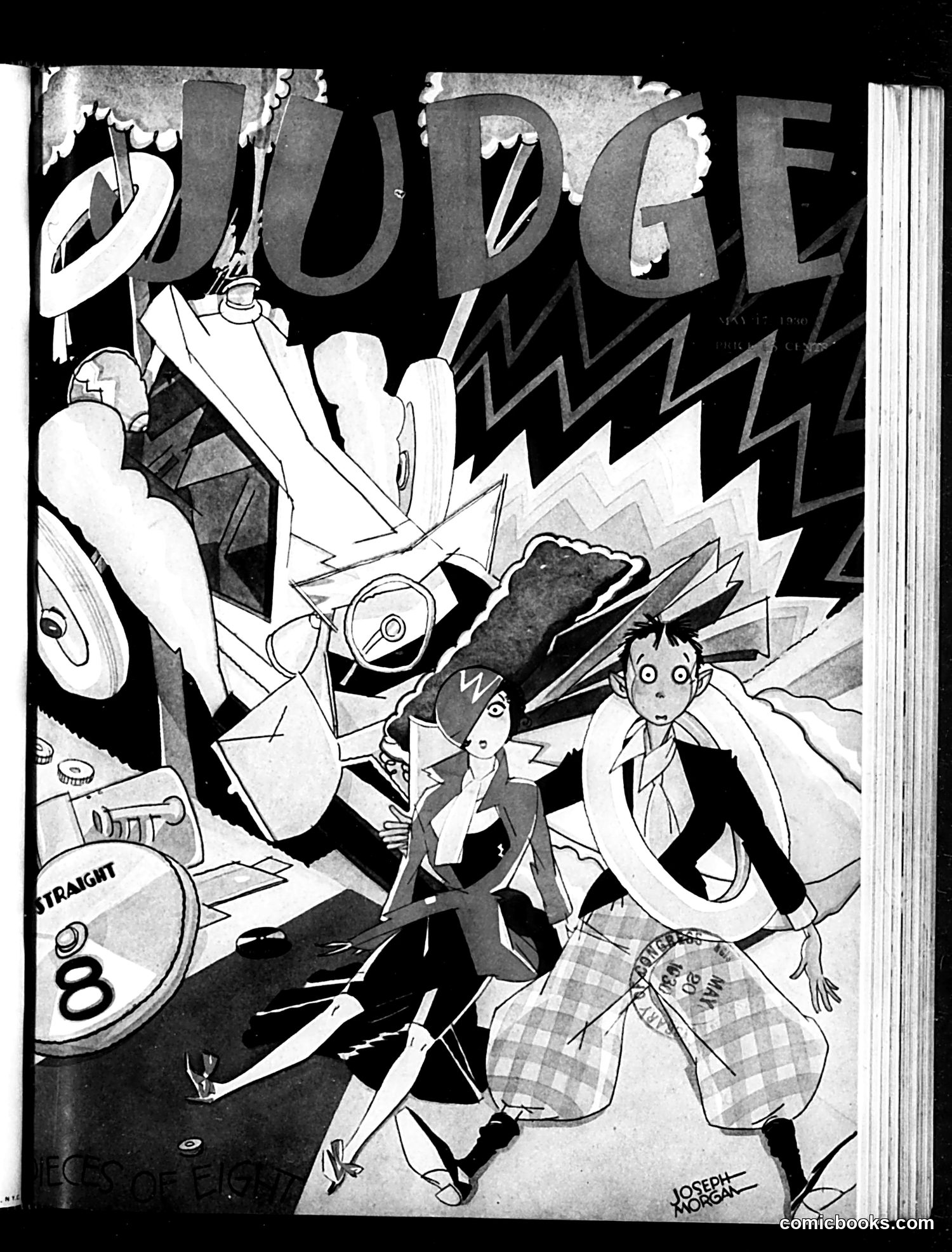
# Analysis of "Dodge" Judge Magazine Page This appears to be a cover or advertisement for Dodge automobiles, featuring a chaotic comedic scene. The cartoon shows two men in business attire reacting with alarm and exaggerated shock as they're caught in the path of a large, aggressive Dodge vehicle bearing down on them. Lightning bolt graphics and motion lines emphasize the vehicle's power and speed. The satire likely plays on Dodge's marketing around vehicle power and performance—suggesting the car is so forceful and unstoppable that even pedestrians must frantically flee. The "8" visible on wheels references Dodge's eight-cylinder engine, then a notable feature. This is essentially automotive advertising dressed as humor, typical of Judge magazine's commercial content during this era.

# Analysis This page is **not a cartoon or satire—it's a straightforward advertisement** for Texaco lubricants, appearing in *Judge* magazine. The ad features an industrial photograph of a steel mill with giant machinery and workers, accompanied by promotional text emphasizing Texaco's specialized lubricants for extreme manufacturing conditions. The copy highlights the company's research capabilities and quality standards. The small illustration of researchers in a laboratory reinforces Texaco's scientific credibility. The Texaco star logo and tagline "The mark of quality for petroleum products" anchor the message. This represents typical corporate advertising from the early-to-mid 20th century that positioned commercial products as solutions to modern industrial challenges. There is no satirical intent—merely brand promotion.
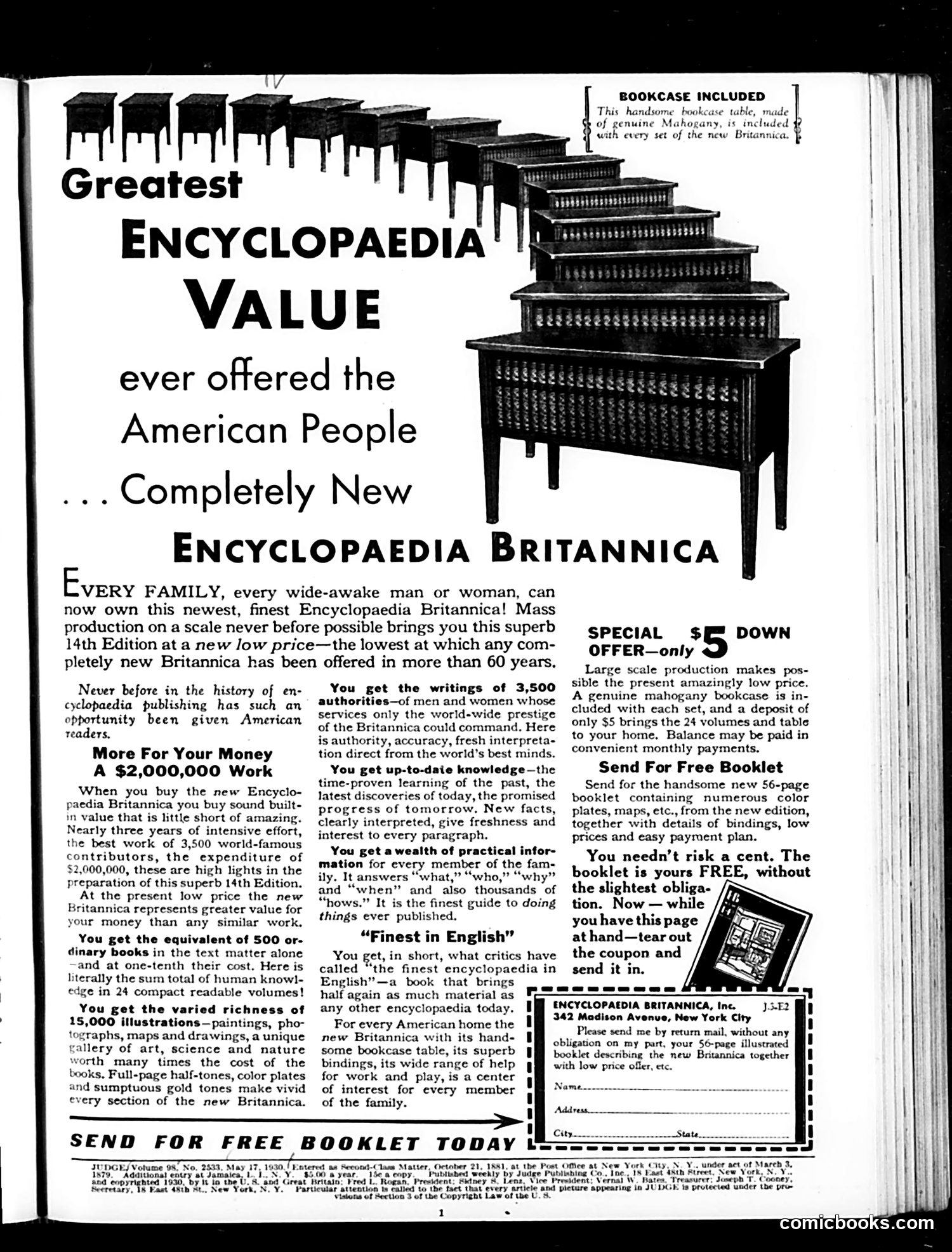
# Analysis This page is **primarily an advertisement**, not satirical content. It's a full-page promotional piece for Encyclopedia Britannica's 14th Edition, placed in Judge magazine. The ad uses a visual metaphor: a staircase of increasingly ornate mahogany bookcases, emphasizing the product's quality and comprehensiveness. The text highlights the encyclopedia as an unprecedented value—"$5 down" with convenient payment plans—marketed to middle-class American families. The only potentially satirical element is the framing: Judge, known for lampooning consumer culture and advertising excess, may be implicitly critiquing the hard-sell tactics. However, the ad itself reads straightforwardly, emphasizing "3,500 authorities" and practical knowledge for families. This reflects 1920s-era print advertising strategies: luxury goods marketed as accessible necessities to aspirational consumers.
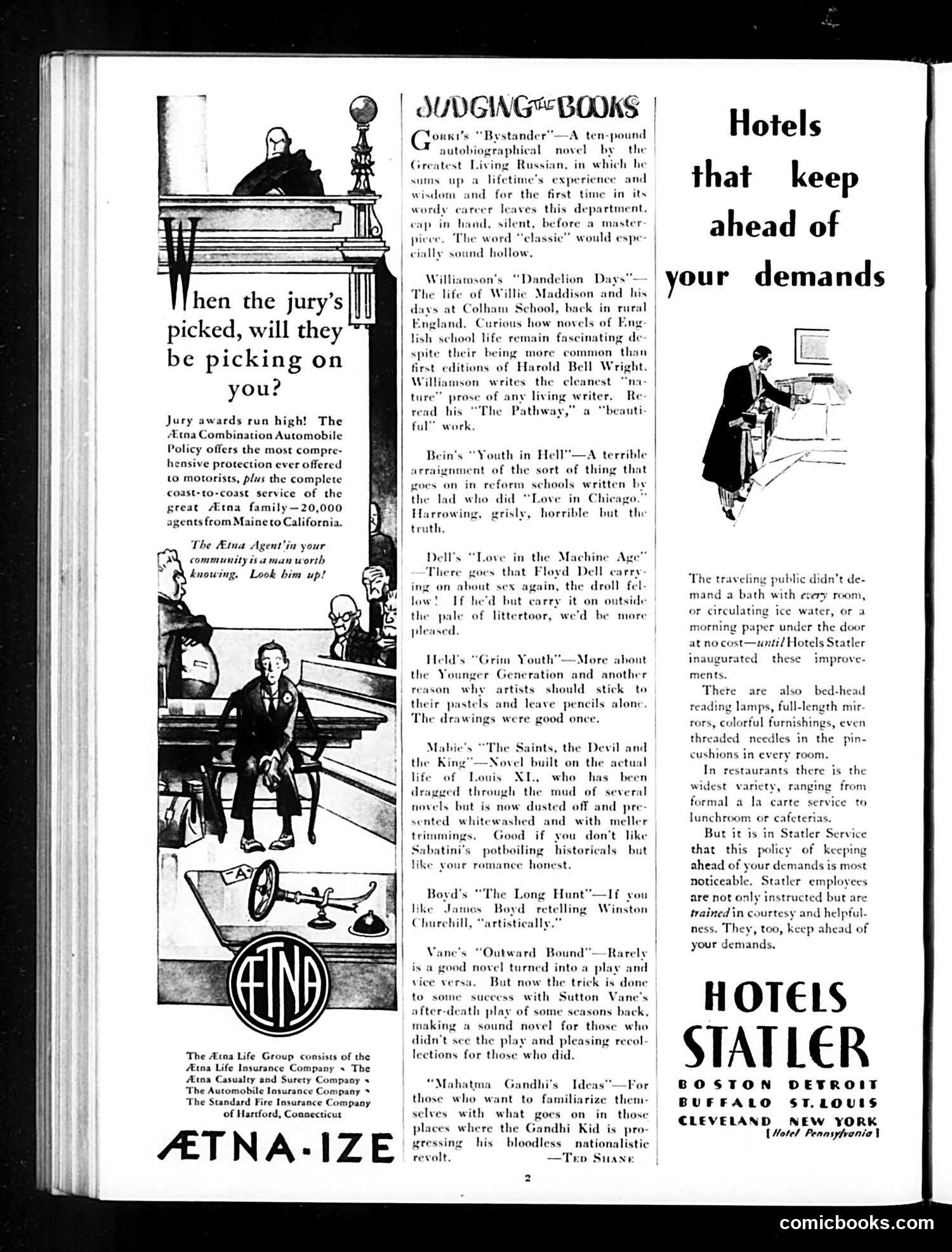
# Page Analysis: Judge Magazine This page is primarily **advertising**, not political satire. The left side features an Aetna Insurance ad ("When the jury's picked, will they be picking on you?") showing a courtroom scene with various figures, emphasizing comprehensive coverage for motorists. The center contains "Judging the Books"—brief literary reviews of novels by Gorky, Williamson, Behn, Dell, and others. These are genuine book critiques, not satire. The right side advertises **Hotels Statler**, emphasizing modern amenities (reading lamps, mirrors, furnishings, circulating ice water, morning papers) as innovations that "keep ahead of your demands." There is **no political cartoon** on this page. It represents typical Judge magazine content: advertising mixed with cultural commentary, reflecting 1920s consumer culture and literary interests.
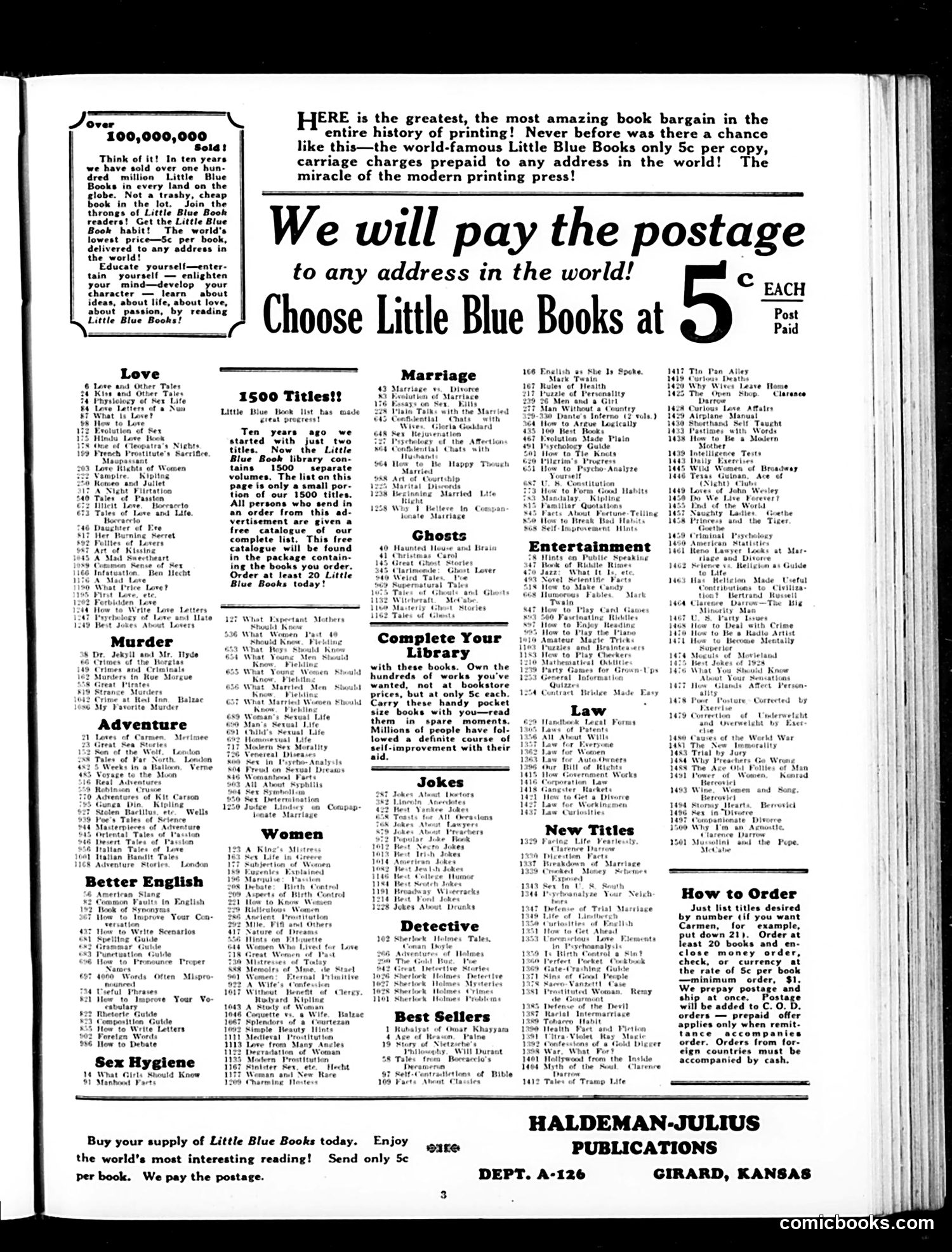
# Analysis This page is **primarily advertising**, not editorial content or political satire. It features a full-page advertisement for Haldeman-Julius Publications promoting their "Little Blue Books" — inexpensive 5-cent paperback volumes available by mail with prepaid postage worldwide. The ad emphasizes the books' affordability and breadth, listing 1,500 titles across categories including Love, Marriage, Ghosts, Entertainment, Law, Jokes, Women, Detective stories, and Best Sellers. It's a straightforward commercial pitch highlighting the "greatest book bargain in the entire history of printing" rather than satirical commentary. The page represents early 20th-century direct-mail marketing and the democratization of literature through cheap printing technology.
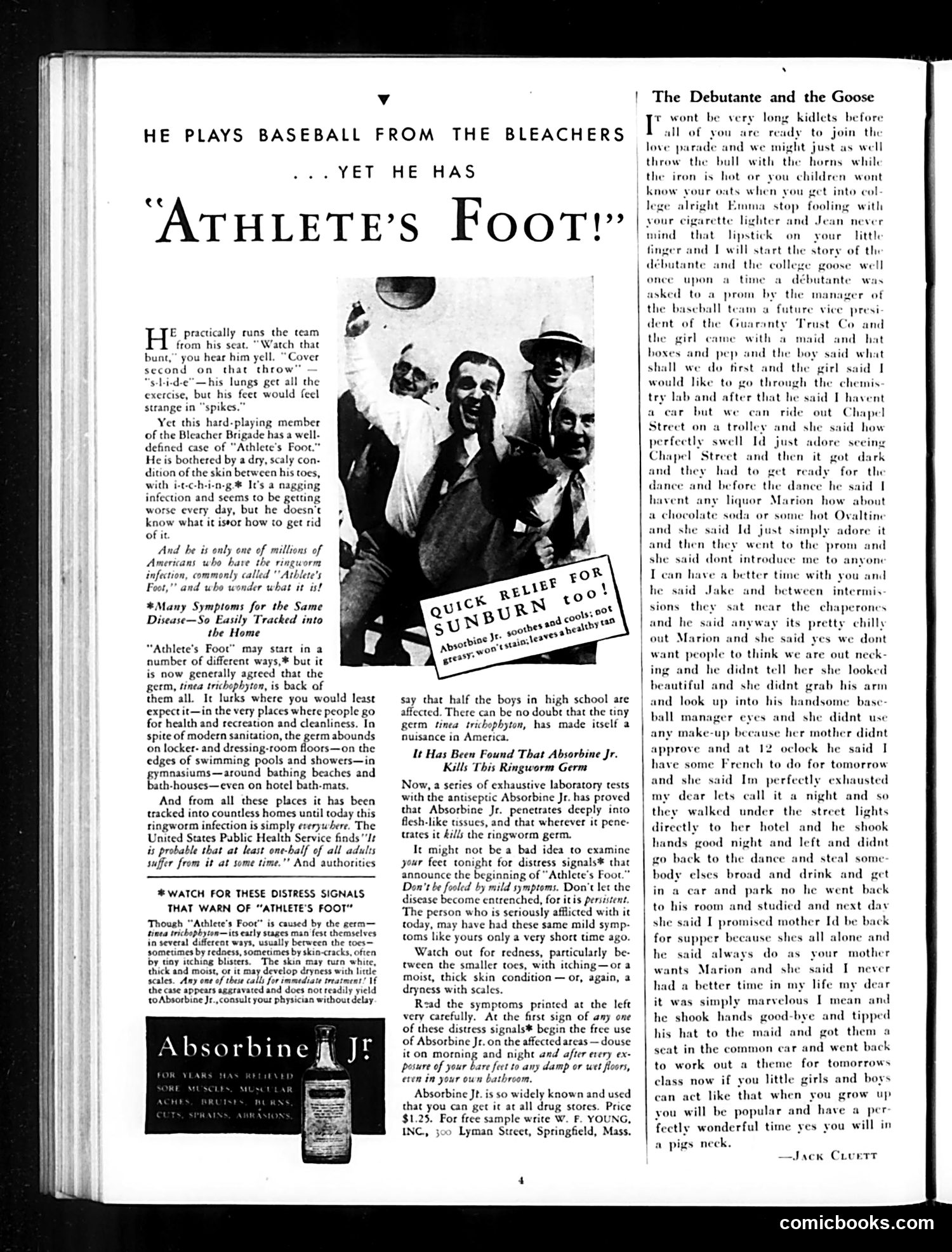
# Analysis of Judge Magazine Page This page is primarily **advertising disguised as editorial content**. The main feature is a large advertisement for Absorbine Jr., a patent medicine marketed for "Athlete's Foot" fungal infection. The left column uses satirical humor: a baseball player suffers from athlete's foot despite his athletic prowess—the ironic contradiction being the joke. The text mocks how widespread this fungal infection was, calling it "one of millions of Americans" afflicted by "Athlete's Foot." The right side contains "The Debutante and the Goose," an unrelated short story by Jack Cluett about young socialites preparing for a dance. The page exemplifies early 20th-century magazine practices: blending paid advertising with entertainment content, using humor to promote commercial products without clear distinction between editorial and promotional material.
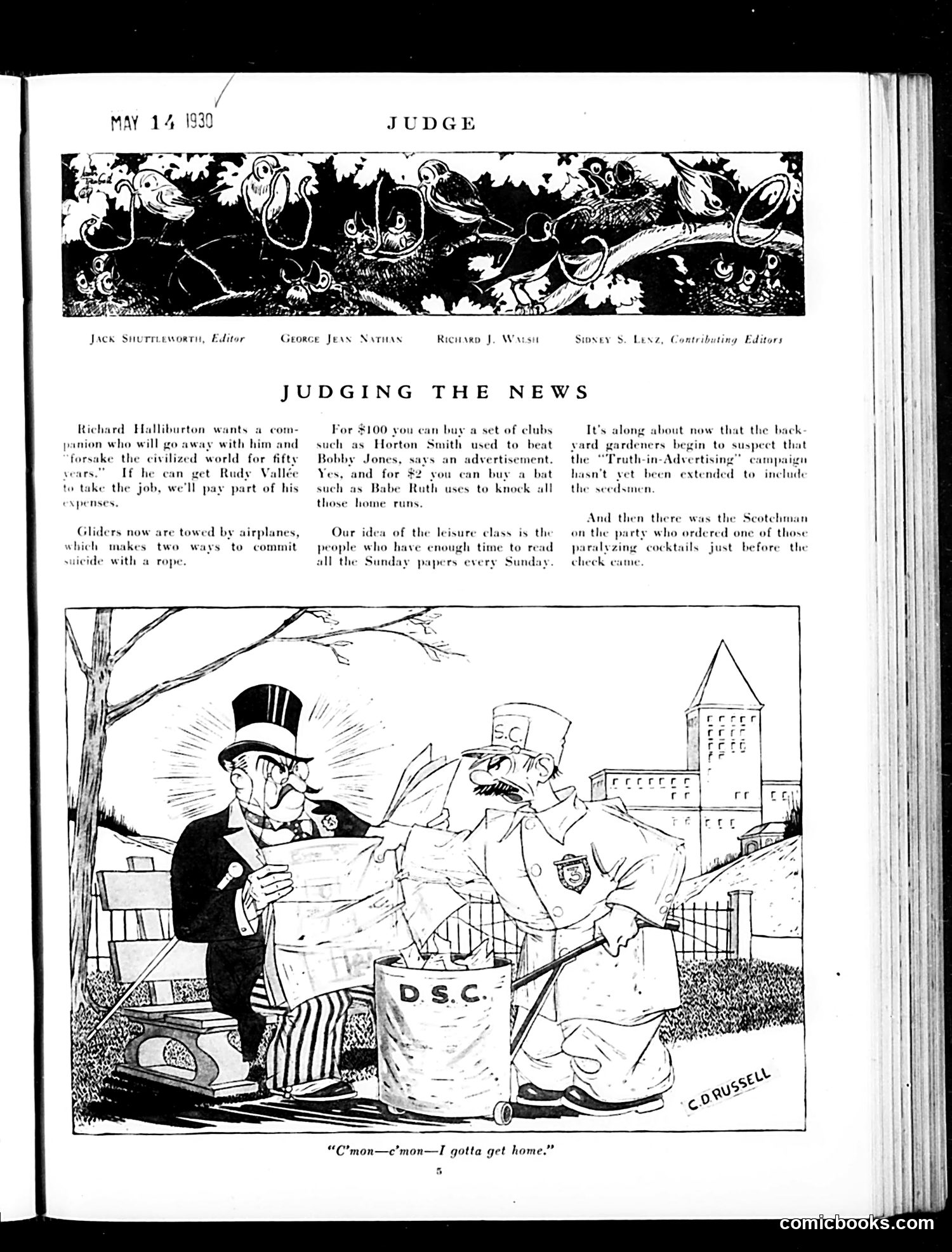
# Judging the News - May 14, 1930 The cartoon depicts a man in formal attire (top hat) labeled "C'mon—c'mon—I gotta get home," holding what appears to be a map, speaking to a uniformed officer standing in a D.S.C. (Distinguished Service Cross) barrel. The satire appears to target government bureaucracy or military administration during the Great Depression era. The accompanying text references Richard Halliburton (an adventurer), Rudy Vallée (entertainer), golf club advertisements, and leisure activities. The joke likely critiques how wealthy individuals pursued frivolous pastimes while ordinary citizens struggled economically. The bureaucratic figure and the "gotta get home" complaint suggest commentary on government inefficiency or red tape frustrating the public during this period of national hardship.
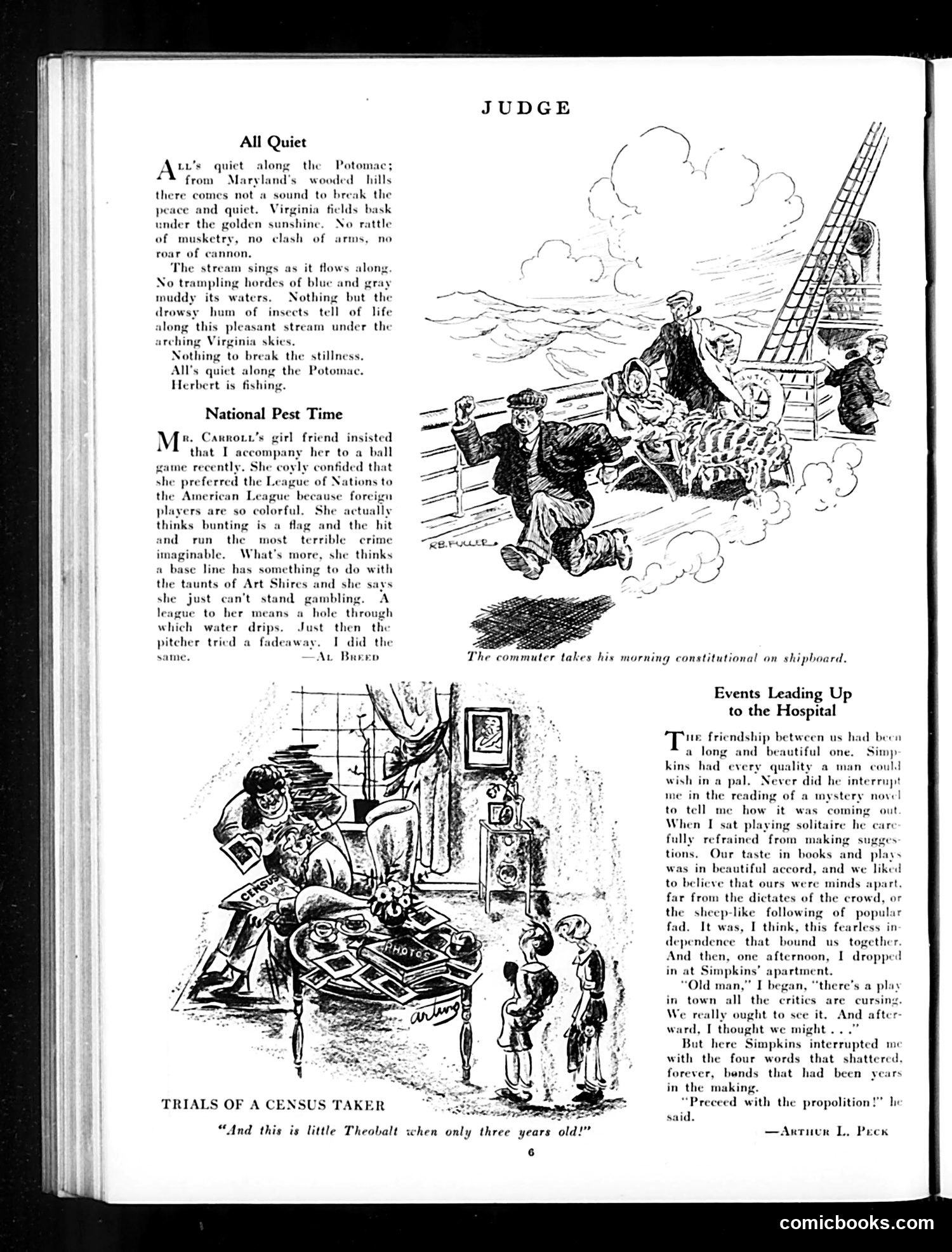
# "Judge" Page Analysis This page contains three humorous pieces satirizing early 20th-century American life: **"All Quiet"** mocks the peaceful Potomac River and Virginia countryside during what appears to be peacetime, contrasting bucolic scenes with Herbert (likely a fishing reference to a public figure). **"National Pest Time"** satirizes baseball fandom through a woman who conflates baseball with crime—she prefers international League of Nations games because American League players are "too colorful" and thinks baseball involves criminal activity. The joke targets both gender stereotypes about women understanding sports and contemporary baseball culture. **"Trials of a Census Taker"** (bottom cartoon) depicts a census-taker overwhelmed by chaotic domestic scenes, illustrating the absurdities encountered during census work, likely from the 1920 or 1930 census period. The Arthur L. Peck byline credits the final piece.
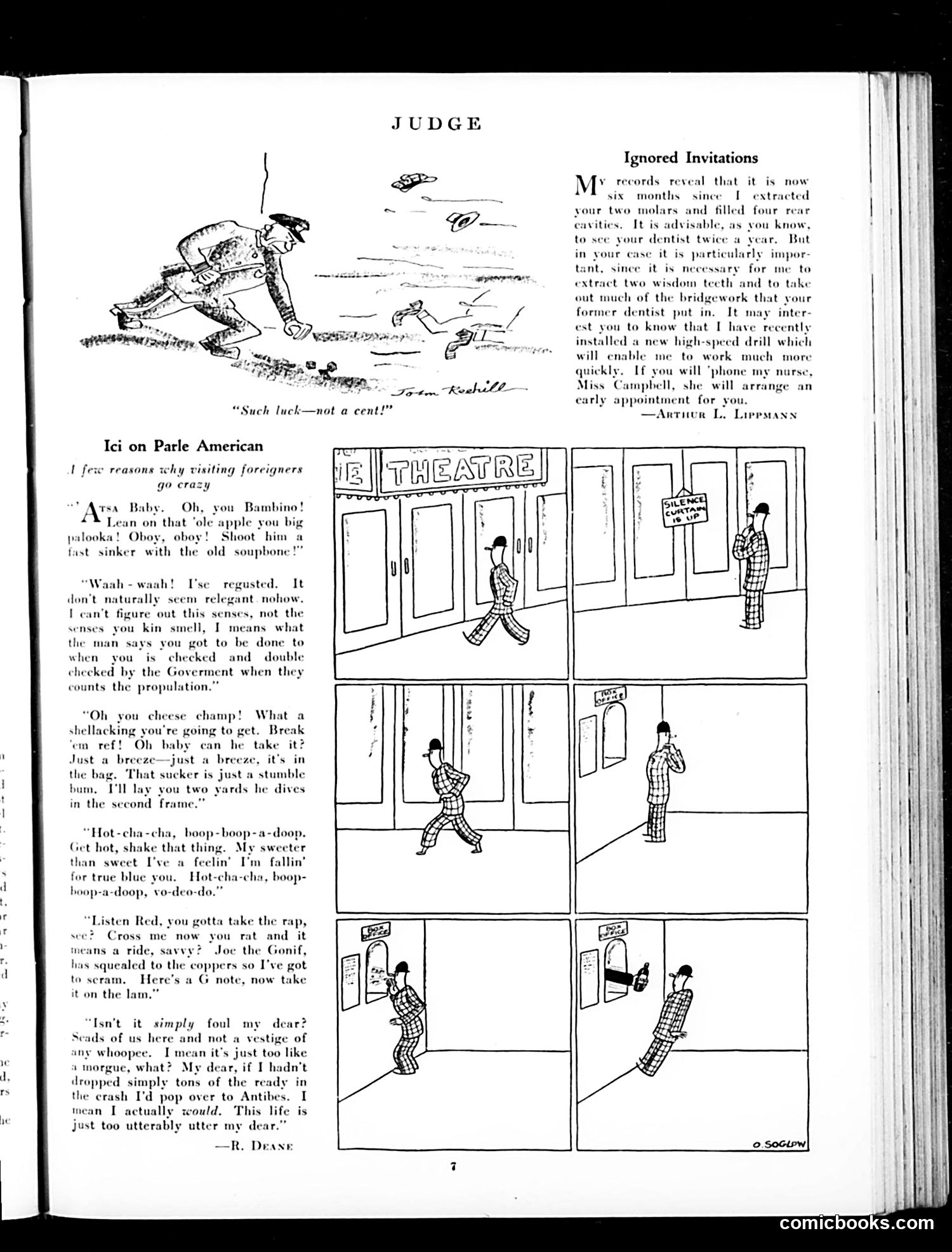
# Page Analysis: Judge Magazine **Top Section - "Ignored Invitations":** A dentist's letter sarcastically congratulates a patient on avoiding dental care for six months, recommending urgent treatment (wisdom teeth extraction, bridgework replacement) and mentioning a new high-speed drill. The cartoon caption "Such luck—not a cent!" shows a man unable to pay, suggesting the satire targets both patients who neglect appointments and the financial burden of dental work. **Bottom Section - "Ici on Parle American":** This satirizes how foreigners perceive American speech and behavior as bewilderingly vulgar. The exaggerated dialogue includes: baseball slang ("soupbone"), incomprehensible colloquialisms about census-taking, Jazz Age references ("Hot-cha-cha, boop-boop-a-doop"), gangster slang ("take the rap," "the lam"), and affected British affectations ("simply foul my dear"). The joke is that American English—spanning low slang to pretentious mimicry—confuses and appalls educated foreign visitors.
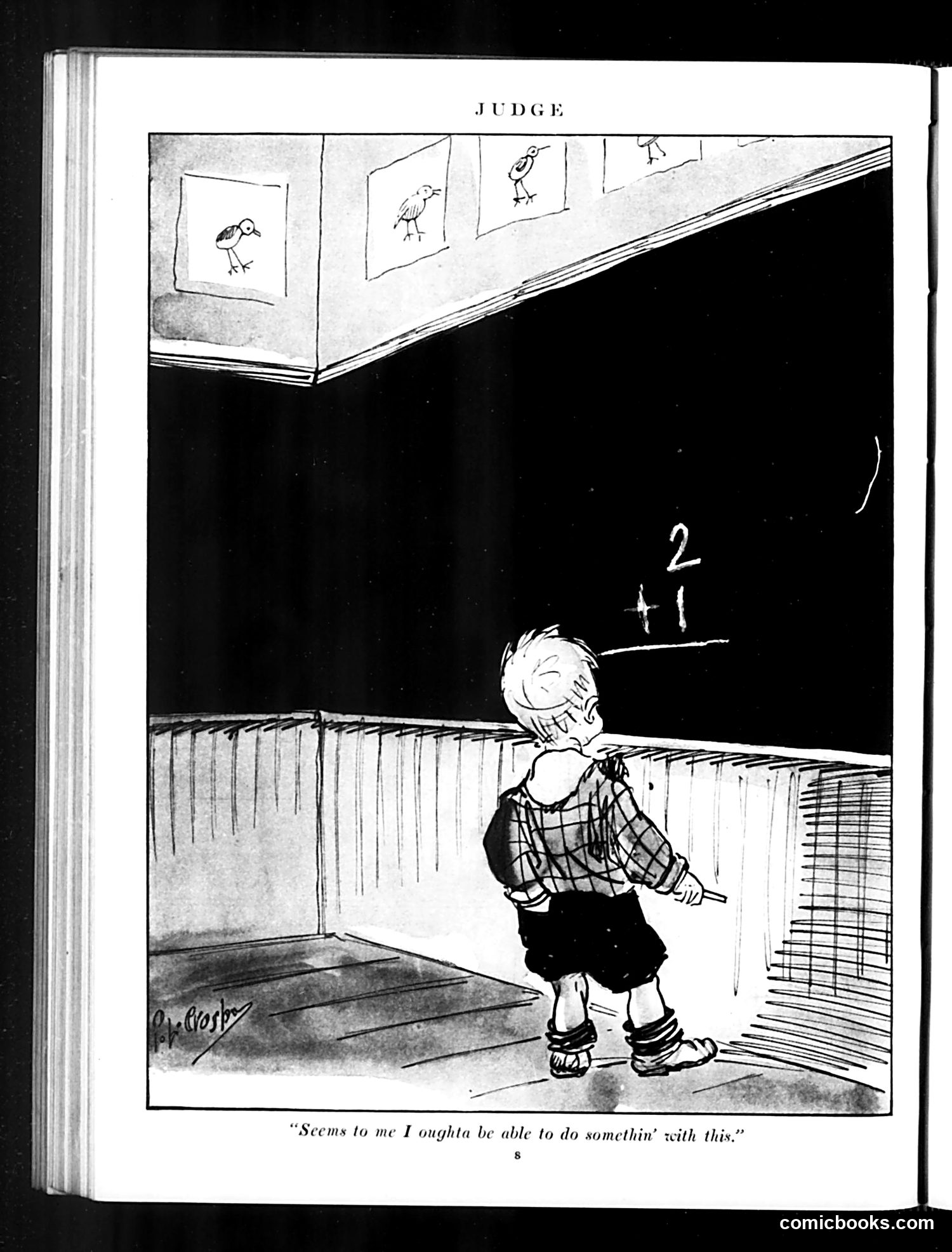
# Analysis This is a single-panel cartoon from *Judge* magazine. The image shows a young child in a classroom standing before a blackboard displaying simple arithmetic ("2 + 1 ="). On the wall above are children's drawings of birds. The child remarks, "Seems to me I oughta be able to do somethin' with this." The satire appears to target the gap between a child's overconfidence and actual capability. The humor lies in the child's presumption that basic arithmetic should enable them to accomplish something meaningful, when in reality it represents only elementary learning. This likely critiques either overeager youth, inadequate education, or inflated expectations about what minimal skills can achieve—a common theme in early 20th-century American satire about education and ambition.
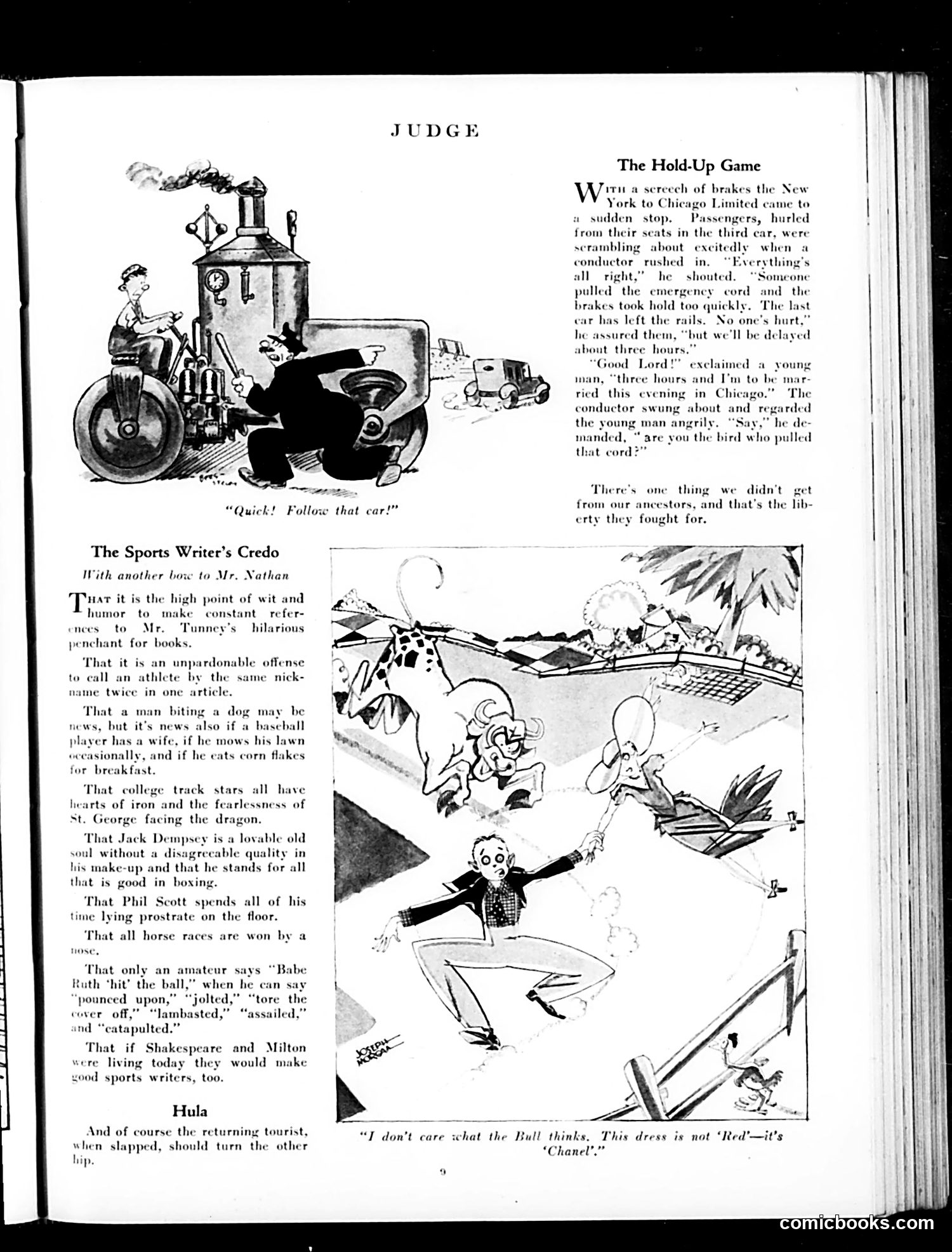
# "The Hold-Up Game" and "The Sports Writer's Credo" **The Hold-Up Game** (top): A train emergency-cord incident delays a passenger's wedding. The satire suggests petty inconveniences—a three-hour delay—prompt passengers to blame the conductor, mirroring how people reflexively demand someone be held responsible for minor disruptions, regardless of actual fault. **The Sports Writer's Credo** (bottom): A humorous list mocking sportswriting clichés of the era. It ridicules the requirement to use varied vocabulary for athletic actions ("jolted," "lambasted," "assailed") rather than simple verbs; romanticizes athletes as morally flawless; and notes excessive description (Jack Dempsey as "lovable," horse races always won by "a nose"). The caption cartoon jokes about fashion terminology—a woman insists her dress is "Chanel" couture, not merely "Red," mocking materialistic status-signaling. Both pieces satirize contemporary American superficiality: the first in public behavior, the second in sports journalism and consumer culture.
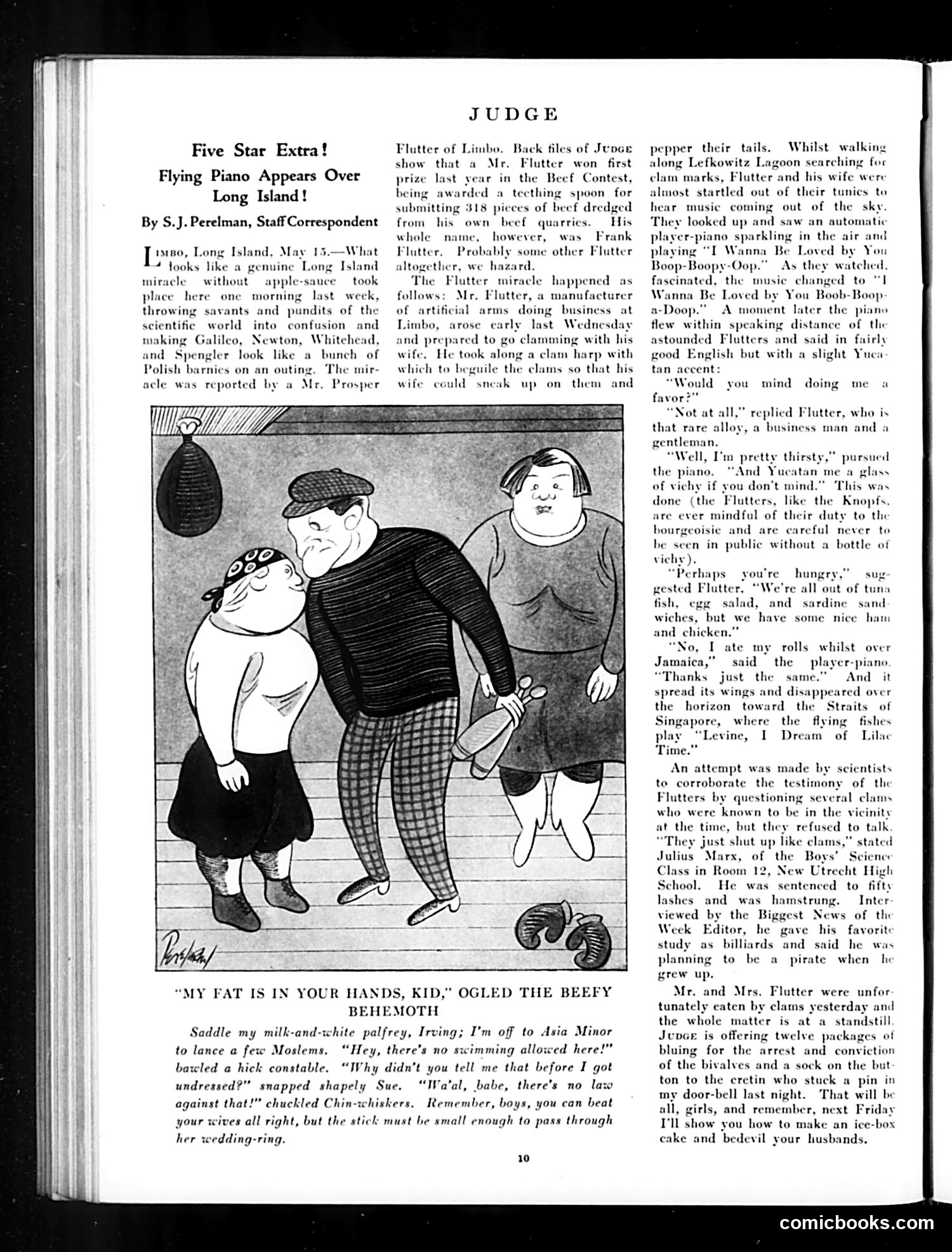
# Judge Magazine Satire Analysis This is a humorous tall tale by S.J. Perelman (a prominent satirist) about a flying piano appearing over Long Island. The cartoon depicts three figures encountering this absurdity—a portly man (Mr. Flutter) and companions reacting to an impossible event. The satire mocks several things: the credulity of newspaper readers who'd believe outlandish "miracles," the contrast between scientific rationalism (Galileo, Newton referenced) and superstition, and the pretensions of the upper-middle class (the Flutters' concern with propriety, serving vichy to a flying piano). The sidebar jokes are period-specific humor about marriage ("you can beat your wives...but the stick must be small enough"), innocent flirtation ("Why didn't you tell me that before I got undressed?"), and absurdist non-sequiturs. The real joke: this fantastical story is presented as journalism, satirizing Judge magazine's own sensationalist "news" style and readers' appetite for the ridiculous.