
Judge, 1930-05-17 · page 30 of 36
Judge — May 17, 1930 — page 30: what you’re looking at
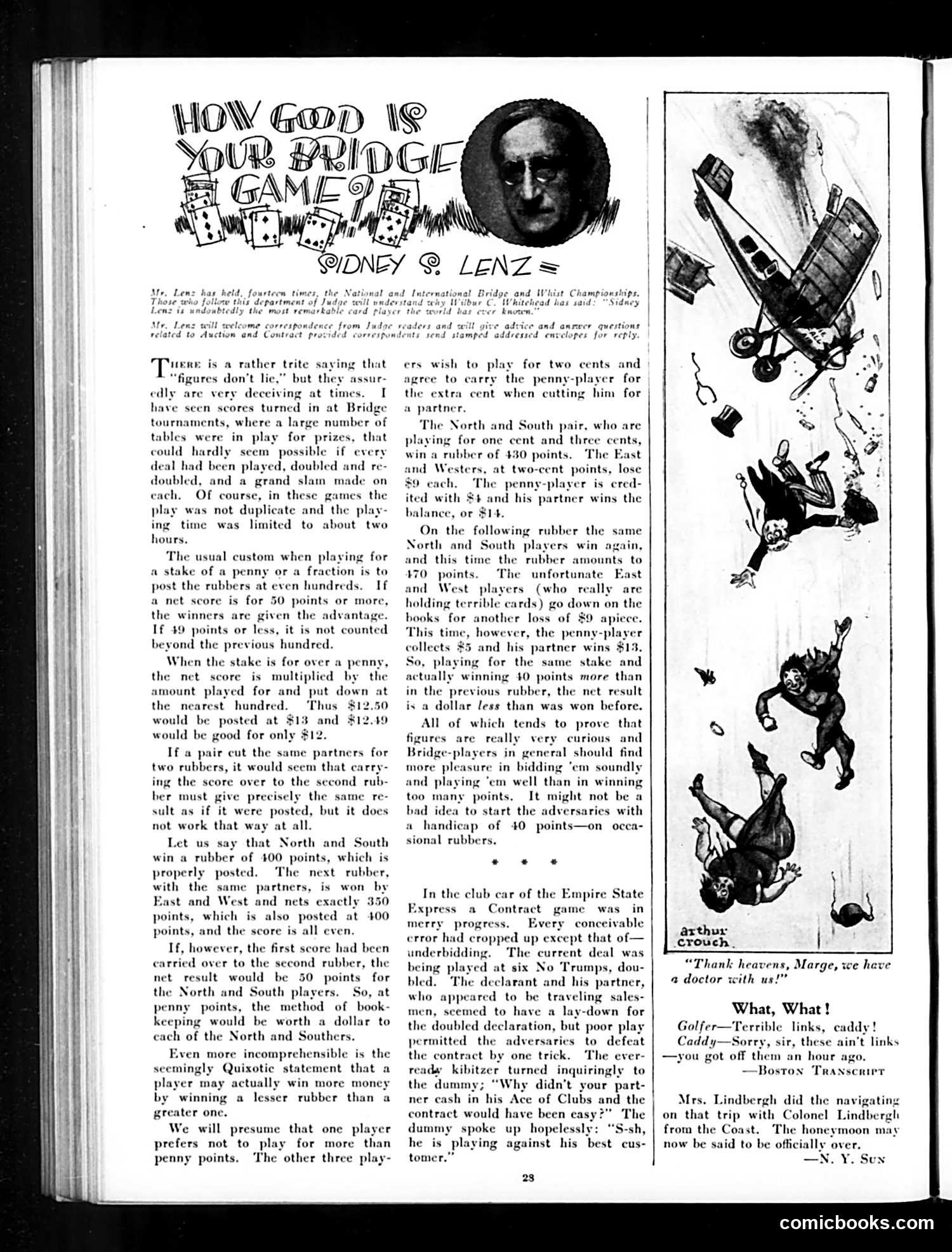
A restored page from Judge, 1930-05-17. Page through the whole issue in the reader above.
📄 Transcribed text from this page (OCR, searchable)
Machine-transcribed from the original scan — historical spelling and the odd misread are preserved.
cre is a rather trite saying that figures don’t lic,” but they a edly are very deceiving at times. have seen scores turned in at Bridge tournaments, where a large number of tables were in play for priz could hardly seem” possible deal had been played, doublec doubled, and a grand slam m h. Of course, in these games the play was not duplicate and the play- ing time was limited to about hours. if every two The usual custom when playing for a stake of a penny or a fraction is to post the rubbers at even hundreds. If a net score is for 50 points or more, the winners are given the advantage. If 49 points or less, it is not counted beyond the previous hundred. When the stake is for over a penny, the net score is multiplied by the amount played for and put down at the nearest hundred. ‘Thus would be posted at would be good for on ame partners for two rubbers, it would seem that carry- If a pair cut the the score over to the second rub- ber must give precisely the same re- sult as if it wer posted, but it does not work that way at all. Let us say that North and South win a rubber of 400 points, which is properly posted. The next rubber, with the same partners, is won by East and West and nets exactly 350 points, which is also posted at 400 points, and the score is all even. If, however, the first score had been carried over to the second rubber, the net result would be 50 points for the North and South players. So, at penny the method of book- keeping would be worth a dollar to each of the North and Southers. Even more incomprehensible is the seemingly Quixotic statement that a player may actually win more moni by winning a lesser rubber than 4 greater one. points, We will presume that one player prefers not to play for than penny points. ‘The other three play- more ge and Whist Championships. itehead has said: “Sidney and anrver questions envelopes for reply ers wish to play for two cents and agree to carry the penny-player for the extra cent when cutting him for a partner. The North and South pair, who are playing for one cent and three cents, win a rubber of 430 points. The East and Westers, at two-cent points, lose $9 each. The penny-pl ited with $4 and his partn balance, or $14. On the following rubber the sa North and South players win and this time the 470 points. The and West. players holding terrible c books for anoth This time, collects or is cred- r wins the rubber amounts to unfortunate East (who really are rds) go down on the loss of $9 apiece however, the penny nd his partner wins So, playing for the same stake and actually winning 40 points more than in the previous rubber, the net result is a dollar less than was won before. All of which tends to prove that figures really curious and Bridge-players in general should find sure in bidding ‘em soundly ng ‘em well than in winning any points, It might not be a r to start the adversaries with a handicap of 40 points—on occa- sional rubbers, very In the club car of the Empire State Express a Contract game in merry progress. Every a error had cropped up ex underbidding. The current deal was being played at six No Trumps, dou- bled. The declarant and his partner, who appeared to be traveling sales- men, seemed to have a lay-down for the doubled declaration, but poor play permitted the adversaries to. defe the contract by one trick. P ever- readw kibitzer turned inquiringly to the dummy; “Why didn’t your part- ner cash in his Ace of Clubs and the contract would have been eas dummy spoke up hopelessly: “S-sh, he is playing against his best cus- tomer.” 23 crouch. “Thank heavens, Marge, we have a doctor with us!” What, What! Golfer—Terrible links, caddy! Caddy—Sorry, sir, these ain't links —you got off them an hour : —Bosre Mrs. Lindbergh did the n: on that t with Colonel I from the Coast. The hon now be said to be offici, comicbooks.com