
Judge, 1930-05-17 · page 27 of 36
Judge — May 17, 1930 — page 27: what you’re looking at
A restored page from Judge, 1930-05-17. Page through the whole issue in the reader above.
📄 Transcribed text from this page (OCR, searchable)
Machine-transcribed from the original scan — historical spelling and the odd misread are preserved.
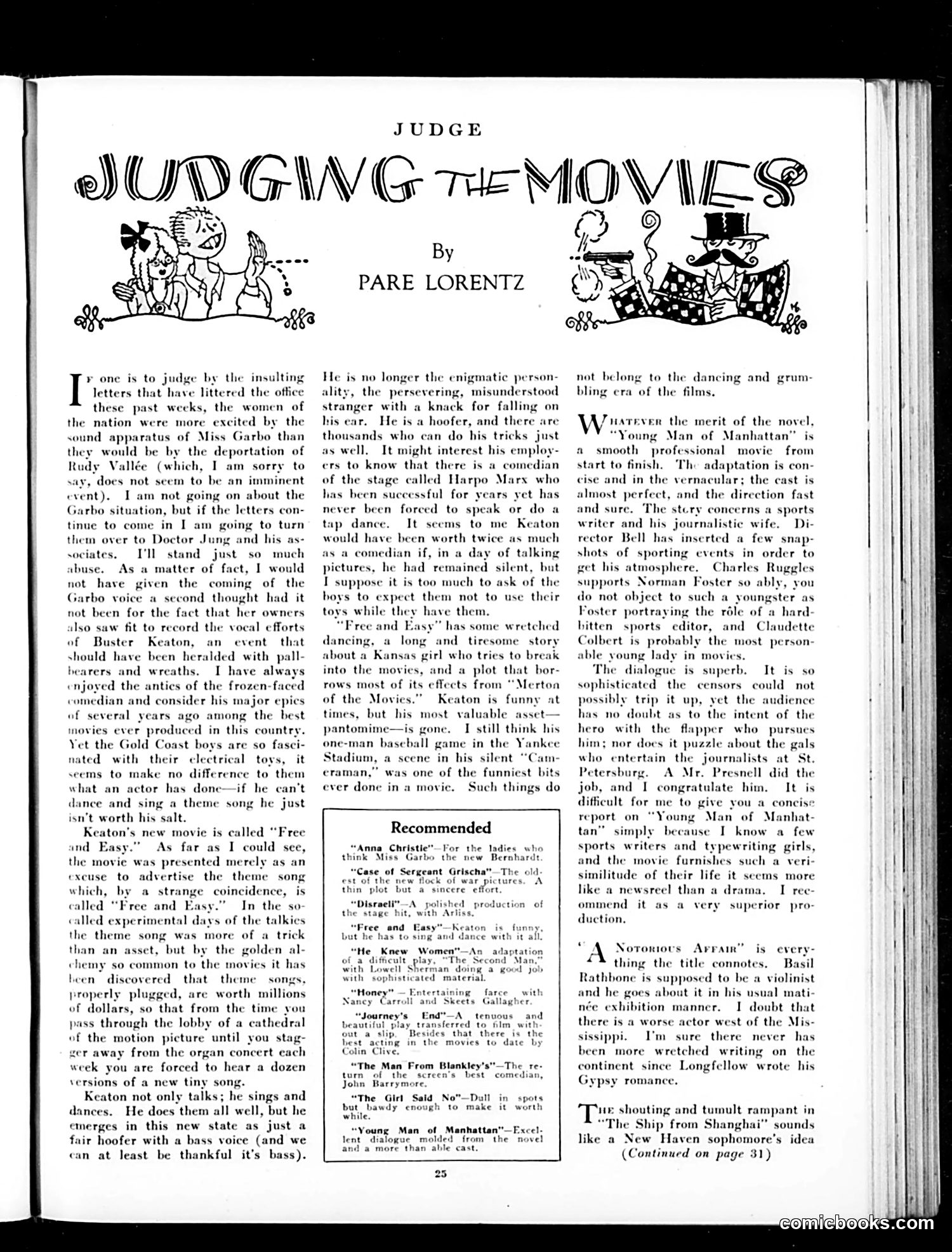
JUDGE ed) UVDGWG THE IOV ¥ one is to judge by the insulting I letters that have littered the office these past weeks, the women of the nation were more excited by the sound apparatus of Miss Garbo than they would be by the deportation of Rudy Vallée (which, I . to ay, does not seem to be event). Iam not going Garbo situation, but if the letters con- tinue to come in I am going to turn them over to Doctor ng and his as- sociates. I'll stand just so much ibuse. As a matter of I would not have given the coming of the Garbo voice a second thought had it been for the fact that her owners also saw fit to record the vocal efforts of Buster Keaton, an event that should have been heralded with ps rers and wreaths. I have always enjoyed the antics of the frozen-faced comedian and consider his major epics of several years among the best movies ever produced in this countr Yet the Gold Coast boys are so fase nated with their electrical toys, it seems to make no difference to them what an if he can’t dance and sing a theme song he just isn't worth his salt. Keaton's new movie is called “Free ind Easy.” As far as I could see, the movie was presented merely as an exeuse to advertise the theme song which, by a strange coincidence, is called “I nd Easy.” In the so- called experimental days of the talkies the theme song was more of a trick n asset, but by the golden al- y so common to the movies it he heen that theme properly plugged, are worth millions of dollars, so that from the tim 0 pass through the lobby of a cathedral ef the motion picture until you stag- ver away from the organ concert each week you forced to hear a dozen versions of a new tiny song. Keaton not only talks; he sings and dances. He does them all well, but he emerges in this new state as just a fair hoofer with a bass voice (and we an at least be thankful it’s bass). actor has done discovered songs, By PARE LORENTZ » longer the enigmatic person- persevering, misunderstood inger with a knack for falling on his ear. He is a hoofer, and there are thousands who can do his tricks just as well. It might interest his employ- ers to know t there is a comedian of the sta called Harpo Marx who has been successful for rs yet has never been forced to speak or do a tap dance. It seems to me would have been worth twice a comedian if, ina day of pictures, he had remained silent, but I suppose it is too much to ask of the boys to expect them not to use their toys while they have them. “Free and Eas) dancing, a long and tiresome story about a Kansas girl who tries to break into the movies, and a plot that bor- rows most of its effects from “Merton of the Movies.” Keaton is funny at times, but his most valuable asset— pantomime—is gone. I still think his one-man baseball game in the Yankee Stadium, a scene in his silent “Cam- eraman,” was one of the funniest bit ever done ina movie. Such things do "has some wretched Recommended “Anna Christie”—For the ladies wl think Miss Garbo the new Bernha The old tures. A “Case of Sergeant Grisch: est of the new flock of war thin plot but a sincere ef “Disraeli”—A polished p © stage hit, with Ari “Free and Easy but he has with Lowell Sherman doing @ ticated material. “Honey” — Ente ey Carroll ining farce and Skeets Gallagher. Journey's End"—A tenuous autiful play transferred to film w ta slip. Besides that there i nest acting in the movies to date Colin Clive. “The Man From Blankley’s"—Th turn of the screen's. best’ com: John Barrymore. “The Girt Said No”—Dull but bawdy enough to make while. in spots young Man of Manhattan"—Fxce nt dialogue molded from the nov Ja more than able cast. 25 not belong to the dancing and grum- bling era of the films. V Juareven the merit of the novel, “Young Man of Manhattan” is a smooth professional movie from start to finish. Tho adaptation is con- cise and in the vernacular; the cast is almost perfect, and the direction fast and sure. The story concerns a sports writer and his journalistic Di- rector Bell has inserted a few snap- shots of sporting events in order to get his atmosphere. Charles Ruggles supports Norman Foster so ably, you do not object to such a youngster as Foster portraying the role of a hard- bitten sports editor, and Claudette Colbert is probably the most person able young lady in movies. The dialogue is superb. It sophisticated the censors could not possibly trip it up, yet the audience has no doubt as to the intent of the with the flapper who pursues him; nor does it puzzle about the gals who entertain the journalists at St. Presnell did the wife. is so hero A Mr. job, and I congratulate him. It is difficult for me to give you a concise report on Man of Manhat- tan” simply because I know a few sports writers and typewriting girls, and the movie furnishes such a veri- ilitude of their life it seems more a newsreel than a drama, I ree ommend it as a very pro- duction, Petersburg. “Young superior Notoniovs Arran’ is eve thing the title connotes. Basil Rathbone is supposed to be a violinist and he goes about it in his usual mati- née exhibition manner. I doubt that there is a worse actor west of the Mis- sissippi. I'm sure there never has been more wretched writing on the continent since Longfellow wrote his Gypsy romance. Ship from Shanghai” sounds © a New Haven sophomore’s idea (Continued on page 31)