
Judge, 1930-05-17 · page 18 of 36
Judge — May 17, 1930 — page 18: what you’re looking at
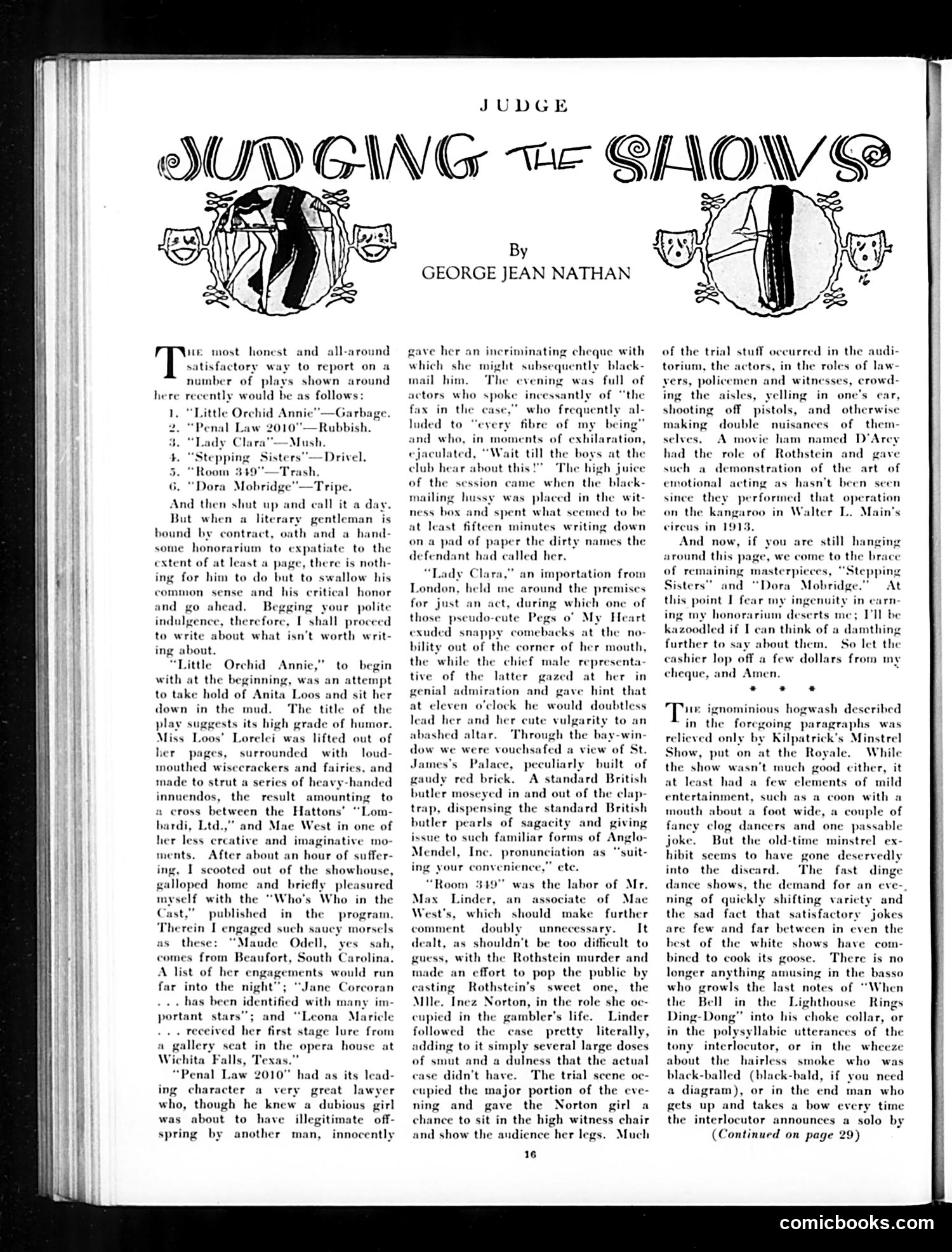
A restored page from Judge, 1930-05-17. Page through the whole issue in the reader above.
📄 Transcribed text from this page (OCR, searchable)
Machine-transcribed from the original scan — historical spelling and the odd misread are preserved.
JUDGE ING we GAOWS ie most honest and all-around satisfactory way to report on a number of plays shown around recently would be as follows: 1, “Little Orchid Annie’—Garb: 2 1 Law 2010"—Rubbish. 3 r Mush. +. i Sisters" —Drivel. 5. “Room 4 Trash. G. “Dora Mobridge”—Tripe. here And then shut up and eal it But when a literary gentleman bound by cont oath and a hand- some honorarium to expatiate to the extent of at least a page, there is noth- ing for him to do but to swallow his common sense and his critical honor and go ahead. Begging your polite indulgence, therefore, I shall proceed to write about what isn't worth writ- ing about. “Little Orchid Annie,” to begin with at the beginning, was an attempt to take hold of Anita Loos and sit her down in the mud. The title of the play suggests its high grade of humor. Miss Loos’ Lorelei was lifted out of her pages, surrounded with loud- mouthed wisecrackers and fairies, and made to strut a series of heavy-handed innuendos, the result amounting to a cross between the Hattons’ ‘Lom- bardi, Ltd.," and Mae West in one of her less ercative and imaginative mo- ments. After about an hour of suffer- ing, I scooted out of the showhouse, galloped home and briefly pleasured myself with the “Who's Who in the Cast,” published in the program. Therein I engaged such saucy morsels as these: “Maude Odell, yes sah, 1 Beaufort, South Carolina. A list of her engagements would run far into the night”; “Jane Corcoran . «has been identified with many im- portant stars”; and “Leona Maricle . received her first stage lure from a gallery Wichita comes fre seat in the opera house at alls, Texas.” “Penal Law 2010" had ing character a very great lawyer who, though he knew a dubious girl was about to have illegitimate off- spring by another man, innocently as its lead- By GEORGE JEAN NATHAN gave her an incriminatin, which she quently black- him. The evening was full of actors who spoke incessantly of “the fax in the case,” who frequently al luded to “every fibre of my being’ and who, in moments of exhilaration, jaculated, “Wait till the boys the club hear about this!” The high juice of the session came when the black- mailing hussy was placed in the wit- ness box and spent what seemed to be at least fifteen minutes writing down ona pad of paper the dirty names the defendant had called her. cheque with “Lady Clara,” an importation from London, held me around the premises for just an act, during which one of those pseudo-cute Pegs o' My Heart exuded snappy comebacks at the no ility out of the corner of her mouth, while the chief male representa of the latter ed at her in ation and gave hint that lock he would doubtless do her and her cute vulgarity to an altar. Through the bay-win- dow we were vouchsafec view of St. James's Palace, peculiarly built of gaudy red brick. A standard British butler moseyed in and out of the clap- trap, dispensing the standard British butler pearls of sagacity and giving issue to such familiar forms of Anglo- Mendel, Inc. pronunciation as “suit- ing your convenience,” et “Room 349" was the Max Linder, an associ: West's, which should make further comment doubly unnecessary. — It alt, as shouldn't be too difficult to guess, with the Rothstein murder and made an effort to pop the public by casting Rothstein's sweet one, the Mlle. Inez Norton, in the role she oc- cupied in the gambler’s life. Linder followed the case pretty literally, adding to it simply several large doses of smut and a dulness that the actual case didn't have. The trial scene oc- cupied the major portion of the eve- ning and gave the Norton girl a chance to sit in the high witness chair and show the andience her legs. Much 16 bor of Mr. of Mae of the trial stuff occurred in the audi- torium, the actors, in the roles of law vers, policemen and witnesses, crowd- ing the aisles, yelling in one's car, shooting off pistols, and otherwise making double nuisances of them- selves. A movie ham named D'Arcy had the role of Rothstein and gave such a demonstration of the art of emotional acting as hasn't been seen since they performed that operation on the kangaroo in Walter L. Main’s circus in : And now, if you are still hi around this page, we come to the b f remaining ters” and this point I asterpieces, “Stepping Dora Mobridge.” At my ingenuity rium deserts an think of a damthing further to about them, » let the cashier lop off a few dollars from my cheque, and Amen. : * 8 « T" ignominious hi in the foregoing agraphs was relieved only by Kilpatrick's Minstrel Show, put on at the Royale. While the show wasn't much good cither, it at least had a few elements of mild inment, such as a coon with a about a foot wide, a couple of fancy clog joke. But the old- hibit seems to have gone deservedly into the discard, The fast dinge dance shows, the demand for an eve- ning of quickly shifting variety the sad fact that satisfactory jokes are few and far between in ev hest of the white shows ha bined to cook its goose. There is no longer anything amusing in the basso who growls the last notes of ‘When the Bell in the Lighthouse Rings Ding-Dong” into his choke collar, or in the polysylabic utterances of the tony interlocutor, or in the wheeze about the hairless smoke who black-balled (black-bald, if you need a diagram), or in the end man who gets up and takes a bow every time the interlocutor announces a solo by (Continued on page 29) nearn- Tl be sh deseribed me minstrel ex- comicbooks.com