
Judge, 1930-05-17 · page 15 of 36
Judge — May 17, 1930 — page 15: what you’re looking at
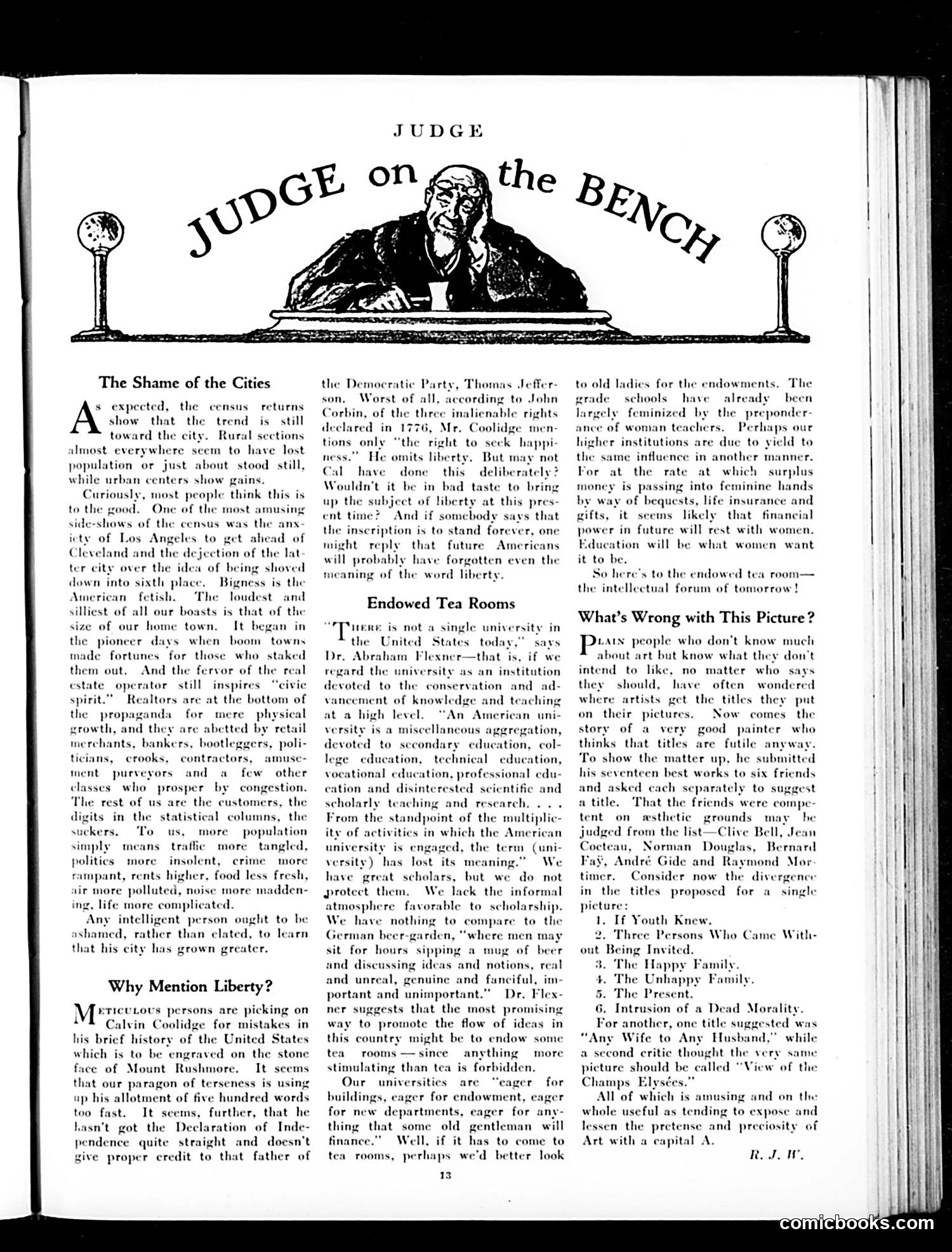
A restored page from Judge, 1930-05-17. Page through the whole issue in the reader above.
📄 Transcribed text from this page (OCR, searchable)
Machine-transcribed from the original scan — historical spelling and the odd misread are preserved.
The Shame of the Cities s expected, the census show that the trend is _ still toward the city. Rural sections ilmost everywhere seem to have lost population or just about stood still, while urban centers show gains. Curiously, most people think this is to the ge One of the most amusing side-shows of the census was the a iety of Los Angeles to get ahes Cleveland and the dejection of the lat ter city over the idea of being shoved down into sixth place, Bigness is the American fetish. The loudest and silliest of all our boasts is that of the size of our home town. It be; the pioneer days when boom towns made fortunes for those who staked them out. And the fervor of the real estate operator still inspires “civic spirit.” Realtors are at the bottom of the pro; nda for physic growth, and they are abetted by retail merchants, bankers, | returns an in mere otleggers, poli- contractors, amuse- purveyors and a few other classes. who’ prosper by congestion. The rest of us are digits in the statistical columns, the suckers. ‘To us, more population simply traffic more tangled, politics more insolent, more rampant, rents higher, food less fresh, tir more polluted, noise more madden- complicated. Any intelligent person ought to be ushamed, rather than elated, to learn that his city has grown greater, ticians, crooks, ment the customers, the means crime ing, life more Why Mention Liberty? IcULOUS persons are picking on Calvin Coolidge for mistakes in M his brief history of the United States which is to be engraved on the stone face of Mount Rushmore. It seems that our paragon of terseness is using up his allotment of five hundred words too fast. It seems, further, that he hasn't got the Declaration of Inde- pendence quite straight and doesn’t give proper credit to that father of JUDGE the Democratic Party, Thomas Jeffer- Worst of all cording to John Corbin, of the three nable rights declared in 17 Mr. Coolidge men- tions only “the right to seek happi ness.” He omits liberty. But may not Cal have done this delibera ? Wouldn't it be in bad taste to brir up the subject of liberty at this pres- ent time? “And if somebody says that the inscription is to stand forever, one might reply that future Americans will probably have forgotten even the meaning of the word liberty. Endowed Tea Rooms “TPirene is not a the United tod says Dr. Abraham Flexner—that is, if we regard the university as an institution devoted to the vancement of knowledg at a high level. “An. Ameri versity is a miscellancous 3 university in conser d- an uni- ation, ration, col- education, vocational education, professional edu- cation and nterested scientific and scholarly teaching and research... From the standpoint of the multiplic- vities in which the American university is engaged, the term (uni- versity) has lost its meaning.” We have gr lars, but we do not protect them. We lack the informal ‘atmosphere favorable to scholarship. have nothing to compare to the an beer-garden, “where men may sit for hours sipping a mug of be and discussing ideas and notions, real and unreal, genuine and fanciful, im- portant and unimportant.” Dr. Flex- ner suggests that the most promising way to promote the flow of ideas in this country might be to e tea rooms — since stimulating than tea is forbidden, Our universities are r for buildings, eager for endowment, r for new departments, eager for any- thing that some old gentleman will finance.” Well, if. it h to come to tea rooms, perhaps we'd better look 13 rere devoted to secondary edu technic: lege education, low some anything — more to old ladies for the endowments. The grade schools already been 1 y feminized by the preponder- woman teachers. Perhaps our higher institutions are due to yield to the same influence in another manner. For at the rate at which surplus money is passing into feminine hands by way of bequests, life insurance and gifts, it seems likely that finan power in future will rest with women Education will be what women want it to be. Soh have e's to the endowed tea room— the intellectual forum of tomorrow ! What’s Wrong with This Picture? Diatw people who don’t know much about art but know what they don't intend to like, no they should, where matter who says have often wondered rtists get the titles they put on their pictures. Now comes the story of a very good painter who thinks that titles are futile anyway. To show the matter up, he submitted his seventeen best works to six friends and asked each sey a title. That the friends were compe tent on wsthetic grounds may judged from the list—Clive Bell, Cc u, Norn Douglas, Be: ¥, André Gide and Raymond Mor timer. Consider now the div in the titles proposed for a picture: 1. If Youth Knew. 2. Three Persons Who Came With- out Being Invited. 3. The Happy +. The Unhappy 5. The Present. 6. Intrusion of a Dead Morality. For another, one title suggested was “Any Wife to Any Husband,” while a second critic thought the very same picture should be called “View Champs Elysées.” All of which is amusing and on the whole useful as te lessen the pretense and preciosity o Art with a capital A. rately to suggest single milly. unily.