A complete issue · 36 pages · 1930
Judge — May 3, 1930
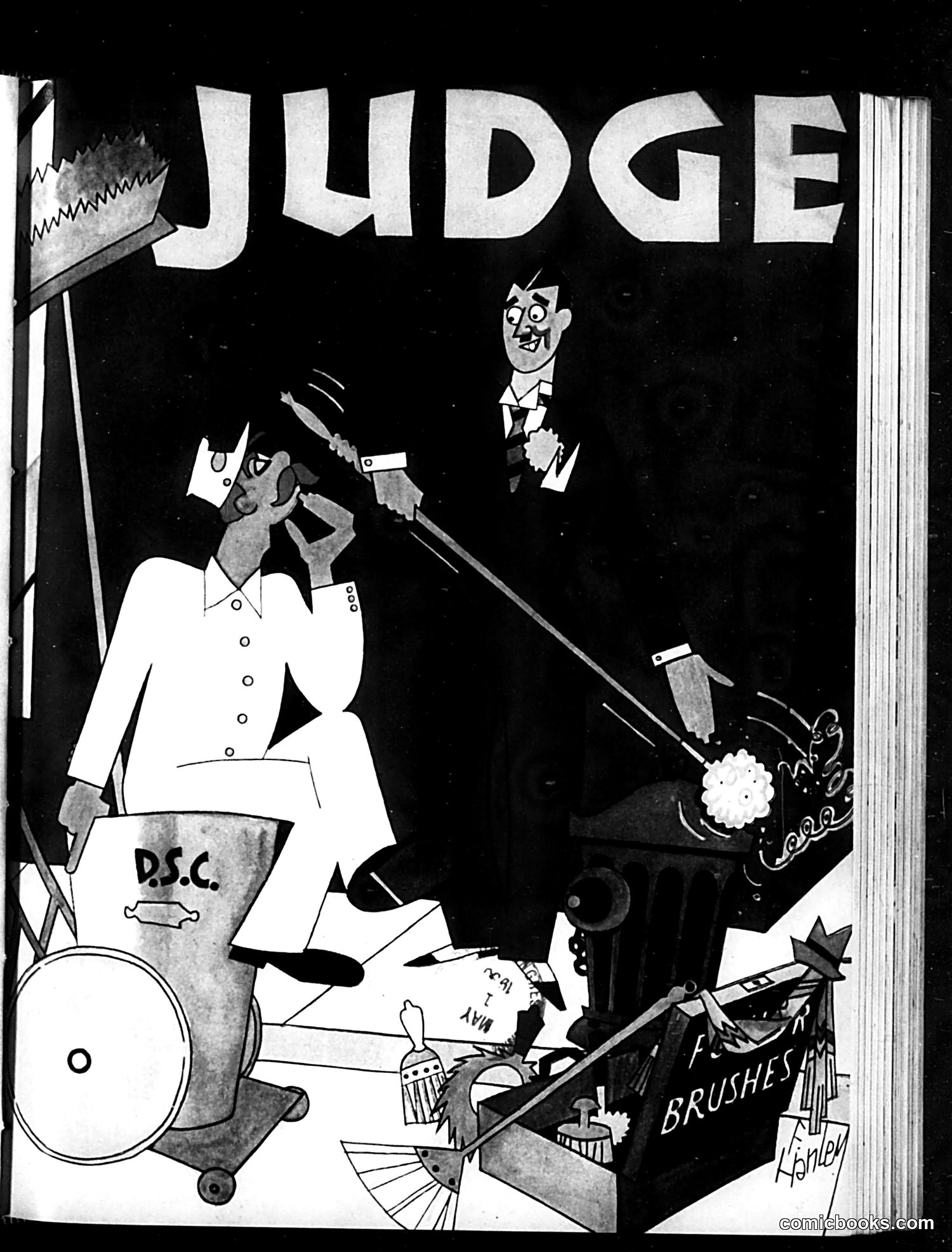
# Judge Magazine Cartoon Analysis This appears to be a **cover or advertisement for Judge magazine** itself, using satirical imagery rather than commentary on a specific political event. The cartoon shows two figures in formal attire appearing to conduct or "judge" painting supplies and brushes displayed below them. The "B.S.C." marking on one figure's outfit and the "BRUSHES" label suggest this is **advertising art supplies or painting materials**. The satire likely plays on Judge's role as an arbiter of taste and humor—positioning the magazine's editors as literal "judges" evaluating commercial products. The exaggerated, cartoonish style of the figures and their theatrical poses emphasize the absurdity of taking such judgment seriously. Without additional context or visible date information, the specific product line or campaign remains unclear.

# Analysis This page is primarily **advertising**, not satire or political commentary. It's an Ethyl Gasoline Corporation advertisement from Judge magazine, likely 1920s-1930s based on styling. The crane image illustrates the ad's metaphor: "The graceful crane depends on its perfect control," paralleling how cars need better fuel for safe handling. The advertisement promotes Ethyl gasoline's anti-knock compound, claiming it improves engine performance and responsiveness—particularly important for new high-compression engines becoming common. The text targets drivers concerned with traffic safety and car performance, positioning Ethyl as a premium product that delivers "control" and "dependable power." There is no political satire present—this is straightforward product marketing using nature imagery to convey reliability and grace.
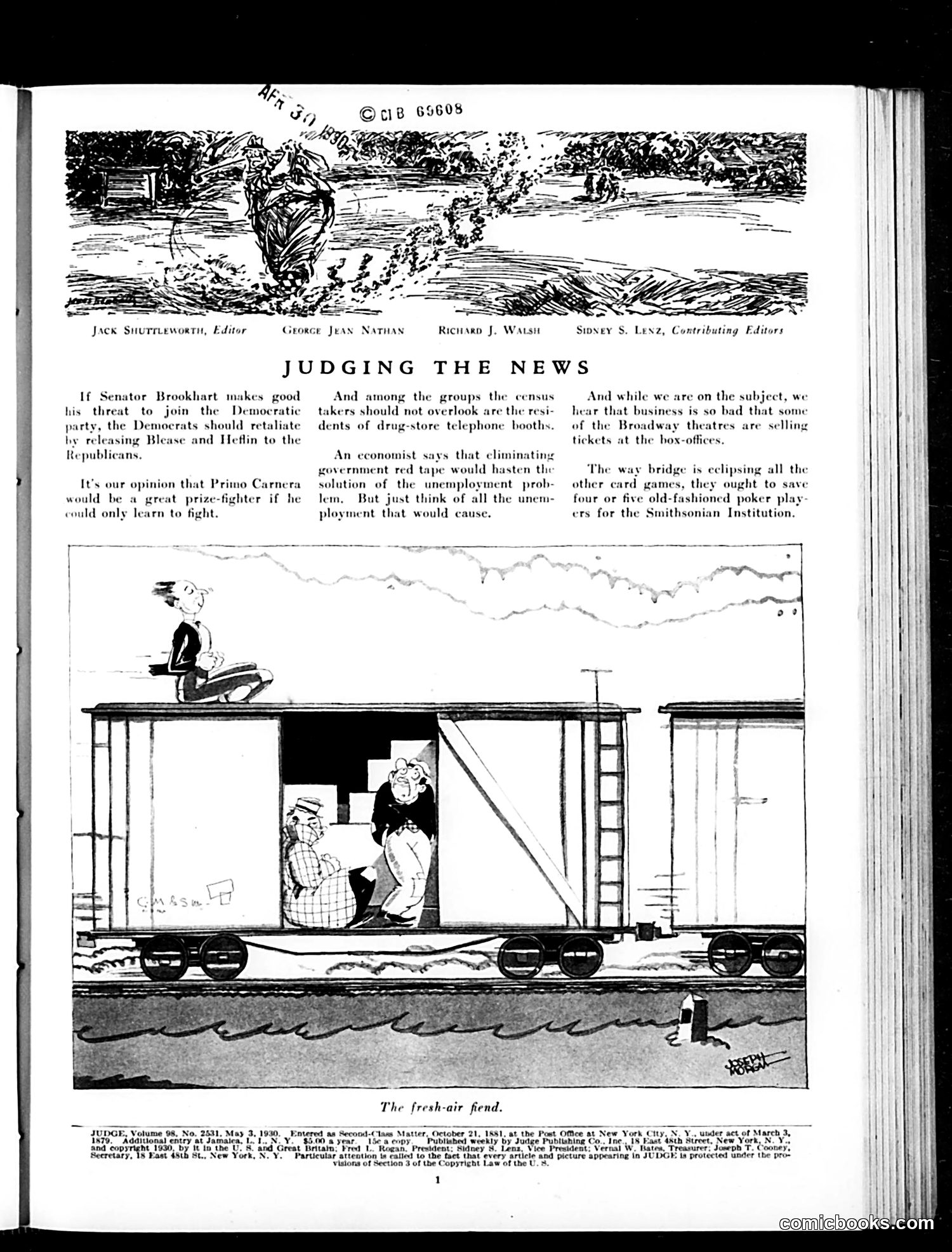
# "The Fresh-air Fiend" - Judge Magazine Cartoon Analysis This cartoon satirizes the early 20th-century "fresh air" movement—a progressive reform promoting outdoor exposure for poor urban children. The image shows a railroad car where working-class passengers are being forced to endure open windows despite crowded, uncomfortable conditions. The satire targets well-intentioned but impractical reformers who prioritized fresh air ideology over actual comfort and practical needs of ordinary people. The figure on top of the car appears to be enthusiastically promoting this principle, while passengers below suffer the consequences—cramped quarters with forced ventilation. The joke reflects common skepticism toward progressive reformism: good intentions applied rigidly without considering real human circumstances or preferences. It's social satire aimed at sanctimonious do-gooders.
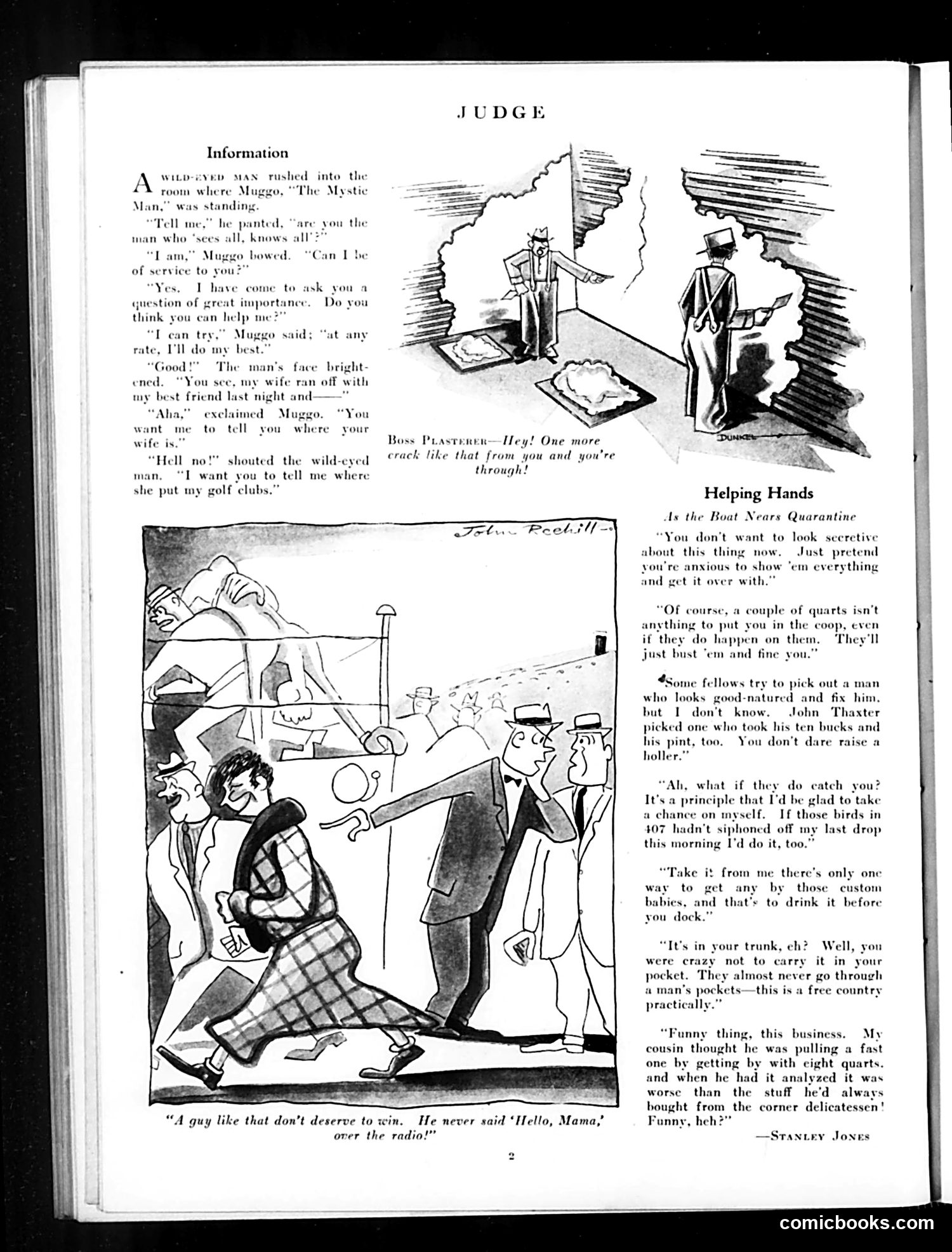
# Analysis of Judge Magazine Page This page contains two distinct pieces: **Top cartoon ("Boss Plasterer")**: A construction supervisor instructs a worker to apply plaster "one more crack" to break through a wall. This appears to be generic workplace humor about shoddy construction rather than specific political satire. **Bottom cartoon & article ("Helping Hands")**: The large cartoon depicts what appears to be a domestic dispute or arrest scene, with the caption "A guy like that don't deserve to win. He never said 'Hello, Mamo,' over the radio!" The accompanying article by Stanley Jones discusses Prohibition-era bootlegging—hiding alcohol in trunks and discussing customs enforcement tactics. The humor centers on absurd justifications for criminal behavior and the casual attitude toward breaking alcohol laws during Prohibition. The content reflects 1920s social attitudes toward Prohibition enforcement.
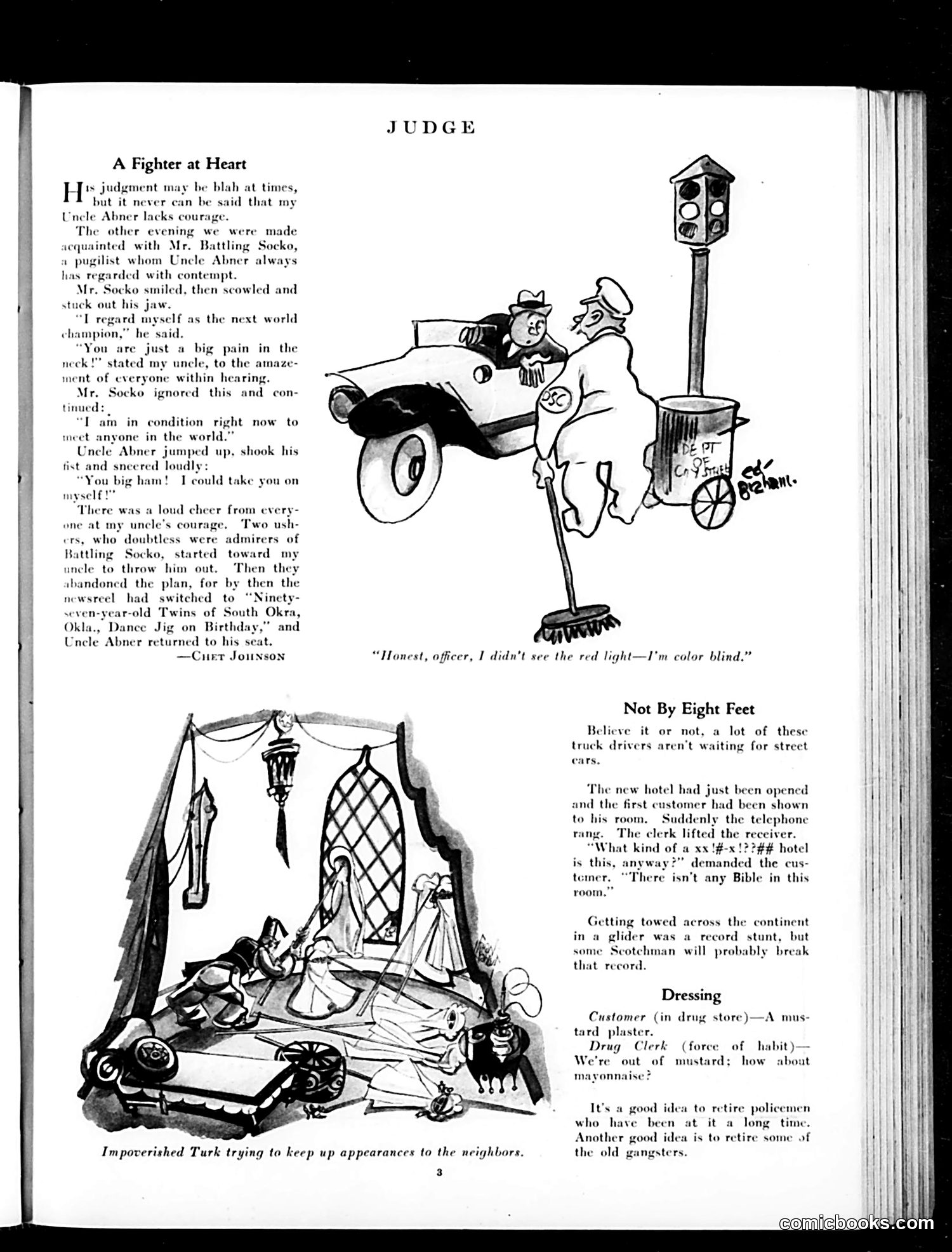
# Judge Magazine Page Analysis This page contains two satirical pieces: **"A Fighter at Heart"** depicts Uncle Abner defending his honor against Mr. Battling Socko, a pugilist. The joke satirizes working-class masculinity and honor culture—Uncle Abner's willingness to fight despite his age and condition to maintain respect, though he's clearly outmatched physically. **"Not By Eight Feet"** and accompanying cartoons mock various social absurdities: a hotel clerk's obscene phone manner, the impracticality of glider aviation across continents, and the phrase "Impoverished Turk trying to keep up appearances to the neighbors"—satirizing economic pretense and class performance. The **"Dressing"** section presents brief humorous customer-clerk exchanges about product availability, typical Judge humor about retail and consumer culture.
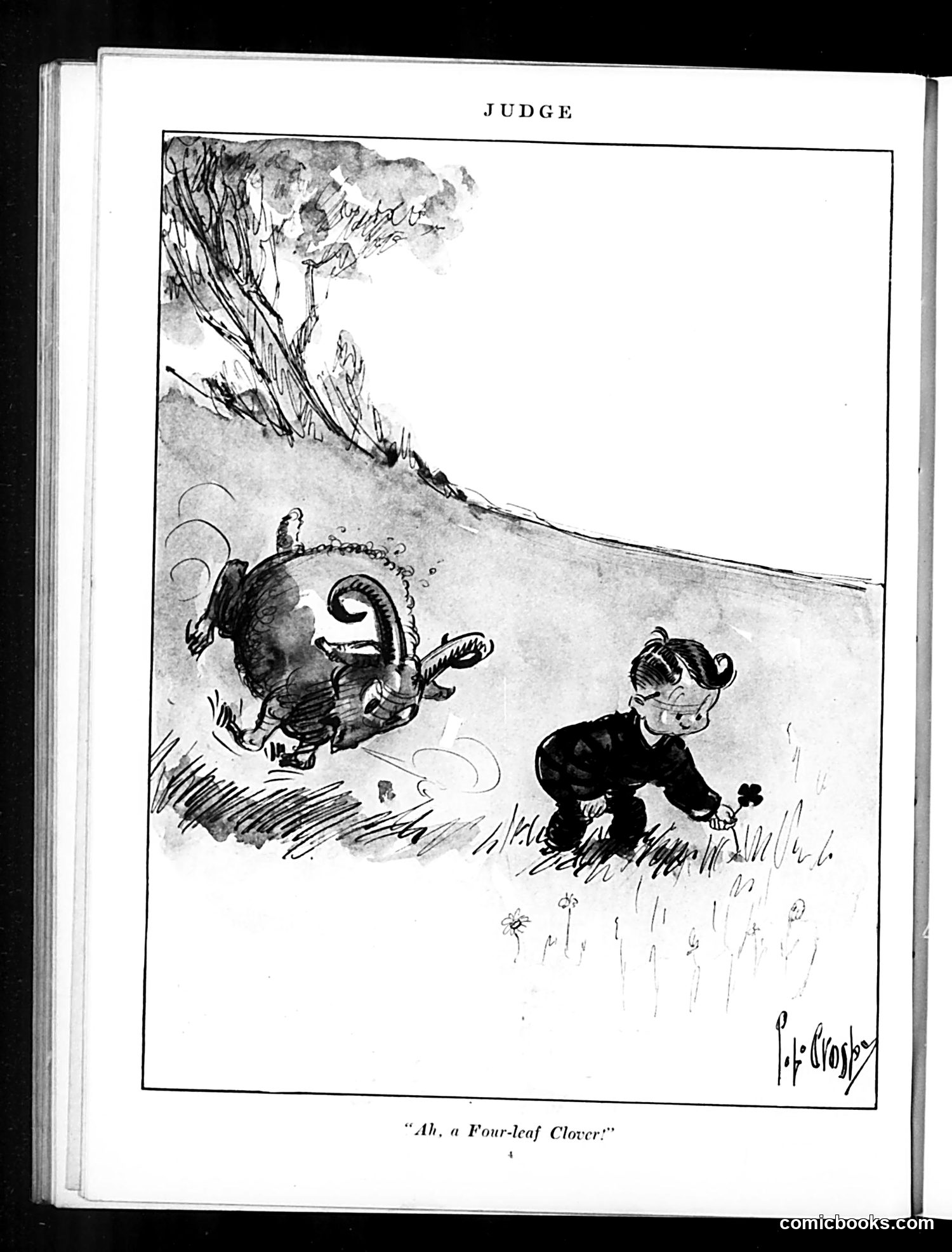
# "Ah, a Four-leaf Clover" This cartoon depicts two figures in a pastoral setting. On the left, a character appears to be tumbling or falling down a hillside, drawn in an exaggerated, comedic style suggesting misfortune or clumsiness. On the right, another figure in dark clothing discovers what they believe is a lucky four-leaf clover in the grass. The satire likely plays on contrasting luck: one character's obvious bad fortune versus another's discovery of a symbol of good luck. The juxtaposition suggests irony about how luck is distributed or perceived. Without additional context about Judge magazine's specific political moment, the exact targets remain unclear, though the humor appears to rest on visual comedy rather than specific political commentary.
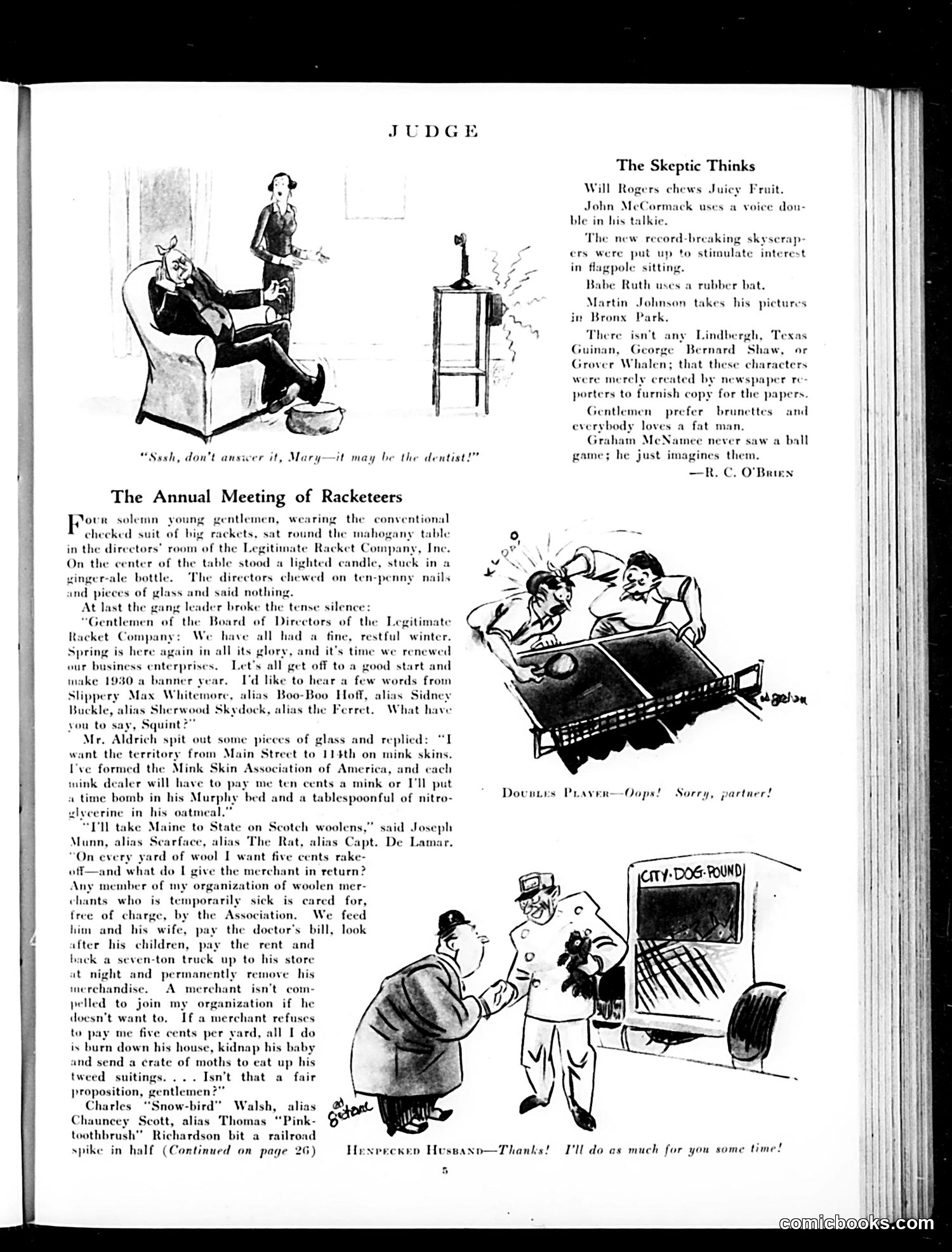
# Analysis of Judge Page This page contains two satirical pieces: **"The Skeptic Thinks"** (top right) mocks contemporary celebrities and their activities—Will Rogers chewing juicy fruit, John McCormack's voice, skyscrapers, Babe Ruth's rubber bat, and Marion Johnson photographing in the Bronx. The author (H.C. O'Bries) skeptically suggests these famous figures were invented by newspapers for copy rather than being genuinely significant. **"The Annual Meeting of Racketeers"** (main article) satirizes organized crime syndicates posing as legitimate business. It depicts mobsters with aliases (Scarface, The Rat, Snow-bird, Pink-toothbrush) conducting a formal corporate meeting where they divvy up territory and establish protection rackets. The satire highlights how organized crime operated with corporate structure during Prohibition-era America. Both pieces use humor to critique American society and celebrity culture.
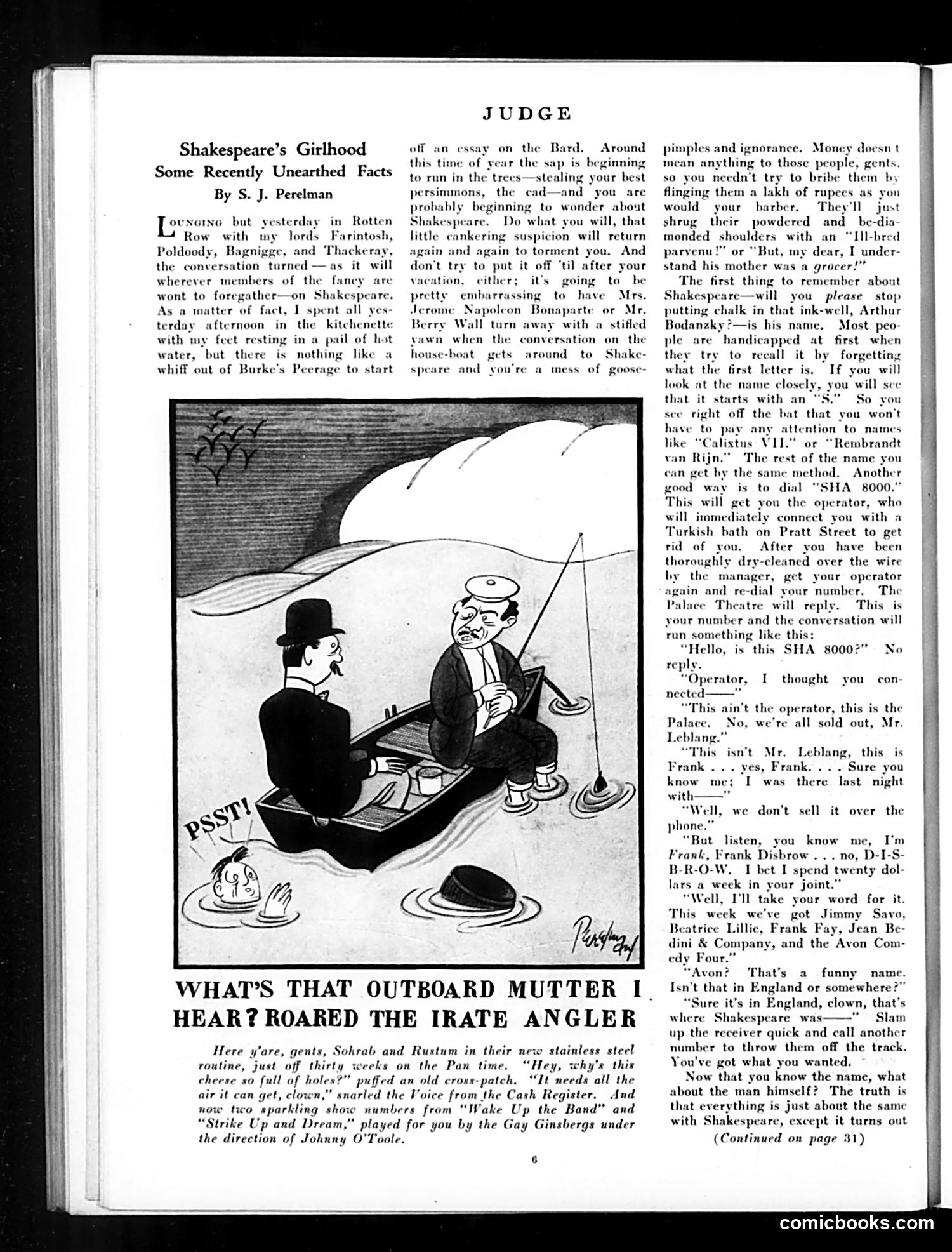
# Analysis of Judge Magazine Page The cartoon "What's That Outboard Mutter I Hear? Roared the Irate Angler" depicts two men fishing in a small boat. One appears distressed by an "outboard mutter" (likely an outboard motor's sound), while the other fishes nearby. The joke plays on the emerging technology of motorized boats disrupting traditional fishing—a common early 20th-century complaint about mechanization invading pastoral activities. The article above, "Shakespeare's Girlhood" by S.J. Perelman, is satirical commentary mocking obsessive Shakespeare scholarship and fandom. The humor targets how enthusiasts endlessly discuss and analyze the playwright, turning casual conversation into embarrassing pedantry. Together, these pieces reflect Judge's satirical stance: mocking both technological disruption of leisure and the pretentiousness of literary obsessives—familiar targets for this era's humor magazine.
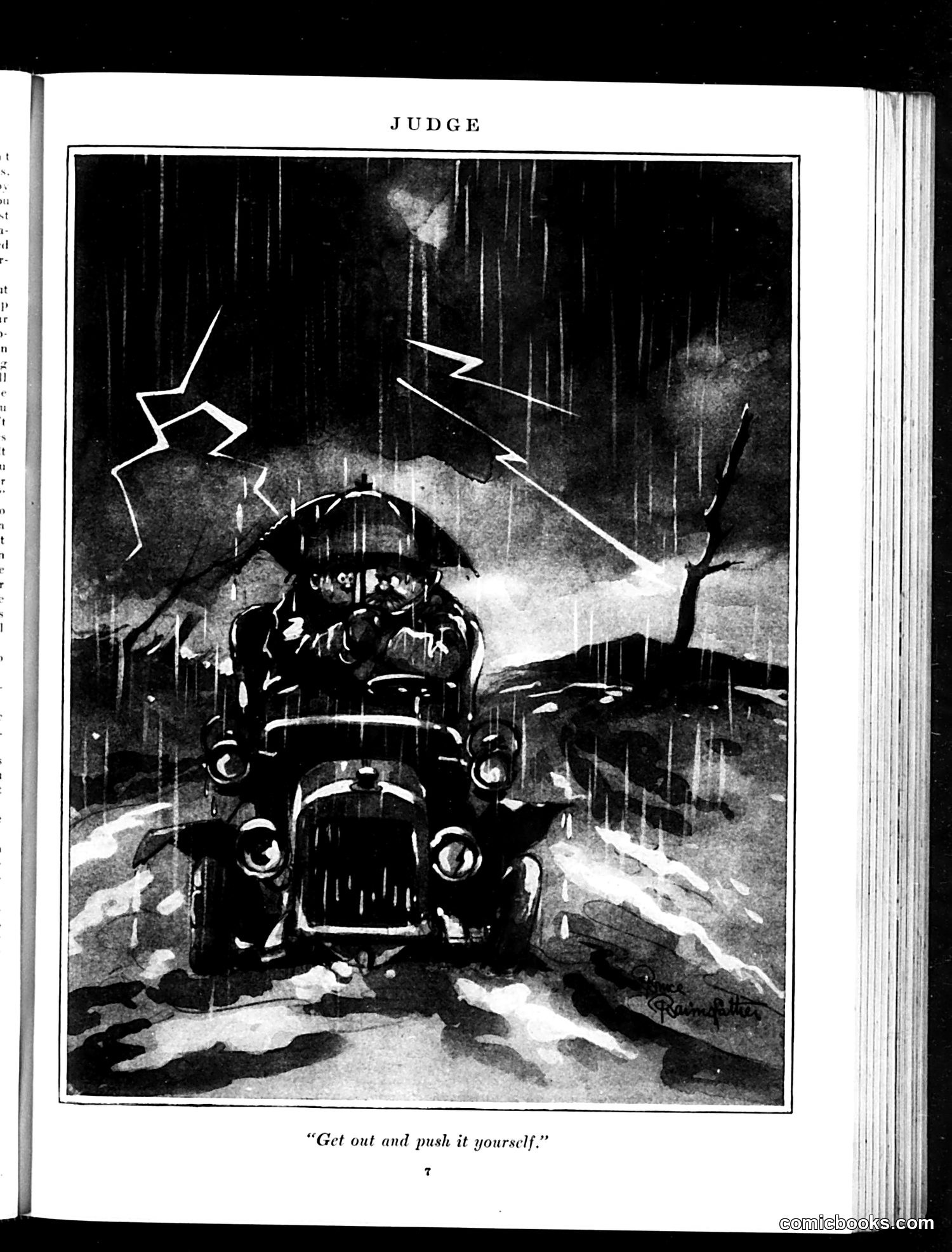
# Analysis of Judge Cartoon Page This single political cartoon depicts a car stuck in mud or snow during heavy rain/storm, with lightning bolts above. A driver sits helplessly in the vehicle while receiving the caption's dismissive command: "Get out and push it yourself." The cartoon likely satirizes political leadership during a crisis—possibly referencing a president or public official who appears ineffectual or unwilling to take direct action during difficult circumstances. The vehicle's predicament symbolizes the nation's troubles, while the command suggests criticism that leaders should personally address problems rather than remain passive. Without additional context about Judge's publication date, the specific political figure or crisis referenced remains unclear, though the imagery conveys frustration with governmental passivity.
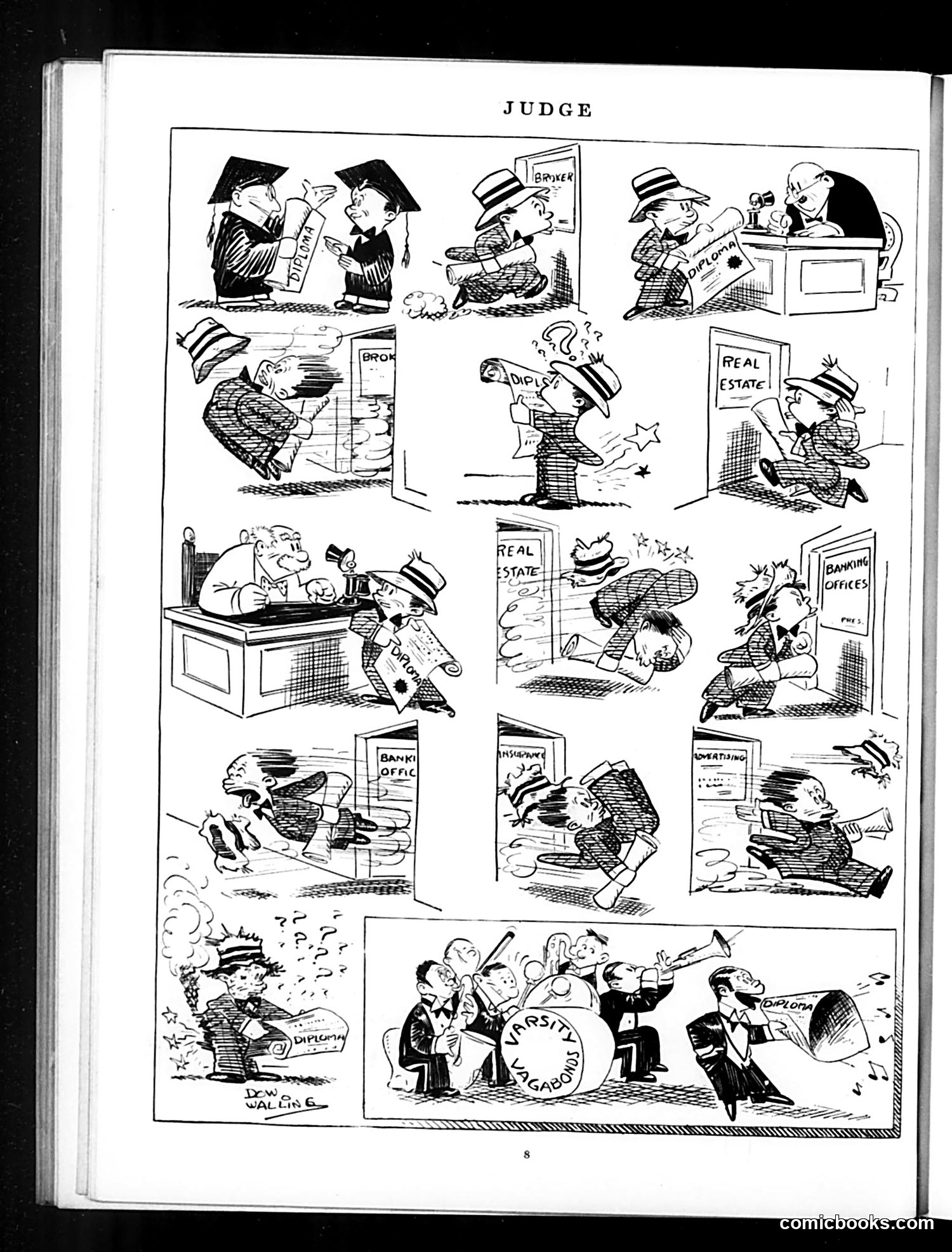
# Analysis of Judge Page This is a multi-panel satirical comic depicting a con artist or swindler (identifiable by his striped suit and hat) being chased through various professional offices and institutions. The sequence shows him running from: - Brokers' offices - Real estate agencies - Banking offices - Insurance companies The final panel shows him being pursued by what appears to be law enforcement or officials (marked "VARSITY CHASERS"). The satire targets financial fraud and deception prevalent in early 20th-century American business. The repeated pattern—the schemer fleeing legitimate businesses—suggests widespread public concern about unscrupulous operators exploiting citizens through various fraudulent schemes in banking, real estate, and investment sectors.
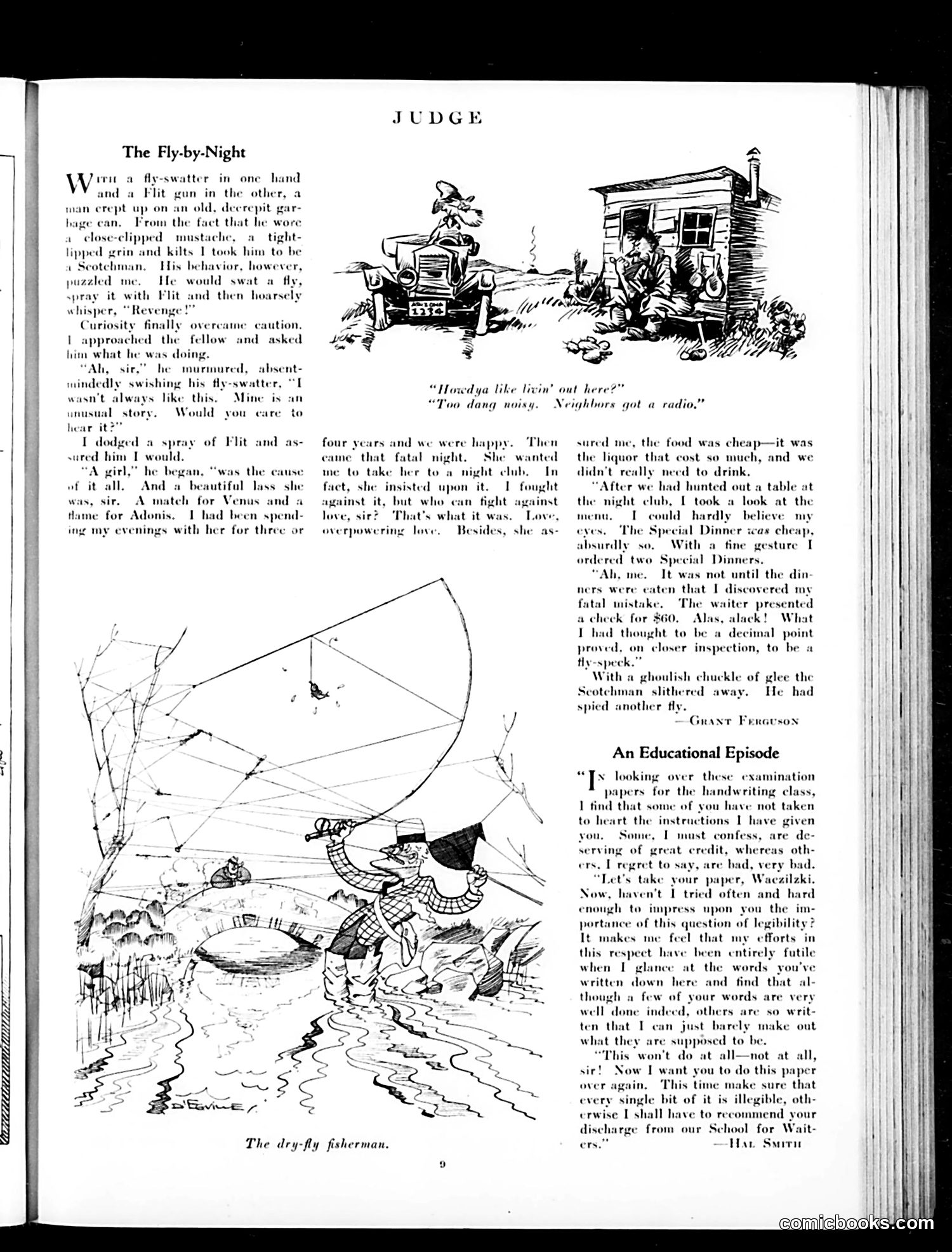
# Two Satirical Stories from Judge Magazine **"The Fly-by-Night"** depicts a kilted Scotsman obsessively swatting flies and spraying Flit (a commercial insecticide brand) while whispering "Revenge!" He explains to a curious observer that his compulsion stems from a romantic betrayal: a woman lured him to an expensive nightclub where he discovered an inflated dinner bill—the "fatal mistake" that ruined him. The joke satirizes how trivial modern annoyances (flies, commercial products like Flit) trigger disproportionate emotional responses, and how people blame external circumstances rather than their own poor decisions. **"An Educational Episode"** mocks a pompous school administrator criticizing a student's illegible handwriting. The teacher demands the student rewrite the paper ensuring "every single bit of it is illegible"—revealing the administrator's actual indifference to legibility standards. The satire targets bureaucratic hypocrisy and performative discipline in educational institutions. Both stories use exaggerated character types and absurdist logic typical of Judge's humor.
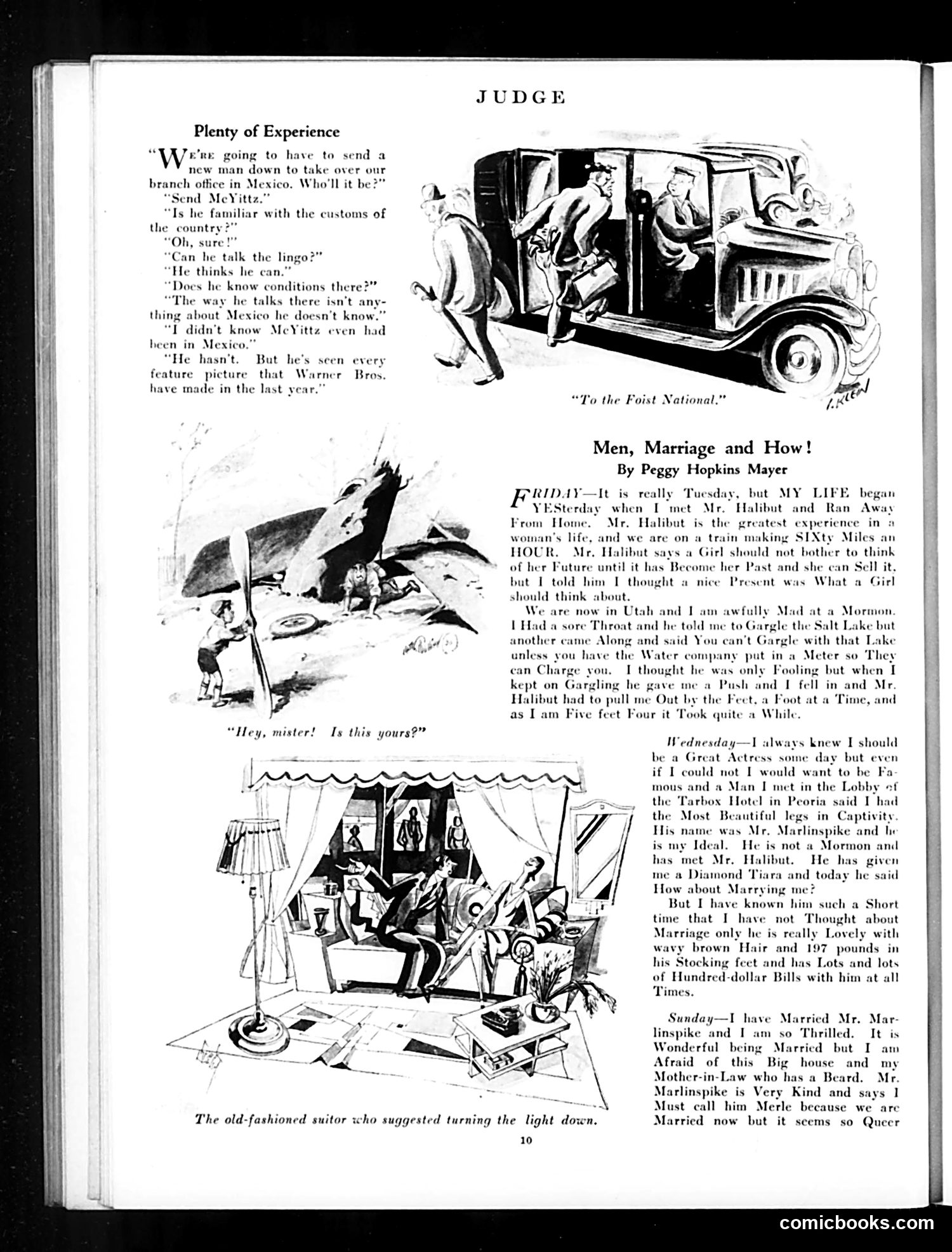
# Judge Magazine Page Analysis **Top Cartoon ("Plenty of Experience"):** A joke about corporate incompetence. An executive suggests sending "McYittz" to manage a Mexican branch office, claiming he's qualified because he's seen every Warner Bros. feature film about Mexico—despite never actually visiting Mexico and knowing nothing about the country, language, or local conditions. The satire mocks both corporate hiring practices and Hollywood's role in shaping Americans' false perceptions of foreign places through movies. **Bottom Section ("Men, Marriage and How!"):** A serialized humor column by Peggy Hopkins Mayer (likely a pseudonym or reference to the actress known for multiple marriages) satirizing modern women and romantic impulsiveness. The narrator impulsively runs away with "Mr. Halibut," then meets "Mr. Marlinspike" days later and marries him for his wealth and appearance, despite barely knowing him. The piece mocks both women's fickleness and materialism, and men's superficiality, using exaggerated capitalization for comedic effect.