
Judge, 1930-05-03 · page 15 of 36
Judge — May 3, 1930 — page 15: what you’re looking at
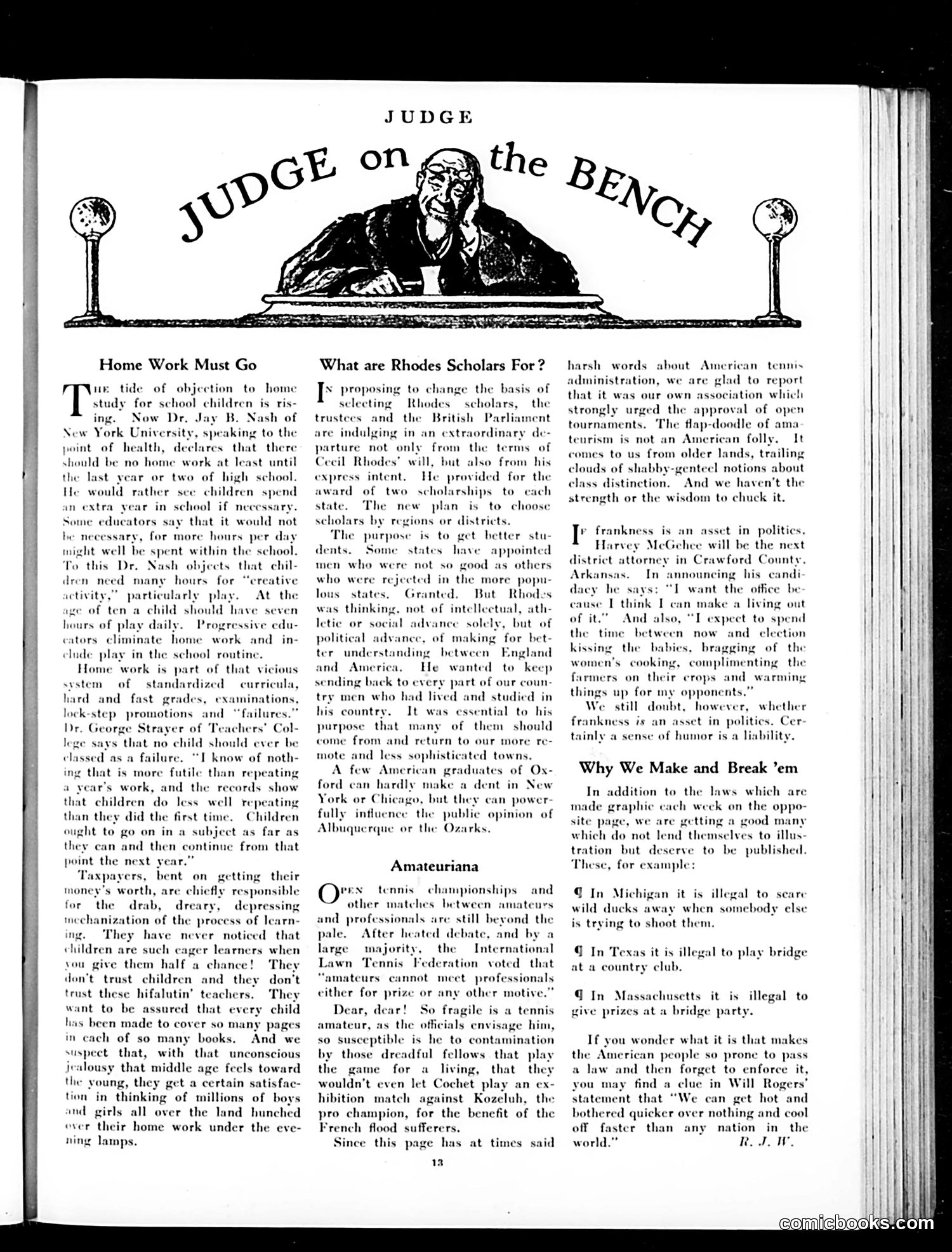
A restored page from Judge, 1930-05-03. Page through the whole issue in the reader above.
📄 Transcribed text from this page (OCR, searchable)
Machine-transcribed from the original scan — historical spelling and the odd misread are preserved.
ay Home Work Must Go ur tide of objection to home study for school children is ris- ing. Now Dr, Jay B. Nash of New York University, speaking to the point of health, declares that there rast until ar or two of high school. ther sce children spend r in school if necessary. tors say that it would not should be no home work at the last y He would in extra ye duc be necessary, for more hours per day ht well be spent within the school. o this Dr. Nash objects that chil- dren need many hours for “creative wtivity,” particularly play. At the age of ten a child should have seven hours of play daily. cators climinate Progressive edu- work and in- clude play in the school routine. Home work is part of that vicious system of s! ardized hard and fast: grades, examinations, lock-step promotions and. “failures.” Dr. George Strayer of T ol says that no child should ever be ilure. “I know of noth- is more futile than repeating 1 year's work, and the records show home curricula, chers’ ing ths that children do less well repeating than they did the first time. Children t to go on in a subject as far as they can and then continue from that point the next year.” Tax bent on getting their money's worth, are chiefly responsible for the drab, dreary, depressing mechanization of the process of learn- They noticed that children are such eager learners when you give them half a chance! ‘They don’t trust children and they don't trust these hifalutin’ thers. They want to be assured that every child has been made to cover so many pages in cach of so many books. And we suspect that, with that unconscious jealousy that middle age feels toward the young, they get a certain satisfac tion in thinking of millions of boys ind girls all over the land hunched ver their home work under the eve- ning lamps. ayers, in © never What are Rhodes Scholars For ? I: vosing to chi the basis of selecting Rhodes schols the trustees and the British Parliament are indulging in an extraordi de- arture not only from the terms of Cecil Rhodes’ will, but also from his express intent. He provided for the award of two scholarships to. « state. The scholars by regions or districts. The purpose is to get better stu- dents. men ch plan is to. choose new Some states have appointed who were not so good as others who were rejected in the more popu- Granted. But) Rhodes was thinking, not of intellectual, ath- letic or social advance solely, but of political advance, of making for bet- ter understanding between England and America, He wanted to keep sending back to every part of our coun try men who had lived and studied in his country. It was essential to his purpose that many of them should from and return to our more re- mote and less sophisticated towns, A few American graduates of Ox- ford can hardly make a dent in New York or Chicago, but they ean power fully influence the public opinion of Albuquerque or the Ozarks. lous states, come Amateuriana tennis and amateurs ond the Ons championships other matches between and professionals are still be pale. After heated debate, and by large majority, the — International Lawn Tennis Federation voted that atcurs cannot meet professionals either for prize or any other motive.” Dear, de So fragile is amateur, as the officials envisage him, so susceptible is he to contamination by those dreadful fellows. th the game for a living, wouldn't even let Cochet pl hibition match against Kozeluh, the pro champion, for the benefit of the French flood sufferers. Since this page has at times said 12 a tennis harsh words about American tennis administration, we d to report that it was our ow tion wl strongly urged the approval of open tournaments. The flap-doodle of ama teurism is not an American folly. comes to us from older lands, t clouds of shabby-genteel notions « class distinction. And we haven't the strength or the wisdom to chuck it. I frankness is an asset in polities. Harvey MeGehce will be the next district attorney in Crawford County. Arkansas. In announcing his candi dacy he says: “I want the office be cause [think I can make a living out of And also, “I expect to spend the time now and ¢ kissing the bragging of the women’s cooking, complimenting the farmers on their crops and warming things up for my opponents.” We still doubt, however, whether frankness is an asset in politics. Cer tainly a sense of humor is a liability. between Why We Make and Break ’em In addition to the laws which are made graphic cach week on the oppo- site page, we are getting a good many which do not lend themselves to illus tration but deserve to be published. These, for example: @ In Michigan it is il wild ducks away when somebody else is trying to shoot them, al to seare @ In Texas it is ill at a country club. 1 to play bridge @ In Massachusetts it is illegal to give prizes at a bridge party. If you w the i f “an people so prone to a law and then forget to enforce it, you may find a cluc in Will Rogers’ statement that “We can get hot and bothered quicker over nothing and cool off faster than any nation in’ the world.” RJ. WW. 7 Vi iL COMmIEHOoKS!com