A complete issue · 36 pages · 1930
Judge — March 29, 1930
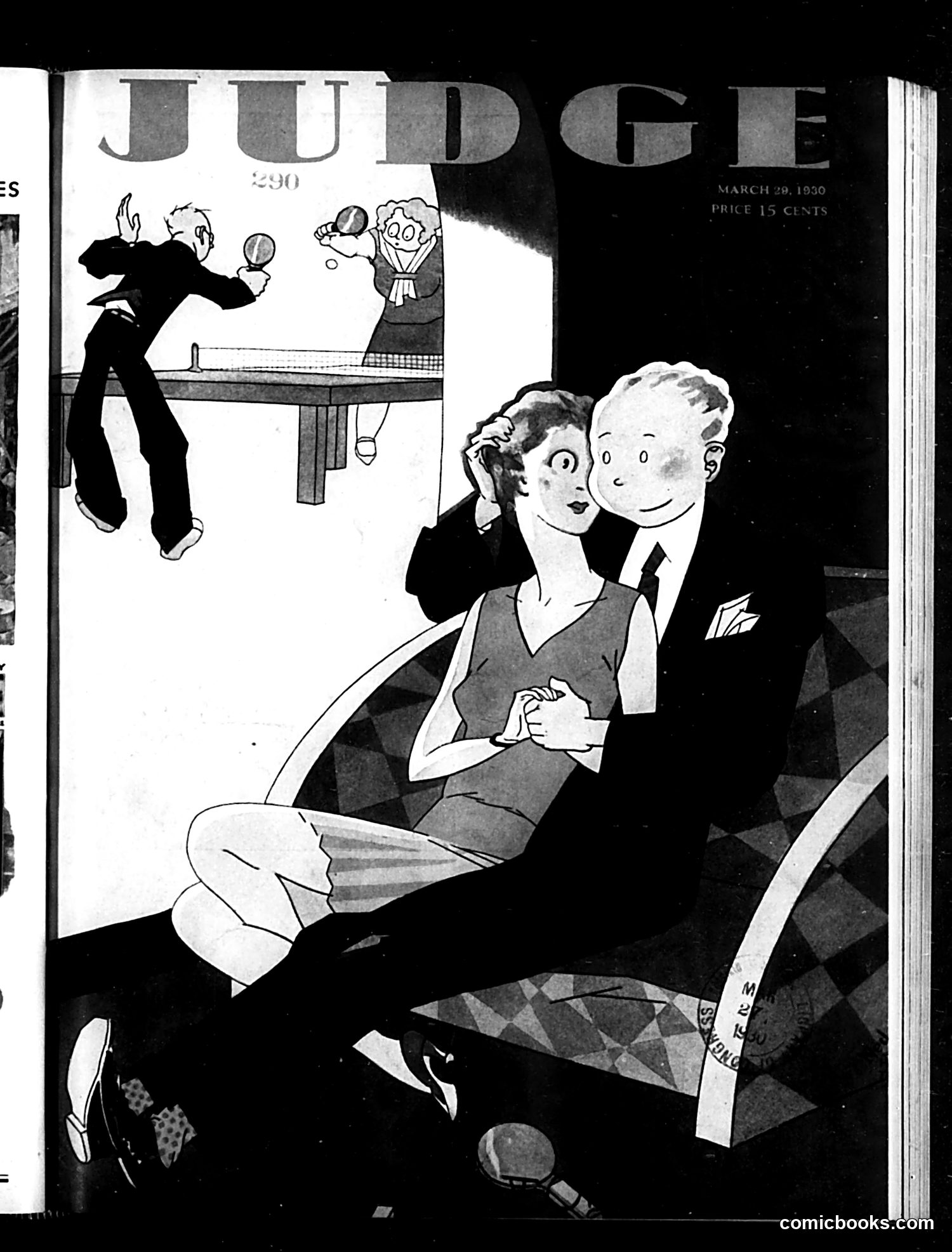
# Judge Magazine, March 28, 1950 This cover depicts a couple watching ping-pong players through what appears to be a window or viewing area. The man has an exaggerated, vacant expression while the woman leans affectionately against him. The humor likely plays on the contrast between the energetic, competitive activity shown in the background (the ping-pong game) and the couple's passive leisure—suggesting they're absorbed spectators at a social venue, possibly a recreation club or sports facility. The man's comically blank expression may satirize male disengagement or boredom despite being out socially. The piece reflects 1950s leisure culture and gender dynamics, where such recreational activities were popular middle-class pastimes. The specific satirical point—whether directed at the couple's relationship, social customs, or entertainment culture—isn't entirely clear from the image alone.
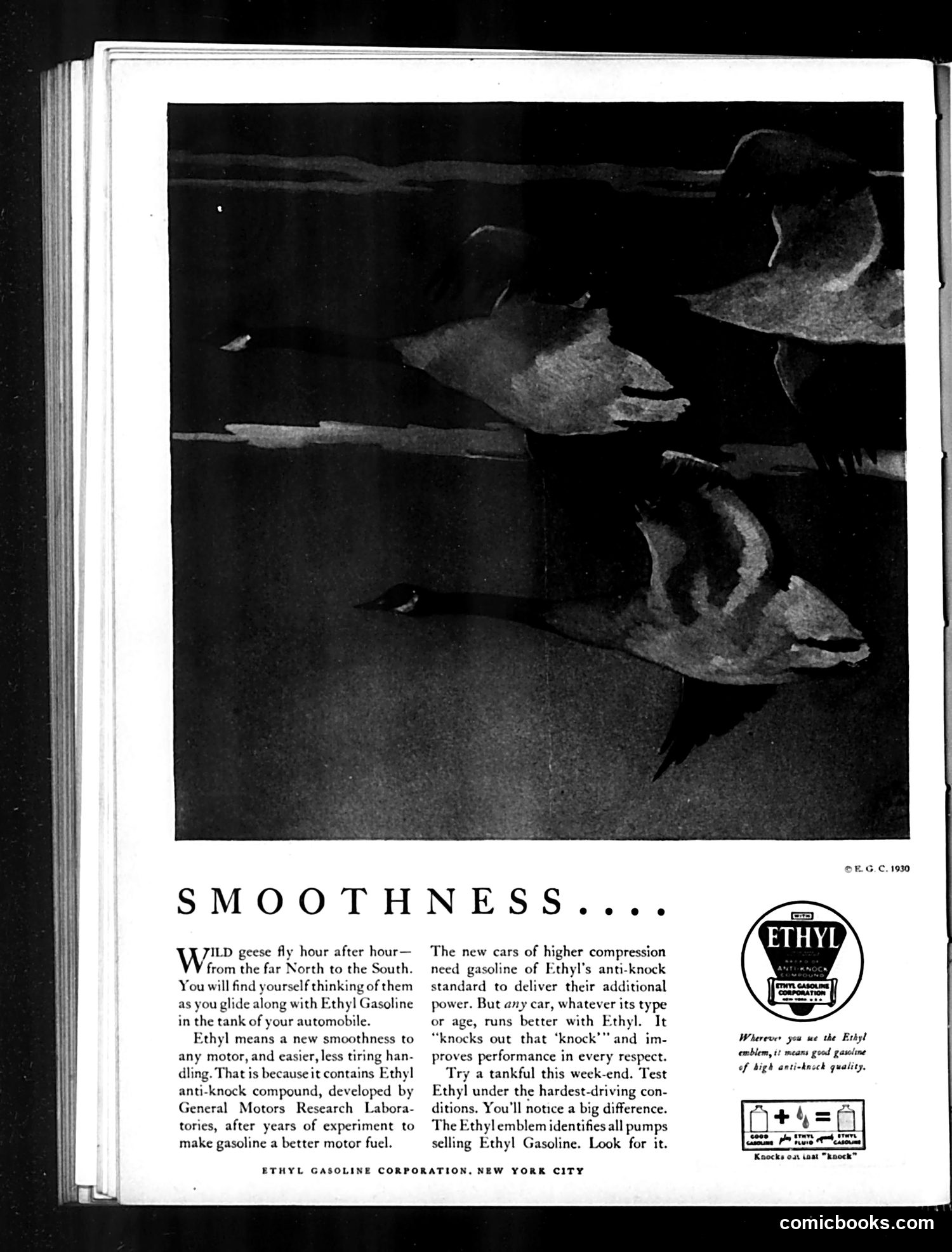
# Analysis This page is **primarily a paid advertisement**, not satirical content. It's an Ethyl Gasoline Corporation ad from 1930 promoting their anti-knock fuel product. The image shows flying geese in formation, used metaphorically: the "smoothness" of geese flying in coordinated flight represents the smooth engine performance Ethyl Gasoline promises. The ad claims that modern high-compression cars require Ethyl's special formula to eliminate engine "knock" and improve performance. The text emphasizes Ethyl's anti-knock compound (developed by General Motors Research Laboratories) as superior to standard gasoline. The call-to-action encourages readers to test Ethyl fuel themselves. This reflects 1930s automotive marketing, when anti-knock gasoline was a significant innovation and competitive selling point.
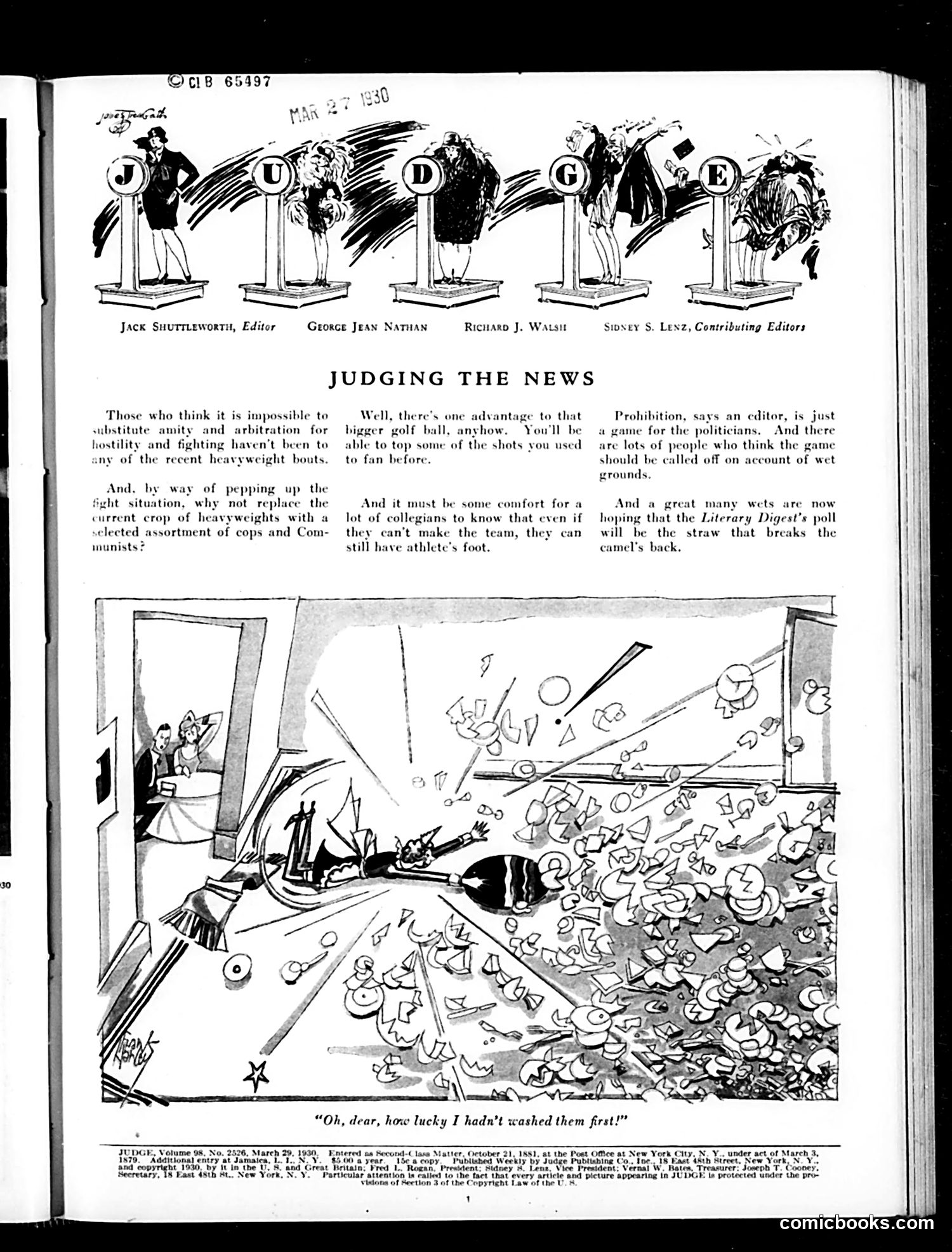
# "Judging the News" - March 29, 1930 This satirical page critiques editorial decisions about what constitutes newsworthy content. The header features five editors labeled J, U, D, G, and E (spelling "JUDGE"), representing the magazine's editorial team including Jack Shuttleworth (Editor) and George Jean Nathan. The main cartoon depicts a domestic catastrophe—a room in chaos with broken items everywhere—captioned "Oh, dear, how lucky I hadn't washed them first!" The satire contrasts trivial domestic concerns with serious news judgment. The accompanying text mocks editors who sensationalize minor conflicts while debating replacing "current crop of heavyweight bouts" with other content, suggesting editorial obsession with scandal over substance. The piece criticizes how news judgment becomes a political game manipulated by those seeking coverage.
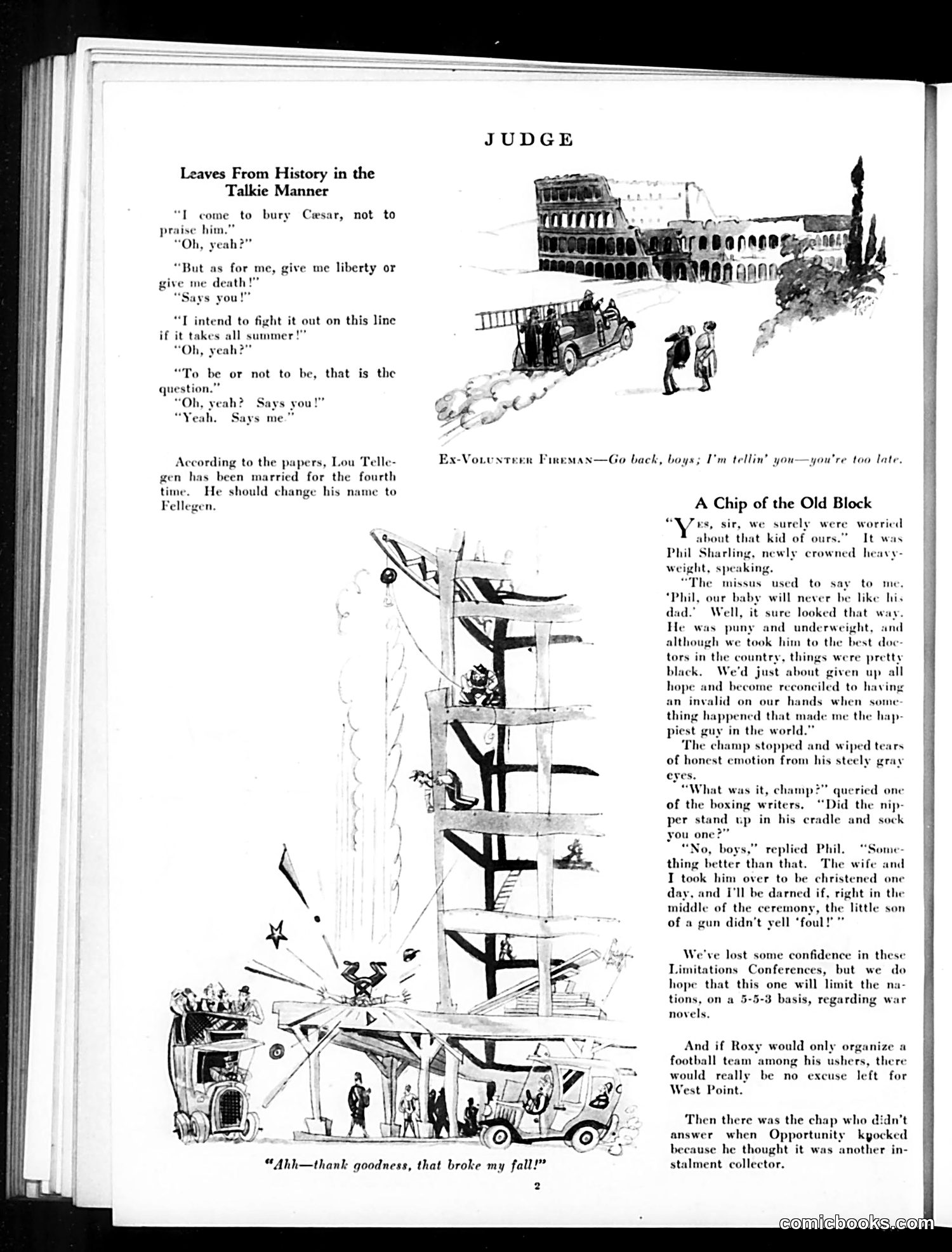
# Analysis of Judge Magazine Page This page contains two distinct sections: **Left side ("Leaves From History"):** A Shakespeare parody featuring famous lines from *Julius Caesar*, presented as modern dialogue with "Oh, yeah?" responses. This satirizes contemporary speech patterns by contrasting them with classical literature—a common humor device mocking modern colloquialism. **Right side ("A Chip of the Old Block"):** A story about Phil Starling, a newly crowned heavyweight boxing champion. The narrative describes his humble origins and physical weakness as a child, contrasting with his current success. The accompanying illustration shows a multi-story building collapse with figures at various levels, captioned "Ahh—thank goodness, that broke my fall!"—a visual gag unrelated to the text above it. The page reflects Judge's blend of literary satire and sports-focused humor typical of early-to-mid 20th century American magazines.
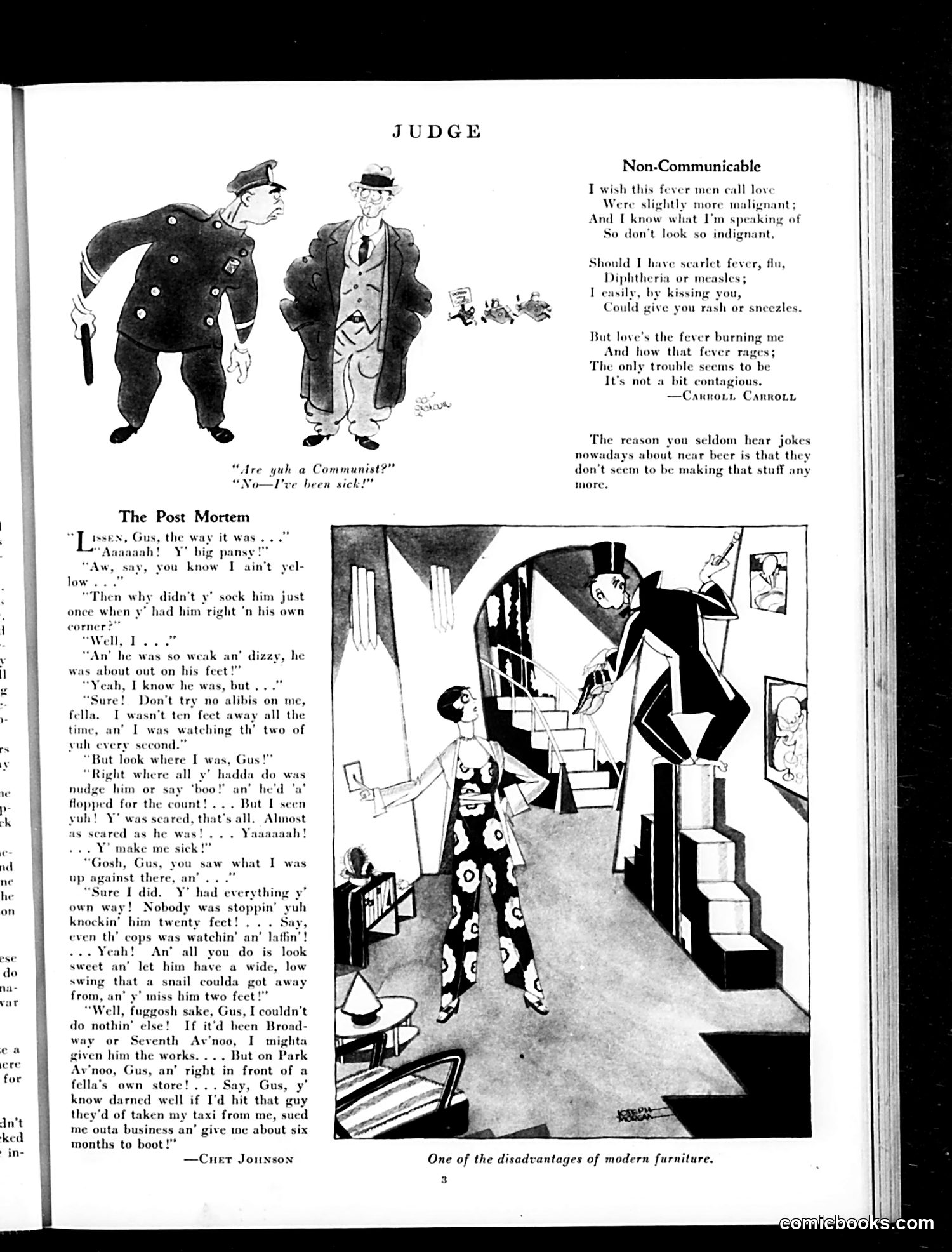
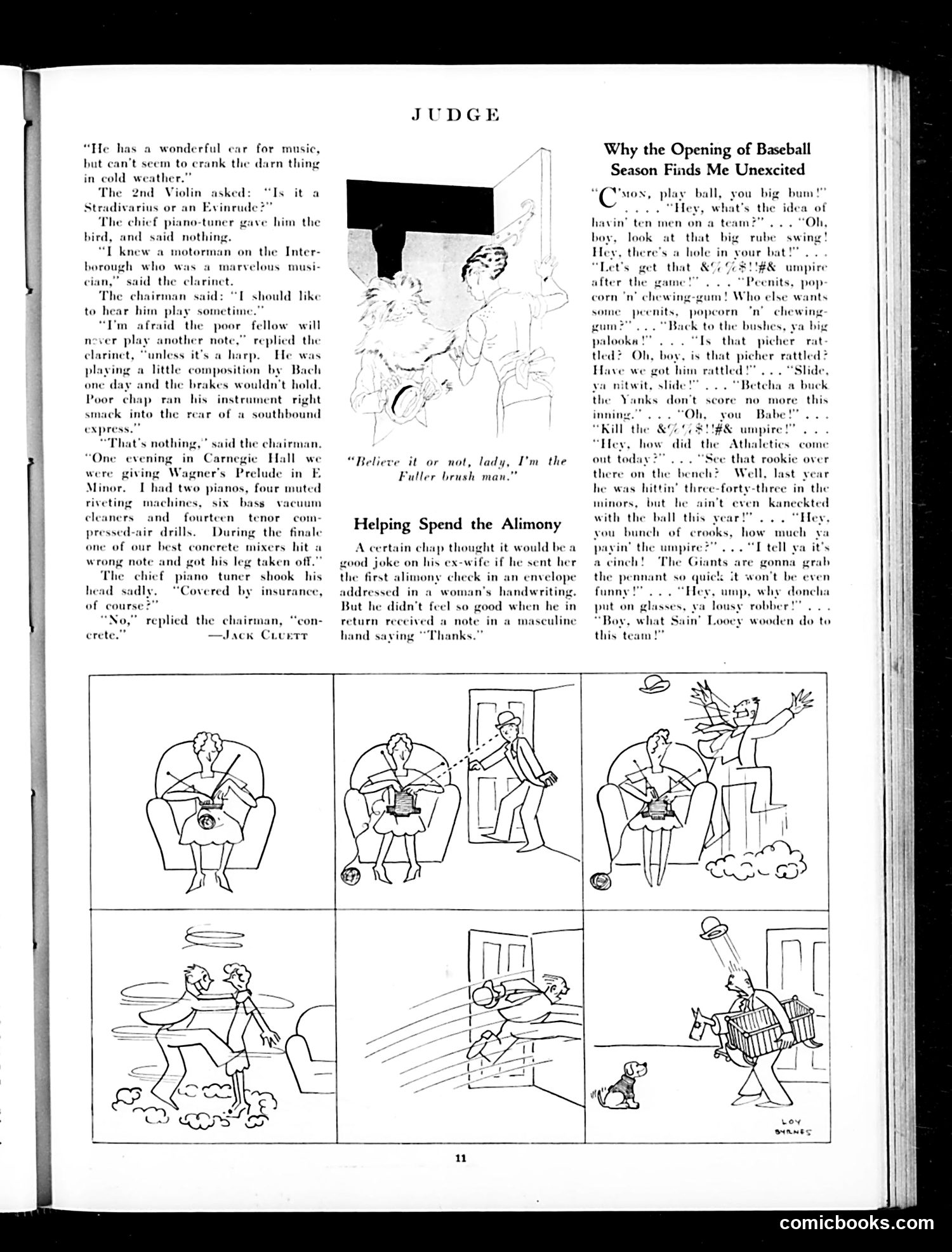
# Analysis of Judge Magazine Page **Top Cartoon:** Shows a military officer interrogating a civilian, asking "Are yuh a Communist?" The civilian replies "No—I've been sick!" This appears to satirize anti-communist paranoia, possibly from the Red Scare era, mocking how authorities suspected anyone who was absent or unwell of political radicalism. **"The Post Mortem" Story:** A humorous anecdote about a man who accidentally hit someone during a street fight, with consequences for his taxi business. It's character-driven humor rather than political satire. **Bottom Illustration:** Captioned "One of the disadvantages of modern furniture," shows a tall, spindly-legged chair unable to support a woman's weight—social satire about impractical contemporary design prioritizing aesthetics over function.
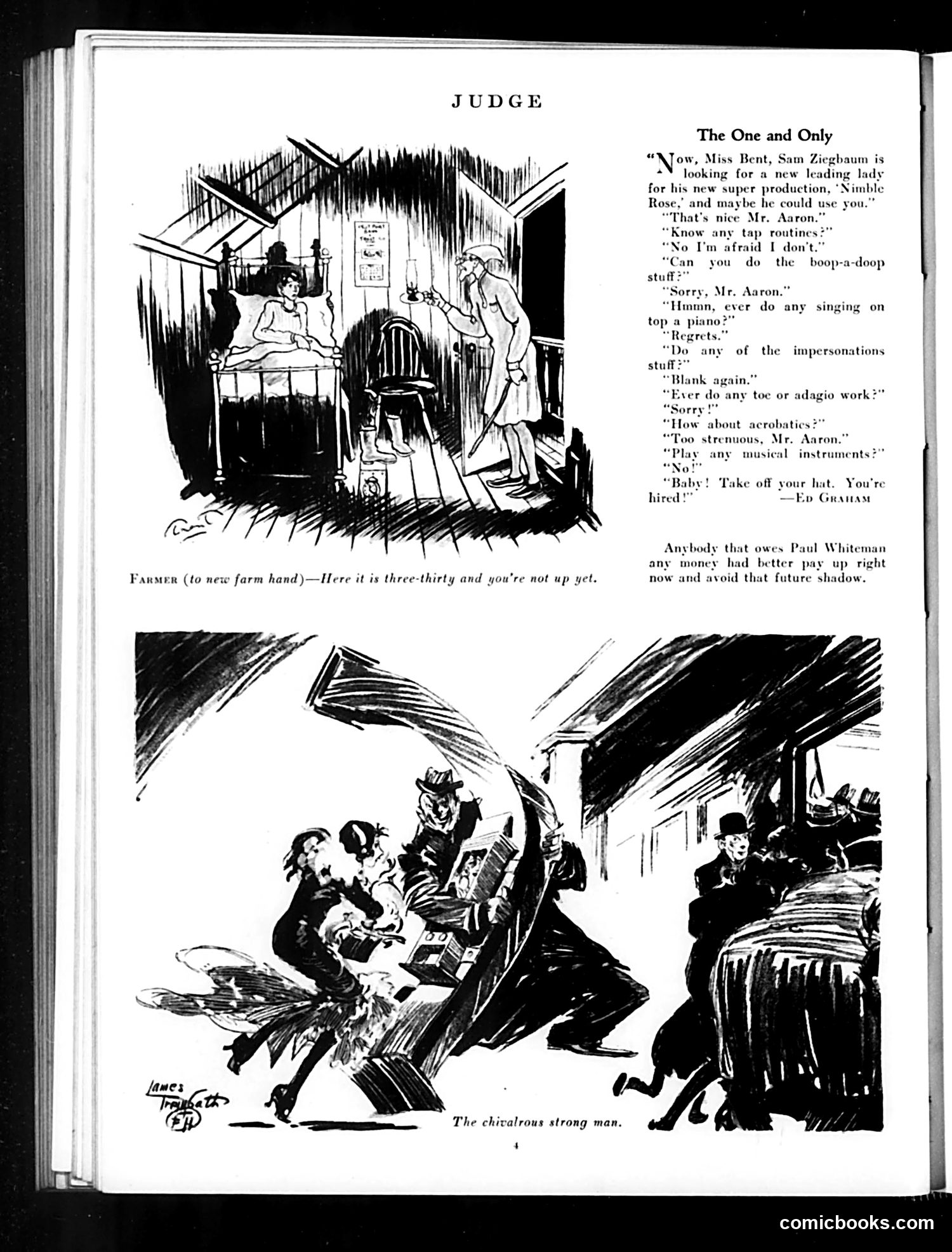
# Analysis This page contains two separate satirical cartoons from *Judge* magazine. **Top cartoon** ("The One and Only"): Shows a theatrical casting director interviewing a performer. The dialogue mocks a talentless vaudeville act, with the director asking increasingly absurd questions ("Can you do the hoop-a-doop doop?" "Ever do any singing on a piano?") to which the performer desperately answers "Sorry, Mr. Aaron" or "Regrets." The joke satirizes the entertainment industry's desperation to find talent for "super production" films. **Bottom cartoon** ("The chivalrous strong man"): Depicts a brawling street scene with multiple figures fighting. The title's irony suggests commentary on masculine violence or disputes over money, referencing a warning about Paul Whiteman debts. Both target early 1920s entertainment industry absurdities and financial conflicts.
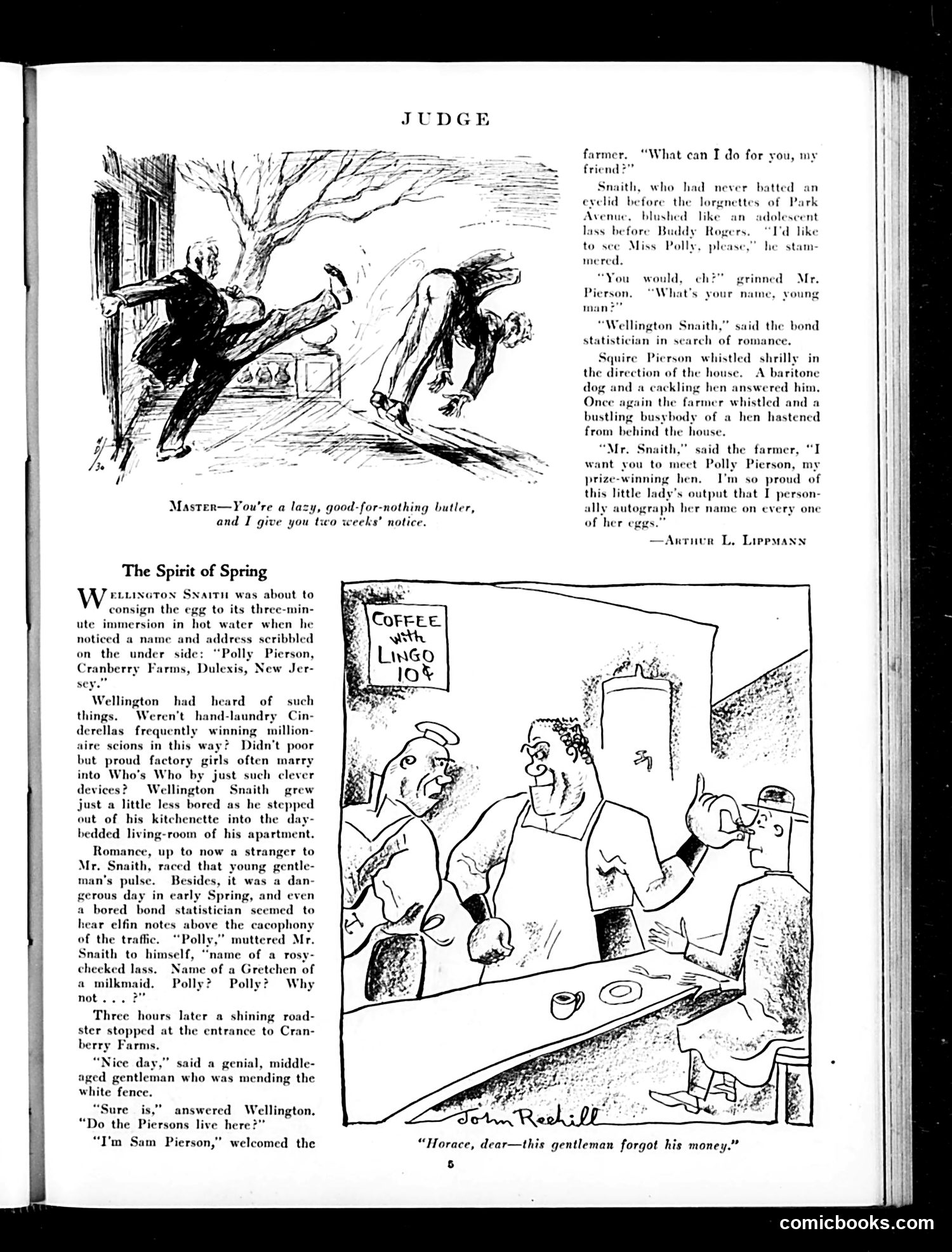
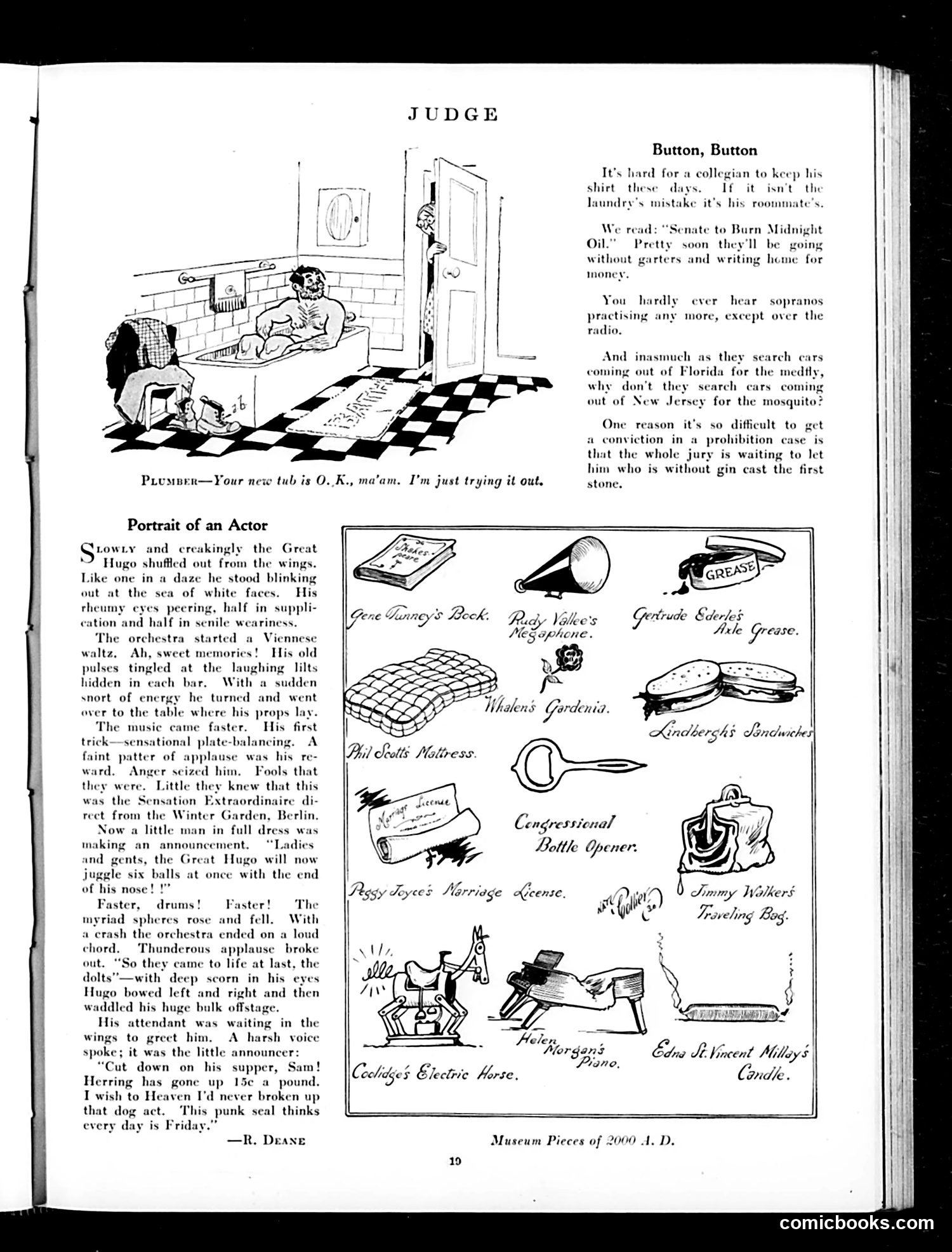
# Analysis of Judge Magazine Page This page contains two unrelated pieces: a top cartoon titled "Judge" showing a man being kicked out by a farmer (with caption about being a "lazy, good-for-nothing butler"), and below it a humorous story "The Spirit of Spring" by Arthur L. Lippmanns. The main story concerns Wellington Smith, who discovers an egg labeled "Polly Pierson, Cranberry Farms, Dulcesis, New Jersey." Through the narrative, we learn Polly is a prize-winning hen whose owner has autographed her eggs. The accompanying cartoon shows a coffee shop scene where a gentleman has forgotten his money—the humor deriving from everyday domestic or commercial mishaps rather than political satire. This appears to be general-interest humor content typical of early-20th-century Judge magazine.
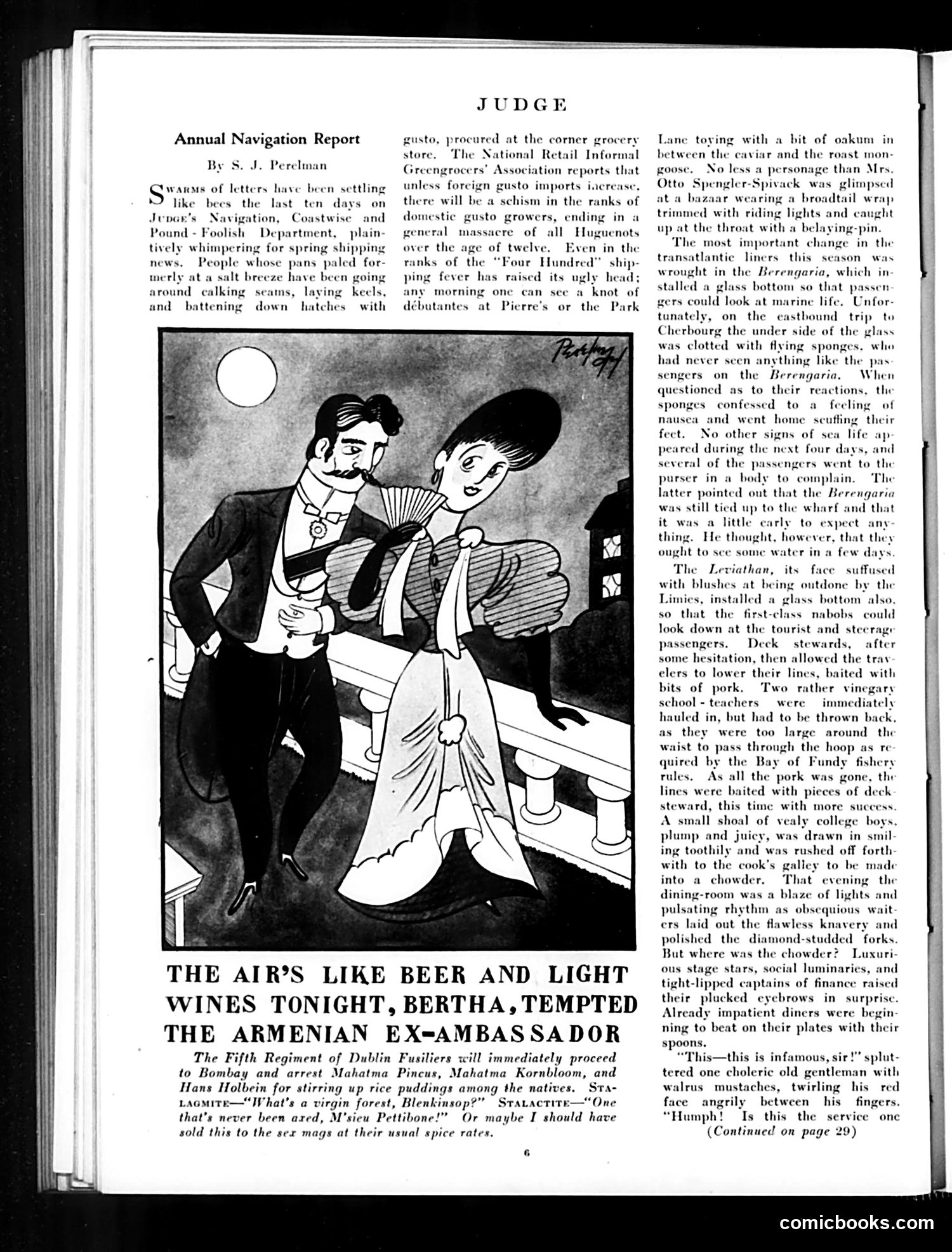
# Analysis of Judge Magazine Page This page contains a humorous illustration titled "The Air's Like Beer and Light Wines Tonight, Bertha, Tempted the Armenian Ex-Ambassador." The cartoon depicts a well-dressed man and woman on what appears to be a ship's deck, with the man offering her a drink. The caption references Mahatma Pincus, Mahatma Kornbloom, and other Jewish-sounding names, alongside food references (pudding, rice) and Yiddish-inflected English dialogue ("Blenkinsop?"). The humor appears to target Armenian and Jewish immigrant communities through ethnic stereotyping common to 1920s satirical magazines. The accompanying article discusses ocean liner amenities and passenger experiences, suggesting this is leisure-travel satire combined with ethnic caricature typical of Judge's era.
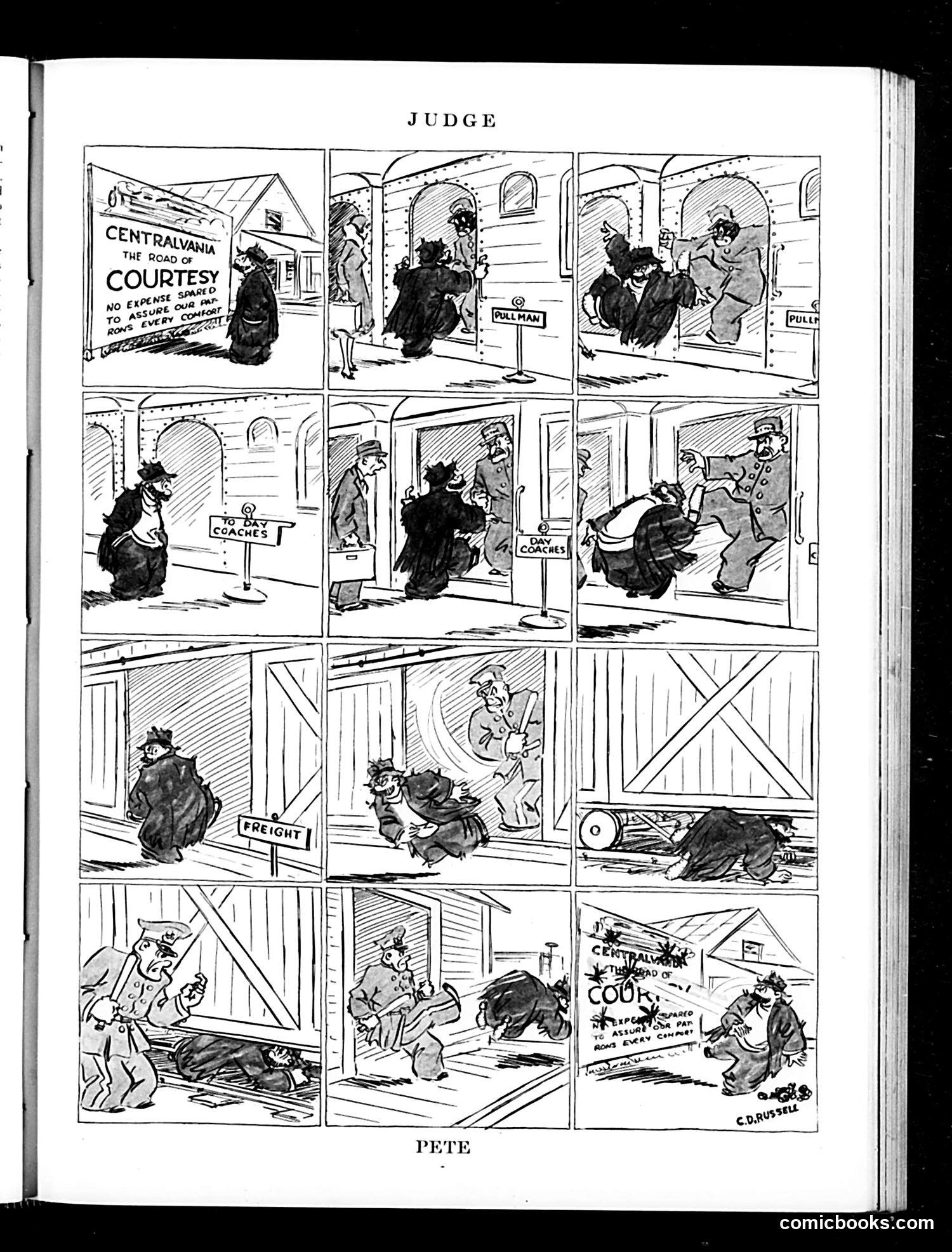
# Analysis This comic strip satirizes the Central Railroad's "Road of Courtesy" slogan through the journey of a passenger named Pete. The narrative shows stark contrast between the railroad's advertised promises of comfort and courtesy versus the actual experience: overcrowded conditions, rude staff, poor service in dining cars, and inadequate facilities (marked "FREIGHT" and "COACHES"). The humor derives from the gap between corporate marketing rhetoric and reality. Each panel progressively undermines the railroad's courtesy claims—crowded platforms, dismissive conductors, chaotic meal service, and substandard accommodations. The final panel, showing Pete outside a "Centralvania Cook" establishment, suggests the railroad experience was so poor he's relieved to be done with it. This represents typical Progressive-era muckraking journalism in *Judge*, targeting corporate hypocrisy and poor service to common travelers.
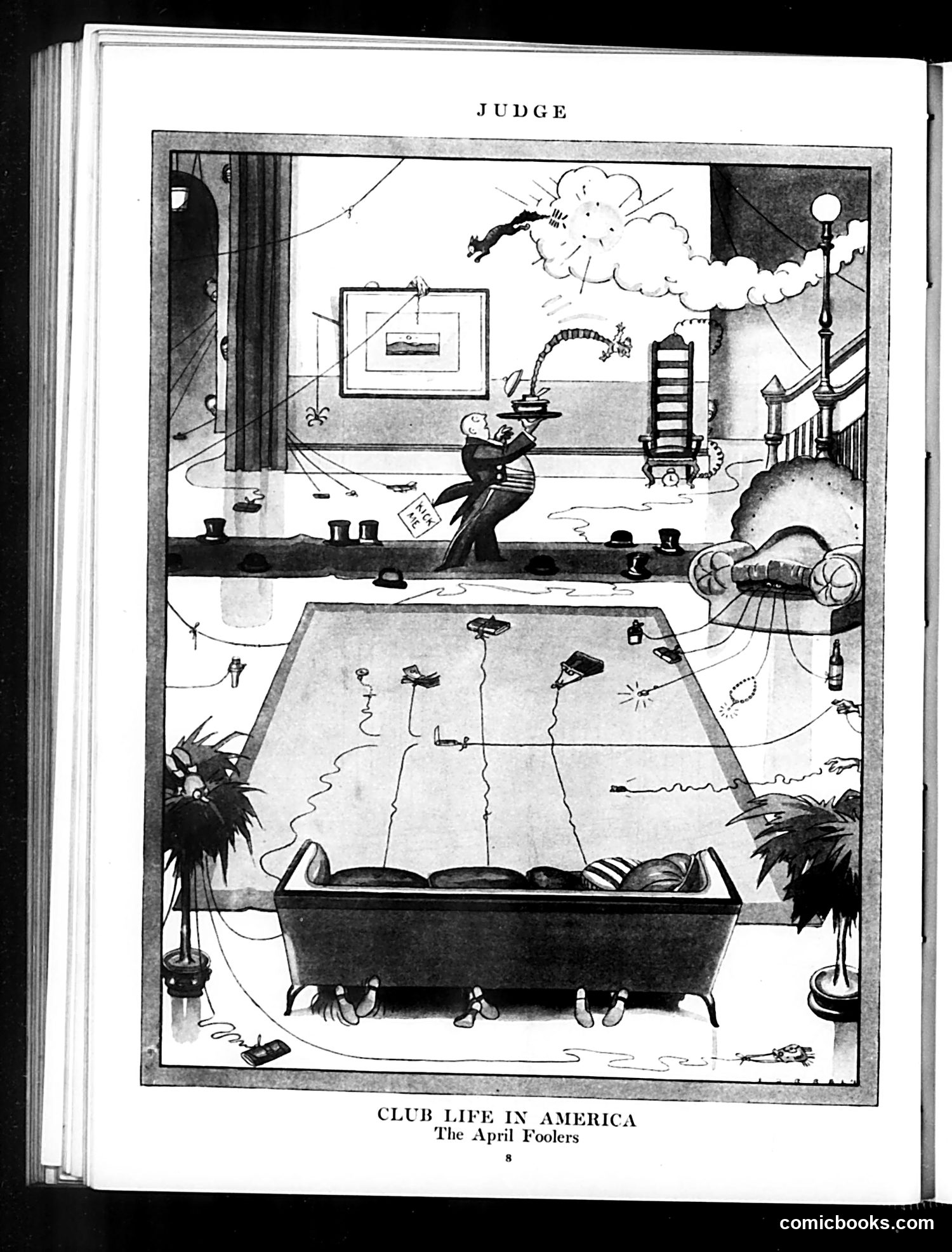
# "Club Life in America: The April Foolers" This cartoon satirizes an exclusive men's club during April Fools' Day. The scene depicts chaos in what appears to be a gentlemen's club—a well-appointed space with a large bathtub, palm plants, and period furnishings. A well-dressed man (likely a club member or servant) stands amid mayhem: explosives detonate, objects fly about, and pranks unfold everywhere. The title "April Foolers" suggests club members are engaging in elaborate April 1st practical jokes and tomfoolery. The satire targets wealthy club culture and its members' juvenile behavior—despite their refined setting and social pretensions, they devolve into childish antics. The cartoon mocks both the exclusivity of such clubs and the foolishness of grown men abandoning dignity for pranks.
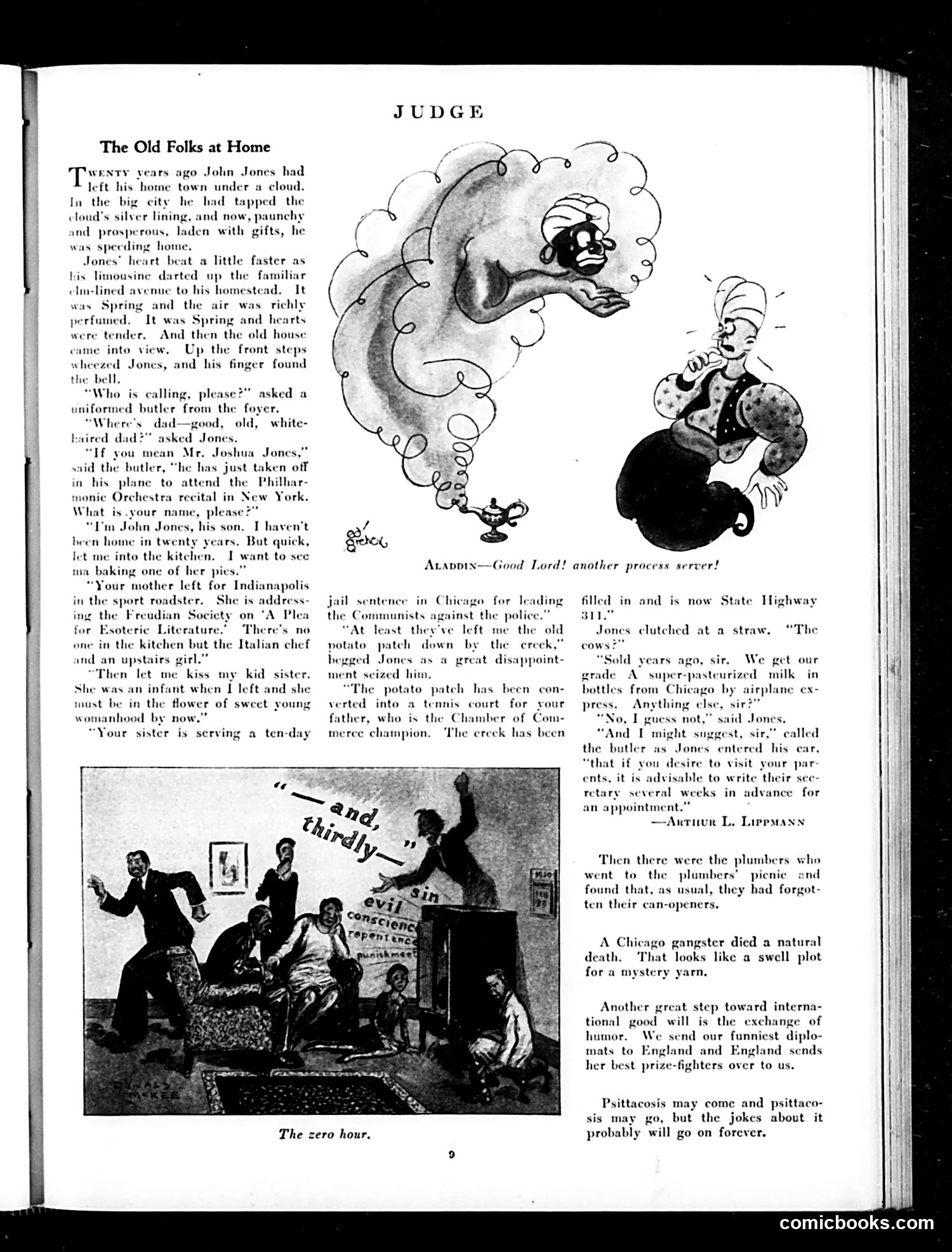
# "The Old Folks at Home" — Judge Magazine Satire This story satirizes the hollowness of American success and the erosion of traditional family life by modern excess. John Jones, who left his hometown twenty years ago in disgrace, has become wealthy in the city. Returning home expecting a sentimental reunion, he finds his entire family has abandoned their modest roots: - His father attends Philadelphia orchestra recitals by plane - His mother lectures on Freudian psychology in Indianapolis - His sister serves jail time for Communist activism - The family's humble potato patch is now a tennis court; cows are replaced by pasteurized milk delivery The butler's final suggestion—that Jones must schedule visits weeks in advance—delivers the punchline: modern prosperity has made family connection impossible. The accompanying cartoon "The Zero Hour" depicts moral decay ("sin," "evil conscience," "punishment"), reinforcing the satirical message that material success corrupts traditional values and family bonds. The satire targets both nouveau riche pretension and the rapid social upheaval of the Jazz Age era.
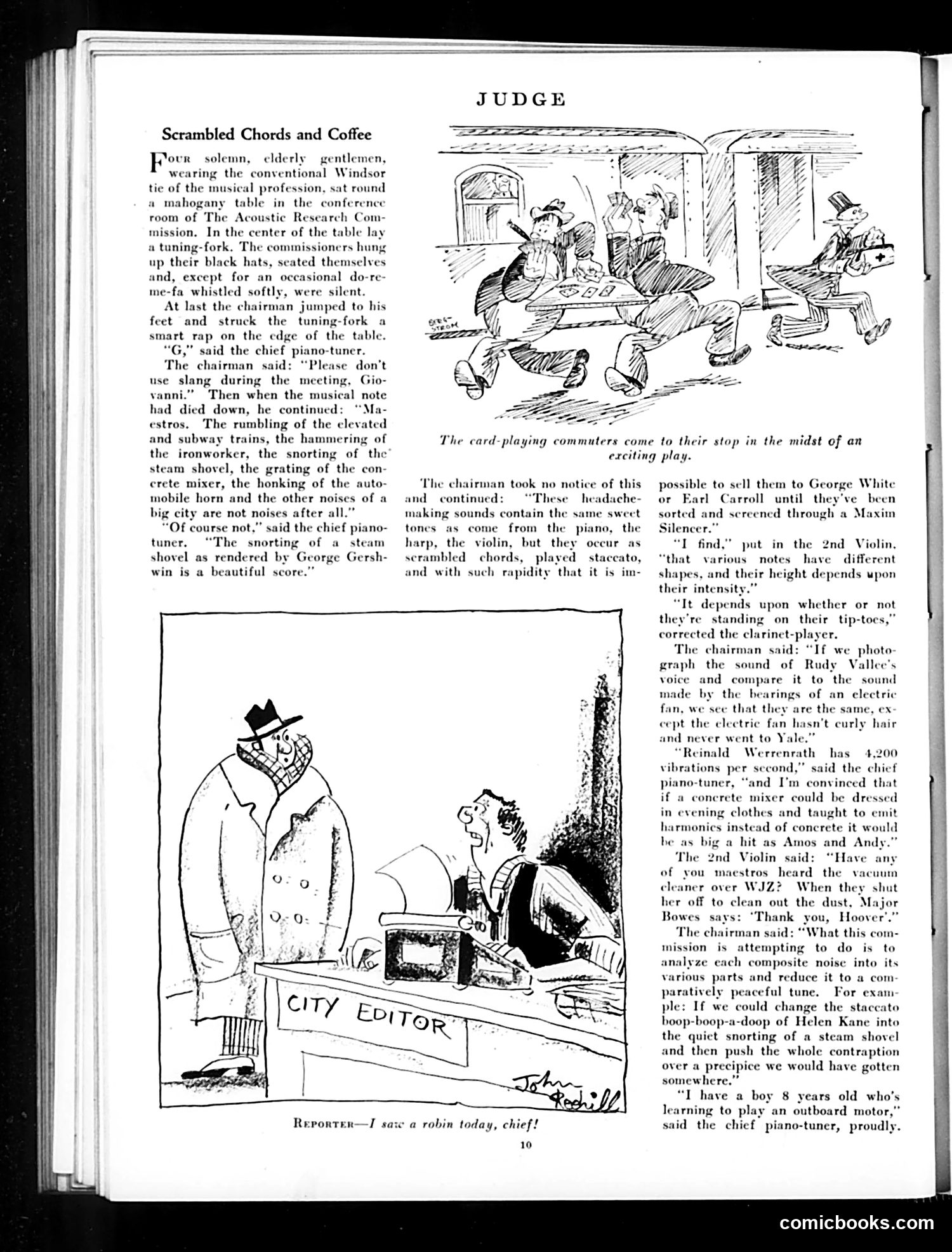
# Explanation for Modern Readers This satirical piece mocks the pretentiousness of classical musicians and music theorists who attempt to find artistic legitimacy in urban noise. The "Acoustic Research Commission"—four stuffy gentlemen in Windsor ties—convenes to argue that city sounds (subway rumbles, jackhammers, car horns) are actually "scrambled chords" worthy of serious musical consideration. The joke operates on multiple levels: it ridicules both the musicians' snobbery (rejecting "slang" terminology) and their absurd pseudo-scientific approach to noise. References to composer George Gershwin, crooner Rudy Vallée, and singers Helen Kane and Reinald Werrenrath anchor the satire in 1920s-30s popular culture—these are contemporary entertainers the theorists might reluctantly acknowledge. The separate cartoon shows a harried newspaper "City Editor" besieged by demands, satirizing journalism's chaos as equally worthy of musical composition. The underlying satire: pretentious intellectuals will rationalize anything as art, no matter how ridiculous.