
Judge, 1930-03-29 · page 18 of 36
Judge — March 29, 1930 — page 18: what you’re looking at
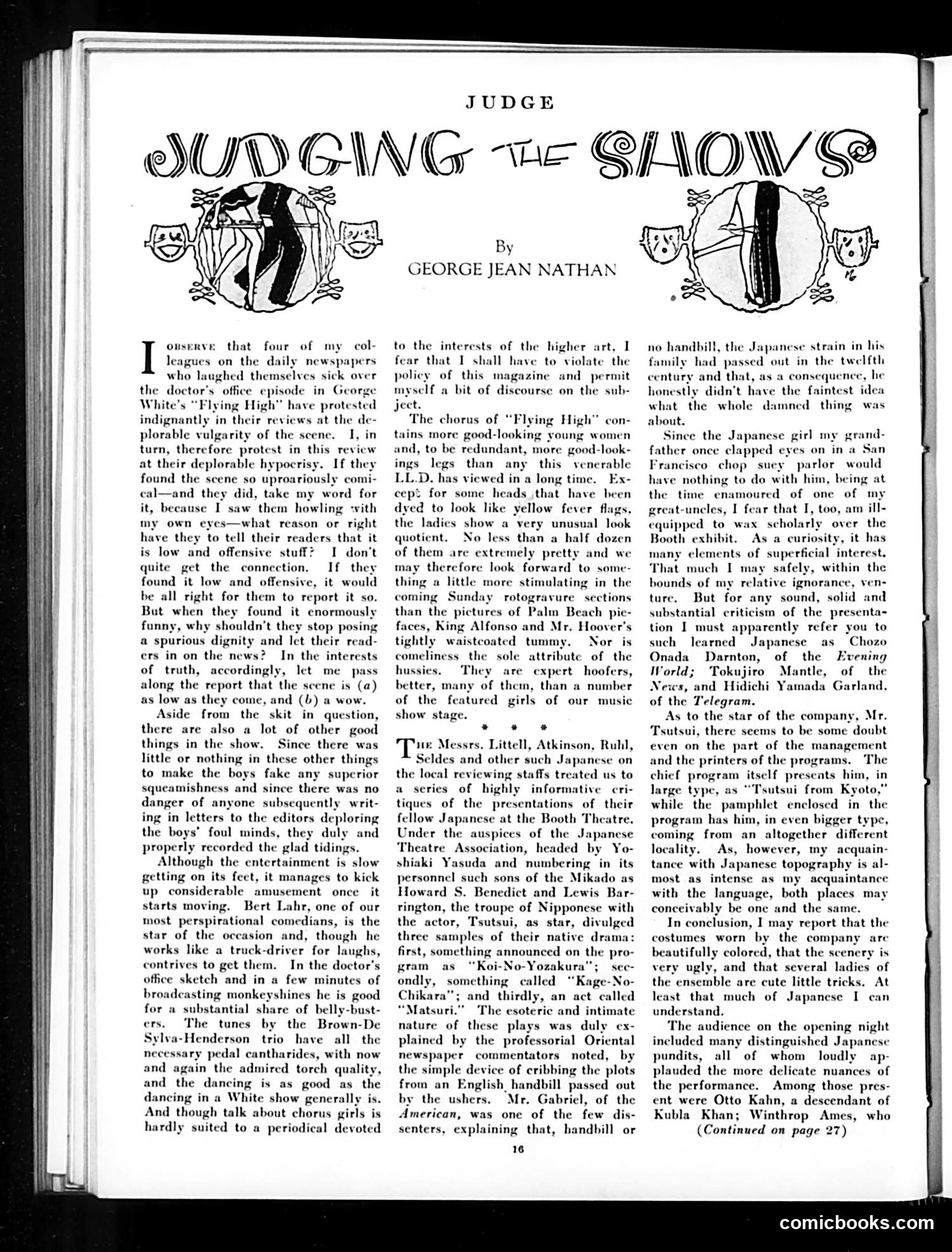
A restored page from Judge, 1930-03-29. Page through the whole issue in the reader above.
📄 Transcribed text from this page (OCR, searchable)
Machine-transcribed from the original scan — historical spelling and the odd misread are preserved.
whl onserve that four of my col- I leagues on the daily newspapers who laughed themselves sick ov the doctor's office episode in Georg White's “Flying High” have protested indignantly in their reviews at the de- plorable vulgarity of the scene. I, turn, therefore protest in this review at their deplorable hypoc If they found the scene so uproariously comi- cal—and they did, take my word for because I saw them howling ith my own eyes—what reason or right have they to tell their readers that it is low and offensive stuff? I don't quite get the connection, If they found it low and offensive, it would be all right for them to report it so. But when they found it enormously funny, why shouldn't they stop po: a spurious dignity and Ict their read- ers in on the news? In the interests of truth, accordingly, let me pass along the report that the scene is (a) as low as they come, and (b) a wow. Aside from the skit in question, there are also a lot of other good things in the show. Since there was little or nothing in these other things to make the boys fake any superior squeamishness and since there was no danger of anyone subsequently writ- ing in letters to the editors deploring the boys’ foul minds, they duly and properly recorded the glad tidi Although the entertainment is slow getting on its feet, it manages to kick up considerable amusement once it starts moving. Bert Lahr, one of our most perspirational comedians, is the star of the occasion and, though he works like a truck-driver for laughs, contrives to get them. In the doctor's office sketch and in a few minutes of broadcasting monkeyshines he is good for a substantial share of belly-bust- 5 tunes by the Brown-De Sylva-Henderson trio have all the necessary pedal cantharides, with now and again the admired torch quality, and the dancing is as good as the dancing in a White show generally is. And though talk about chorus girls is hardly suited to a periodical devoted JUDGE NG te SHOWS vy By ie GEORGE JEAN NATHAN ° Ne to the interests of the fear that I shall have to violate the policy of this magazine and permit myself a bit of discourse on the ject. The chorus of “Flying High” con- tains more good-looking young women and, to be redundant, more good-look- ings legs than any this venerable LL.D. has viewed in a long time. E cept for some heads that have dyed to look like yellow fever the ladies show a very unusual look quotient. No less than a half dozen of them are extremely pretty and we may therefore look forward to some- thing a little more stimulating in the coming Sunday rotogravure sections than the pictures of Palm Beach pi faces, King Alfonso and Mr. Hoover's tightly waistcoated tummy. Nor is comeliness the attribute of the hussies. They are expert hoofers, better, many of them, than a number of the featured girls of our music show stage. higher art, I sub- been jags, sole * * @ ne Messrs. Littell, Atkinson, Ruhl, Seldes and other such Japanese on the local reviewing staffs treated us to a series of highly informative cri- tiques of the presentations of their fellow Japanese at the Booth Theatre. Under the auspices of the Japanese Theatre Association, headed by Yo- shiaki Yasuda and numbering in its personnel such sons of the Mikado as Howard S. Benedict and Lewis Bar- rington, the troupe of Nipponese with the actor, Tsutsui, as star, divulged three samples of their native drama: first, something announced on the pro- gram as “Koi-No-Yozakura ondly, something called “Kag Chikara"; and thirdly, an act called “Matsuri.” The esoteric and intimate nature of these plays was duly ex- plained by the professorial Oriental newspaper commentators noted, by the simple device of cribbing the plots from an English, handbill passed out by the ushers. Mr. Gabriel, of the American, was one of the few dis- senters, explaining that, handbill or 16 no handbill, the Japanese st 1 passed out in the twelfth century and that, as a consequence, he honestly didn’t have the what the whole damned thing was about. Since the Japanese girl my grand- father once clapped eyes on in a San Francisco chop suey parlor would have nothing to do with him, being at the time enamoured of one of my great-uncles, I fear that I, too, am ill- equipped to wax scholarly over the Booth exhibit. As a curios’ it has many elements of superficial interest That much I may safely, within the bounds of my relative ignorance, ven- ture, But for any sound, solid and substantial criticism of the presenta- tion I must apparently refer you to such learned Japanese Chozo Onada Darnton, of the Evening World; Tokujiro Mantle, of the News, and Hidichi Yamada Garland, of the Telegram. As to the star of the company, Mr. Tsutsui, there seems to be some doubt even on the part of the managen and the printers of the programs. chief program itself preseats him, large type, as “Tsutsui from Kyoto,” while the pamphlet enclosed in the program has him, in even bigger type, coming from an altogether different locali As, however, my acquain- tance with Japanese topography is al- most as intense as my acquaintance with the language, both places may conceivably be one and the same. In conclusion, I may report that the costumes worn by the company are beautifully colored, that the scenery is very ugly, and that several ladies of the ensemble are cute little tricks. At least that much of Japanese I can understand. The audience on the opening night included many distinguished Japanese pundits, all of whom loudly plauded the more delicate nuan the performance. Among those pres- ent were Otto Kahn, a descendant of Kubla Khan; Winthrop Ames, who (Continued on page 27) faintest ide as comicbooks.com