
Judge, 1930-03-29 · page 12 of 36
Judge — March 29, 1930 — page 12: what you’re looking at
What you’re looking at
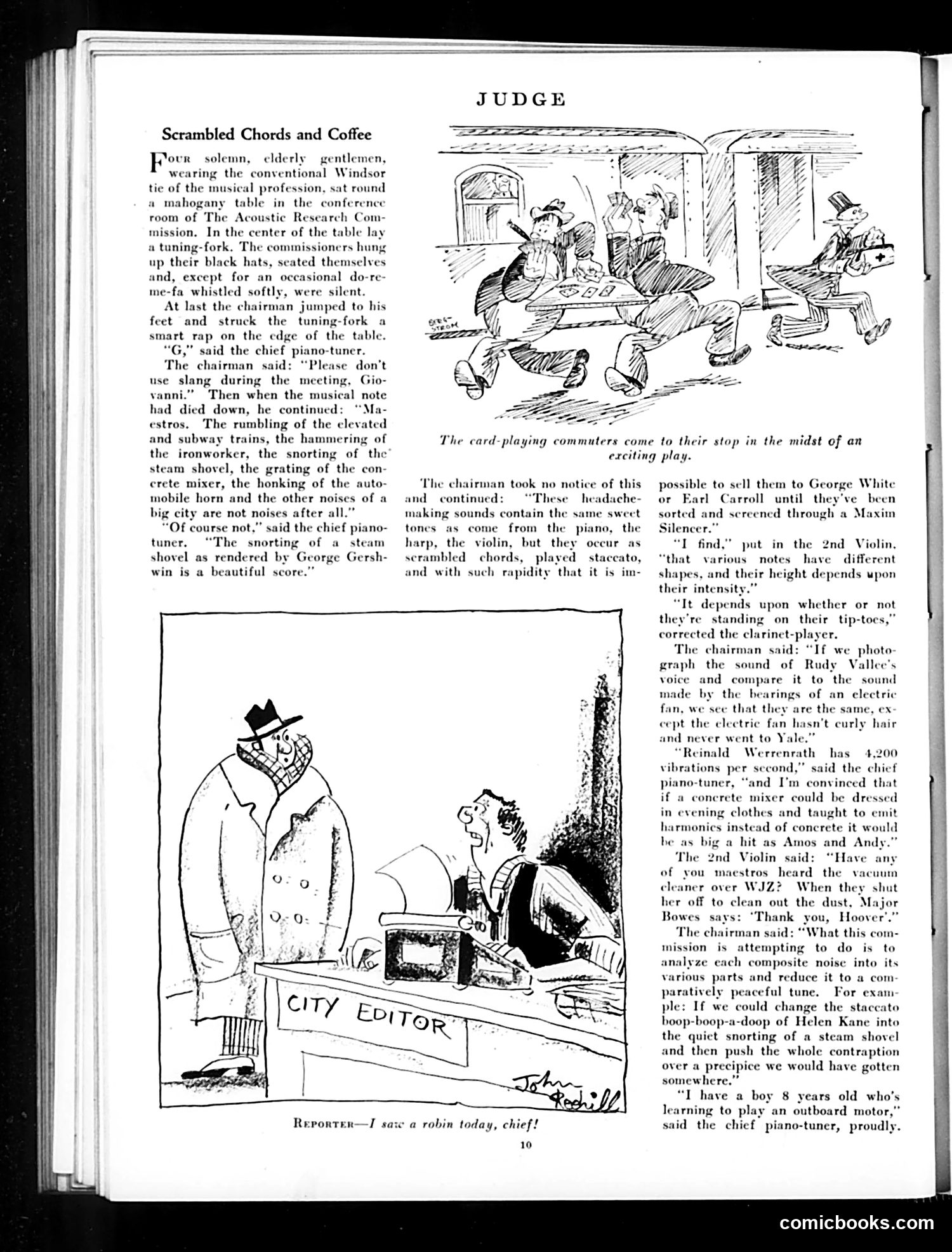
# Explanation for Modern Readers This satirical piece mocks the pretentiousness of classical musicians and music theorists who attempt to find artistic legitimacy in urban noise. The "Acoustic Research Commission"—four stuffy gentlemen in Windsor ties—convenes to argue that city sounds (subway rumbles, jackhammers, car horns) are actually "scrambled chords" worthy of serious musical consideration. The joke operates on multiple levels: it ridicules both the musicians' snobbery (rejecting "slang" terminology) and their absurd pseudo-scientific approach to noise. References to composer George Gershwin, crooner Rudy Vallée, and singers Helen Kane and Reinald Werrenrath anchor the satire in 1920s-30s popular culture—these are contemporary entertainers the theorists might reluctantly acknowledge. The separate cartoon shows a harried newspaper "City Editor" besieged by demands, satirizing journalism's chaos as equally worthy of musical composition. The underlying satire: pretentious intellectuals will rationalize anything as art, no matter how ridiculous.
📄 Transcribed text from this page (OCR, searchable)
Machine-transcribed from the original scan — historical spelling and the odd misread are preserved.
Scrambled Chords and Coffee Frere solemn, elderly gentlemen, wearing the conventional Windsor tie of the musical profession, sat round a mahogany table in the conference room of The Acoustic Research Com- mission. In the center of the table lay a tuning-fork. The commissioners hung up their black hats, seated themselves and, except for an occasional do-re- me-fa whistled softly, were silent. At last the chairman jumped to his feet and struck the tuning-fork a smart rap on the edge of the table. “G,” said the chief piano-tuner. The chairman said: ‘Please don’t use slang during the meeting, Gio- vanni.” Then when the mus note had died down, he continued: ‘Ma- estros. The rumbling of the elevated and subway trains, the hammering of the ironworker, the snorting of the steam shovel, the grating of the con- crete mixer, the honking of the auto- mobile horn and the other noises of a big city are not noises after all.” “Of course not,” said the chief piano- tuner. ‘The snorting of a shovel as rendered by George Gersh- win is a beautiful score.” steam The card-playing commuters come to their stop in the midst of an exciting play. ‘The chairman took no notice of this and continued: “These headache- making sounds contain the same sweet tones as come from the piano, the harp, the violin, but they occur as scrambled chords, played staccato, and with such rapidity that it is im- Reporten—I saz a robin today, chief! 10 possible to sell them to George White or Earl Carroll until they've been sorted and screened through a Maxim Silencer.” “IT find,” “that various notes shapes, and thei their intensity “It depends upon whether or not ‘re standing on their tip-toes,” cted the clarinet-player. The chairman said: “If we photo graph the sound of Rudy Vallce’s voice and compare it to the sound made by the bearings of an electric fan, we see that they are the sam cept the electric fan hasn't curly hair and never went to Yale.” “Reinald) Werrenrath has 4,200 vibrations per second,” said the chief piano-tuner, “and I’m convinced that if a concrete mixer could be dressed put in the 2nd Violin, have different height depends upon th cor in evening clothes and taught to emit harmonics instead of concrete it would s big a hit as Amos and Andy.” The 2nd Violin said: “Have any of you maestros heard the vacuuin er over WJZ? When they shut off to clean out the dust, Maj ays: ‘Thank you, Hoover’.” “What this com- ig to do is to h composite noise into its ious parts and reduce it to a com- paratively peaceful tune. For exam ple: If we could change the stac hoop-boop-a-doop of Helen Kane into the quict snorting of a steam shovel and then push the whole contraption over a precipice we would have gotten somewhere,” “I have a boy 8 years old who's learning to play an outboard motor,” said the chief piano-tuner, proudly. comicbooks.com