
Judge, 1930-03-29 · page 15 of 36
Judge — March 29, 1930 — page 15: what you’re looking at
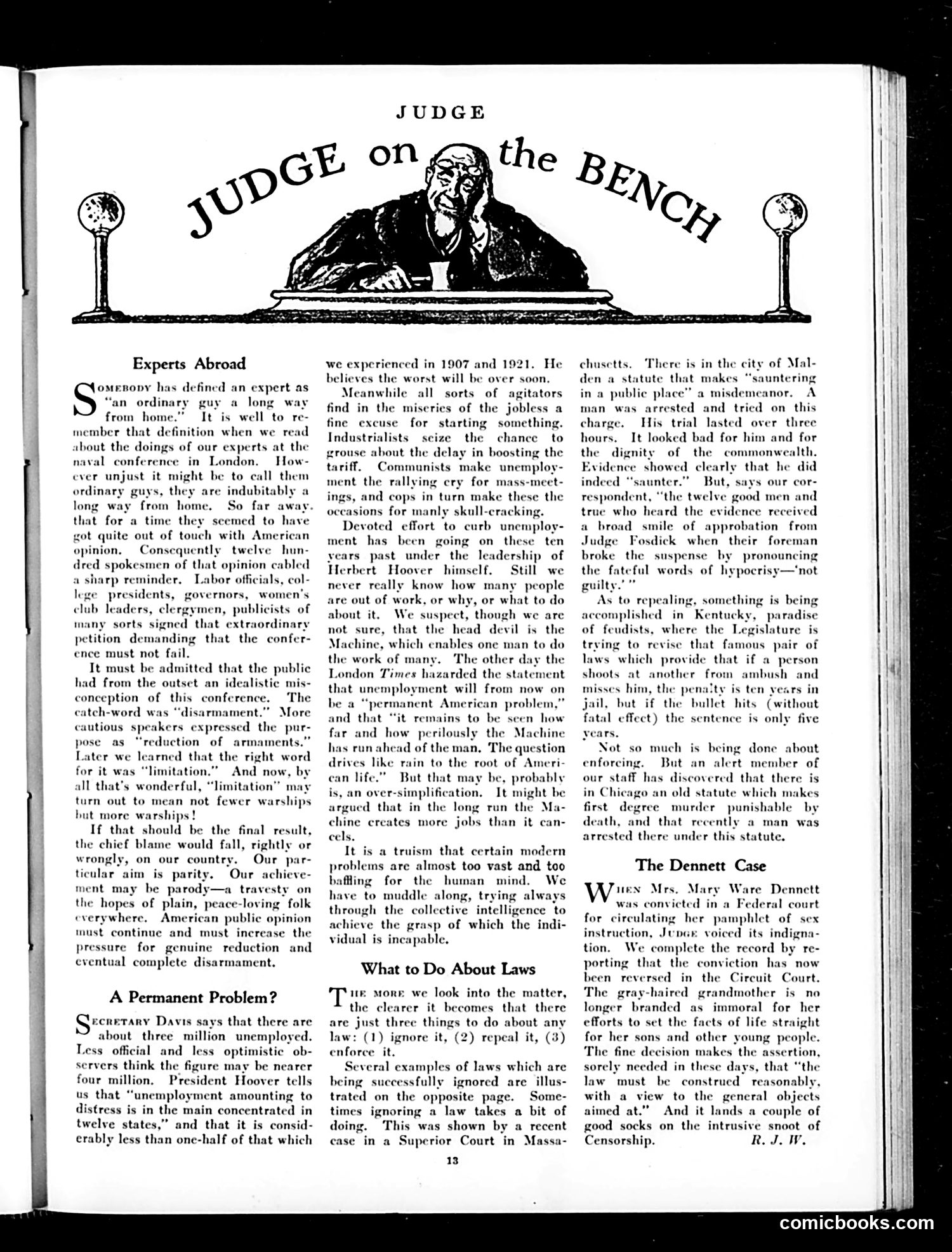
A restored page from Judge, 1930-03-29. Page through the whole issue in the reader above.
📄 Transcribed text from this page (OCR, searchable)
Machine-transcribed from the original scan — historical spelling and the odd misread are preserved.
Experts Abroad omenopy has defined an expert as S “an ordinary guy a long way from home.” It is well to re- member that definition when we read about the doings of our experts at the naval conference in London. How- ever unjust it might be to call them ordinary guys, they are indubitably long way from home. S$ that for a time they got quite out of touch with Ame opinion, Consequently twelve hun- dred spokesmen of that opinion cabled a sharp reminder. lege presidents, gov club leaders, cle Labor officials, col- women’s , publicists of many sorts signed that extraordinary petition demanding that the confer- ence must not fail. It must be admitted that the public had from the outset an idealistic mis- conception of this conference. ‘The catch-word was “disarmament.” More cautious sp rs expressed the pur- “reduction of Later we learned t for it was “limitation And now, by all that’s wonderful, “limitation” 1 turn out to mean not fewer warships but more warships ! If that should be the final result, the chief blaine would fall, rightly or wrongly, on our country. ticular aim is parity. “Our : ment may be parody—a travesty on the hopes of plain, peace-loving folk everywhere, American public opinion must continue and must increase the pressure for genuine reduction and eventual complete disarmament. rnors, armaments.” the right word pose as A Permanent Problem? Grenetany Davis says that there are about three million unemployed. Less official and less optimistic ob- servers think the figure may be nearer four million. President Hoover tells us that “unemployment amounting to distress is in the main concentrated in twelve states,” and that it is consid- erably less than one-half of that which we experienced in 1907 and 1921. He believes the worst will be over soon. Meanwhile all sorts of a find in the miseries of the jobless a fine excuse for starting something. Industrialists seize the chance to grouse about the delay in boosting the tariff. Communists make unemploy- ment the rallying ery for mass-meet- i and cops in turn make these the sions for manly skull-cracking. Devoted effort to curb unemploy- ment has en going on these ten years past under the leadership of Herbert Hoover himself. Still we never really know how many people are out of work, or why, or what to do about it. We suspect, though we are not sure, that the head devil is the Machine, which enables one man to do the work of many. The other day the London Times hazarded the statement that unemployment will from now on “permanent American problem,” and that “it remains to be seen how far and how perilously the Machine 1of the man, The question rain to the root of Ameri- be, probably is, an over-simplification. It might be argued that in the long run the Ma- chine creates more jobs than it cels, It is a truism that certain modern problems are almost too vast and too baffling for the human mind. We have to muddle along, trying always through the collective intelligence to achieve the grasp of which the indi- vidual is incapable, What to Do About Laws uk Morr we look into the matter, the clearer it becomes that there are just three things to do about any law: (1) ignore (2) repeal it, (3) enforce it. Several examples of laws which are being successfully ignored are illus- trated on the opposite page. Some- times ignoring a law takes a bit of doing. This was shown by a recent case in a Superior Court in Massa- 13 chusetts. There is in the city of Mal- den a statute that makes “sauntering in a publi 1 misdemeanor. A man wa and tried on this charge. His trial lasted over three hours. It looked bad for him and for the dignity of the commonwealth. idence showed clearly that he did indeed “saunter.” But, says our cor- respondent, “the twelve good men and true who heard the evidence received a broad smile of approbation from Judge Fosdick when their foreman broke the suspense by pronouncing the fateful words of hypocrisy—‘not guilty.” As to repealing, something is being accomplished in Kentucky, paradise of feudists, where the Leg trying to revise that famous pair of laws which provide that if a person shoots at another from ambush and misses him, the penalty is ten years in jail, but if the bullet hits (without fatal effect) the sentence is only five years. ature is Not so much is being done about enforcing. But an alert member of our staff has discovered that there is inc an old statute which m: ag s first. degree murder punishable by deat nd that recently a man was arrested there under this statute. The Dennett Case Wires Mrs. Mary Ware Dennett Ws convicted in a Federal court for circulating her pamphlet of sex instruction, Jupar voiced its indigna- tion, We complete the record by re- porting that the conviction has now heen reversed in the Circuit Court. The gray-haired grandmother is no longer branded as immoral for her efforts to set the facts of life straight for her sons and other young people. The fine decision makes the assertion, sorely needed in these days, that “the law ‘must be construed” reasonably, with a view to the general objects aimed at.” And it lands a couple of good socks on the intrusive snoot of Censorship. RJ. 1. comicbooks.com