
Judge, 1930-03-29 · page 23 of 36
Judge — March 29, 1930 — page 23: what you’re looking at
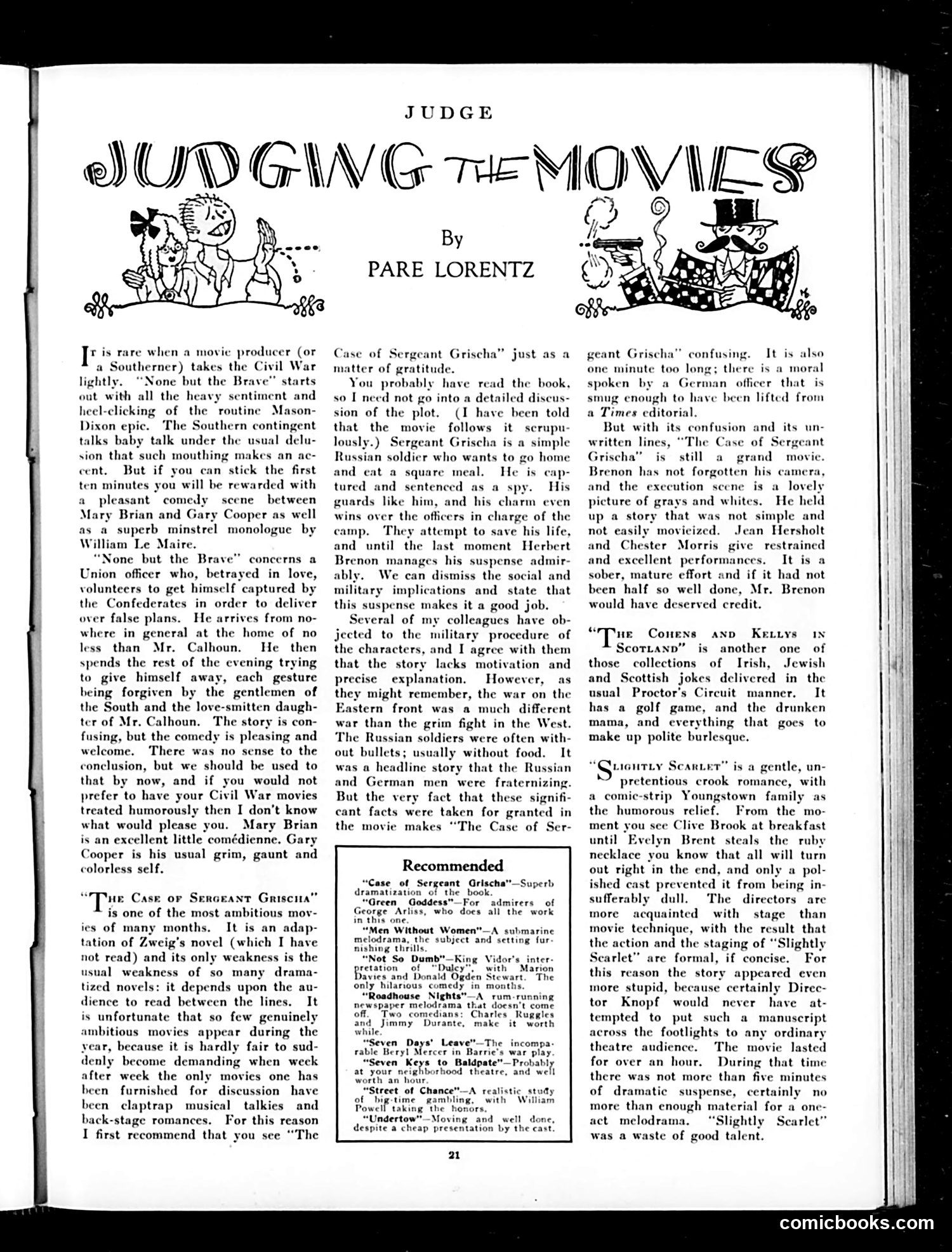
A restored page from Judge, 1930-03-29. Page through the whole issue in the reader above.
📄 Transcribed text from this page (OCR, searchable)
Machine-transcribed from the original scan — historical spelling and the odd misread are preserved.
JUDGIWG HM KS ft is rare when a movie producer (or a Southerner) takes the Civil War lightly. “None but the Brave” starts out with all the heavy sentiment and heel-clicking of the routine Mason- Dixon epic. The Southern contingent talks baby talk under the usual delu- sion that such mouthing makes an ac- cent. But if you can stick the first ten minutes you will be rewarded with a pleasant comedy scene between Mary Brian and Gary Cooper as well as a superb minstrel monologue by William Le Maire. “None but the Brave” concerns a Union officer who, betrayed in love, volunteers to get himself captured by the Confederates in order to deliver over false plans. He arrives from no- where in general at the home of no less than Mr. Calhoun. He then spends the rest of the evening trying to give himself away, each gesture being forgiven by the gentlemen of the South and the love-smitten daugh- ter of Mr. Calhoun. The story is con- fusing, but the comedy is pleasing and welcome. There was no sense to the conclusion, but we should be used to that by now, and if you would not prefer to have your Civil War movies treated humorously then I don’t know what would please you. Mary Brian is an excellent little comédienne. Gary Cooper is his usual grim, gaunt and colorless self. “"Dne Case or Serceant Griscia” is one of the most ambitious mov- ies of many months. It is an adap- tation of Zweig’s novel (which I have not read) and its only weakness is the usual weakness of so many drama- tized novels: it depends upon the au- dience to read between the lines. It is unfortunate that so few genuinely ambitious movies appear during the year, because it is hardly fair to sud- denly become demanding when weck after week the only movies one has been furnished for discussion have been claptrap musical talkies and back-stage romances. For this reason I first recommend that you see “The JUDGE By PARE LORENTZ Case of Sergeant Grischa” just as a matter of gratitude. You probably have read the book, so I need not go into a detailed discus- sion of the plot. (I have been told that the movie follows it scrupu- lously.) Sergeant Grischa is a simple vants to go home and square meal. He is tured and sentenced as a spy. guards like him, and his charm even wins over the officers in charge of the ‘amp. They attempt to save his life, and until the last moment Herbert Brenon manages his suspense admir- ably. We can dismiss the social and military implications and state that this suspense makes it a good job. Several of my colleagues have ob- jected to the military procedure of the characters, and I agree with them that the story lacks motivation and precise explanation. However, as they might remember, the war on the Eastern front was a much different war than the grim fight in the West. The Russian soldiers were often with- out bullets; usually without food. It was a headline story that the Russian and German men were fraternizing. But the very fact that these signifi- cant facts were taken for granted in the movie makes “The Case of Ser- Recommended “Case of Sergeant Grischa”—Superb matization of the book “Green Goddess"—For admirers of George Arliss, who does all the work in this one “Men Without Women"—A submarine melodrama, the subject and setting fur nishing thrills. “Not So Dumb"—King Vidor's inter- retation of “Duley”, with M Davies and Donald Ogden Stewart only hilarious comedy in months. “Roadhouse Night: newspaper melodrama © off. Two comedians: Charles Ruggles and Jimmy Durante, make it” worth while. rion The incompa- war play —Probabl. if borhood theatre, and we! Seven Keys to Baldpate at your neigh! worth an hour “Street of Chance"—A realistic study of big-time gambling, with William Powell takin “Undertow and well done, despite a cheap presentation by the cast 0 6? geant Grischa” confusing. It is also one minute too long; there is a moral spoken by a German. offi that is smug eno to have been lifted from a Times editorial. But with its confusion and its un- written lines, “The C. Grischa” is still Brenon has not forgott and the execution scene is a lovely picture of gr nd whi He held up a story that was not simple and not easily movieized. Jean Hersholt and Chester Morris give restrained and excellent performances. It is a sober, mature effort and if it had not been half so well done, Mr. Brenon would have deserved credit. “rue Comens ann Ketiys 1N Scottanp” is another one of those collections of Irish, Jewish and Scottish jokes delivered in the usual Proctor’s Circuit manner. It has a golf game, and the drunken mama, and everything that goes to make up polite burlesque. 1GUTLY ScarLet” is a gentle, un- pretentious crook romance, with a comic-strip Youngstown far the humorous relief. From the mo- ment you see Clive Brook at breakfast until Evelyn Brent steals the ruby necklace you know that all will turn out right in the end, and only a pol- ished cast prevented it from being in- sufferably dull. The directors are more acquainted with stage than movie technique, with the result that the action and the staging of “Slightly Scarlet” are formal, if concise. For this reason the story appeared even more stupid, because certainly Diree- tor Knopf would never have at- tempted to put such a manuscript across the footlights to any ordinary theatre audience. The movie lasted for over an hour. During that time there was not more than five minutes of dramatic suspense, certainly no more than enough material for act melodrama. “Slightly Scarlet” was a waste of good talent. comicbooks.com