A complete issue · 36 pages · 1930
Judge — January 4, 1930
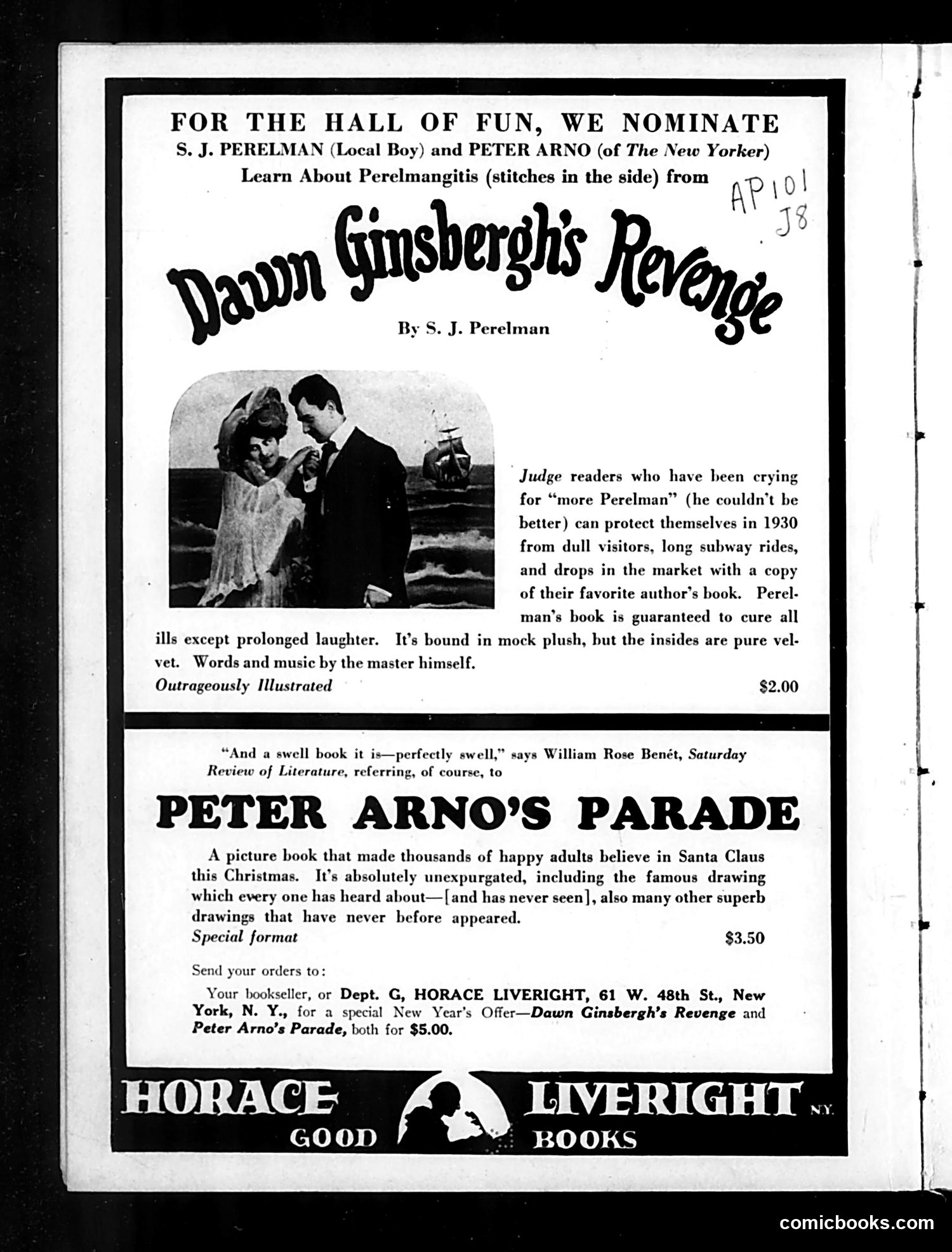
# Analysis This page is primarily **advertising**, not political satire. It promotes two books by humorists: 1. **"Dawn Ginsberg's Revenge"** by S.J. Perelman—a collection of humorous essays. The ad jokes that the book cures "Perelmangitis (stitches in the side)," playing on the author's name. The photograph shows two figures in what appears to be a comedic scene. 2. **"Peter Arno's Parade"** by cartoonist Peter Arno—a picture book with drawings, including a famous Santa Claus illustration the ad promises readers have "heard about" but never seen. Both are marketed as entertainment for adults seeking relief from everyday boredom (subway rides, dull visitors, market downturns). The ads are placed by publisher Horace Liveright and cost $2.00 and $3.50 respectively.
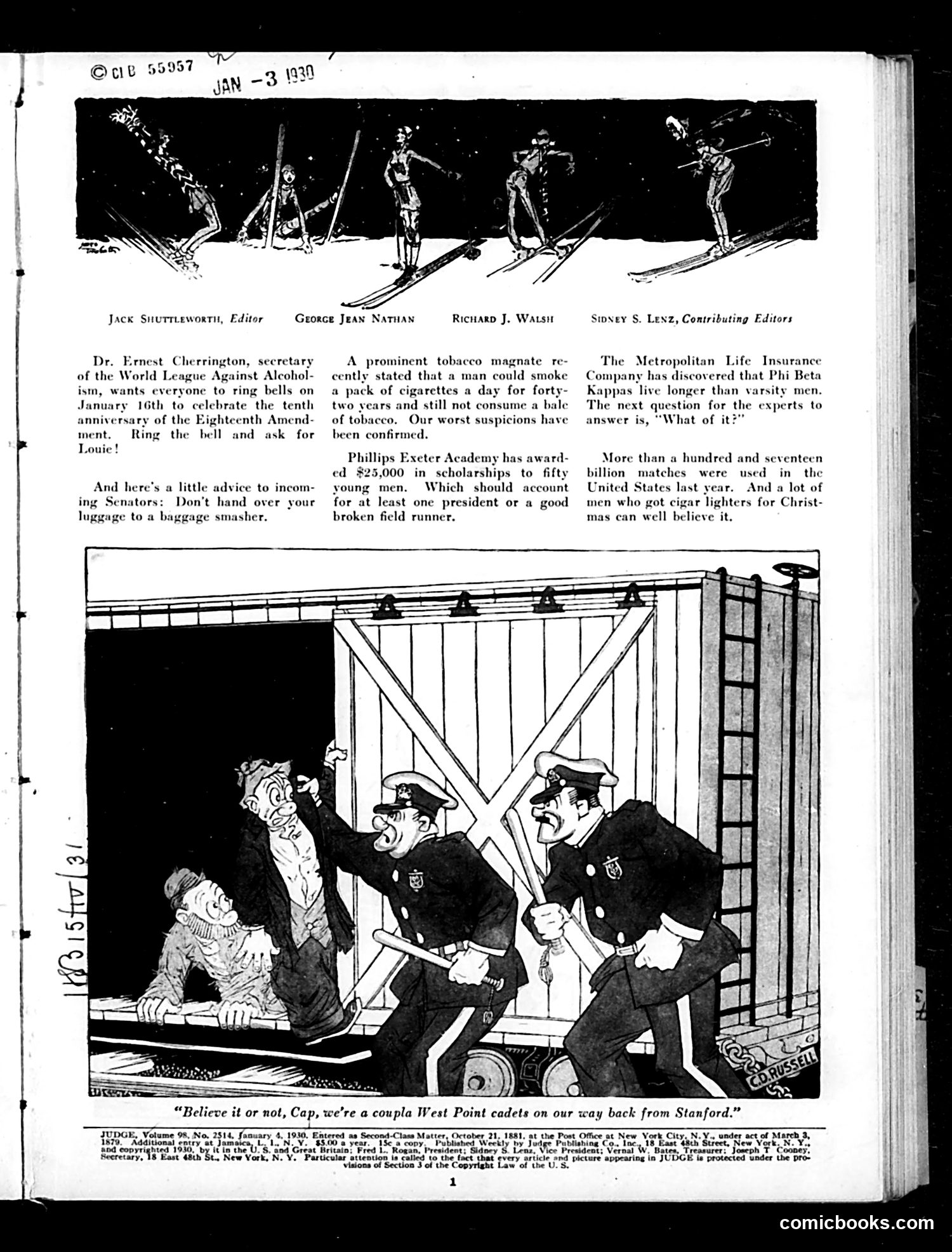
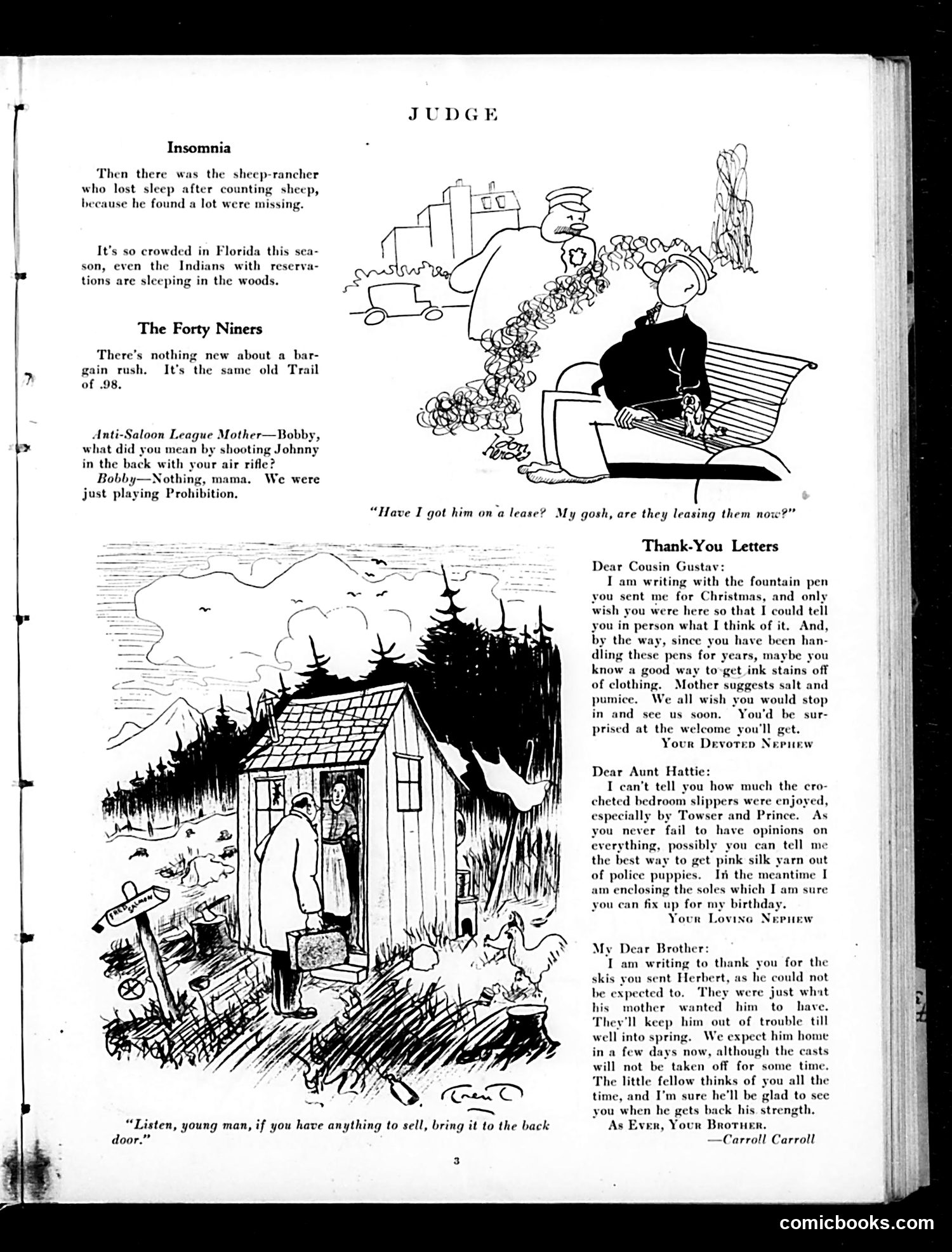
# Judge Magazine Cartoon Analysis This 1930 Judge cartoon satirizes military discipline and the prestige of West Point. The caption reads: "Believe it or not, Cap, we're a coupla West Point cadets on our way back from Stanford." The joke targets the contrast between West Point's elite reputation and the cadets' current disheveled appearance—one appears intoxicated or rowdy, being restrained by what look like police or military officers. The humor comes from the absurdity of claiming prestigious West Point status while visibly violating military conduct standards, likely after revelry at Stanford (a West Coast university). The cartoon mocks both military pretension and the behavior of privileged young officers, suggesting that the Academy's graduates don't always live up to their institution's disciplinary ideals.
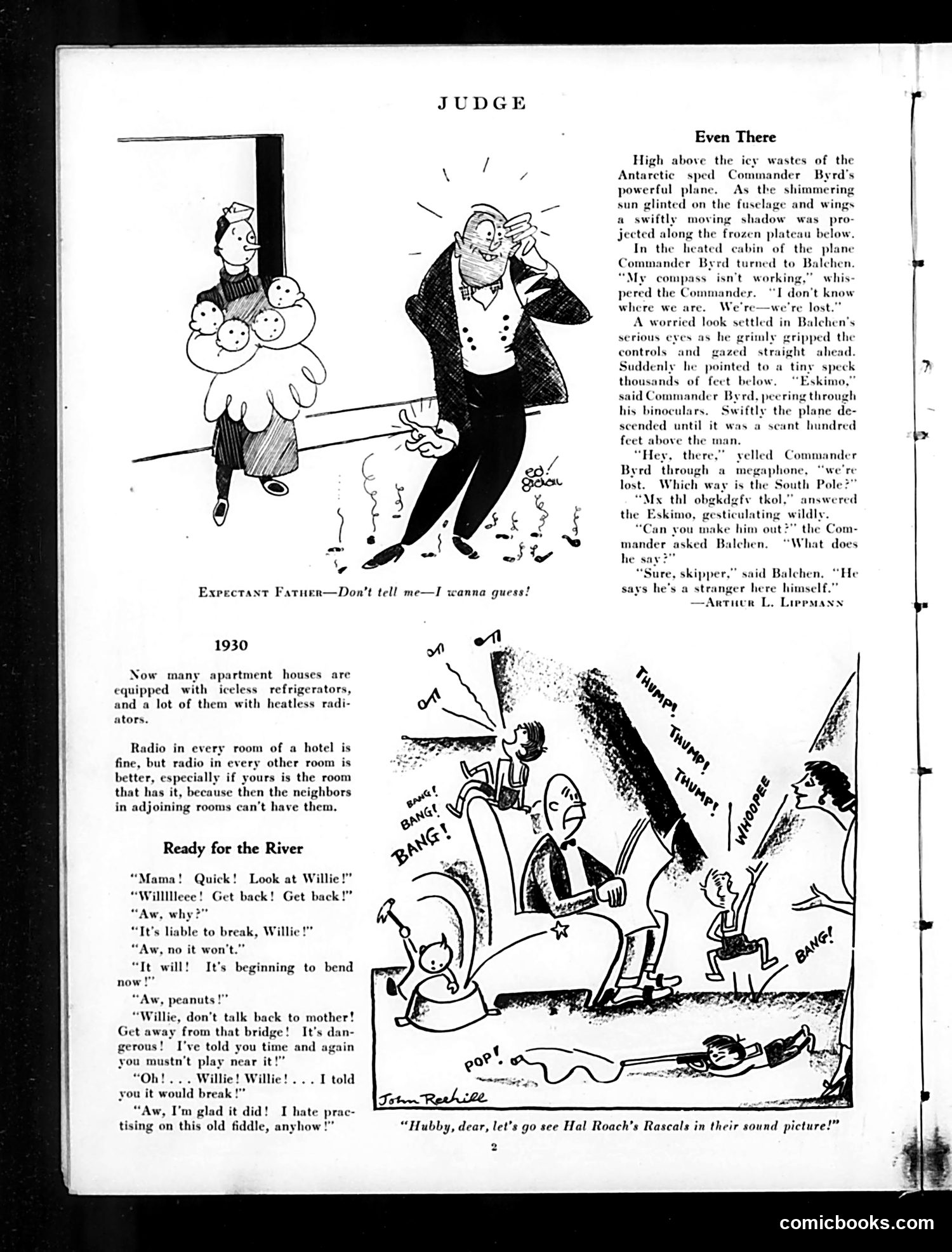
# Analysis of Judge Magazine Page **Top Cartoon: "Expectant Father"** A man holding multiple spheres (likely representing eggs or offspring) asks "Don't tell me—I wanna guess!" The joke plays on the anxious anticipation of impending parenthood, with the visual gag suggesting he's about to become a father to many children simultaneously—a common source of domestic humor in 1930s satire. **Middle Section: "1930"** Commentary on modern apartment living with built-in refrigerators and "heatless radiators," suggesting technological progress made homes more efficient but potentially colder—likely social satire about modernization's tradeoffs. **Bottom Cartoon: "Ready for the River"** Depicts chaotic family scene with a child playing a loud instrument ("bangs," "thumps"), causing domestic disruption. The mother's exasperation ("I hate practicing on this old fiddle, anyhow!") satirizes both parental frustration with children's musical lessons and noise complaints in shared housing.
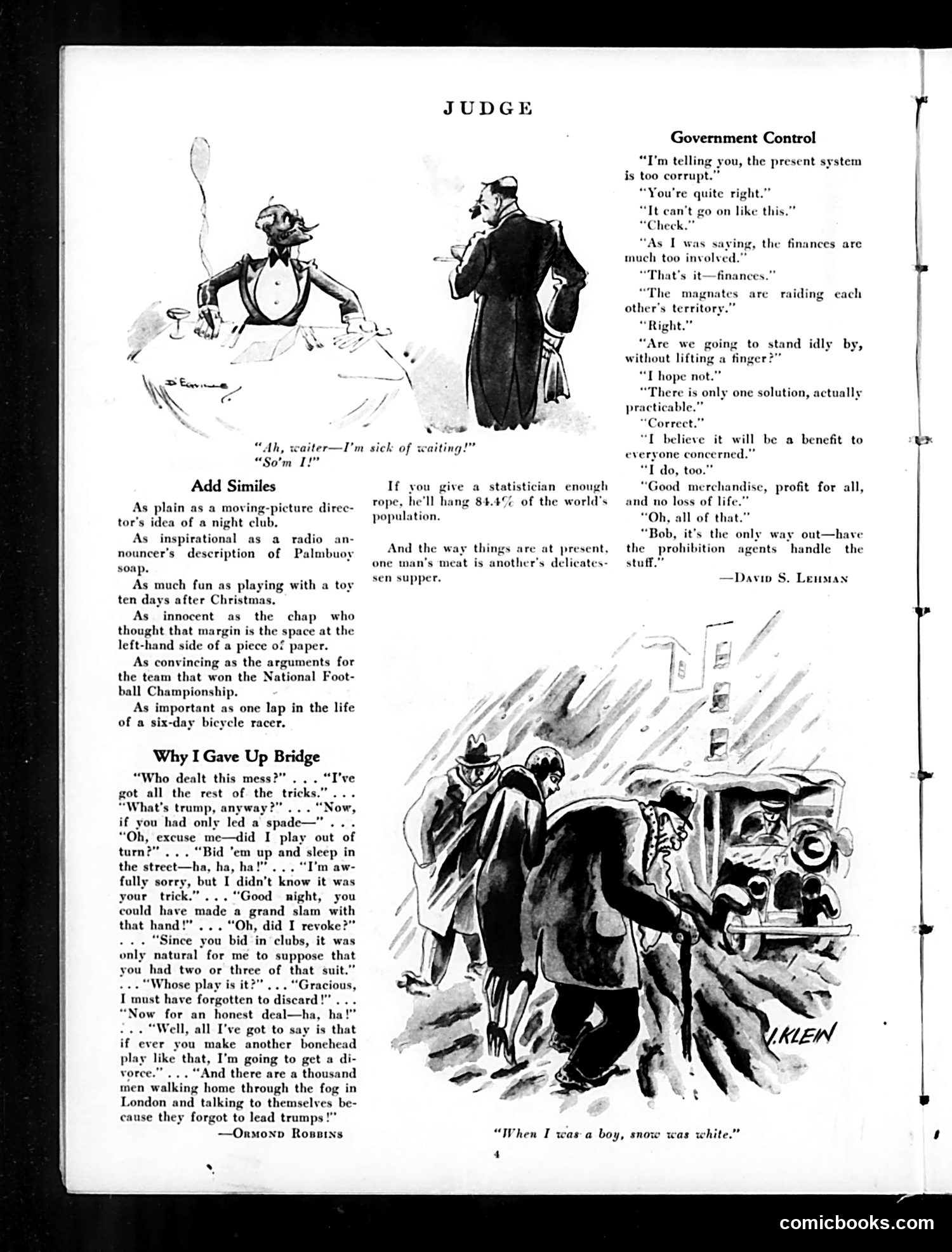
# Analysis of Judge Magazine Page The top cartoon shows a waiter at a table with a seated diner, captioned "Ah, waiter—I'm sick of waiting!" / "So'm I!" This appears to be a simple visual pun about restaurant service complaints rather than political satire. The right panel titled "Government Control" presents a dialogue between two figures discussing systemic corruption—one warns that "the present system is too corrupt" and suggests prohibition agents should "handle the stuff" (apparently referring to alcohol enforcement). This satirizes Prohibition-era debates about government corruption and whether federal agents could effectively manage illegal substances. The lower illustration, signed by Klelein, shows figures examining an old automobile, captioned "When I was a boy, snow was white"—a nostalgic commentary on industrial pollution and environmental degradation.
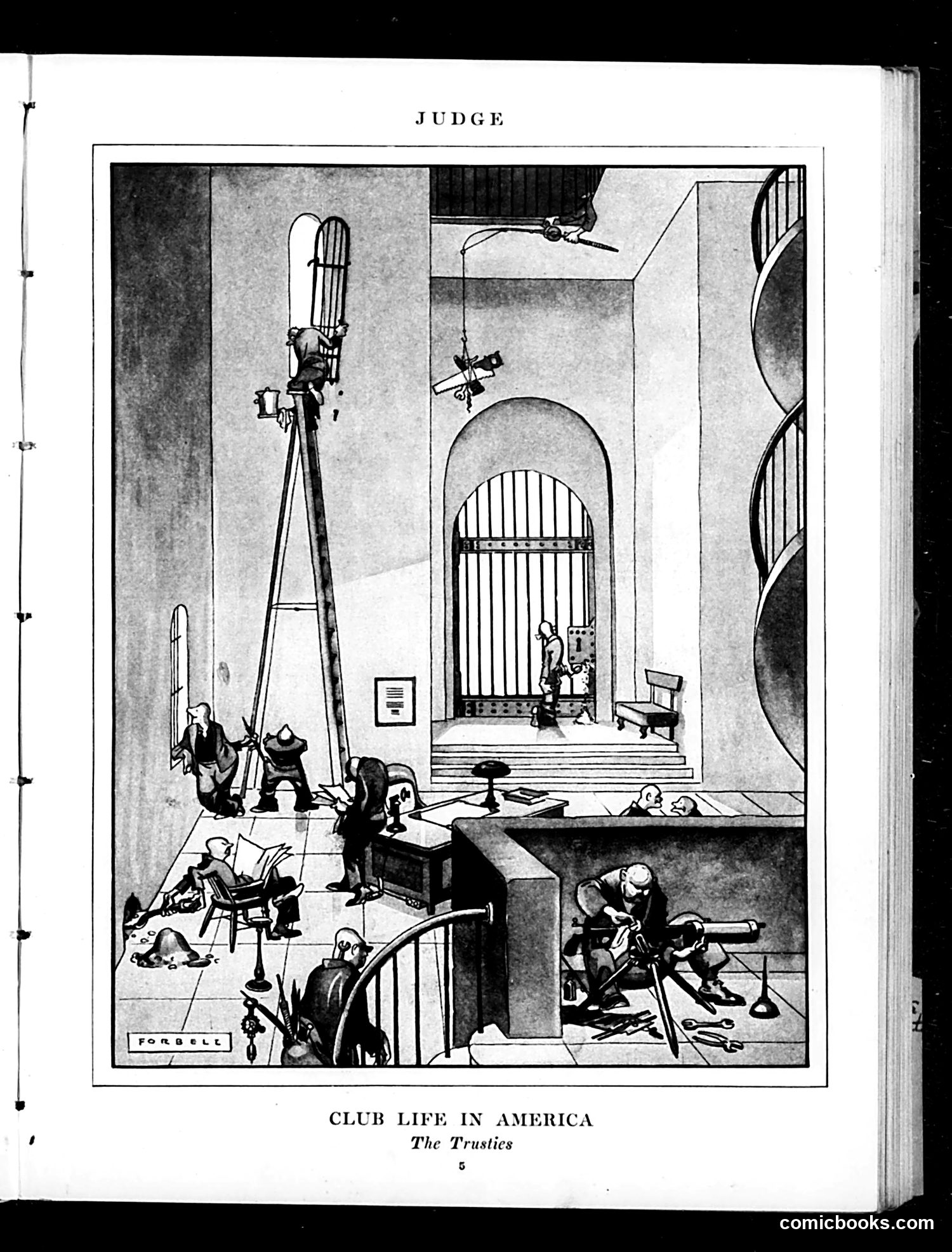
# Analysis of "Club Life in America: The Trusties" This satirical cartoon depicts a wealthy gentlemen's club as a chaotic headquarters for industrial monopolies—"the Trusties." The multi-level scene shows suited men conducting business amid astronomical equipment (telescopes), suggesting they're viewing themselves as cosmic powers controlling markets. The architectural grandeur (arched doorways, formal furnishings) contrasts ironically with the frenetic activity below. The satire targets the growing power of business trusts in early 20th-century America. By portraying these industrial magnates as club members casually managing monopolies from an elite social space, the cartoon critiques how wealth and power concentrate among interconnected businessmen. The "Trusties" nickname mocks their control of industries while operating within society's upper echelons, essentially above normal accountability.
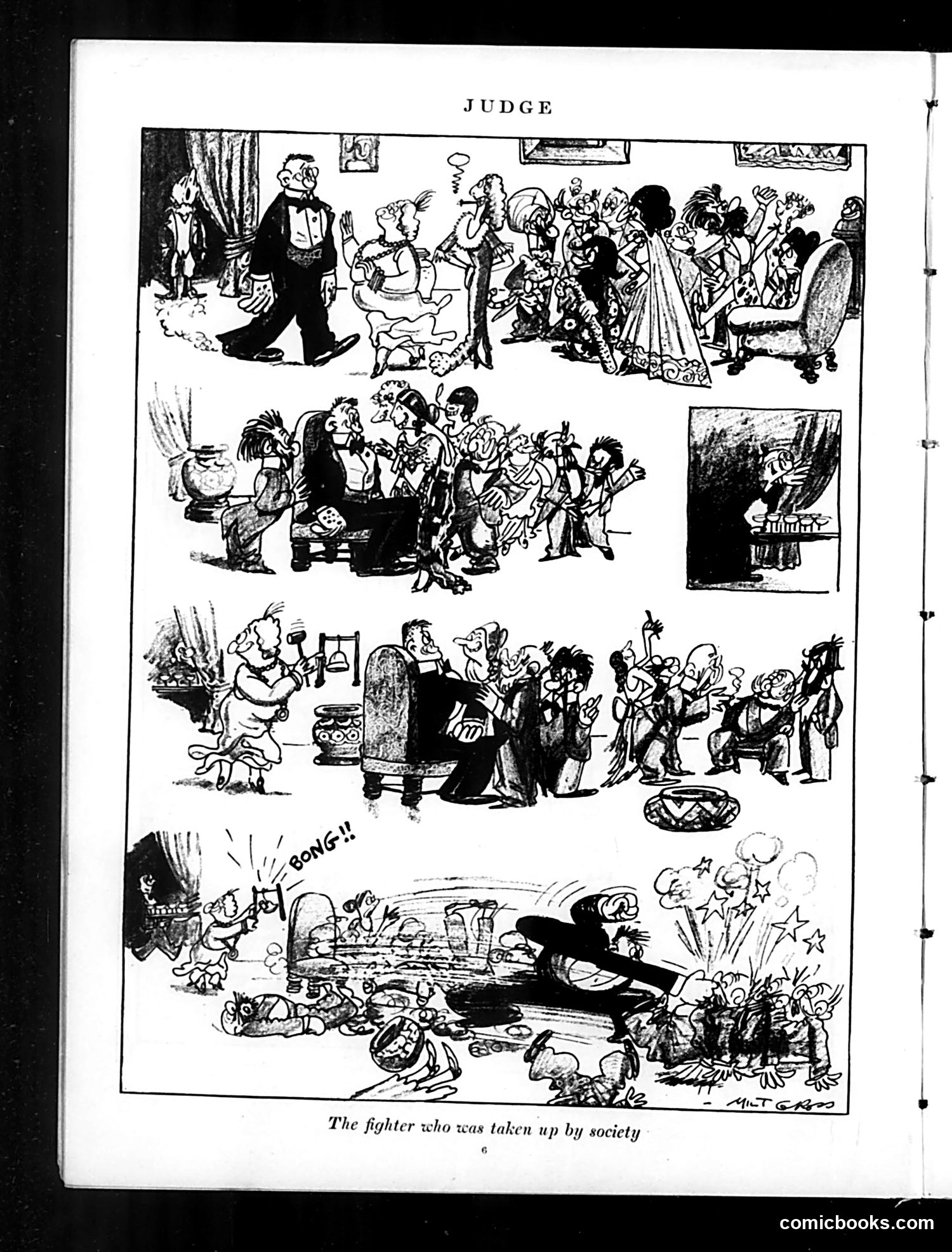
# "The Fighter Who Was Taken Up by Society" This satirical cartoon from *Judge* magazine depicts the social elevation of a boxer through high society's embrace. The multi-panel narrative shows: 1. **Top panels**: A crude fighter is introduced to wealthy, fashionable society folk who adopt him as a novelty 2. **Middle panels**: He's dressed formally and paraded through social events, treated as an exotic curiosity 3. **Bottom panel**: The punchline—once "society" loses interest, he's literally knocked down and abandoned, surrounded by chaos The satire targets both the fighter's naïve ambition and society's shallow, fickle patronage. Wealthy elites elevate working-class figures temporarily for entertainment, then discard them without consequence. The cartoon critiques the class exploitation underlying Gilded Age celebrity culture and the disposability of outsiders once their novelty fades.
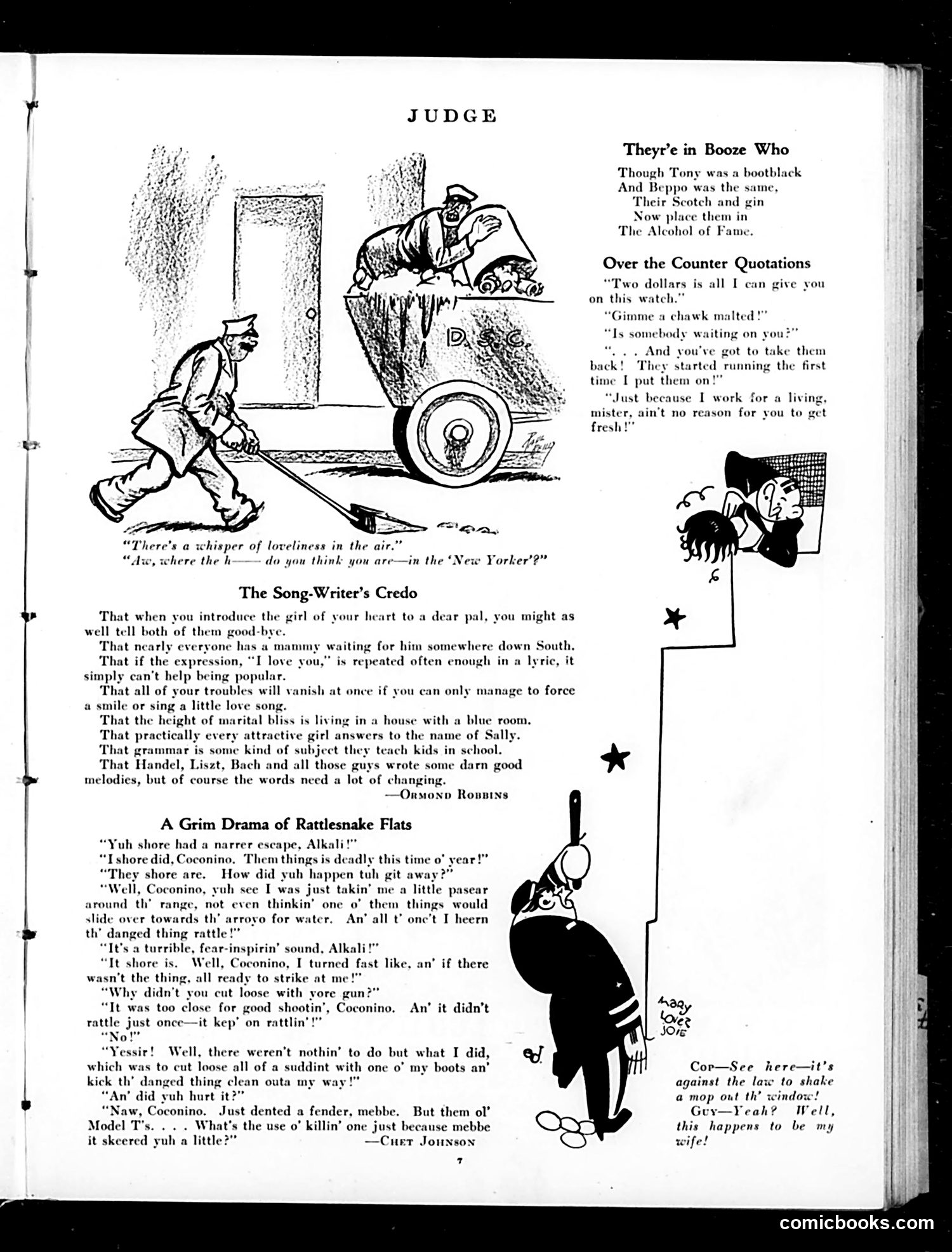
# Judge Magazine Satire Analysis This page contains three distinct satirical pieces reflecting 1920s American concerns: **"There's in Booze Who"** mocks Prohibition-era celebrity worship, suggesting criminals ("bootblack" Tony and Beppo) achieve fame through illegal alcohol distribution—a sharp jab at how Prohibition created glamorous underworld figures. **"Over the Counter Quotations"** presents everyday working-class dialogue, with the final exchange mocking *The New Yorker* magazine's sophisticated pretensions, suggesting that publication caters to affected urban elites. **"A Grim Drama of Rattlesnake Flats"** parodies Western dialect stories and melodrama through exaggerated cowboy characters (Alkali, Coconino) discussing a rattlesnake encounter. The punchline—a man kicked his boot at the snake and merely dented a Model T Ford—deflates the Western genre's dramatic tension with mundane reality. The cartoons criticize both emerging mass media (celebrity criminals, literary snobbery) and tired literary conventions (Wild West tales), using humor to expose social pretense and changing American culture.
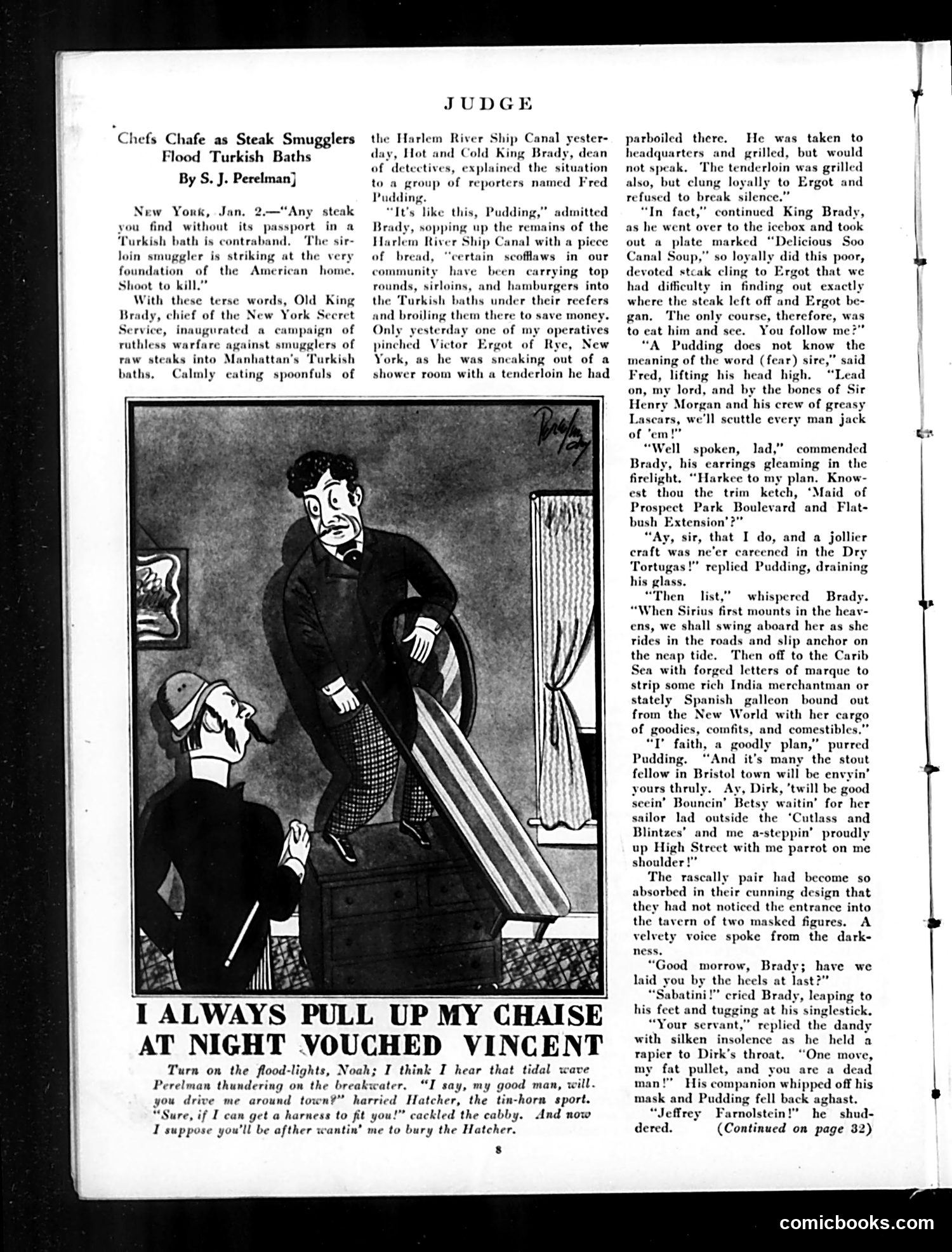
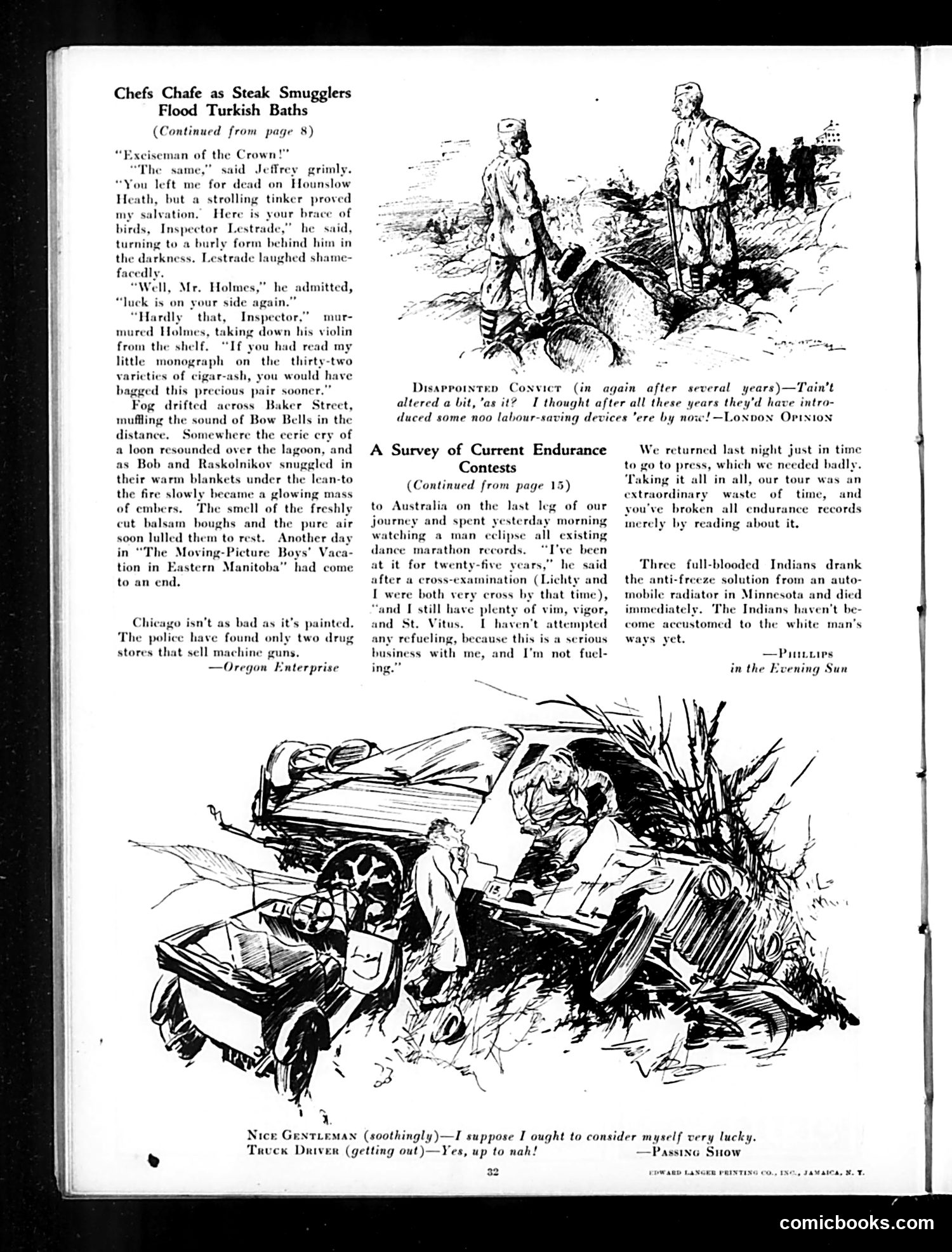
# Explanation for Modern Readers This is a humorous short story by S. J. Perelman (a celebrated comic writer) satirizing the absurdity of Prohibition-era enforcement. The premise: authorities are cracking down on steaks being smuggled into Turkish baths—treating contraband meat like serious crime. The joke plays on how ridiculous law enforcement had become under Prohibition. Police chief "King Brady" speaks in mock-serious detective jargon about intercepting smuggled steaks, grilling suspects, and conducting surveillance—language better suited to actual criminal investigations. The accompanying illustration shows a dramatic interrogation scene. Below it runs an unrelated serialized adventure story parody in melodramatic style ("I Always Pull Up My Chaise at Night Vouched Vincent"), mocking overwrought pulp fiction. The satire targets both overzealous Prohibition enforcement and cheap serialized entertainment popular at the time. Perelman's absurdist humor became a Judge magazine trademark.
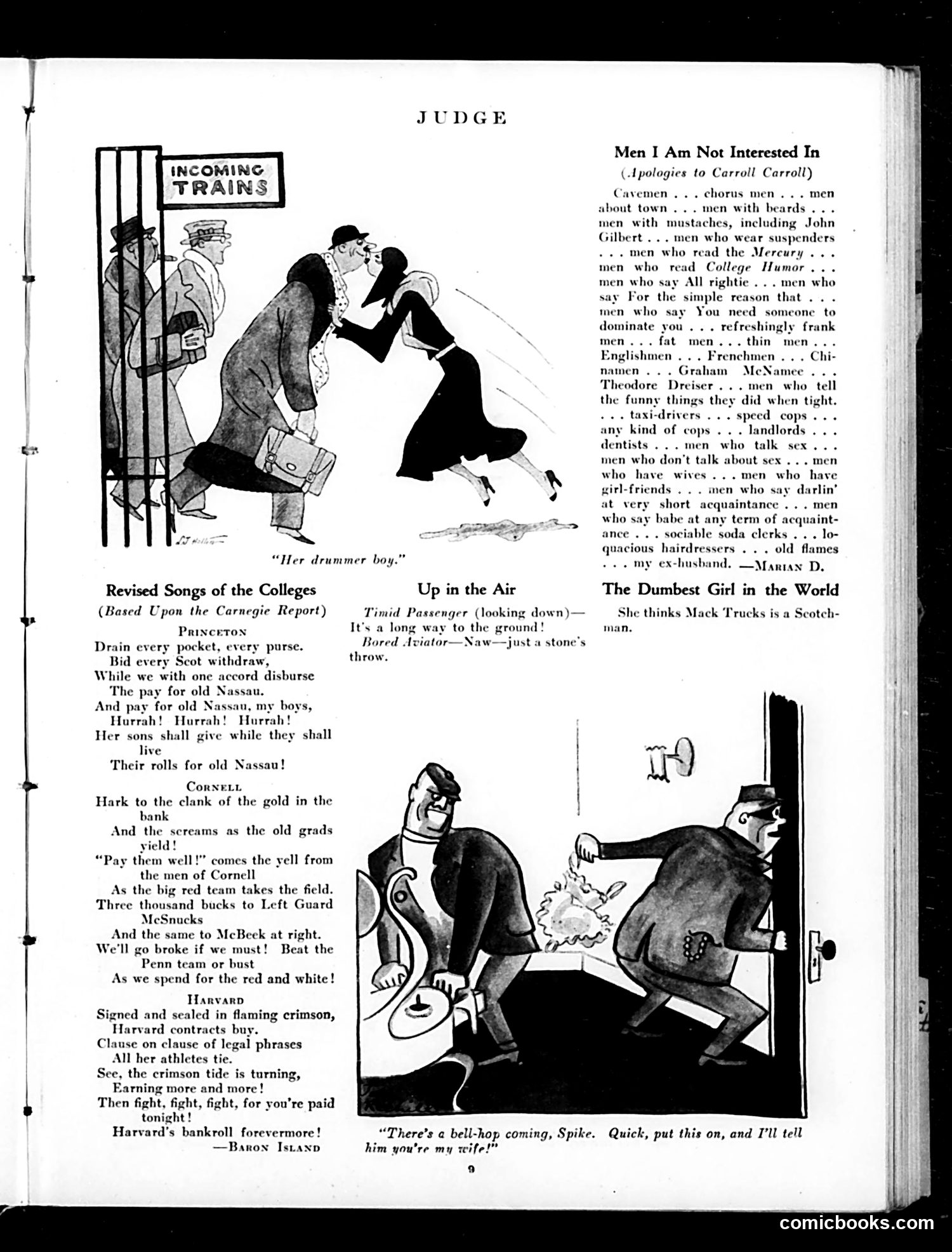
# Judge Magazine Page Analysis This page contains three distinct pieces of satire: **"Revised Songs of the Colleges"** parodies college fight songs, satirizing how universities now financially exploit alumni. The verses mock Princeton, Cornell, and Harvard for openly demanding money from graduates and paying athletes enormous sums ("Three thousand bucks to Left Guard"). The satire targets the commercialization of college sports and fundraising, likely referencing the Carnegie Report mentioned in the subtitle—apparently a report on college athletics that exposed such practices. **"Up in the Air"** is a brief joke about airplane travel. A nervous passenger fears the height; the blasé aviator dismisses the danger casually. **"Men I Am Not Interested In"** is a humorous list (credited as parody of Carroll Carroll's work) cataloging types of men a woman rejects—ranging from cavemen to "old flames" and her ex-husband. It's social commentary on dating preferences and male stereotypes. **"The Dumbest Girl in the World"** is a one-liner joke: a woman mistakes "Mack Trucks" (the vehicle brand) for a Scottish person, playing on her supposed stupidity.
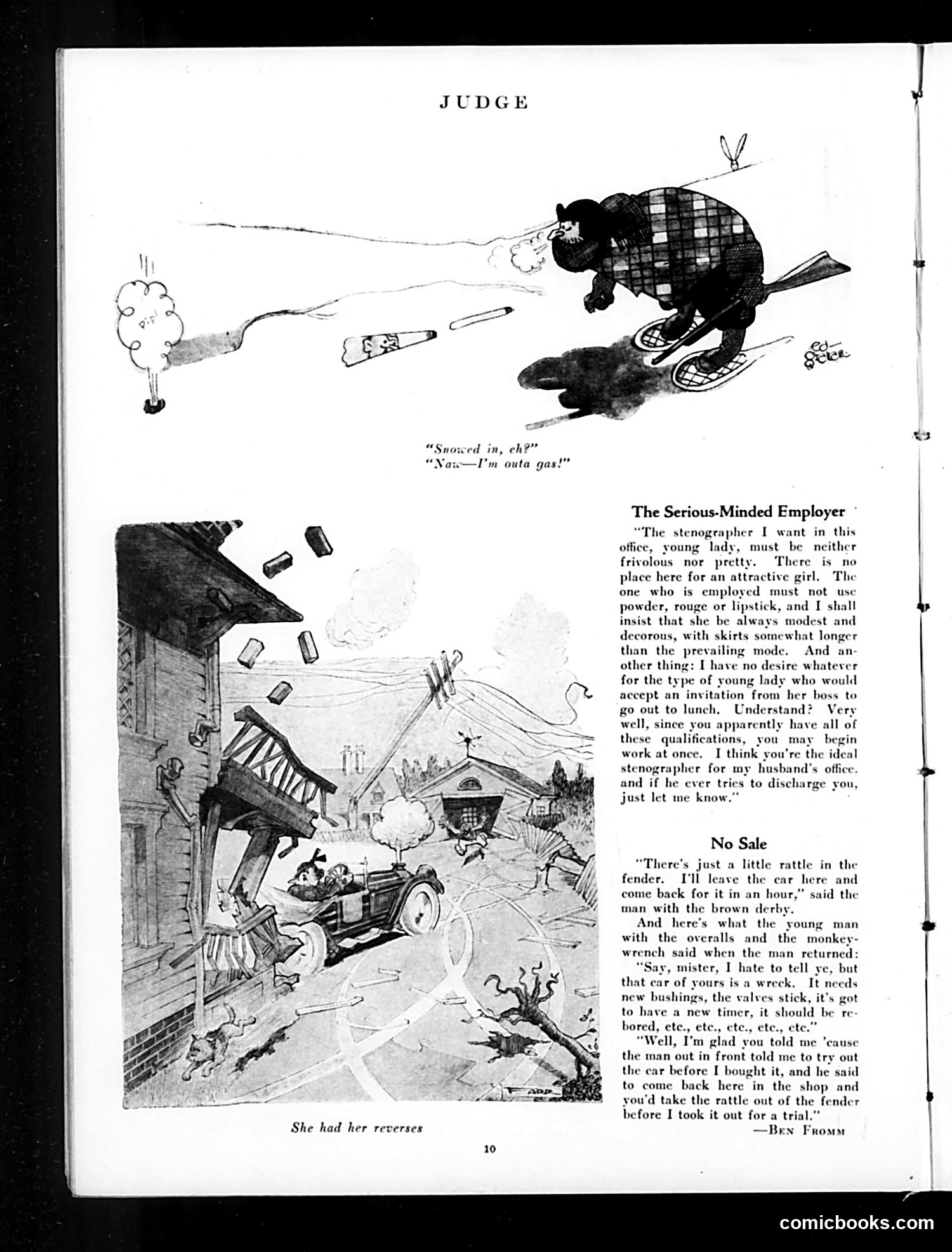
# Judge Magazine Page Analysis This page contains three separate satirical pieces: **Top cartoon ("Snowed in, eh?")**: A skier in winter gear claims he's "outa gas" rather than snowed in—likely mocking the era's new automobile culture and the excuse-making around car breakdowns. **"The Serious-Minded Employer"**: Satire of prudish, controlling bosses who demand stenographers be plain, modestly dressed, and makeup-free, while forbidding fraternization. The joke targets rigid Victorian workplace morality and hypocrisy. **"No Sale"**: A mechanic exposes a used-car scheme. A dealer told a customer to have the shop "take the rattle out" before trial, but the mechanic discovers the car needs major repairs. The satire critiques deceptive auto sales practices and collusion between dealers and mechanics to hide vehicle defects. The page reflects early 20th-century concerns: automobile reliability issues, workplace gender dynamics, and consumer fraud.