
Judge, 1930-01-04 · page 18 of 36
Judge — January 4, 1930 — page 18: what you’re looking at
A restored page from Judge, 1930-01-04. Page through the whole issue in the reader above.
📄 Transcribed text from this page (OCR, searchable)
Machine-transcribed from the original scan — historical spelling and the odd misread are preserved.
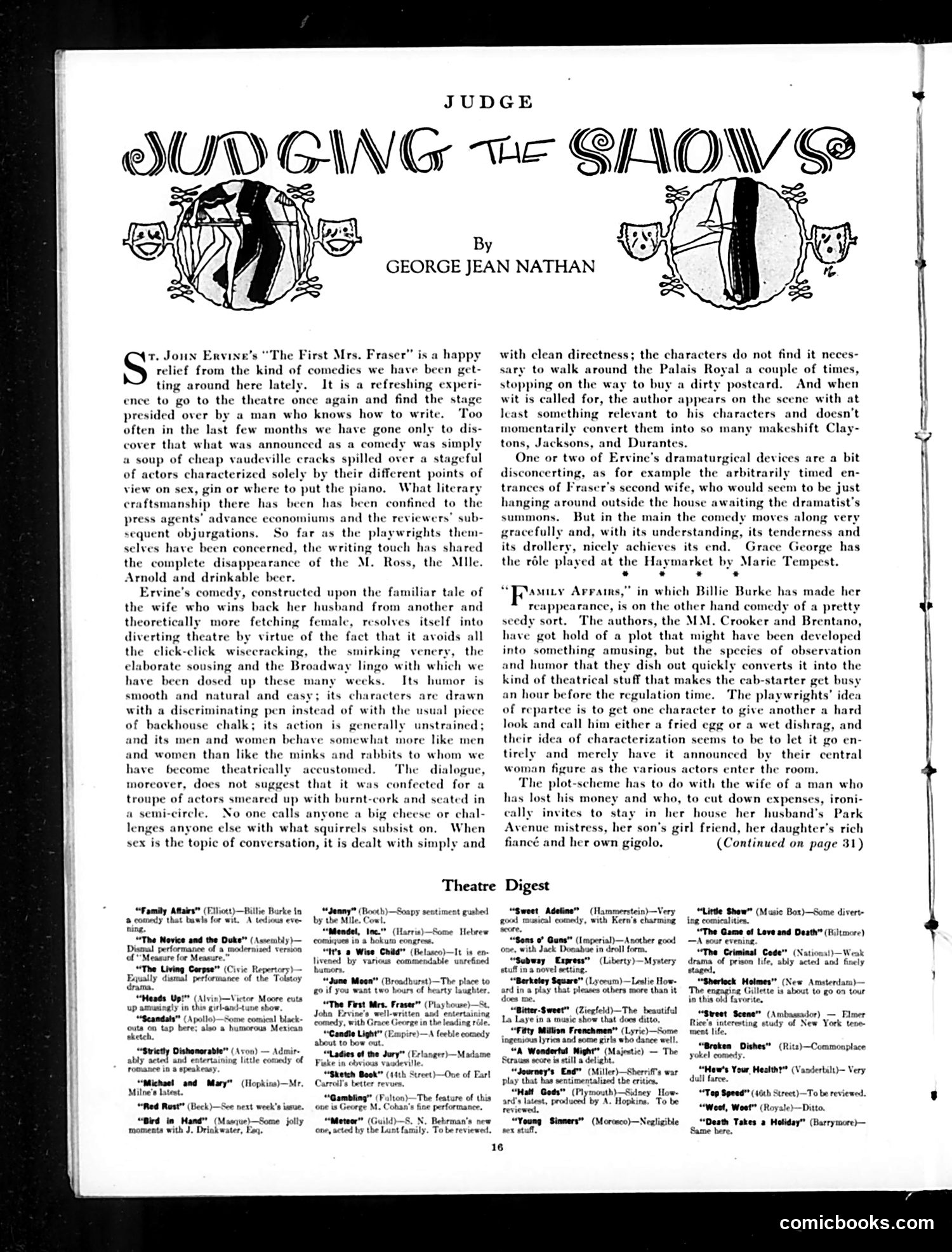
SUD Joun Ervin relief from the JUDGE ING we GAOW SG 's "The First Mrs. Fraser” is a happy kind of comedies we ting around here lately ence to go to the theatre onc © be F n get- It is a refreshing experi again and find the sta presided over by a man who knows how to write. Too often in the last few months we have gone only to dis- cover that what a soup of cheap of actors chars view on se: vas announced as a comedy was simply audeville cracks spilled over a st cterized solely by thei » gin or where to put the piano. Wh craftsmanship there has been has 1 eful i different points of at literary rd to the n confin press agents’ advance economiums and the reviewers’ sub- ations. sequent objur; selves } the complete disappe Arnold and drinkable be nce So far as th ve been concerned, the writing touch has shared of the M. Ross, the Mlle. Ervine’s comedy, constructed upon the familiar tale of the wife who wins back her hust ching few tre by virtue of the more fe theoretically diverting thes the ¢ ick-click wisee) cking, the smirking vene elaborate sousing and the Bre nd from another and le, resolves itself into act that it avoids all > the y lingo with which we dw, ve been dosed up these many weeks. Its humor is smooth and natural and easy; its characters are drawn with a discriminating pen instes of backhouse chalk; its act and its men and women behave somewl d of with the usual piece om is generally unstrained; t more like men and women than like the minks and rabbits to whom we have become theatrics moreover, ¢ troupe of actors sw a semi-circle. No one calls lenges anyone else with what squirrels subsist on. Hy accustomed. The nes not suggest that it was con ared up with burnt- dialogue, ted for a ork and seated in ig cheese or | When vone a k sex is the topic of conversation, it is dealt with simply and “Family Affairy” (Elliott) —Billie Burke tn a comedy that bawls for wit. A tedious eve ning. “The Novice and the Duke” (Assembly) — ormance of a modernized version for Meas (Civie Repertory) — Equally dismal performance of the Tolstoy drama. “Heads Up!” (Alvin)—Victor Moore cuts up amusingly in this girhand-tune show. “Scandals” (Ap outa on tap bere: sketeb. “si Dishonor able” (von) — ably acted and entertaining romance in a speakeasy Milne’s “Red Rust” (Beck)—See next week's issue. “Bird ia Hand” (Masue)—Some jolly moments with J. Driakwater, Ea, est. By as with clean directness; the characters do not find it neces- sary to walk around the Palais Royal a couple of times, stopping on the way to b wit is called for, the least something rele iy a dirty uthor appears ant to posteard. And when n the scene with at acters and doesn’t his momentarily convert them into so many makeshift Clay- tons, Jacksons, One or two disconcerting, trances of F and Durantes. of Ervine’s dramaturgical devices are a bit for example the arbitraril r’s second wife, who would seem to be just hanging around outside the house awaiting the dra ns. But in the main the comedy moves timed en- ist’s png very gracefully and, with its understanding, its tenderness and its drollery, nicely achieves the réle played at the F . Mity Arrains, rane d humor that they market ve got hold of a plot that might have been deve! into something amusing, but the spe its end. G ce George has y Maric Tempest. in which Billie Burke has made her is on the other ha seedy sort. The authors, the MM. Crooker nd comedy of a pretty and Brentano, ies of observation dish out quickly converts it into the kind of theatrical stuff that makes the cab-starter get busy an hour before the regulation time. of repartee is to get one character to giv look and their id tirely wor 1 him either 1 of characteri d merely have The playwrights’ idea another a hard fried egg or a wet dishrag, and ion seems to be to let it go en- it announced by their ¢ n figure as the various actors enter the room. ntral The plot-scheme has to do with the wife of a man who has lost his money and who, to cut down expenses, ironi- cally invites to stay in her house her husband's rk Avenue mistress, her son’s girl friend, her daughter's rich fiancé and her own gigolo. Theatre Digest “Jenny” (Booth) —Soapy seo by the Mile. Cowl. “tendel, toe." (Harris)—Some Hebrew comiqves in a bokum congress. “t's @ Wise Child” (Belasco)—It is en- livened by various commendable unrefined bumors “June Moon” (Broadburst)—The place to g0 if you want two hours of hearty laughter “The First Mrs. Fraser” (Playbouse)—St. John Exvine’s well-written and entertaining comedy, with Grace George in the leading réle. “Candie Light” (Empire)—A feeble comedy about to bow out “Ladies of the Jury” (Erlanger)—Madame Fiake in cbvious vaudeville. “Sketch Book™ (14th Strcet)—One of Earl Carroll's better revues. “Gambling” (Fulto)—The feature of this ne is George M. fine performance. “Meteor” (Guild)—S. N. Bebrman’s new cone, acted by the Lunt family. To be reviewed. ot guabed 16 “Sweet Adeline” (Hammerstein)—Very goad musical comely, with Kern's charming score, “Subway Express” (Liberty)—Mystery stuff in a novel setting. “Berkeley Square” (Lyceum)—Leslie How- ard ina play that pleases others more than it, does me. “Bitter-Sweet” (Ziegfeld)—The beautiful ye in a music show that does ditto, “Fitty Million Frenchmen” (Lyric)—Some ingenious lyrica and some girls who dance well. “A Wondertul Wight"* (Majestic) — The Scraum score is still a delight. “Journey's End” (Miller)—Sherriff's war play that has sentimentaliaed the eritics. “Hall Gets” (Plymouth) —Si How- art's latest, produced by A. Hopkins. To be reviewed. “Young Sinners” (Morcsco)—Negligible sex stuff, (Continued on page 31) “Little Show” (Music Bot)—Some divert- ing comicalities. “The Game of Love and Death” (Biltmore) —A sour evening. “The Criminal Cede" (Nationa!)—Weak drama of prison life, ably acted and finely staged. “Sherlock Holmes!” (New Amstertam)— ‘The engaging Gillette is about to go 01 tour in this old favorite. nbassador) — Elmer of New York tene- “Broken Dishes” (ititz)—Commonplace yokel comedy “How's Your Health? (Vanderbilt)— Very dull farce. “Top Speed” (46th Street) —To be reviewed. “West, Woot” (Royale)—Ditto. ‘Death Takes 2 Holiday” (Barrymore)— Same here. — comicbooks.com