A complete issue · 37 pages · 1929
Judge — December 28, 1929
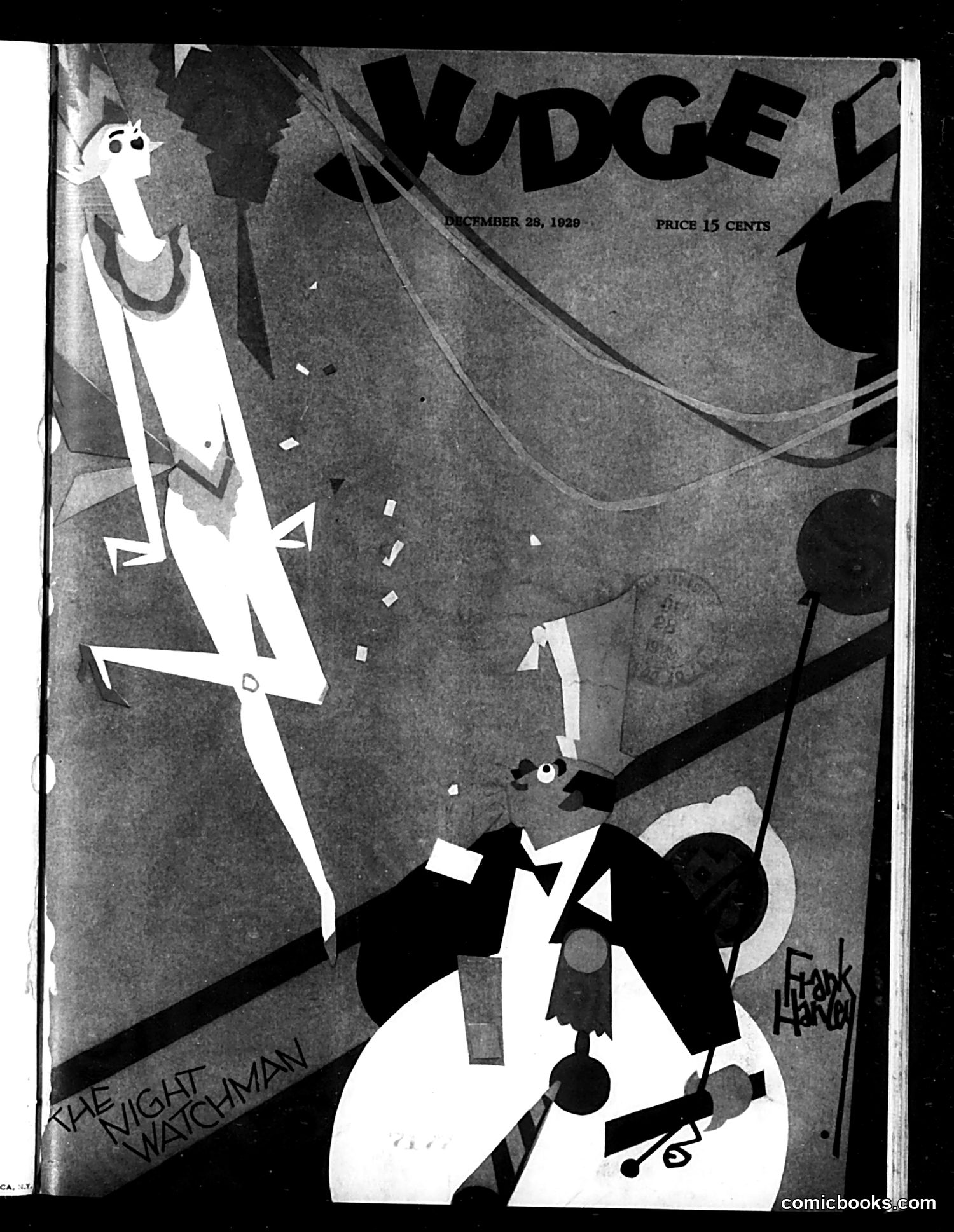
# "The Night Watchman" - Judge Magazine, December 28, 1929 This Frank Hardly cartoon depicts a nighttime scene of chaos and disorder. The title "The Night Watchman" suggests commentary on law enforcement or social order during a period of crisis. The stylized figures and dramatic composition—with one character elevated above another in a seemingly chaotic arrangement—likely satirizes the inadequacy of authorities to maintain control during the Great Depression, which had just begun in October 1929. The magazine's publication date places this squarely in the economic collapse's immediate aftermath. The "watchman" figure appears overwhelmed or ineffectual, a common satirical trope for depicting governmental or institutional failure during national emergencies. The modernist art style was typical of Judge's 1920s aesthetic.
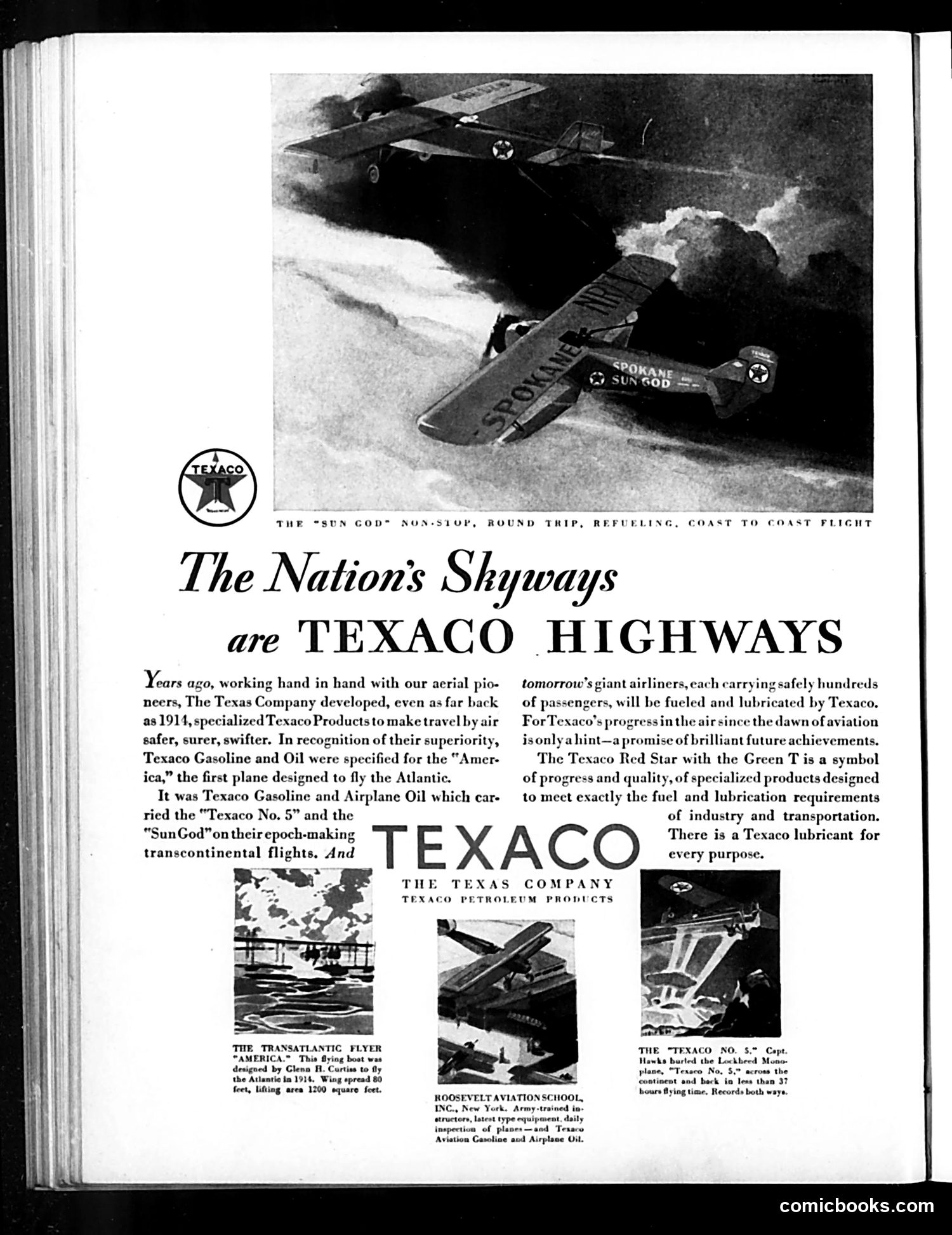
# Analysis This is primarily a **Texaco corporate advertisement**, not political satire. The page celebrates Texaco's role in aviation history and fuel technology. The advertisement claims Texaco gasoline and oil powered early aviation achievements, including: - The "Texaco No. 5" plane (shown in photographs) - The "Sun God" on transcontinental flights - The Transatlantic Flyer - Roosevelt Aviation School operations The headline "The Nation's Skyways are TEXACO HIGHWAYS" uses patriotic language to associate the company with American technological progress and aviation advancement. The imagery of multiple aircraft in flight reinforces this message of reliability and superiority. This represents **1920s-era corporate propaganda**—using aviation's cutting-edge glamour to promote fuel products to consumers and industry clients. There is no political cartoon or satire present on this page.
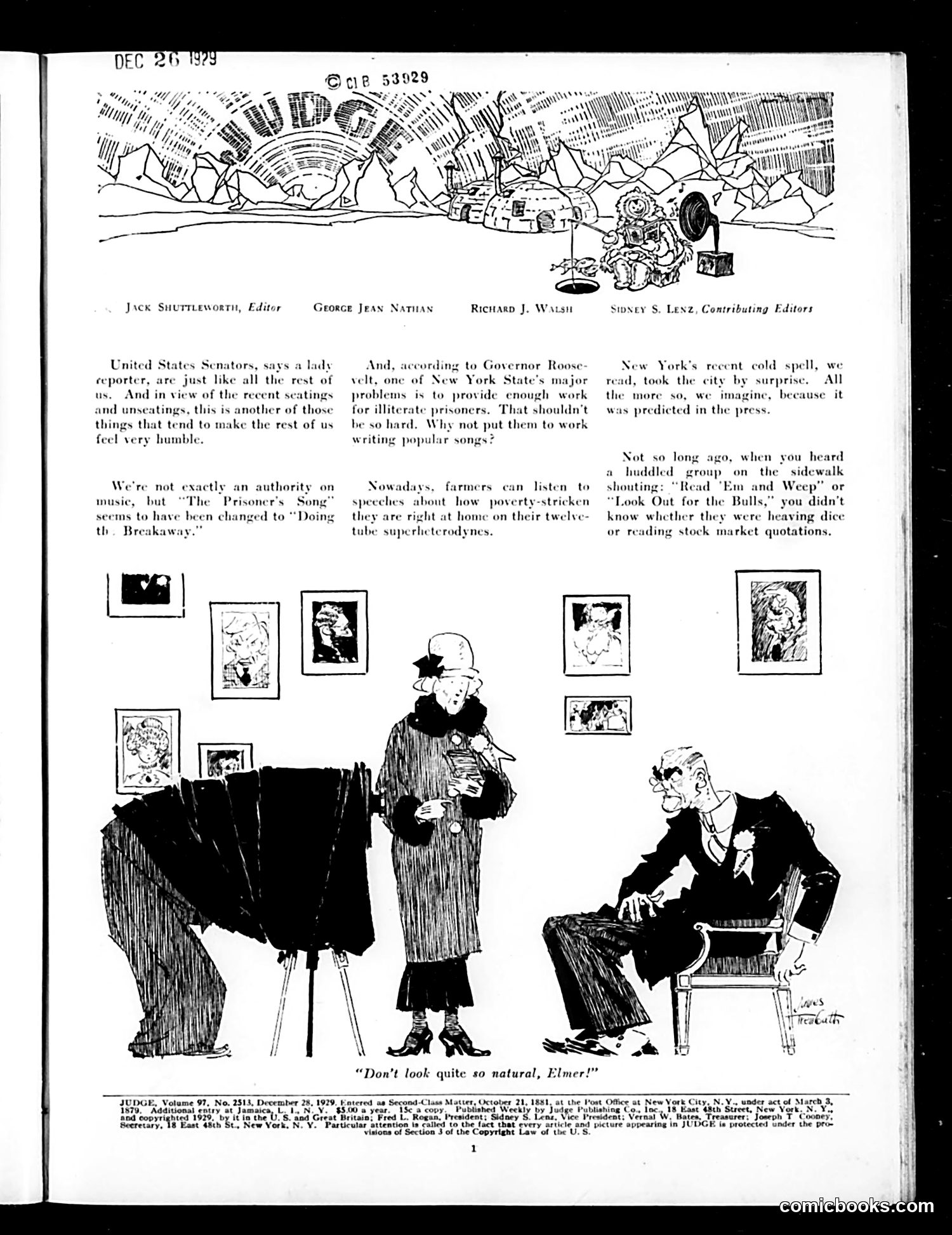
# Analysis of Judge Magazine Page (December 26, 1929) The main cartoon depicts a scene labeled "Don't look quite so natural, Elmer!" showing a man posing stiffly for a portrait painter while a woman arranges his appearance. This appears to be satirizing artificial or forced social posturing—the joke being that "Elmer" looks too natural/relaxed, when the woman wants him to appear more refined or dignified for the portrait. The accompanying text discusses poverty relief and prison labor under Governor Roosevelt, farmers listening to radio broadcasts, and references to popular songs like "Read 'Em and Weep" and "Look Out for the Bulls." The overall theme seems to mock social pretense and class anxiety during the late 1920s, published just weeks after the 1929 stock market crash.
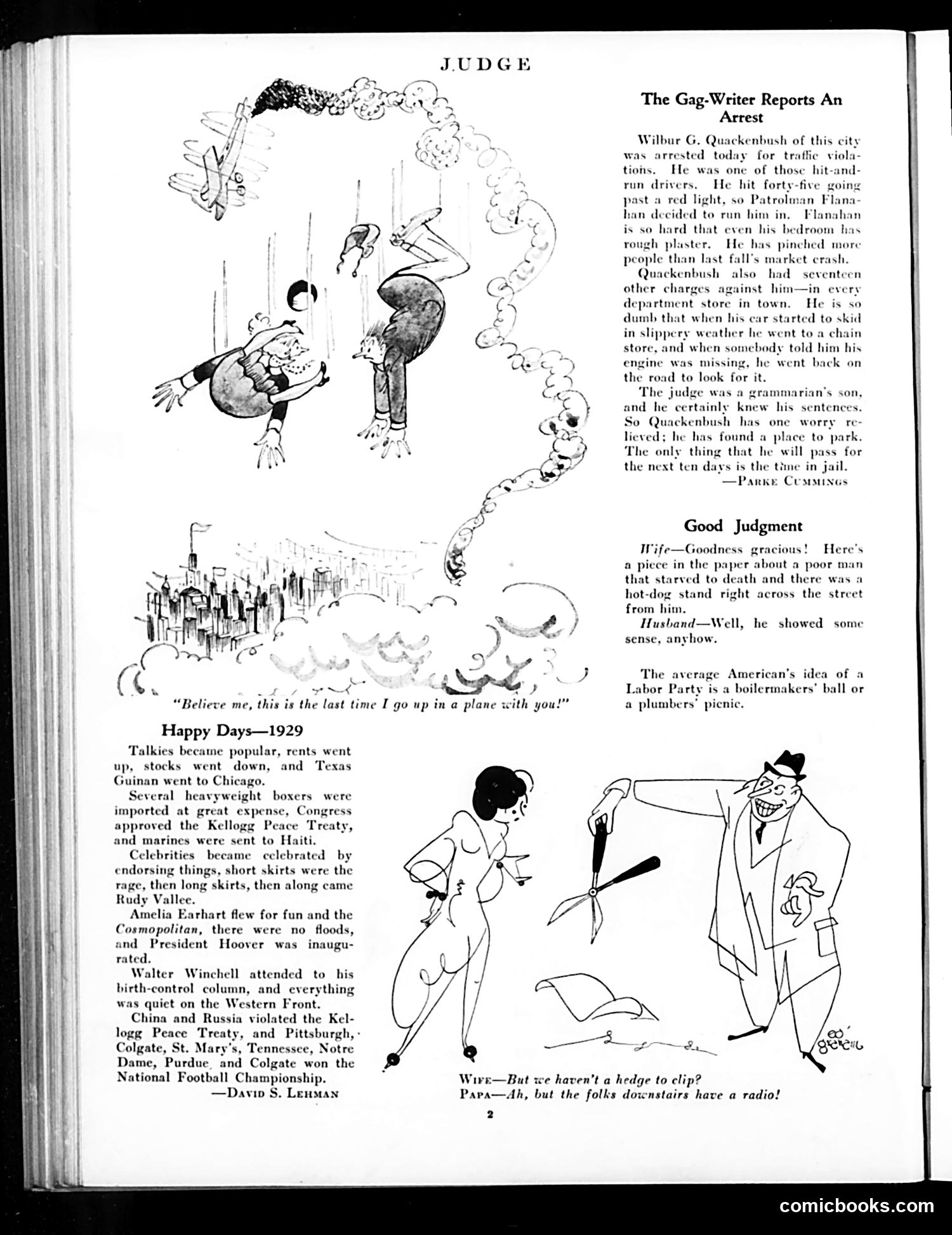
# Judge Magazine Page Analysis This page contains three satirical pieces from 1929: **"The Gag-Writer Reports An Arrest"** mocks Wilbur G. Quackenbush, a reckless driver arrested for traffic violations. The cartoon illustrates his dangerous driving habits—running red lights, causing accidents. The satire targets careless motorists endangering public safety, a growing concern as automobile use increased in the 1920s. **"Good Judgment"** is a brief domestic joke about a poor man who starved to death near a hot-dog stand, suggesting the husband showed "sense" by dying rather than spending money. It's dark humor about economic hardship. **"Happy Days—1929"** summarizes notable 1929 events: talking pictures' popularity, stock market fluctuations, Amelia Earhart's aviation achievements, and college football championships. The tone is celebratory of American progress, published just before the October stock market crash.
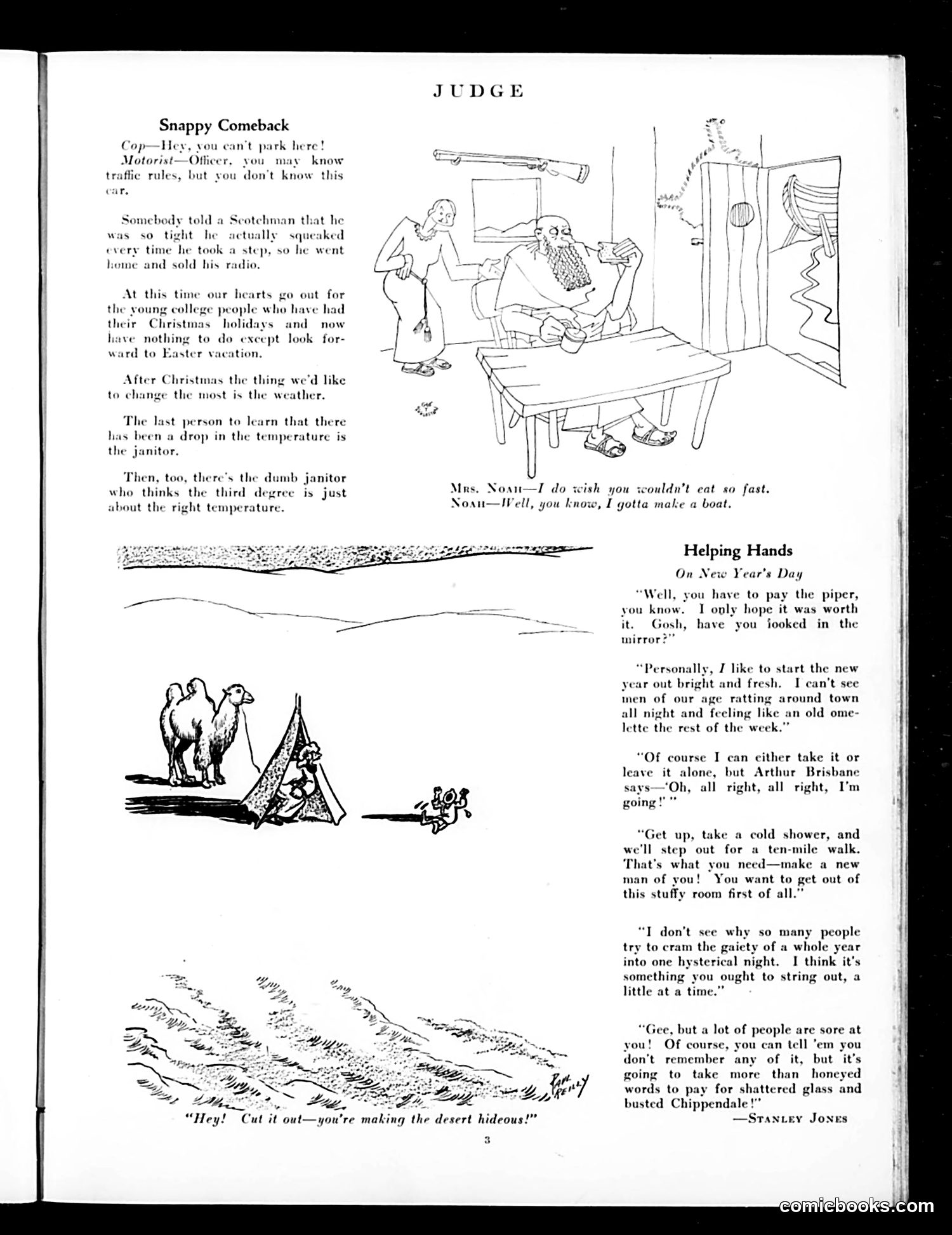
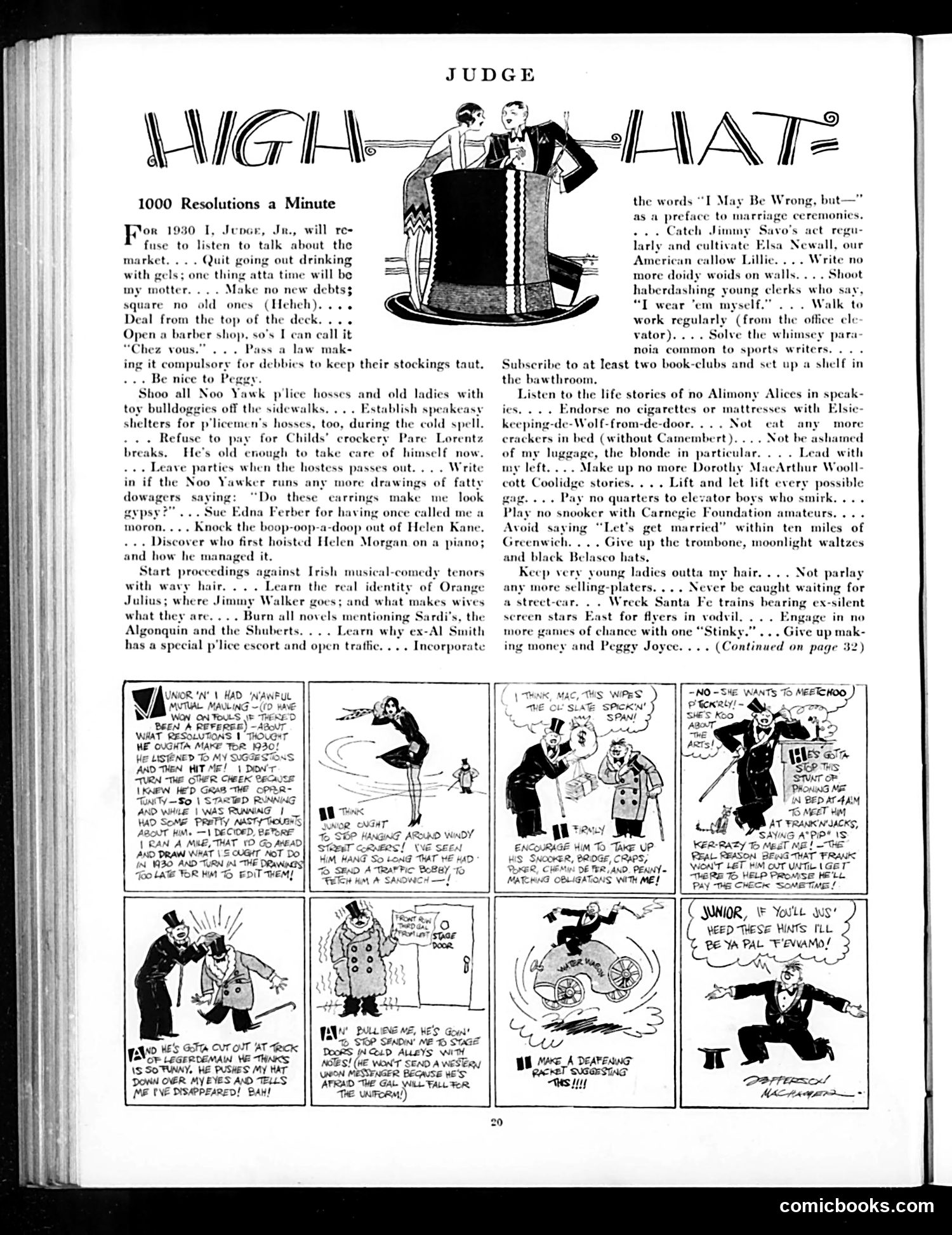
# "Snappy Comeback" & "Helping Hands" - Judge Magazine **"Snappy Comeback"** depicts a traffic enforcement interaction where a cop confronts a motorist about illegal parking. The officer claims ignorance of traffic rules; the motorist responds with a Scottish anecdote about someone so constipated he squeaked with each step, then sold his radio. The joke targets bureaucratic incompetence—the officer represents authorities who enforce rules without understanding them. **"Helping Hands"** discusses New Year's resolutions and lifestyle changes. The dialogue advocates moderate celebration and physical activity (cold showers, ten-mile walks) rather than excessive drinking. The comic critiques how people compressed a year's indulgences into single hysteria-filled nights, arguing for measured self-improvement spread throughout the year. Both pieces reflect early-20th-century social commentary on urban life and personal conduct.
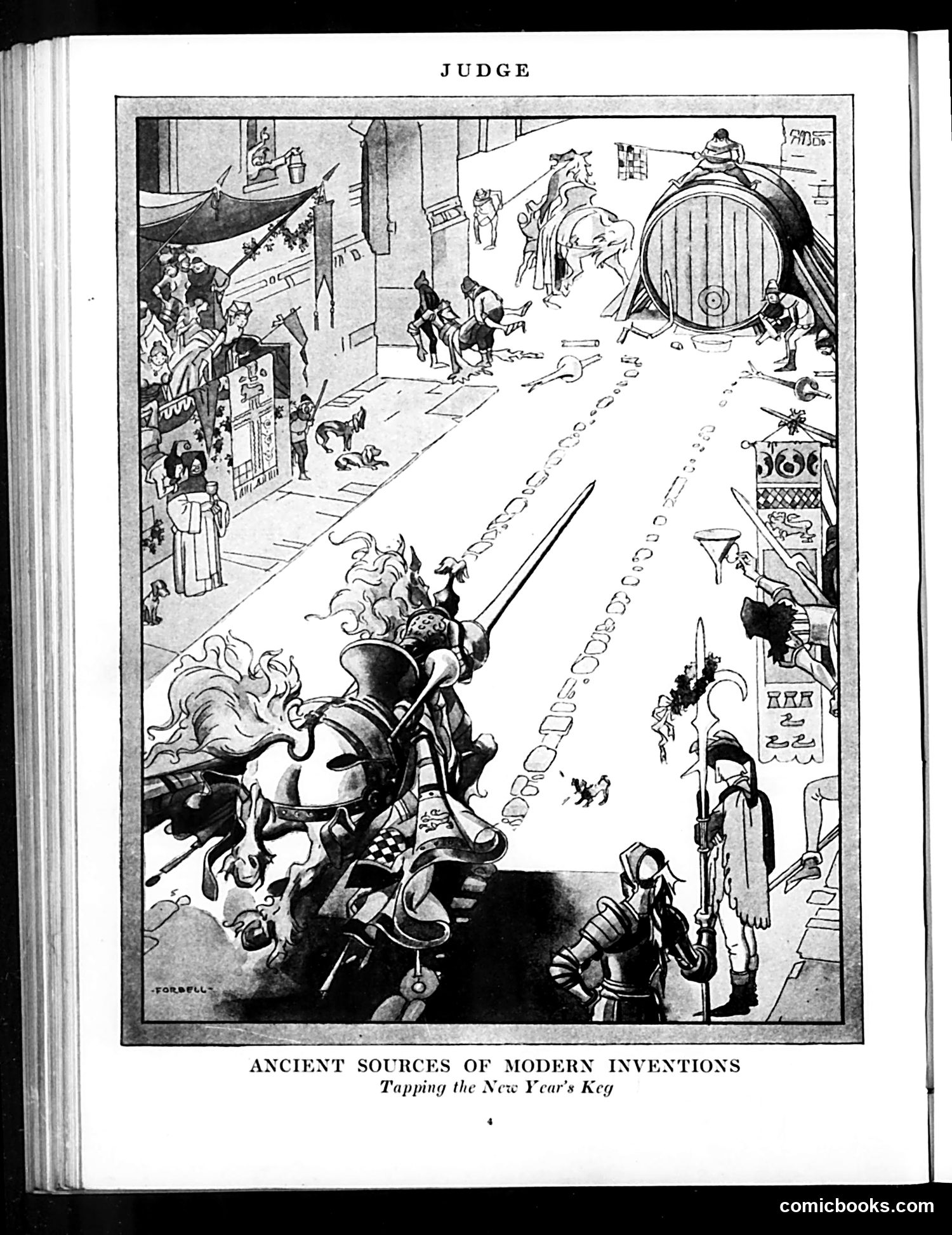
# Analysis of "Ancient Sources of Modern Inventions" This Judge cartoon satirizes the idea that modern innovations have ancient origins. The subtitle "Topping the New Year's Key" suggests a New Year's themed piece playing on the phrase "turning over a new leaf." The central figure appears to be a knight or warrior on horseback wielding a large sword, depicted in classical/medieval style. The scene shows this ancient figure amid what appears to be a modern cityscape with contemporary buildings and people observing from windows and streets. The satire likely mocks either: (1) pseudointellectual claims that everything modern was invented in antiquity, or (2) the pretentious use of classical references in contemporary society. The contrast between the archaic warrior and the modern urban setting drives the humorous point about anachronism and misplaced nostalgia.
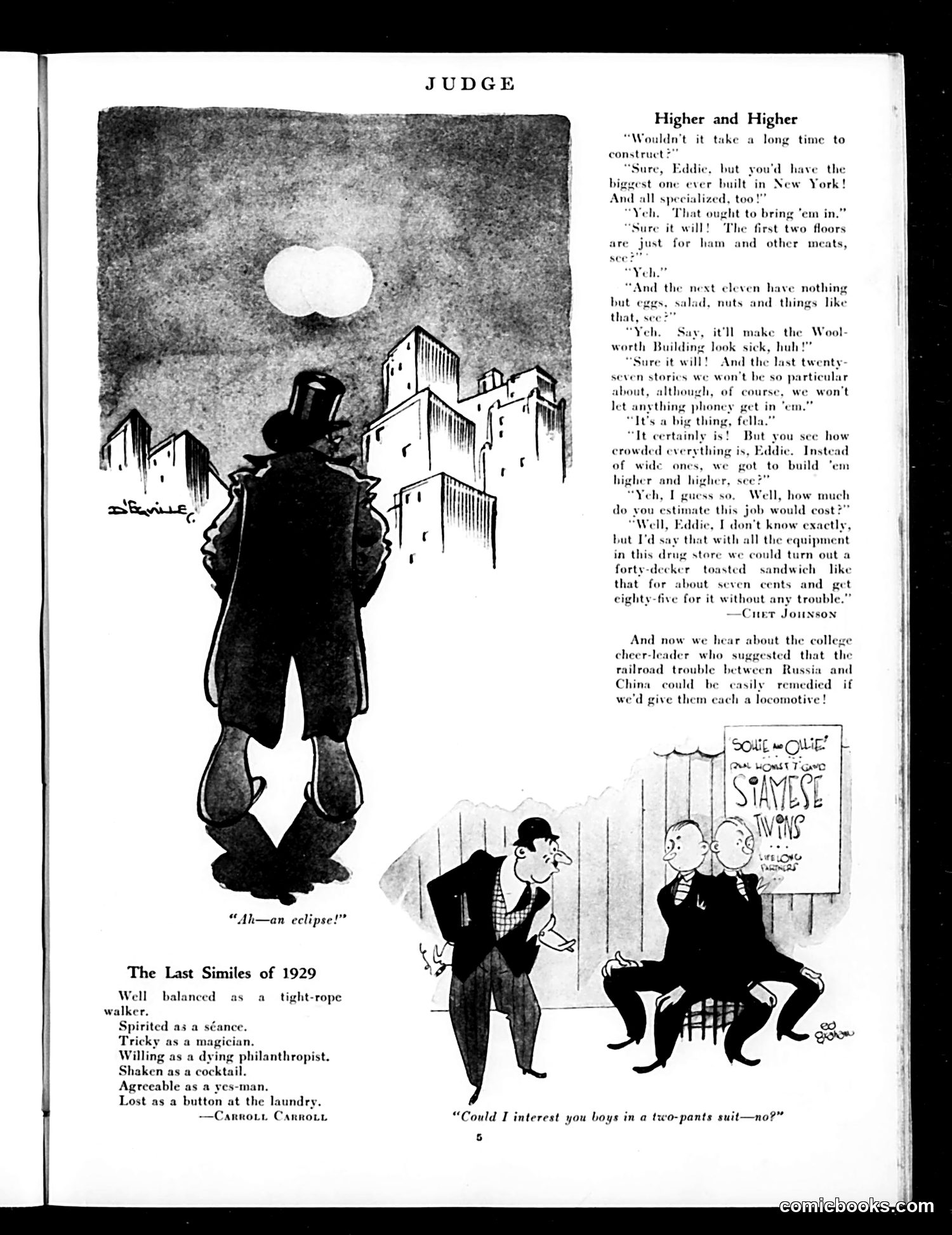
# Analysis of Judge Page **Main Cartoon ("Ah—an eclipse!"):** A silhouetted figure gazes upward at tall buildings and a moon, captioned "Ah—an eclipse!" This appears to satirize the then-new skyscraper boom—the buildings are so tall they literally block out the sky/sun, creating an "eclipse" effect in urban areas. The joke critiques how aggressive construction was transforming city skylines. **"Higher and Higher" Dialogue:** A conversation between two men about constructing an enormous specialized building in New York with 29+ stories—poking fun at the era's obsession with ever-taller, increasingly absurd buildings and the competitive one-upmanship among developers. **"The Last Similes of 1929":** A humorous list comparing 1929 figures to objects (e.g., "Lost as a button at the laundry"). **Bottom cartoon:** Two men discussing a two-pants suit—likely commercial humor unrelated to politics.
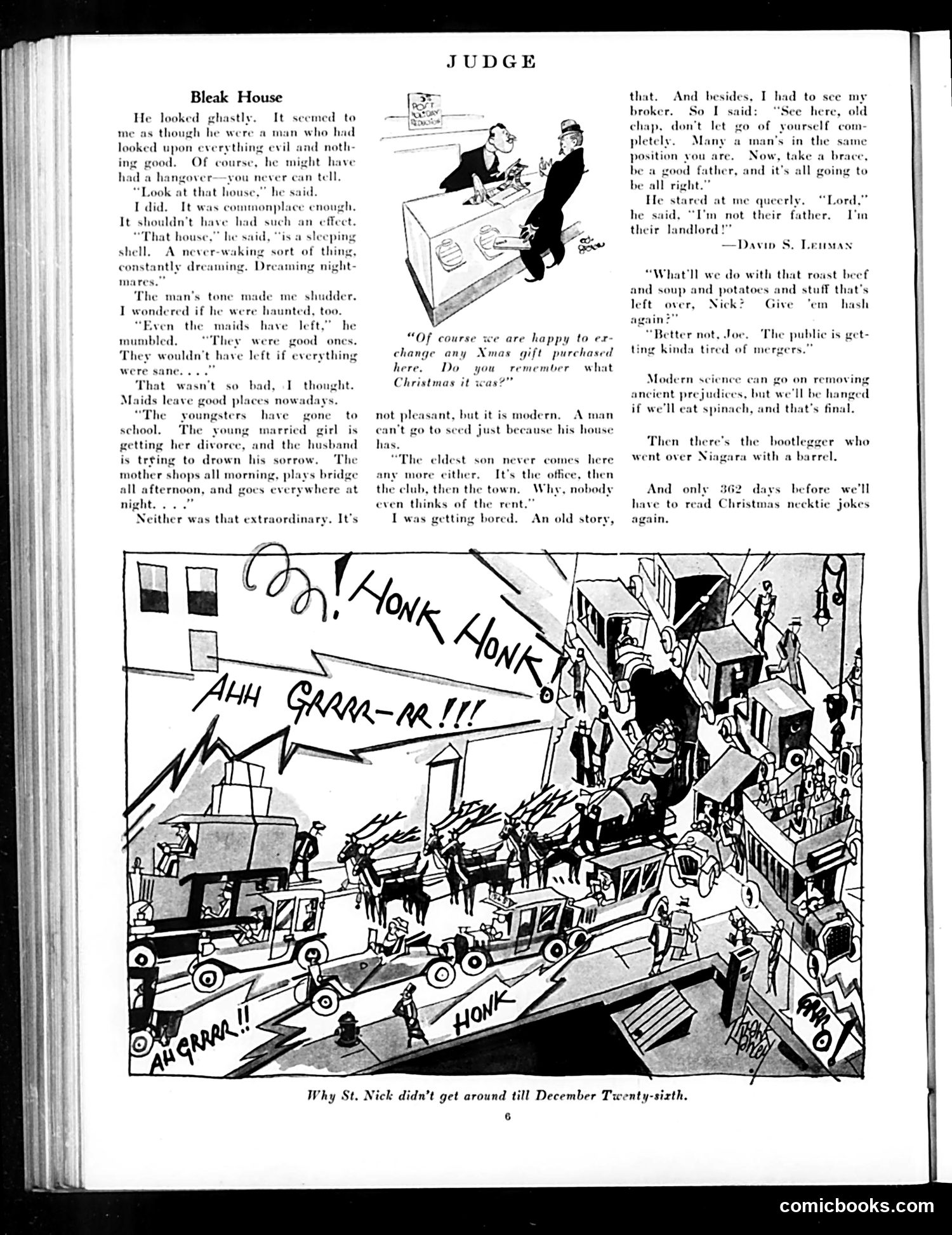
# Analysis of Judge Magazine Page This page contains a story titled "Bleak House" and a cartoon about St. Nick (Santa Claus). **The Story:** A man describes visiting a broker's office, finding it depressingly gloomy. He reflects on how servants leaving good positions and modern domestic instability—young married women divorcing, mothers managing households alone—have made homes bleaker. He's bored by an "old story" about tenants not paying rent. **The Cartoon:** Depicts St. Nick struggling through a chaotic, noisy city street filled with traffic, horns, and crowds on December 26th. The caption jokes that Santa "didn't get around till December Twenty-sixth." **The Satire:** Both pieces critique modern urban/domestic life as increasingly dysfunctional—servants abandoning households, family instability, and city congestion making even Christmas deliveries impossible. The humor targets early 20th-century anxieties about societal decline and modern chaos disrupting tradition.
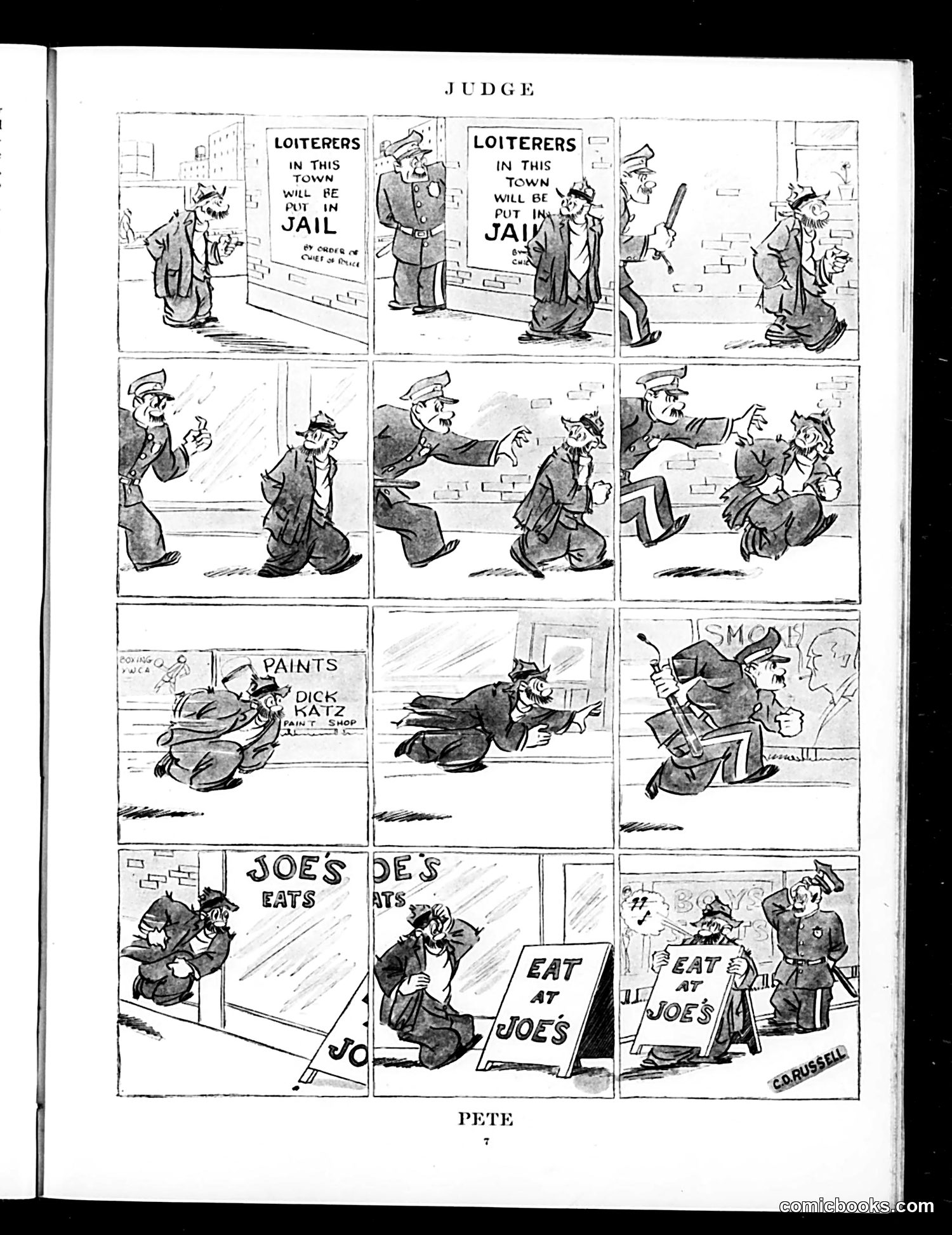
# Analysis of "Pete" Comic Strip This comic strip satirizes law enforcement's selective enforcement of loitering laws. A judge posts warnings that loiterers will be jailed, but then is shown pursuing someone through town—apparently the judge himself is loitering or behaving disruptively. The figure flees past a "Paints & Dyes Katz" shop, then crashes into "Joe's" restaurant where the final panels show the judge among other patrons eating at Joe's establishment. The satire points to hypocrisy: authorities threatening ordinary citizens with jail for loitering while apparently exempt from the same rules themselves. The judge's undignified chase and tumble suggest his authority is undermined by his own behavior—he cannot credibly enforce laws he violates. This reflects broader Progressive-era critiques of corrupt or hypocritical urban governance.
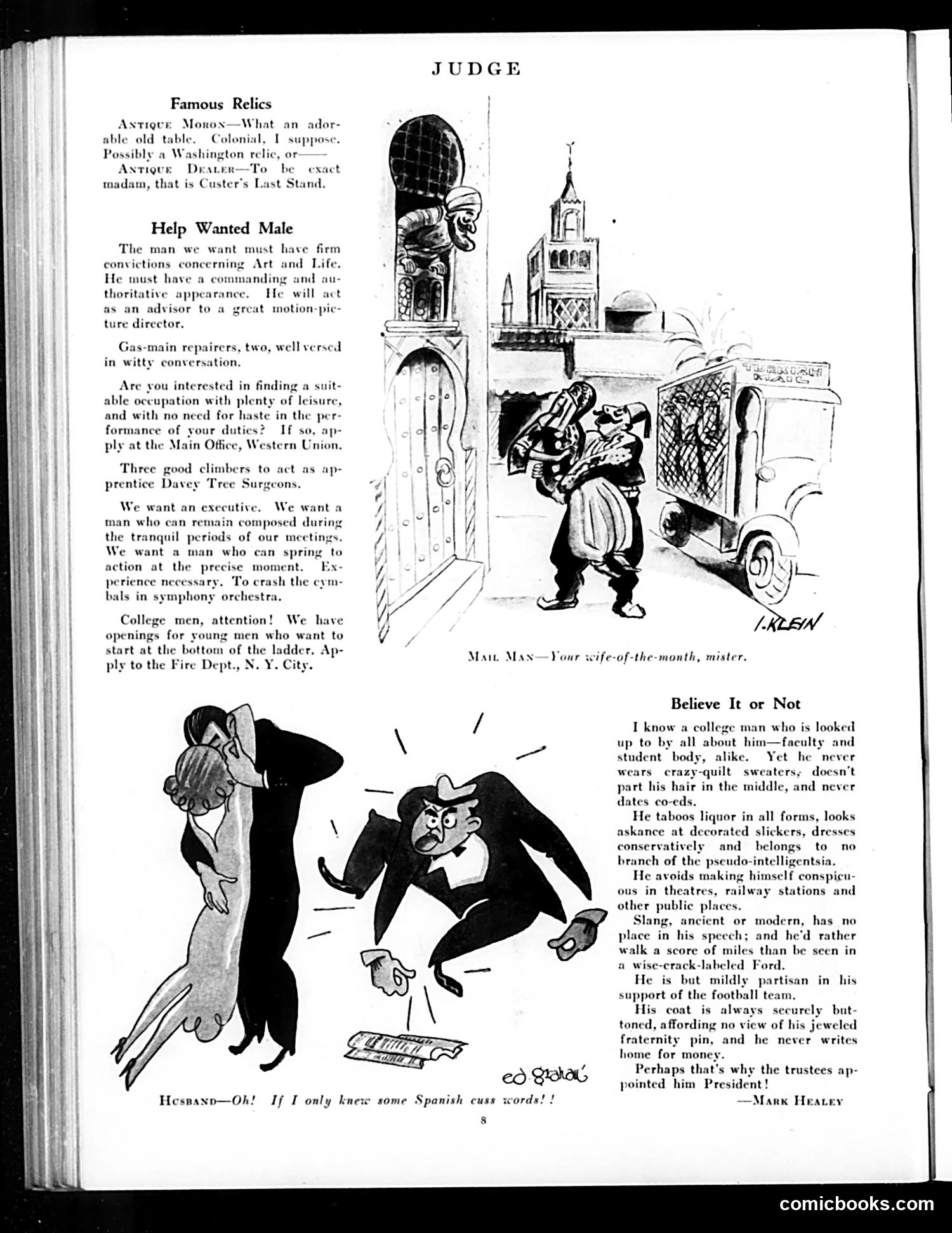
# Judge Magazine Page Analysis This page contains satirical content mocking various social trends and conventions of the era (appears to be early 20th century). The **"Famous Relics"** exchange jokes about antique dealers misidentifying items—a woman mistakes a table for a Colonial Washington artifact, only to learn it's actually "Custer's Last Stand," humorously treating the famous military defeat as furniture. The **"Help Wanted Male"** section satirizes absurd job postings, including positions for "gas-main repairers" skilled in witty conversation and symphony cymbal-crashers requiring "experience"—mocking employers with ridiculous or contradictory qualifications. The **"Mail Man"** cartoon depicts a domestic dispute with slapstick violence, titled "Your wife-of-the-month, mister"—likely satirizing infidelity or casual attitudes toward marriage. The **"Husband"** cartoon shows a man seeking Spanish curse words, presumably to argue with someone. The **"Believe It or Not"** column ironically describes an exemplary college man who breaks all contemporary youth stereotypes (no wild sweaters, no drinking, no flashy behavior, conservative dress)—concluding that his very *normalcy* is what got him appointed college president, mocking both student excess and administrative hypocrisy.
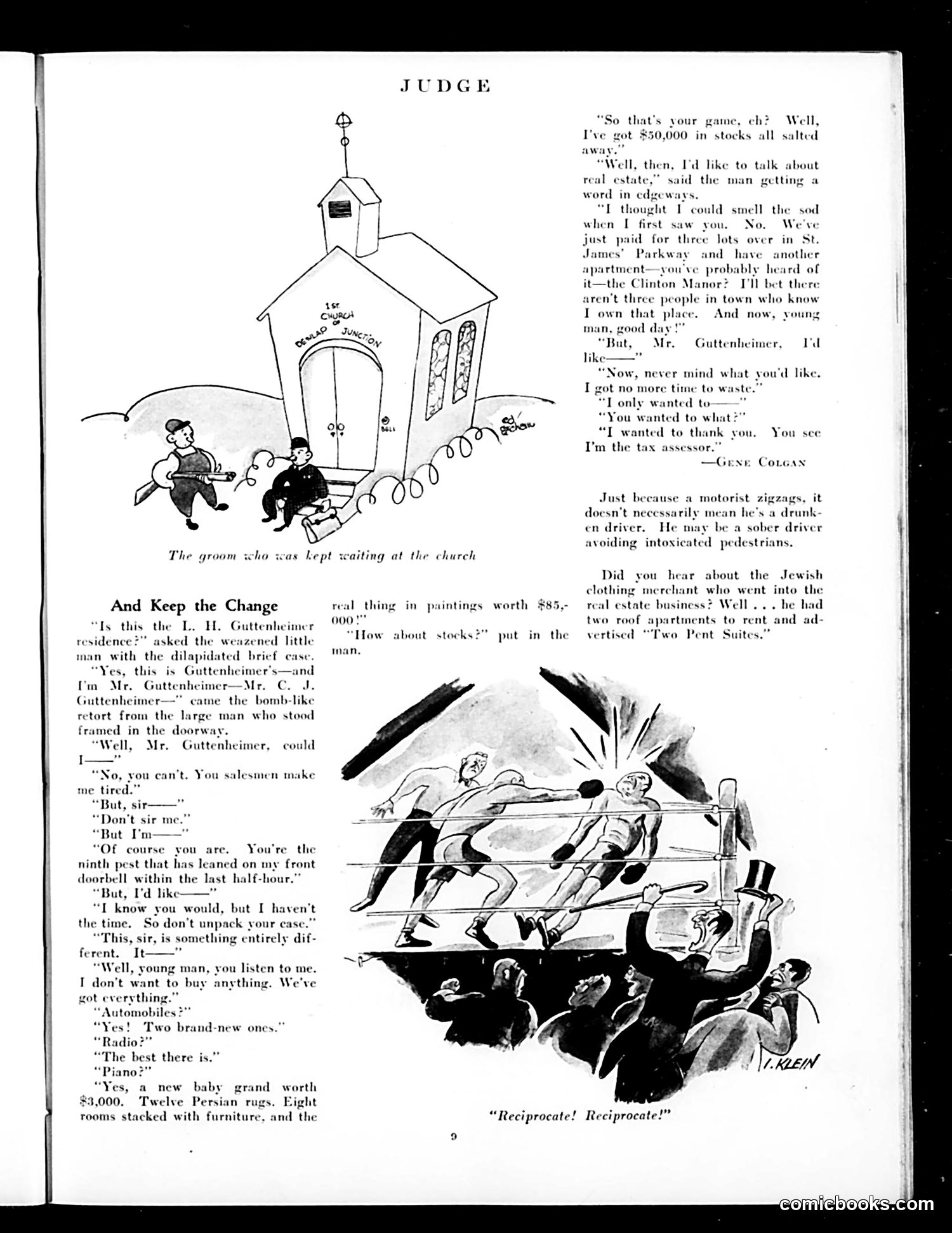
# Analysis for Modern Readers This page contains two satirical pieces about wealth and materialism in early 20th-century America. **"And Keep the Change"** depicts a wealthy businessman (L.H. Guttenheimer) rudely rejecting a salesman at his door. The joke's twist: the "salesman" is actually the tax assessor trying to thank Guttenheimer—implying the man brags about his possessions (stocks, real estate, art) to everyone *except* the one person who matters: the tax collector. The satire mocks nouveau-riche boastfulness and tax evasion. **The lower cartoon** (titled "Reciprocate! Reciprocate!") shows a car accident with multiple people being thrown about, satirizing reckless driving. The accompanying text argues that zigzagging drivers aren't necessarily drunk—they may be sober drivers *avoiding* intoxicated pedestrians, reversing blame. **The Jewish merchant joke** stereotypes Jewish businessmen as shrewd but incompetent at ventures outside their traditional clothing trade (advertising "Pent Suites" instead of "Penthouses"). All three pieces reflect period attitudes toward wealth, driving safety, and ethnic stereotypes.
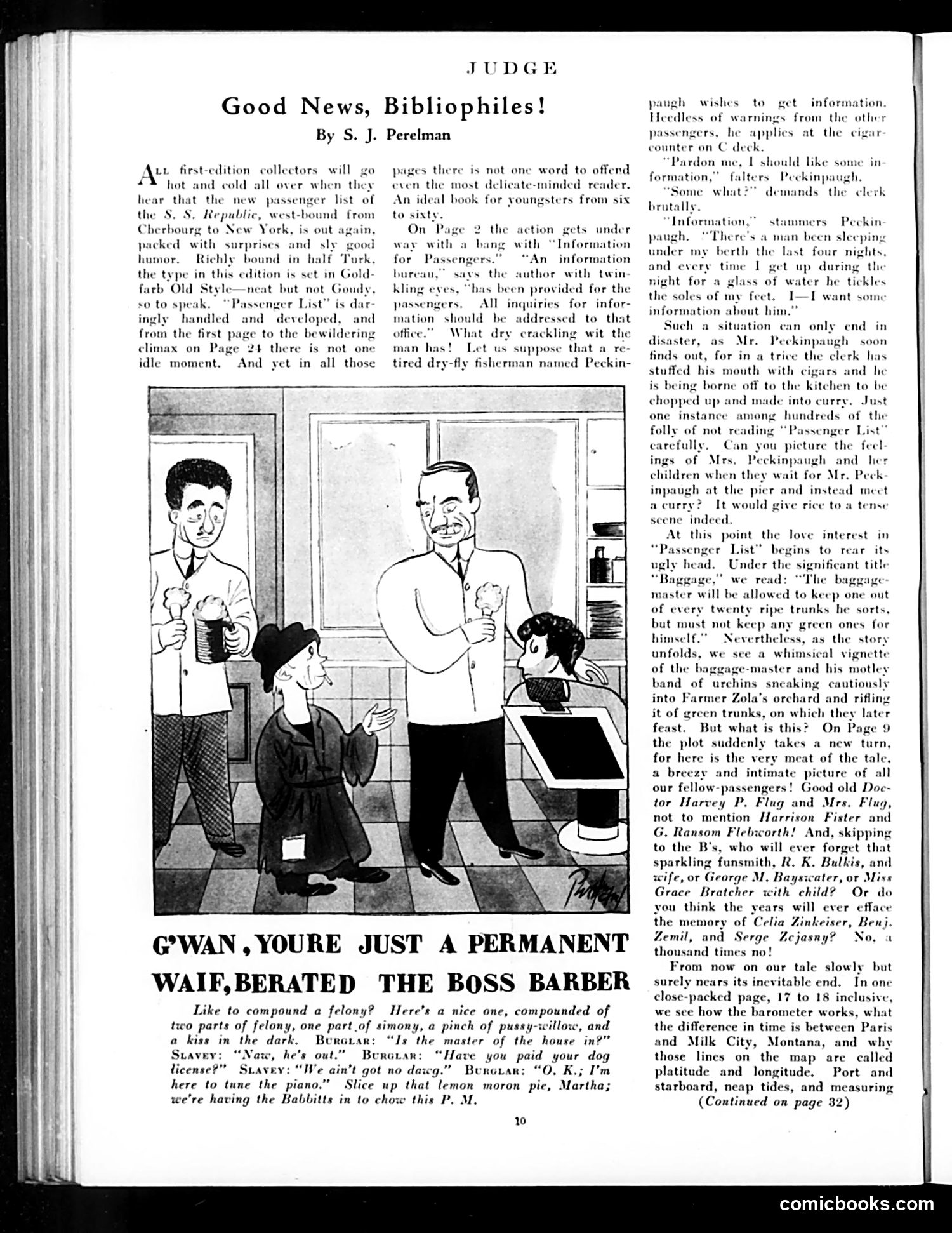
# Explanation for Modern Readers This is a humorous book review by S.J. Perelman satirizing a fictional passenger list from the S.S. Republic cruise ship. The joke mocks the mundane tedium of such documents—supposedly an "ideal book for youngsters" despite containing nothing objectionable. The cartoon illustrates the absurd consequences: a passenger named Peckinpaugh innocently requests information from a clerk, only to have his mouth stuffed with cigars and be hauled to the kitchen to be made into curry. This darkly comic escalation mocks both the uselessness of the passenger list and the cruelty of trying to seek help aboard ship. Perelman names fictional passengers (Harvey P. Flug, Harrison Fister, R.K. Bulkis, etc.) to parody how tedious such lists are. The review's breathless enthusiasm about mundane details—the barometer explanation, time zone differences—further satirizes the absurd appeal of bureaucratic documents masquerading as entertainment. The piece is vintage Perelman: surreal, witty, and mocking middle-class publishing conventions.