
Judge, 1929-12-28 · page 15 of 37
Judge — December 28, 1929 — page 15: what you’re looking at
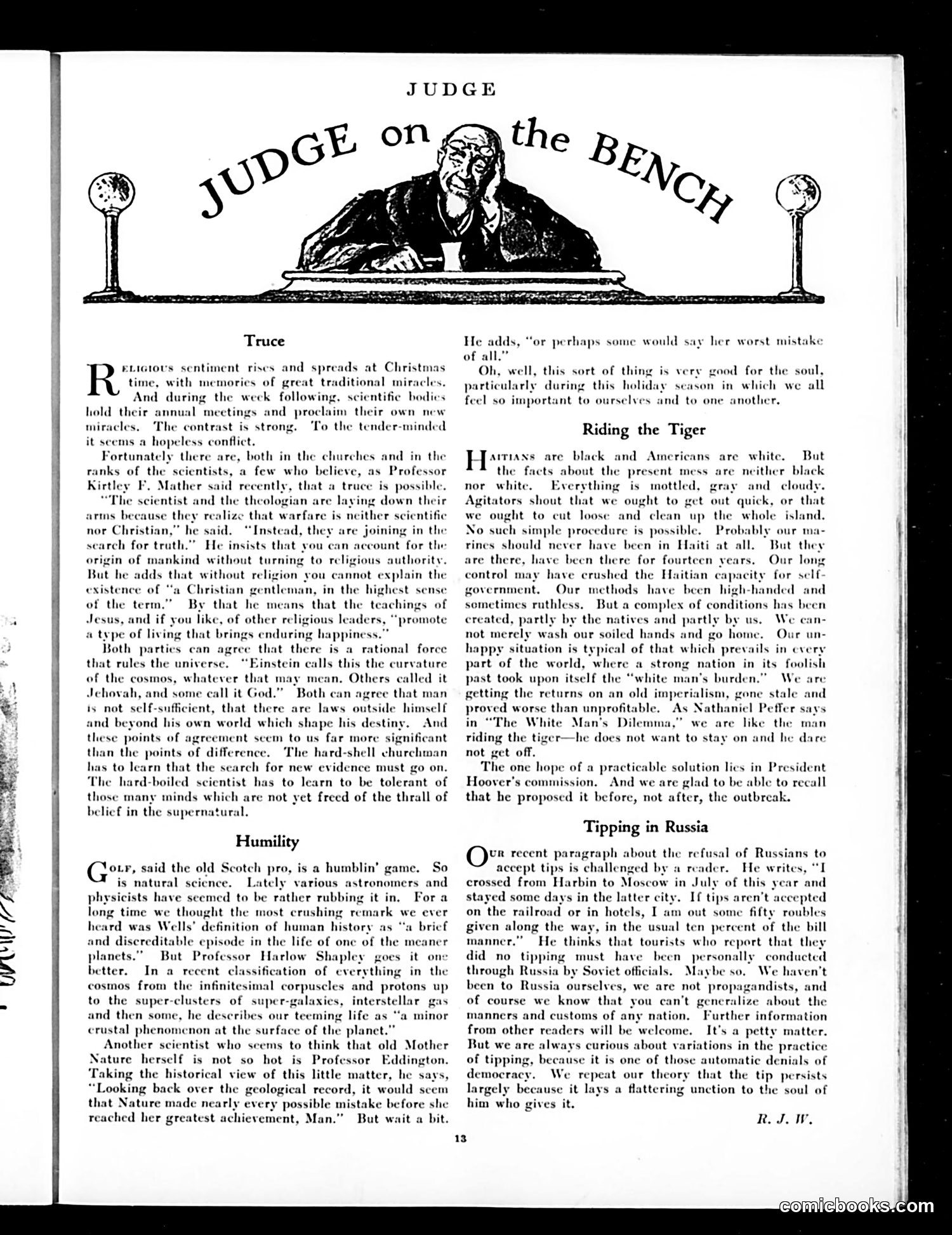
A restored page from Judge, 1929-12-28. Page through the whole issue in the reader above.
📄 Transcribed text from this page (OCR, searchable)
Machine-transcribed from the original scan — historical spelling and the odd misread are preserved.
WOW 3 Truce ELiGtous sentiment rises and spreads R time, with memories of great traditio And during the weck following. scientific box hold their annual meetings and proclaim their own new miracles, The contrast is strong. ‘To the tender-minded it seems a hopeless conflict. Fortunately there are, both in the churches and in the ranks of the scientists, a few who believe, as Professor F, Mather said recently, that a truce is possible. “The scientist and the theologian are laying down their ise they realize that warfare is neither scientific n,” he ss re joining in the arch for truth.” He insists th punt for the origin of mankind without turnir ious authority. But he adds that without re existence of “a Christian g of the term.” By that he means that the t Jesus, and if you like, of other religious leaders, a type of living that brings enduring happiness.” Both parties can agree that there is a rational force that rules the universe. “Einstein calls this the curvature of the cosmos, whatever that may mean, Others called it Jehov nd some call it Go Both can agree th: is not self-sufficient, that there are laws outside himself and beyond his own world which shape his destiny. And these points of a ar more signific than the points of difference. The hard-shell churche has to learn that the search for new evidence must The hard-boiled scientist has to learn to be tolerant of those many minds which are not yet freed of the thrall of belief in the supernatural. arms be promote man reement seem to us Humility Gq. said the old Scotch pro, is a humblin’ game. So is natural science. Lately various astronomers and e seemed to be rather rubbing it in. For a long time we thought the most crushing remark we ever heard was Wells’ definition of human history as brief and discreditable episode in the life of one of the meaner planets.” But Professor Harlow Shapley goes it one better. In a recent classification of everything in the cosmos from the infinitesimal corpuscles and protons up to the super-clusters of super-galaxies, interstellar gas and then some, he describes our teeming life as “a minor crustal phenomenon at the surface of the planet.” nother scientist who seems to think that old Mother ure herself is not so hot is Professor Eddington. Taking the historical view of this little matter, he “Looking back over the geological record, it would scem that Nature made nearly every possible mistake before she reached her greatest a vement, Man.” But wait a bit. 13 dds, “or perhaps some would say her worst mista of all.” Oh, well, this particularly during this holiday ses feel so important to ourselves and t ort of thing is very good for the soul, on in which we all one another, Riding the Tiger Hotes are black and Americans are white. But the facts about the present mess are neither black nor white. Everything is mottled, gray and cloudy. Agitators shout that we ought to get out quick, or that we ought to cut loose and clean up the whole island. No such simple procedure is possible. Probably our ma- rincs should never have been in Ha tall. But they c there, have been there for fourteen years. Our lor control may have crushed the Haitian capacity for self government, Our methods have been anded and sometimes ruthless. But a complex of conditions has been created, partly by the natives and partly by us. We can- not merely wash our soiled hands and go home. Our un- happy situation is typical of that which prevails in every part of the world, where a strong nation in its f¢ past took upon itself the “white man's burden.” We getting the returns on an old imperialism proved worse than unprofitable. As Nathaniel Peffer says in “The White Man’s Dilemma,” we are like the man riding the tiger—he does not want to stay on and he not get off. The one hope of a practicable solution lies in President Hoover's commission. And we are glad to be able to recall that he proposed it before, not after, the outbreak. Tipping in Russia O R recent paragraph about the refusal of Russians to accept tips is challenged by a reader. He writes, “I crossed from Harbin to Moscow in July of this year and stayed some days in the latter city. If tips aren't accepted on the railroad or in hotels, I am out some fifty roubles given along the way, in the usual ten percent of the bill manner.” He thinks that tourists who report that they did no tipping must have been personally conduct through Russia by Soviet officials. Maybe so. We haven't been to Russia ourselves, we are not proj ndists, and of course we know that you can't generalize about the manners and customs of any nation. Further information from other readers will be welcome. It's a petty matter. But we are always curious about variations in the practice of tipping, because it is one of those automatic denials of democra We repeat our theory that the tip persists largely because it lays a flattering unction to the soul of him who gives it. R.JLW.