
Judge, 1929-12-28 · page 20 of 37
Judge — December 28, 1929 — page 20: what you’re looking at
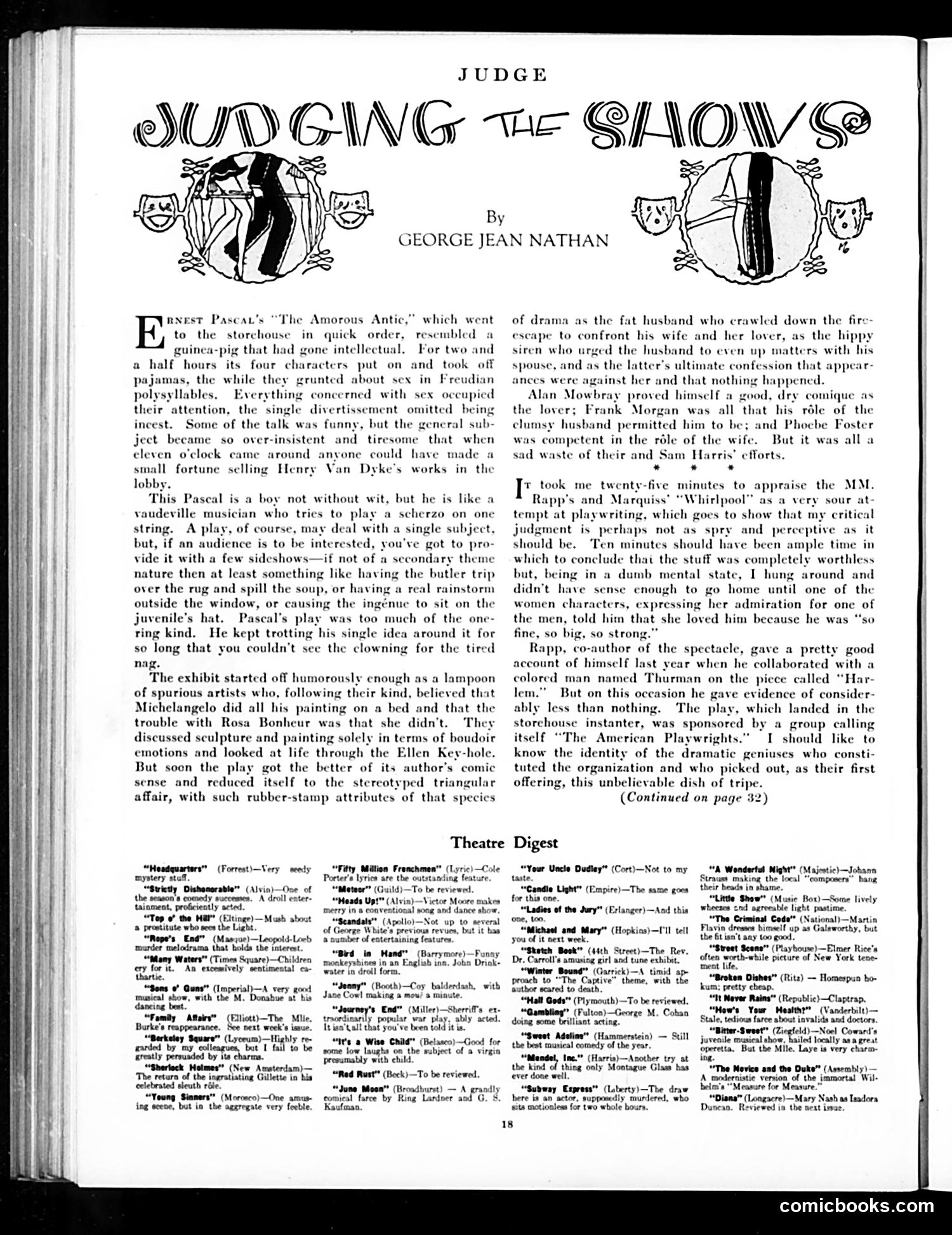
A restored page from Judge, 1929-12-28. Page through the whole issue in the reader above.
📄 Transcribed text from this page (OCR, searchable)
Machine-transcribed from the original scan — historical spelling and the odd misread are preserved.
JUDGE eW By NG we GAOWS GEORGE JEAN NATHAN rnest Pascat’s “The Amorous Antic,” which went to the storchouse in quick order, resembled a guinea-pig that had gone intellectual. For two and a half hours its four characters put on and took off Pp s, the while they grunted about sex in polysyllables. Everything concerned with sex occupied their attention, the single divertissement omitted incest. Some of the talk was funny, but the ject became so over-insistent and tiresome eleven o'clock came around : small fortune selling Henry lobby. ‘ Freudian general sub- that when could have made Dyke's works in the nyone Van but he is like scherzo on one a boy not without wit, ideville musician who tries to play a of course, may deal with a single subject, but, if an audience is to be interested, you've got to pro- vide it with a few sideshows—if not of a secondary theme nature then at least something like having the butler trip over the rug and spill the soup, or having a real rainstorm outside the window, or causing the ingénue to sit on the juvenile’s hat. Pase: play was too much of the one- ring kind. He kept trotting his single idea around it for so long that you couldn't see the clowning for the tired nag. The exhibit started off humorously enough as a lampoon of spurious artists who, following their kind, believed that Michelangelo did all his painting on a bed and that the trouble with Rosa Bonheur was that she didn't. Th discussed sculpture and painting solely in terms of boudoir emotions and looked at life through the Ellen Key-hole. But soon the play got the better of its author's comic sense and reduced itself to the stereotyped triangular affair, with such rubber-stamp attributes of that species is I's Theatre “Headquarters” mystery stu. “Suietly Dishonorable” (Alvin)—One of the season's comedy successes. A droll ester- tainment, profciently acted. “Top of the HUI” (Eltinge) — 8 prostitute who sees the Light. “Pepe's End” (Mas yor)—Leopold-Loeb marder melodrama that holds the interest. “Many Waters” (Times Square)—Chiliren czy for it. An excemively sentimental ca- thartie. (Forrest)—Very seety “Fifty Million Frenchmen” (Lyric) —Cole Porter's lyrics are the outstanding feature, “Meter” (Guild) —To be reviewed. “Heads Up!” (Alvin) —Vietor Moore makes merry in 8 conventional song and dance show. “Scandals” (Apollo)—Not up to several of George White's previous revues, but it bas a oumber of entertaining features. ‘Bird in Hand” (Barrymore)—Funay monkeyshines in an English inn. Joba Drink- water in droll form. Mush about of drama the fat husband who crawled down the fire ape to confront his wife and her lover, as the hippy siren who urged the husband to even up matters with his spouse, and as the latter's ultimate confession that appear- ances were against her and that nothing happened. Alan Mowbray proved himself a good, dry comique as the lover; Frank Morgan was all that of the clumsy husband permitted him to be; and Phoebe Foster was competent in the réle of the wife. But it was all a sad waste of their and Sam Harris’ efforts. * * * his réle + took me twenty-five minutes to appraise the MM. Rapp's and Marquis’ “Whirlpool a very sour at tempt at playwriting, which goes to show that my critical judgment is perhaps not as spry and. pe it should be. Ten minutes should have been ample time in which to conclude that the stuff was completely worthless but, being in a dumb mental state, I hung around and didn’t have sense enough to go home until one of the women characters, expressing her admiration for one of the men, told him that she loved him because he was fine, so big, so strong. Rapp, co-author of the spe account of himself last year wh colored man named Thurman on the pi lem.” But on this occasion he e evidence of consider- ably less than nothing. The play, which landed in the storchouse instanter, was sponsored by a group calling itself “The American Playwrights.” I should like to know the identity of the dramatic geniuses who consti- tuted the organization and who picked out, as their first offering, this unbelievable dish of tripe. (Continued on page 32) as. ceptive as gave a pretty good n he collaborated with a e called “Har- Digest “Your Uncle Dudley” taste. “Candle Light” (Empire)—The same goes for this one. “Ladies of the Jury” (Erlanger) —: ‘one, too. “Michael and Mary” (Hopkins)—I'll tell you of it next week. “Sketch Book” (44th Street)—The Rev. Dr. Carroll's amusing girl and tune exhibit, “Winter Bound” (Garrick) —A timid ap proach to ‘The Captive” theme, with the (Cort}—Not to my “A Wendertul Might” (Majestic) —Johann, Straus making the local “composers” hang their beads in shame, “Little Show” (Music Box)—Some lively wheeaes tnd agreeable light pastime. “The Criminal Code” (National)—Martin Flavin dresses himself up as Galeworthy, but the Bit isn't aay too good. “Street Scone” (ayhoure)—Elmer Rice's often worth-while picture of New York tene- ment life, “Broken Dishes” (fits) — Homespun ho- And this “Sons of Guns” (Imperial) —A very good musical show, with the M. Donahue at his dancing best. “Family Affaire” (Elliott)—The Mlle. Burke's reappearance. See next week's isue. “Berkeley Square” (Lyceum)—Highly . garded by my colleagues, but I fall to greatly persuaded by its charms. “Sherlock Holmes” (New Amsterdam)— ‘The return of the ingratiating Gillette in bis celebrated sleuth réle. “Young Sinners” (Moroco)—One amus- ing scene, but io the aggregate very feeble. “denny” (Booth)—Coy balderdash, with Jane Cow! making a mou/ minute. “deurney’s End” (Miller)—Sherrif's ex- traordisarily popular war play, ably acted. Is isn’Qall that you've been told it is. “It's a Wise Child” (Belasco)—Good for some low laught on the subject of @ virgin Presumably with child. “Red Rust” (Beck) “June Moon” (Broadhurst) — A grandly gpnical farce by Ring Lardner and . —To be reviewed. author seared to death. “Hall Gods" (Plymouth)—To be reviewed. “Gambling” (Fulton)—George M, Cohan doing some brilliant acting. “Sweet Adeliae” (Hammerstein) — Still the best musical comedy of the year. “Bendel, Une." (Harris) —Another try at the kind of thing only Montague Glass has ever done well, “Subway Express” (Liberty)—The draw here is an sector, supposediy murdered, who sits motionless for two whole hours, 18 kum; pretty cheap. “It Maver Rains” (Republic)—Claptrap. “How's Your Hesltht” (Vanderbilt) — Stale, tedious farce about invalids and doctors, “Binter-Sweet” (Ziegfeld)—Noel Cowart’ juvenile musical show. hailed locally as a great operetta. But the Mile. Laye is very charm i “The Mevice and the Duke” (Assembly) — A modernistie version of the immortal Wil- jeasure for Measure.” jiana”™ (Longacre)—Mary Nash as Isadora Duncan. Reviewed ia the next inae. comicbooks.com