
Judge, 1929-12-28 · page 4 of 37
Judge — December 28, 1929 — page 4: what you’re looking at
What you’re looking at
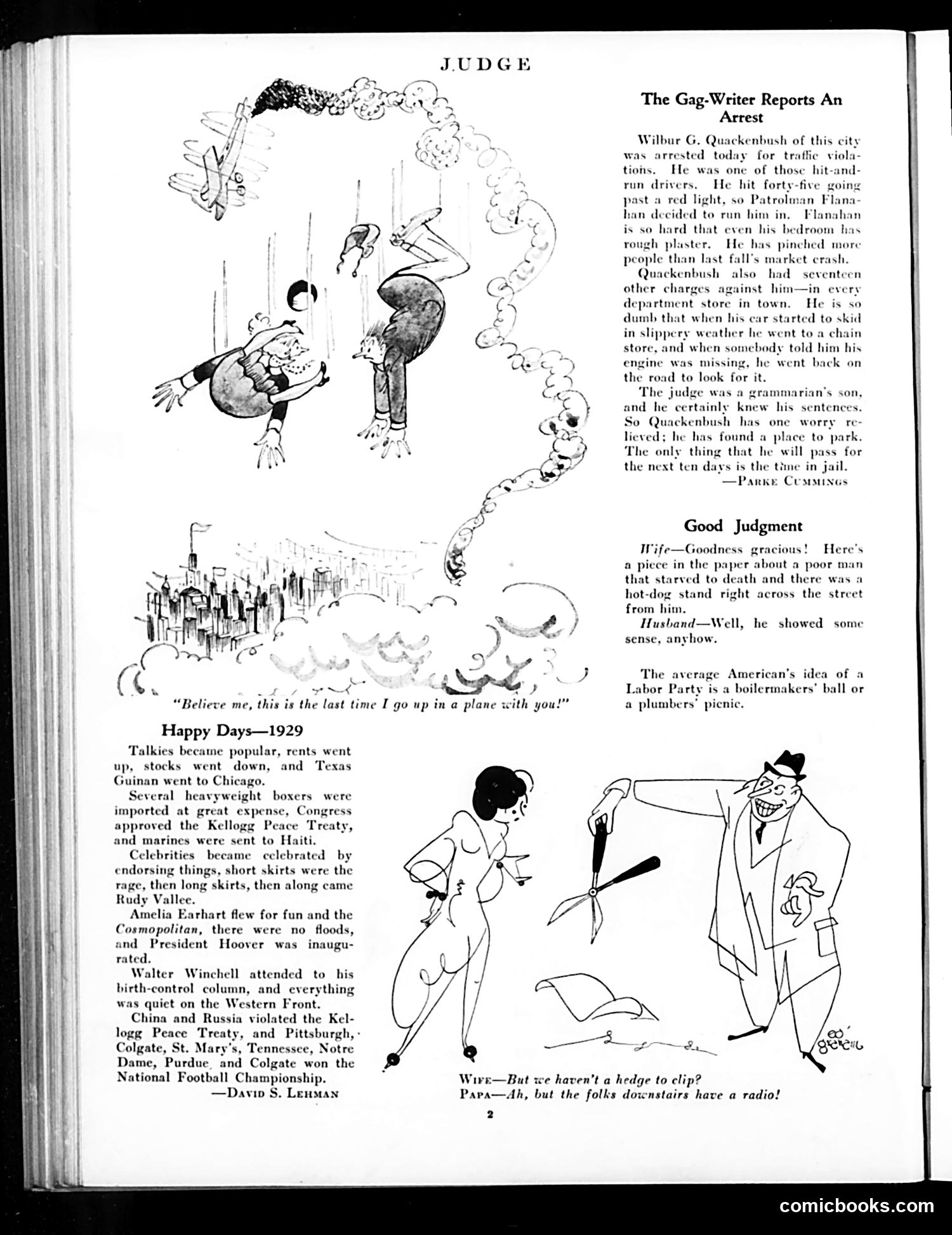
# Judge Magazine Page Analysis This page contains three satirical pieces from 1929: **"The Gag-Writer Reports An Arrest"** mocks Wilbur G. Quackenbush, a reckless driver arrested for traffic violations. The cartoon illustrates his dangerous driving habits—running red lights, causing accidents. The satire targets careless motorists endangering public safety, a growing concern as automobile use increased in the 1920s. **"Good Judgment"** is a brief domestic joke about a poor man who starved to death near a hot-dog stand, suggesting the husband showed "sense" by dying rather than spending money. It's dark humor about economic hardship. **"Happy Days—1929"** summarizes notable 1929 events: talking pictures' popularity, stock market fluctuations, Amelia Earhart's aviation achievements, and college football championships. The tone is celebratory of American progress, published just before the October stock market crash.
📄 Transcribed text from this page (OCR, searchable)
Machine-transcribed from the original scan — historical spelling and the odd misread are preserved.
JUDGE The Gag-Writer Reports An Arrest Wilbur G. Quackenbush of this city was arrested today for traffic viola- tions. He was one of those hit-and- run drivers. He hit forty-five past a red light, so Patrolman han decided to run him in, Flanahan is so hard that even his bedroom has rough plaster. He has pinched mor people than last fall’s market erash. j Quackenbush other charges against him—in every department store in town. He is so dumb that when his car started to skid in slippery weather he went te store, and when somebody told him his Ine was missing, he went back on id to look for it. The judge was ammarian’s son, and he certainly knew his sentences. So Quackenbush has one worry. re- lieved; he has found a place to park. The only thing that he will pass for the next ten days is the time in jail. —Parke Cummines also had seventeen the Good Judgment Wife—Goodness gracious! Here's a piece in the paper about a poor man that starved to death and there was a hot-dog stand right across the street from him. Husband—Well, he showed some sense, anyhow. 1 A Le — dD The aver: American's idea of a wi (¢ ‘ aoe ; wrepud ) Labor Party is a boilermakers’ ball or BP tii “Believe me, this is the last time I go up ina plane with you!” a plumbers’ picnic. Ht | | Happy Days—1929 yk Talkies became popular, rents went | 1 up, stocks went down, and Texas ! Guinan went to Chicago. Dy Several heavyweight boxers were | it | imported at great expense, Congress | eh | approved the Kellogg Peace Treaty, ae and marines were sent to Hait ha Celet ne celebrated by | endorsing things, short skirts were the H i rage, then long skirts, then along came | F t Rudy Vallee. F | Amelia Earhart flew for fun and the Cosmopolitan, there were no floods, and President Hoover was inaugu- rated. Walter Winchell attended to his birth-control column, and everything was quiet on the Western Front. } China and Russia violated the Kel- | logg Peace Treaty, and Pi | ; \ Colgate, St. Mary's, Tenness: ( a. en. oa arcteu, Dame, Purdue, and Colgate won the National Football Championship. Wire—But we haven't a hedge to clip? —Davin S. Lenman Para—aAh, but the folks downstairs have a radio! comicbooks.com