
Judge, 1929-12-28 · page 25 of 37
Judge — December 28, 1929 — page 25: what you’re looking at
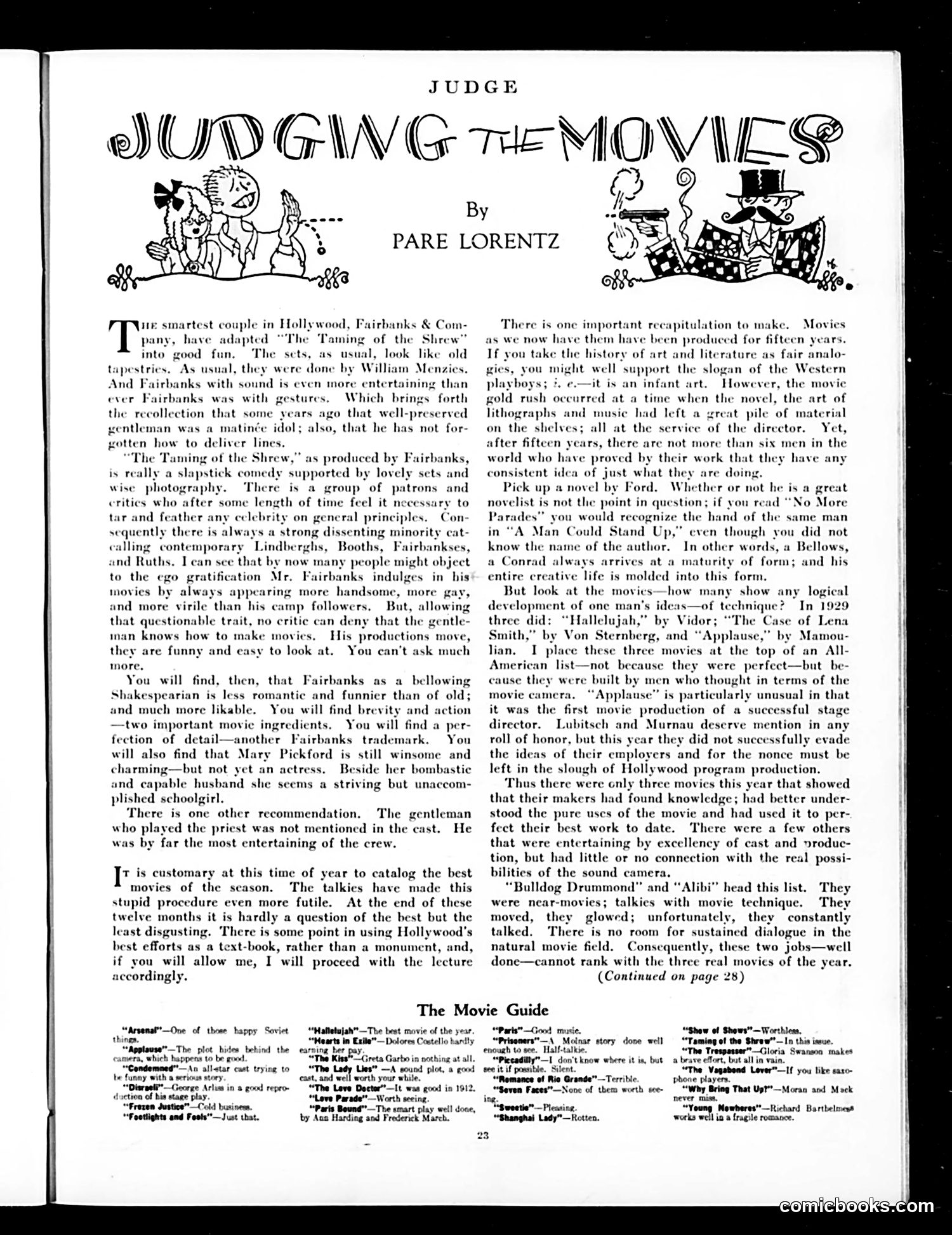
A restored page from Judge, 1929-12-28. Page through the whole issue in the reader above.
📄 Transcribed text from this page (OCR, searchable)
Machine-transcribed from the original scan — historical spelling and the odd misread are preserved.
JUDGE SUVGING THe MOV [Ss By PARE LORENTZ ite smartest couple in Hollywood, Fairbanks & Com- pany, have adapted “The ‘Taming of the Shrew” into good fun, The sets, as usual, look like old tapestries. As usnal, they were done by William Menzies. And Fairbanks with sound is even more entertaining than ever Fairbanks was with gestures. Which brings forth the recollection that some years ago that well-preserved gentleman was a matinée idol; also, that he has not for- J w to deliver lin aming of the Shrew,” as produced by Fairbanks, is really a slapstick comedy supported by lovely sets and photography. There is a group of patrons and critics who after some length of time feel it necessary to tar and feathe Con- sequently there is always a strong dissenting minority cat- calling contemporary Lindberghs, Booths, Fairbankses, and Ruths. that by now many people might object to the ego gratification Mr. Fairbanks indulges in his movies by appearing more handsome, more gay, and more than his camp followers. But, allowing that questionable trait, no critic can deny that the gentle- inan knows how to make movies. His productions move, they are funny and e: to look at. You can’t ask much more, You will find, then, that Fairbanks as a bellowing Shakespearian is less romantic and funnier than of old; and much more likable. You will find brevity —two important movie ingredients. You w fection of detail—another Fairbanks trademark. You will also find that Mary Pickford is still winsome and charming—but not yet an actress. Beside her bombastic and capable husband she scems a striving but unaccom- plished schoolgirl. There one other recommendation, The gentleman who played the priest was not mentioned in the cast. He was by far the most entertaining of the crew. wise is y celebrity on general principles. T can se virile and action 1 find a per- I" is customary at this time of year to catalog the best movies of the season. The talkies have stupid procedure even more futile. twelve months it is hardly a question of the best but the least disgusting. There is some point in using Hollywood's best efforts as a text-book, rather than a monument, and, if you will allow me, I will proceed with the lecture accordingly. made this At the end of these There is one important recapitulation to make. as we now have them have been produced for fift If you take the history of art and literature as fair analo- gies, you might well support the slogan of the Western playboys; # e.—it is an infant art. However, gold rush occurred at a time when the lithographs and music had left a great pile of material on the all at the service of the director. Yet, after fiftecn years, there are not more than six men in the world who have proved by their work that they have any consistent idea of just what they are doing. Pick up a novel by Ford. Whether or not be is a great novelist is not the point in question; if you read “No More ‘ou would recog the hand of the same man in “A Man Could Stand Up,” even though you know the name of the author. In other words, a Conrad always arrives at a maturity of form; entire creative life is molded into this form, But look at the movies—how development of one man’s ideas—of technique? In 1929 three did: “Hallelujah,” by Vidor; “The Case of Lena Smith,” by Von Sternberg, and “Applause,” by Mamou- lian, I place these three movies at the top of an All- American list—not because they were perfect—but be- cause they were built by men who thought in ter movie came “Applause” is particularly unusua it the first movie production of a successful director. Lubitsch and Murnau deserve mention in any roll of honor, but this year they did not successfully evade the ideas of their employers and for the nonce must be left in the slough of Hollywood program production, Thus there were only three movies this year that showed that their makers had found knowledge; had better under- stood the pure uses of the movie and had used it to per- fect their best work to date. There were a few others that were entertaining by excellency of cast and vroduc- tion, but had little or no connection with the real possi- bilities of the sound camera. “Bulldog Drummond” and “Alibi” head this list. They were near-movies; talkies with movie technique. They moved, they glowed; unfortunately, they constantly talked. There is no room for sustained dialogue in the natural movie field. Consequently, these two jobs—well done—cannot rank with the three real movies of the y (Continued on page 28) the movie novel, the art of shelves many show any logical stage The Movie Guide “Arvenat"—One of those happy Soviet y"—The plot hides bebind the camera, whicb happens to be good. “Condemaed”—An allstar cast trying to be funny with a serious story George Arlim in a good repro duction of bis stage play. “Freren dustice”—Cold busines. “Foettights and Feets"”—Just that. “"Halleta|ah”—The beat movie of the year “Hearts in Exile”—Dolores Costello bantly earning ber pay “The Kiss? Greta Garbo in nothing at all “The Lady Lies" —A round plot, a good cast, and well worth your while. “The Love Dector”—It was good in 1912. “Paris Bound” —The smart play well done, by Aun Harding and Frederick March. M coomth oem. Hiallasitie ee it if posnble. Silent. “Lave Parade”—Worth seeing. ing. “Sweetie” —Pleasing. Price | mute. “Prisoners” — nar story “Shaw of Shows" —Worthless, “Taming of to Shrew" In this ine. —Gloria Swanson makes stare but all in vain. Lever"—If you like saxo- done well “Piceadilly”—1 don't know where it is, but “Romance of Rio Grande” —Terribte. phone players. “Seven Faces™—None of them worth see“ ‘Why Bring That Up?”—Moran and Mock never miss, “ye works w Nowberes”—Richard Bartbelmess ip a fragile romance. “Shanghai Lady”—Rotten.