A complete issue · 36 pages · 1929
Judge — November 30, 1929
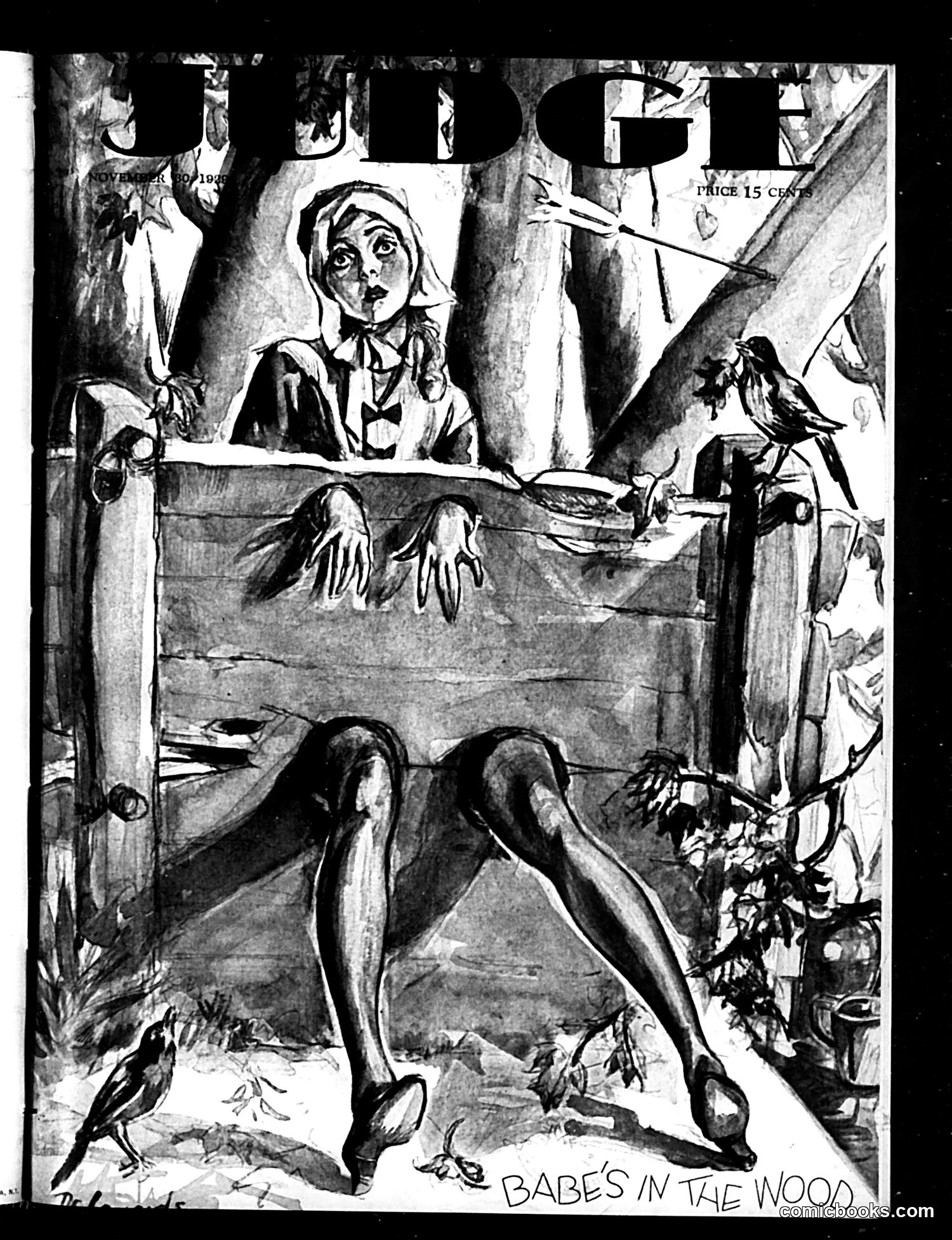
# "Babes in the Wood" - Judge Magazine Cartoon This cartoon illustrates the classic fairy tale "Babes in the Wood," where two lost children perish in a forest. The image shows a woman peering from behind wooden slats (suggesting a coffin or enclosure) with two figures below displaying their legs prominently. The caption "BABES IN THE WOOD" indicates this is likely a satirical commentary using the fairy tale as allegory. The composition suggests commentary on vulnerability, abandonment, or peril—possibly referencing contemporary social or political issues affecting women or children. The suggestive pose and the magazine's satirical nature suggest this may be social commentary on exploitation or endangerment, though the specific historical reference requires additional context to definitively identify the intended targets or scandal being mocked.
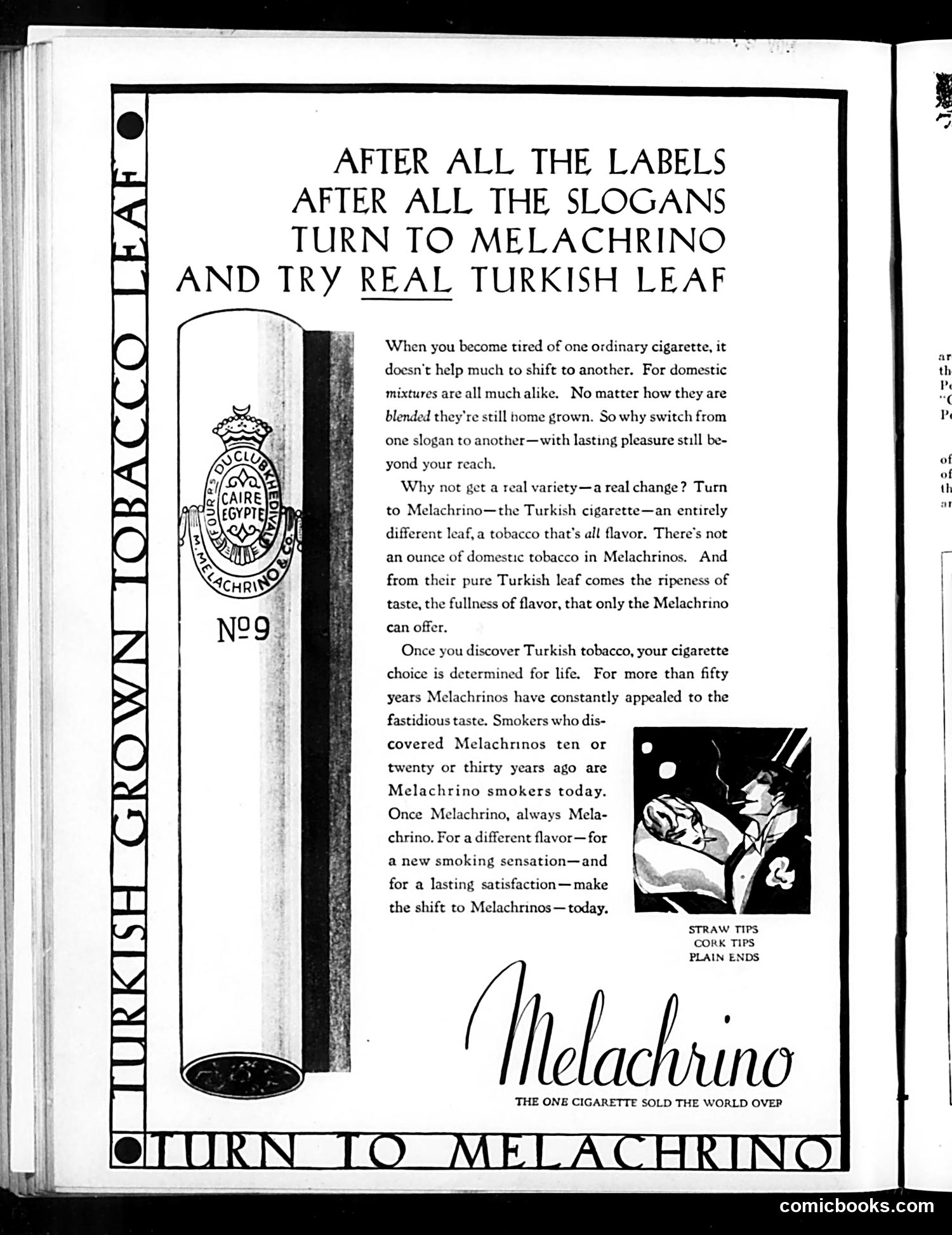
# Analysis This page is primarily a **cigarette advertisement**, not political satire. It's a full-page ad for Melachrino Turkish cigarettes, published in *Judge* magazine. The ad argues that switching between different domestic cigarette brands offers no real variety—they're all similar. It pitches Melachrino as genuinely different, being pure Turkish leaf rather than American-blended tobacco. The copywriting emphasizes that Turkish tobacco provides superior "ripeness of taste" and "fullness of flavor." The small illustration shows someone smoking contentedly. The left margin features the cigarette package and branding. This reflects early-20th-century advertising strategy: using magazines' editorial space to position premium imported cigarettes as sophisticated alternatives to mass-market American brands. No political commentary is evident—it's purely commercial persuasion.
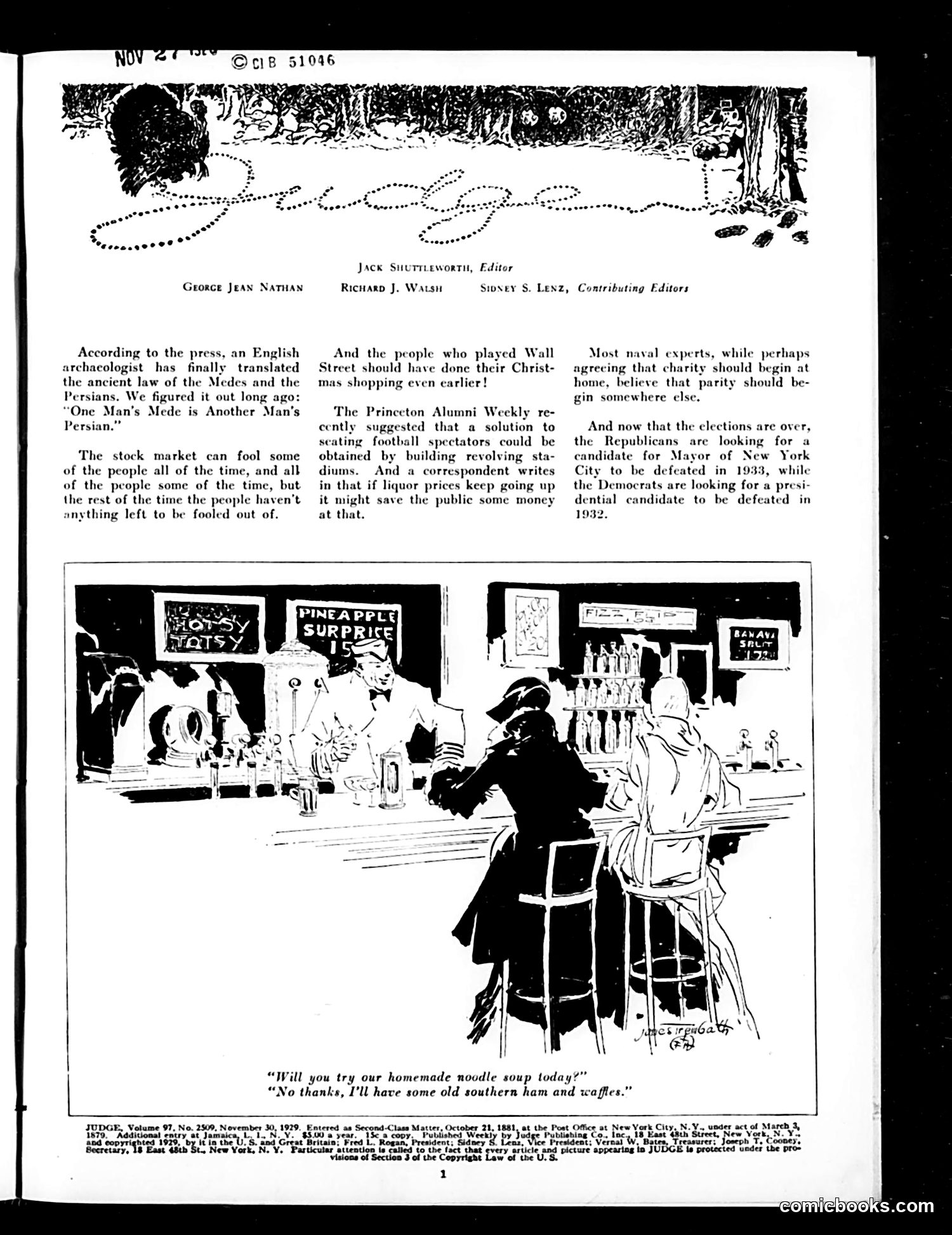
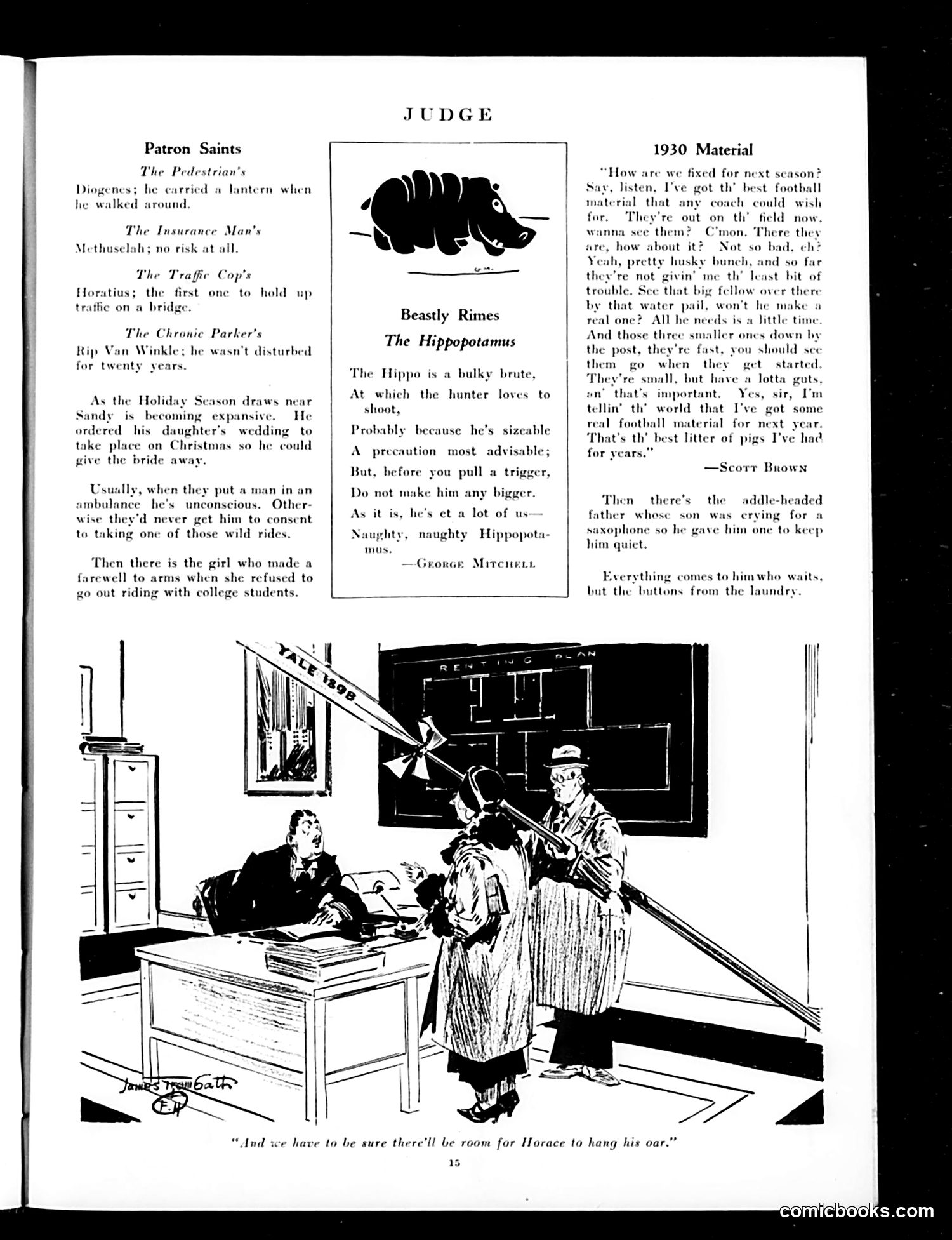
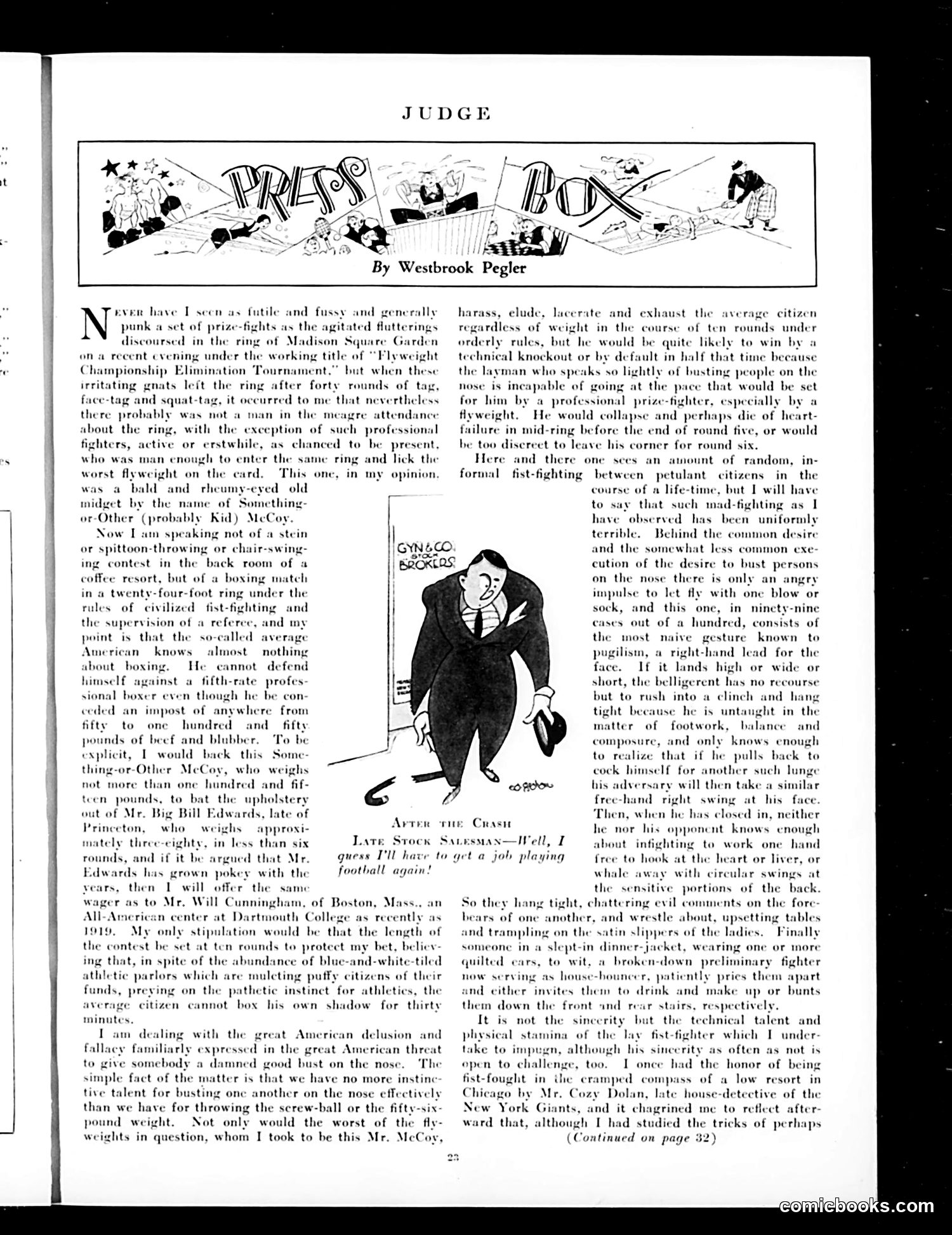
# Analysis This page from *Judge* (November 30, 1929) contains satirical commentary and a cartoon. The text discusses several contemporary issues: an English archaeologist's translation of Persian law; stock market speculation fooling the public; football stadium seating solutions; and upcoming mayoral elections in New York City, referencing both Republican and Democratic candidates for 1932. The cartoon depicts a diner scene where a server offers "homemade noodle soup" to a customer who declines, preferring "old southern ham and waffles." The satire likely mocks Depression-era economic hardship—the irony being that "homemade noodle soup" represents affordable but unappetizing necessity, while the customer clings to fancier Southern foods as a status symbol despite economic constraints. The joke highlights Americans' reluctance to accept economic reality during the early Great Depression.
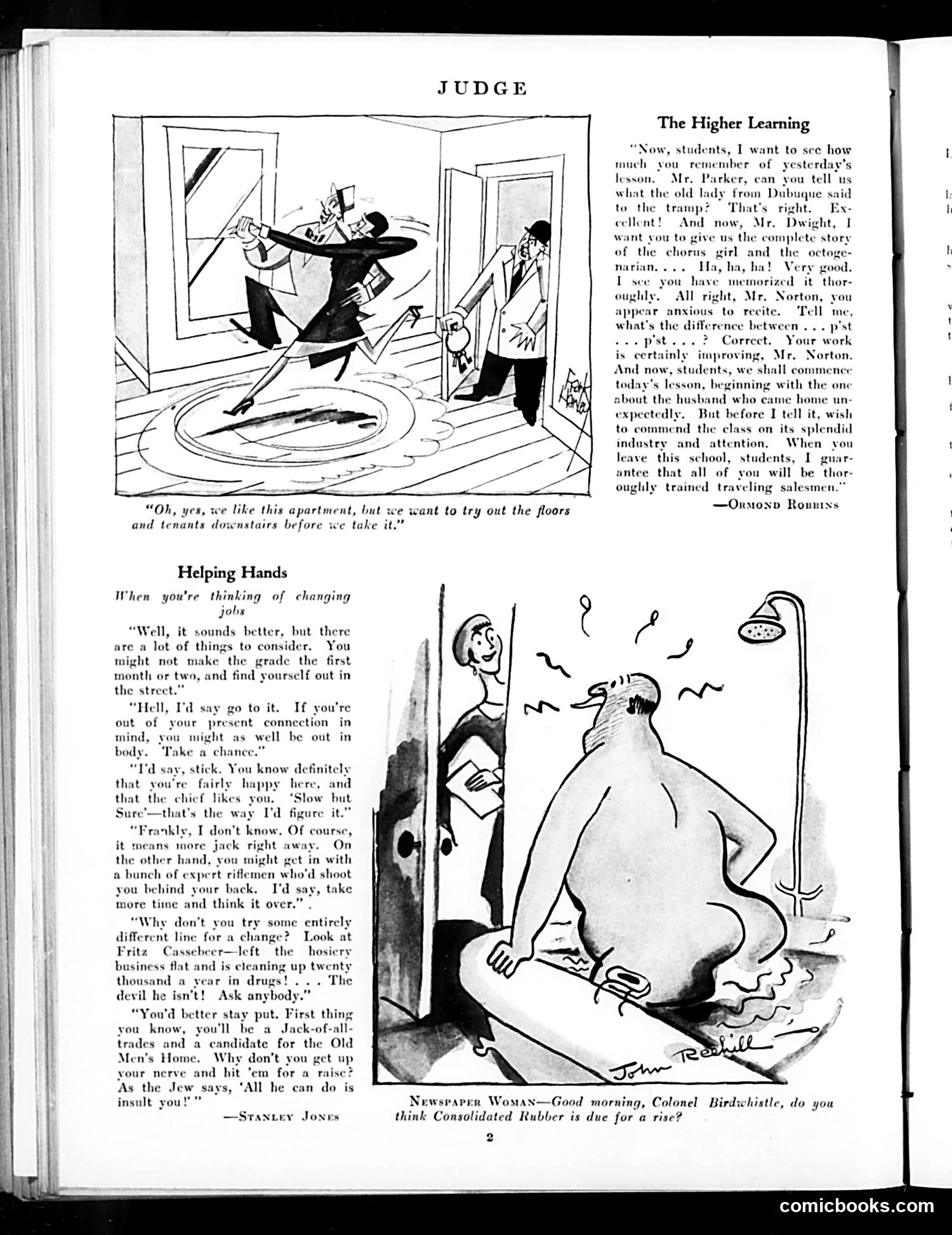
# Analysis of Judge Magazine Page This page contains two separate pieces of humor: **"The Higher Learning"** (top) satirizes classroom pretension. A teacher quizzes students on culture and literature, emphasizing proper elocution and refined behavior. The humor targets academic pomposity and the gap between the teacher's aspirations to produce "thoroughly trained traveling salesmen" and actual student interests. **"Helping Hands"** (bottom) presents a conversation about career changes, likely referencing contemporary job-switching anxieties. The dialogue between characters discusses whether to leave a comfortable position, with references to "Fritz Cassebeer" (appears to be a known figure) and commentary on Jewish experience ("All he can do is insult you!"). The accompanying cartoon shows a nude man in a bathtub with a shower head, captioned as a "Newspaper Woman" asking about a Colonel's due for a raise—its satirical point is unclear without additional context.
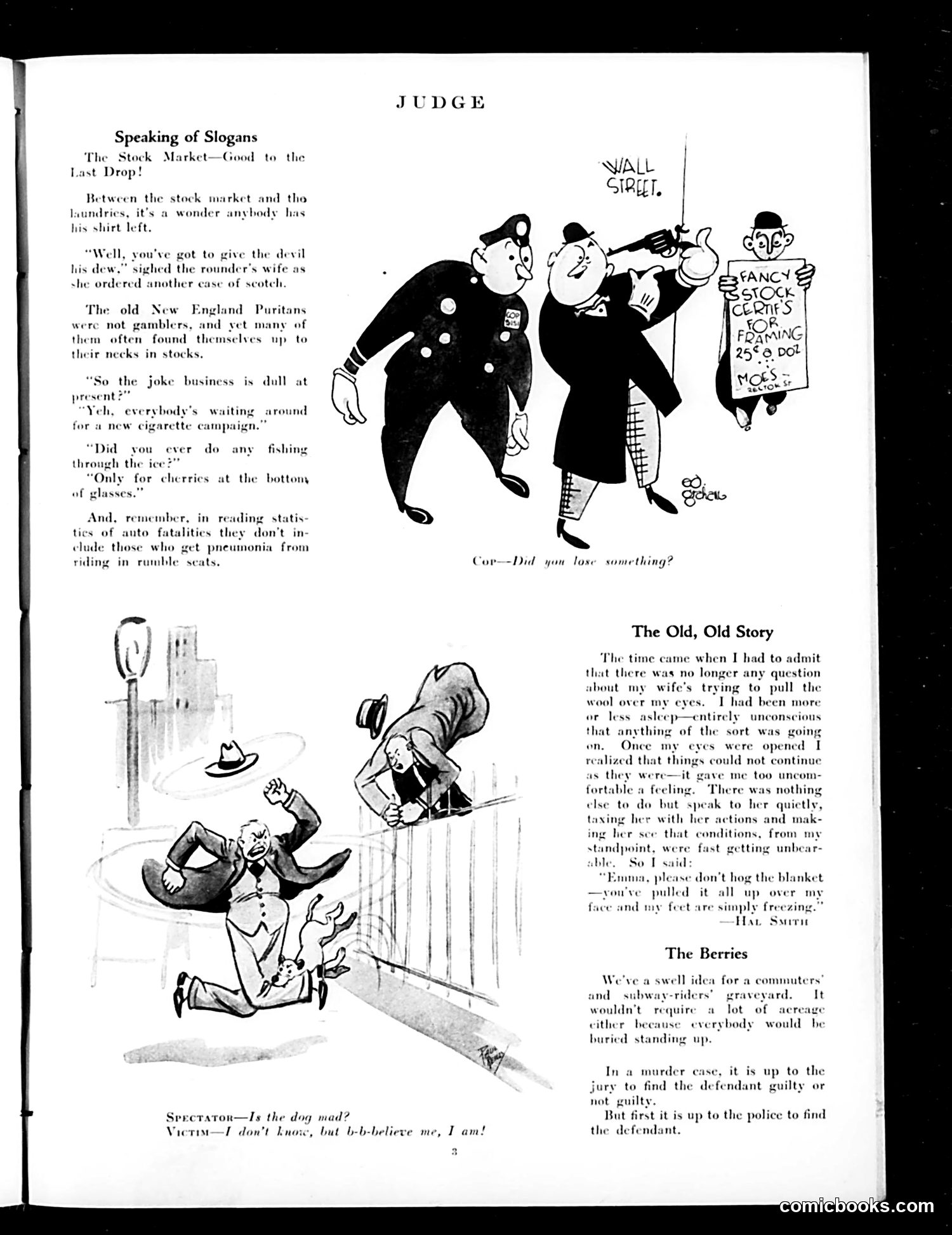
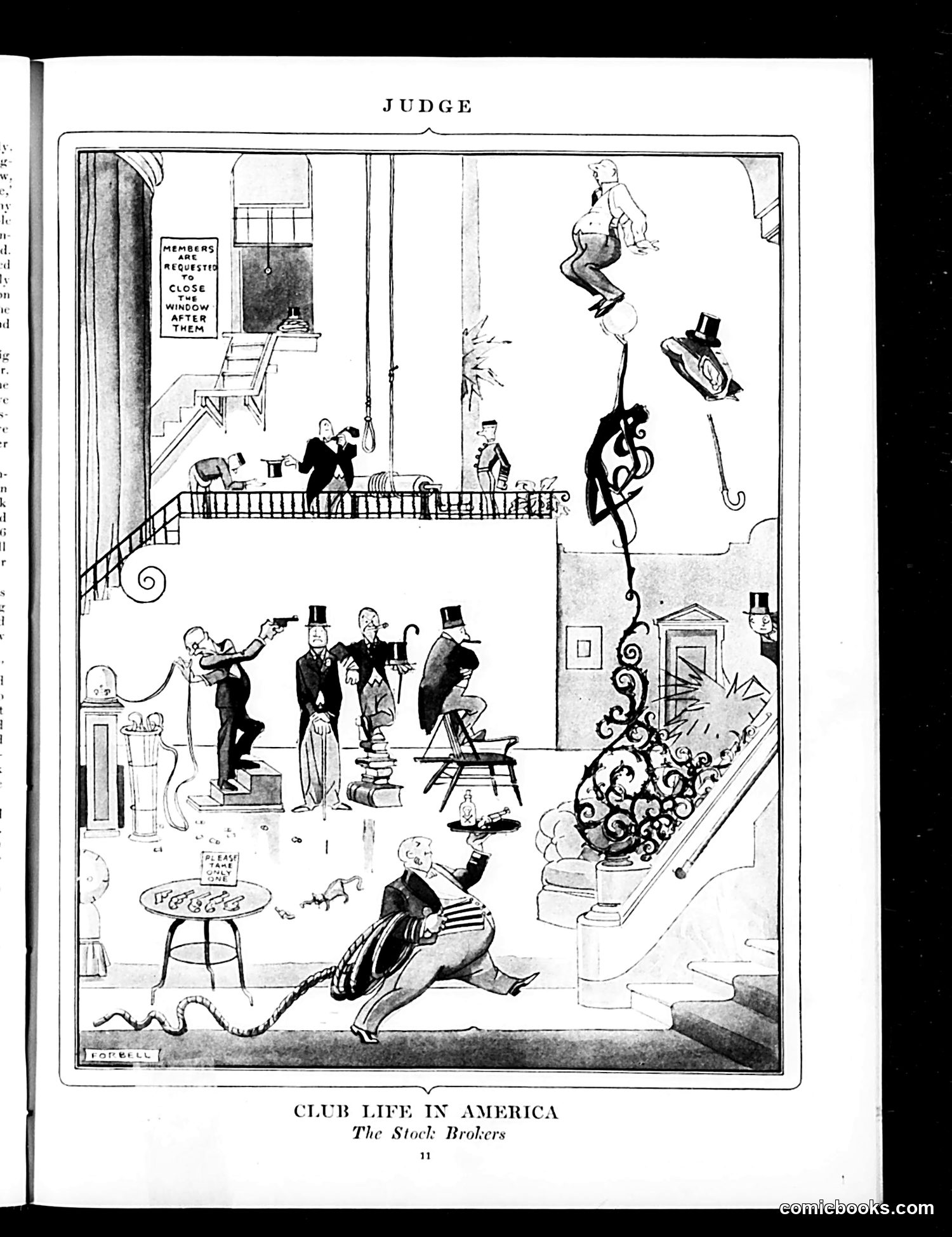
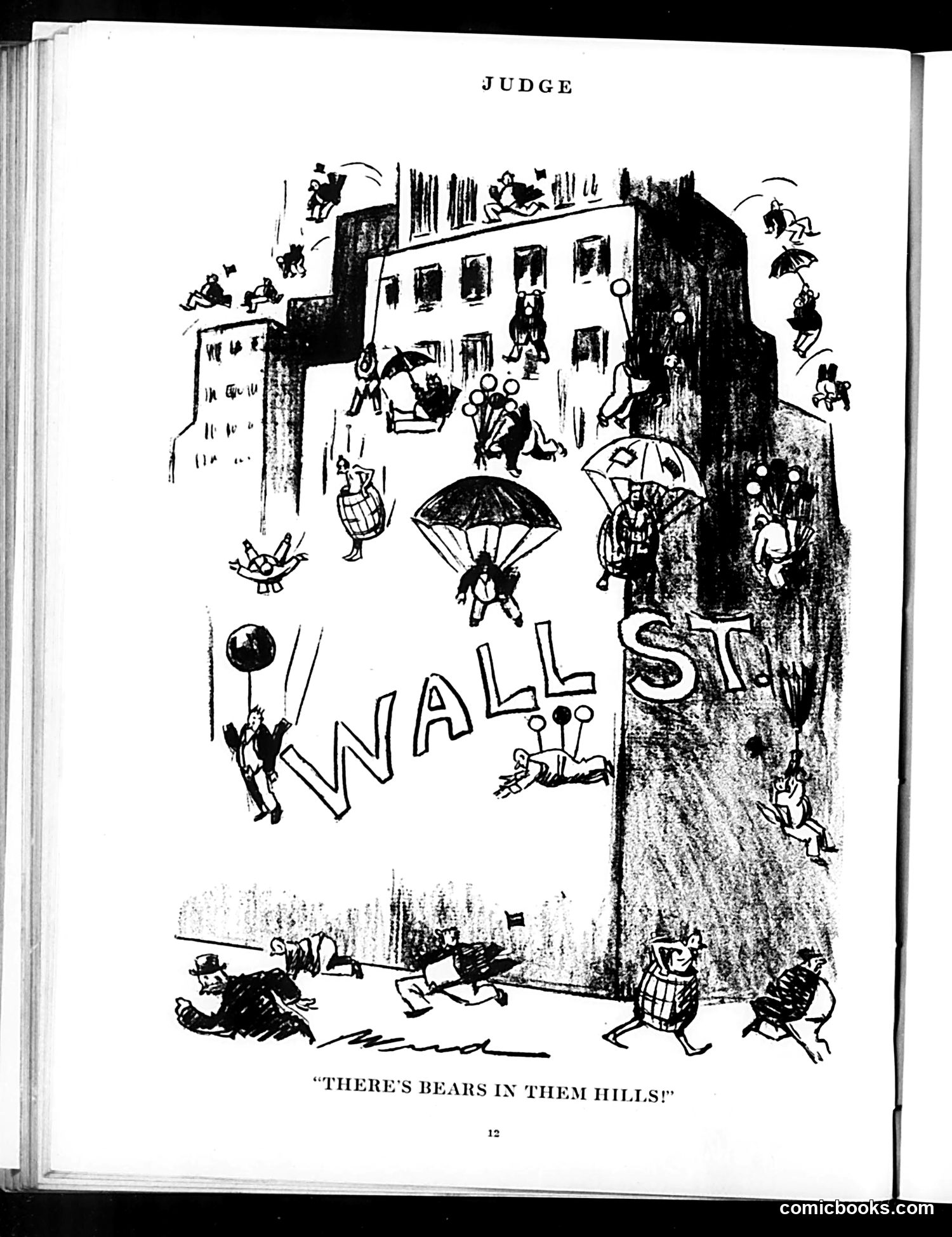
# Analysis of Judge Magazine Page **Top Cartoon ("Wall Street"):** Two stock market traders confront a disheveled figure labeled with financial crimes and stock schemes. The satire targets Wall Street fraud and market manipulation—common concerns during economic downturns. The specific schemes mentioned (framing 25% margins, mobs) suggest this addresses contemporary stock market abuses, though the exact historical moment is unclear without dating. **Bottom Cartoon ("Spectator-Is the dog mad?"):** A slapstick scene of someone falling while a dog causes chaos. This appears to be simple physical comedy rather than political satire. **Articles:** "The Old, Old Story" and "The Berries" contain mild domestic and legal humor unrelated to the cartoons. The page primarily satirizes financial corruption through exaggerated caricature and visual chaos.
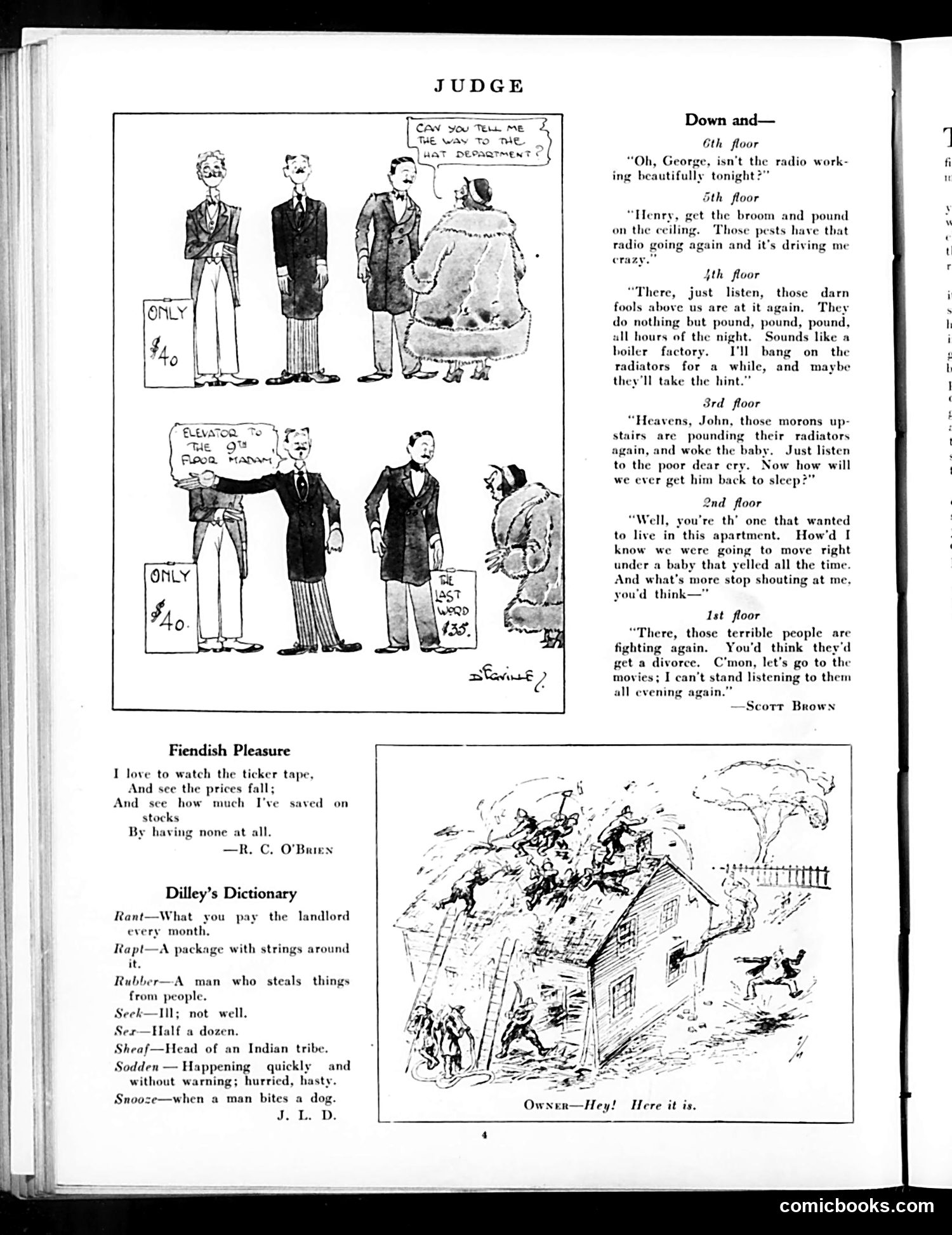
# Judge Magazine Page Analysis The main cartoon satirizes apartment hunting and rental disputes. It shows three men (prospective tenants) viewing apartments marked "ONLY $40," with a landlord quoting inflated prices. The humor targets the disconnect between advertised and actual rental costs—a perennial urban complaint. The "Down and—" section presents neighbors complaining across multiple floors about noise: a radio upstairs, pounding on ceilings, children crying, and fighting couples. This satirizes the shared miseries of apartment living and how tenants blame each other rather than addressing root problems. The surrounding content includes humorous dictionary definitions and a Western sketch about pursuing a fugitive. The overall tone mocks both predatory landlords and the chaotic frustrations of urban apartment dwelling in what appears to be the early-to-mid 20th century.
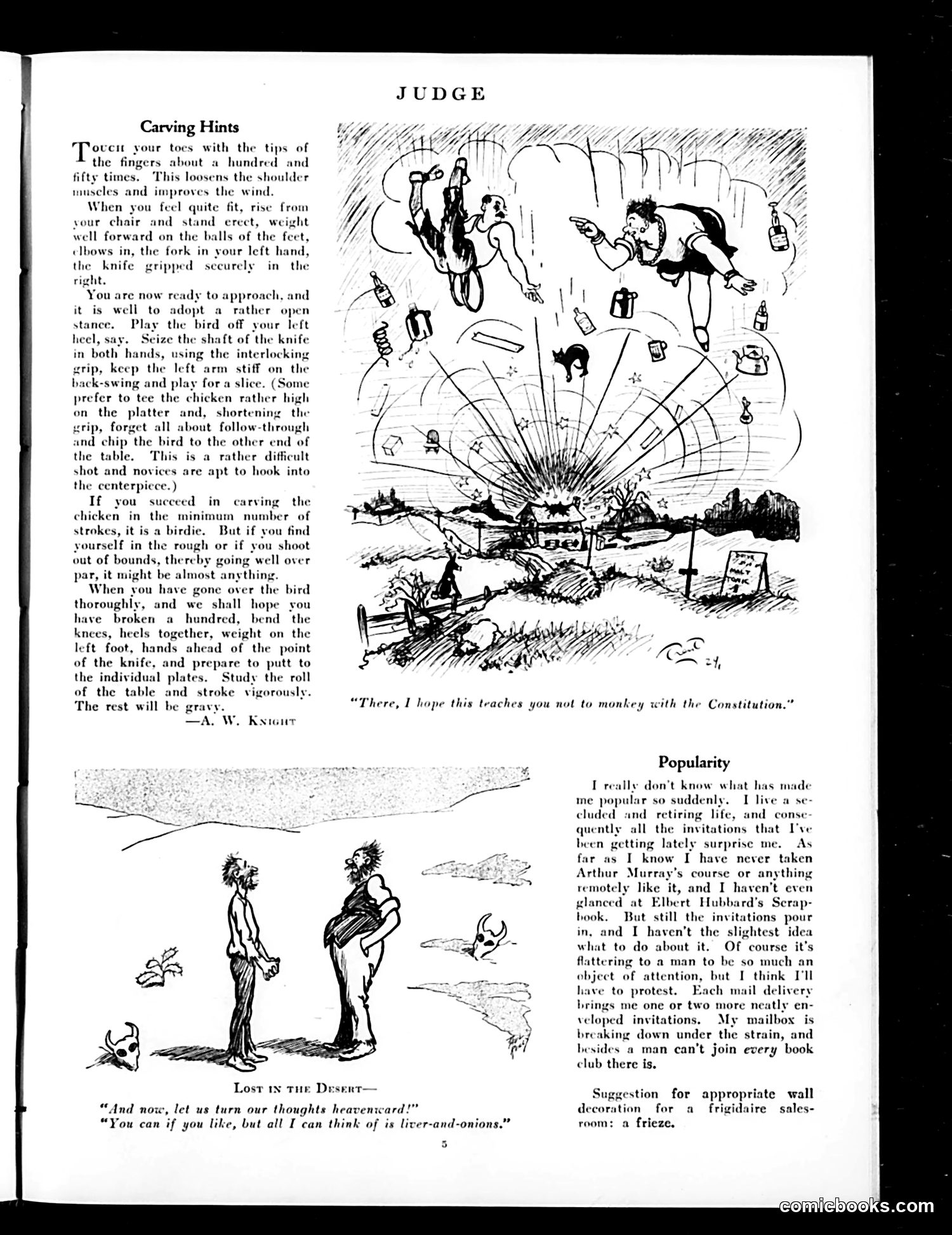
# Analysis of Judge Magazine Page This page contains three unrelated sections: 1. **"Carving Hints"** by A.W. Knight—a humorous instructional piece on proper carving technique at dinner, written in mock-serious etiquette-guide style. 2. **A large political cartoon** showing explosions raining down on a landscape with the caption "There, I hope this teaches you not to monkey with the Constitution." This appears to reference constitutional conflict, likely from the early 20th century, though the specific dispute is unclear without dating information. 3. **"Popularity"** section—a personal essay about receiving unexpected social invitations, seemingly autobiographical commentary on the author's social life. 4. **"Lost in the Desert"** cartoon showing two thin men, with dialogue about "liver-and-onions." The page blends satirical commentary, practical humor, and personal reflection typical of Judge magazine's eclectic format.
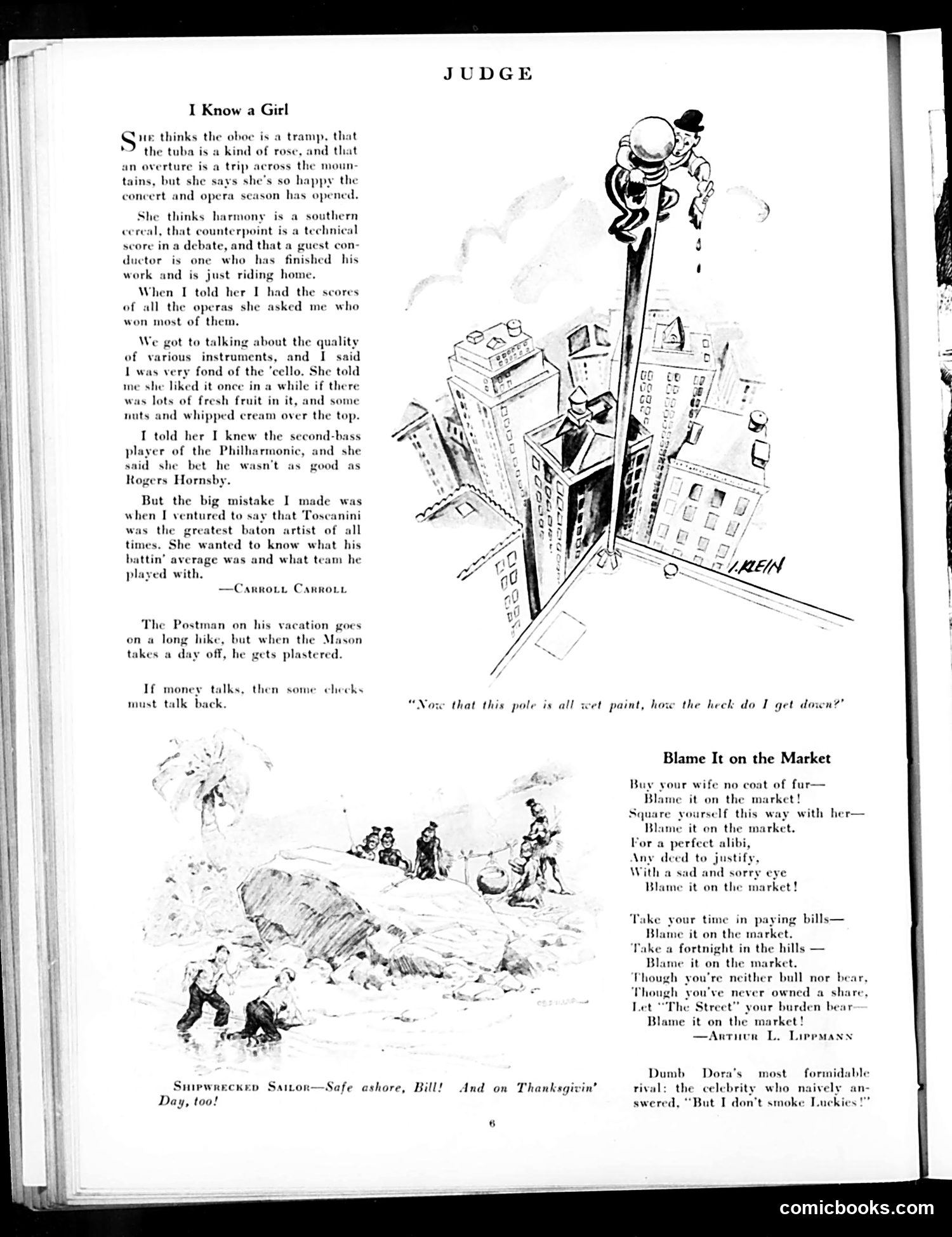
# Analysis of Judge Magazine Page This page contains several satirical pieces lampooning middle-class anxieties and social pretensions circa early 20th century. The top cartoon shows a man atop a skyscraper conducting an orchestra, satirizing pretentious musical discussion. The accompanying text by Carroll Carroll mocks a woman who confuses operatic terminology with actual musical knowledge—she mistakes instruments, composers, and performers, exposing shallow cultural affectation. Below, "Blame It on the Market" by Arthur L. Lippmann uses rhyming verse to satirize how spouses blame external economic forces for financial irresponsibility—buying expensive coats or failing to pay bills while crediting "the market" rather than acknowledging personal excess. The bottom sketch depicts a shipwrecked sailor, likely commentary on maritime disaster or economic hardship, though context is limited. The humor targets pretension, financial irresponsibility, and marital blame-shifting among the middle class.
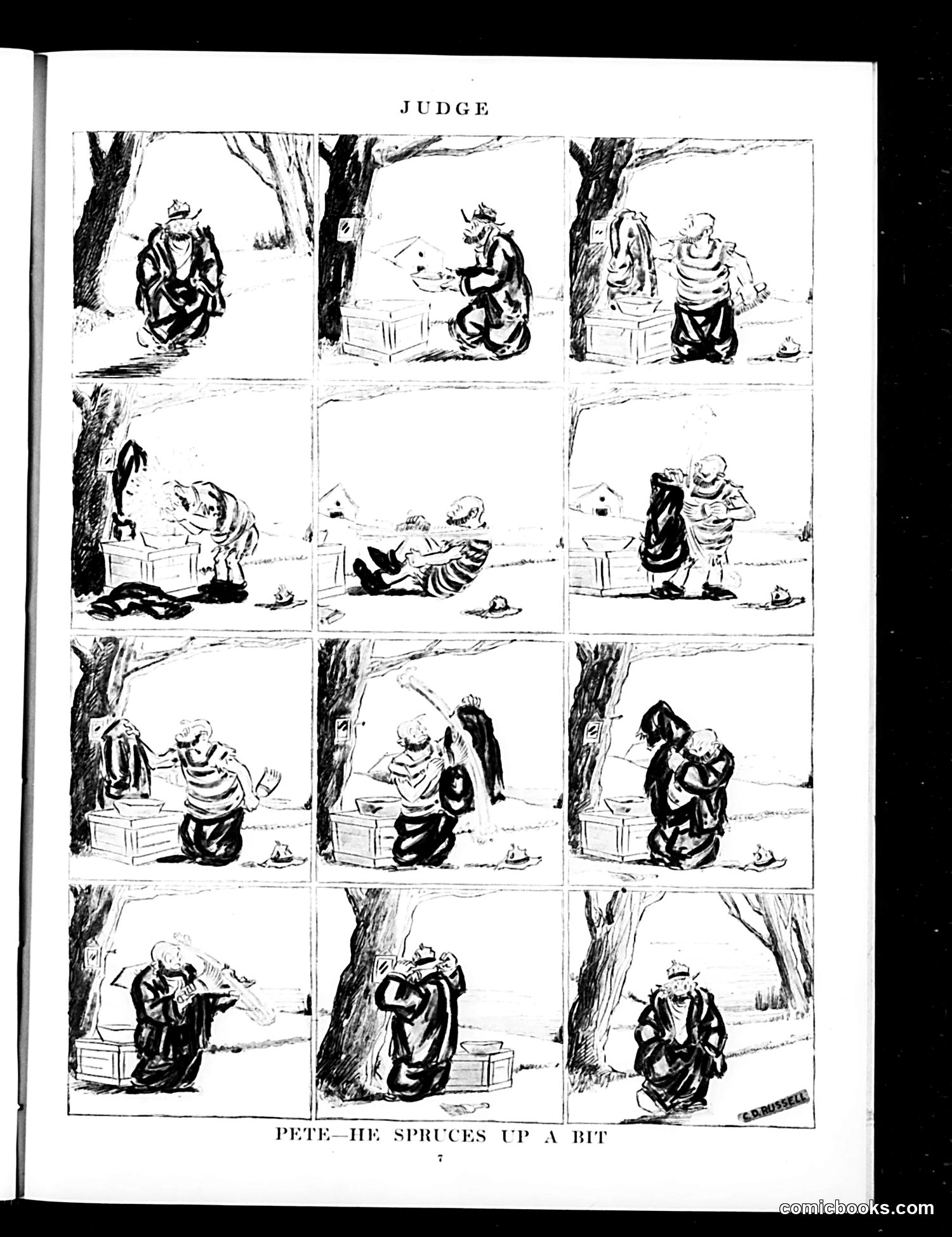
# Analysis This is a 12-panel comic strip titled "Pete—He Spruces Up a Bit" from *Judge* magazine. The panels show a man named Pete gradually improving his appearance and behavior while sitting on a bench near a tree. The narrative appears to show Pete transforming from a slovenly, disheveled figure into a more respectable-looking gentleman through a series of grooming and behavioral adjustments—straightening his clothes, improving his posture, and becoming more presentable. The satire likely comments on self-improvement, social climbing, or the performative nature of respectability—suggesting that Pete is "sprucing up" his outward appearance, possibly to impress someone or gain social acceptance. Without additional context about the specific time period or *Judge*'s editorial stance, the exact satirical target remains unclear, though it appears to mock either vanity or superficial social advancement.
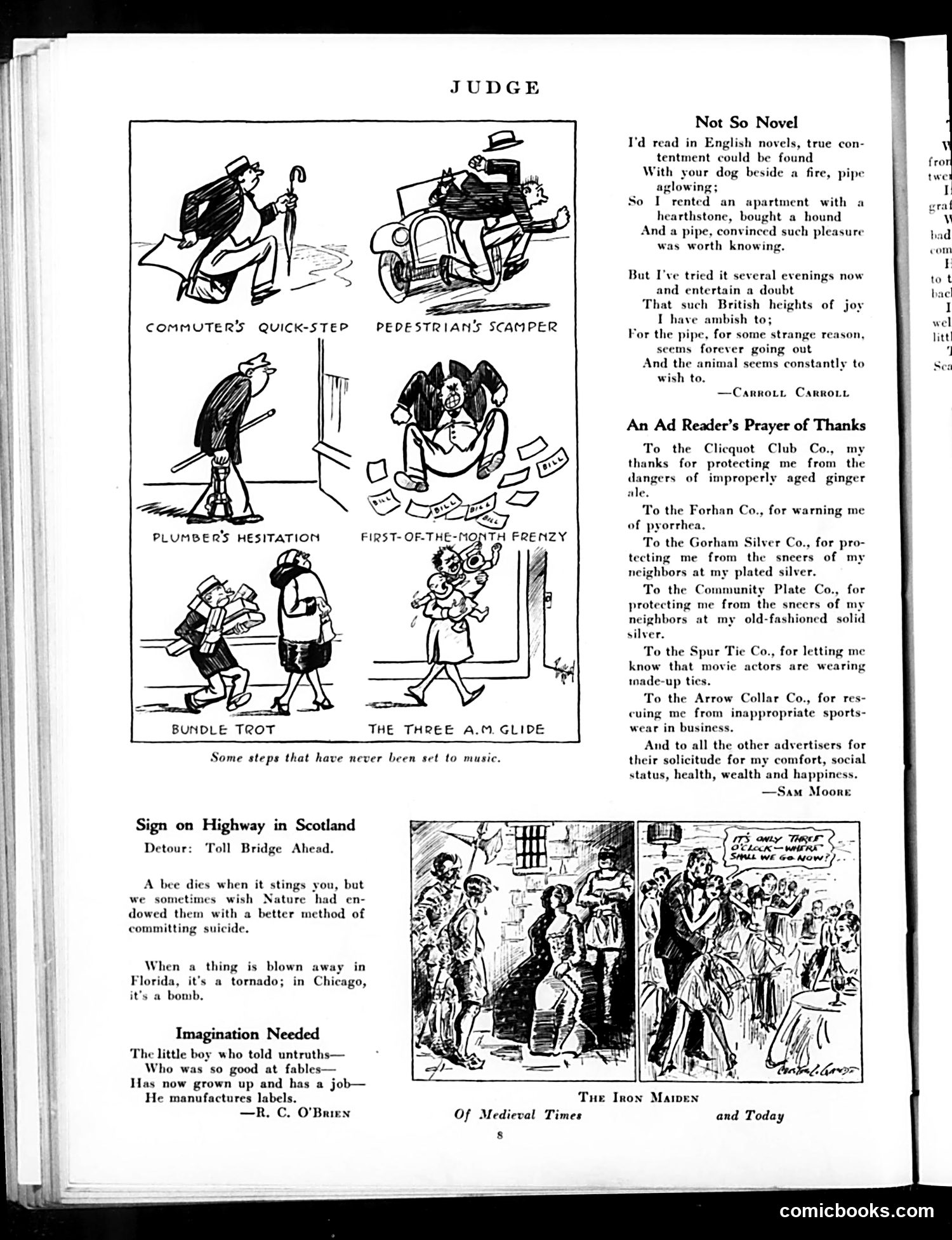
# Analysis of Judge Magazine Page This page contains early 20th-century American humor satirizing modern urban life and advertising culture. **"Some Steps That Have Never Been Set to Music"** is a six-panel cartoon depicting exaggerated walking styles: commuters rushing, pedestrians fleeing, bill collectors frantically pursuing debtors ("First-of-the-Month Frenzy"), plumbers hesitating nervously, and people stumbling home drunk at 3 AM. The humor targets urban workers' hectic lives and financial anxiety. **"Not So Novel"** mocks the romanticized British literary ideal of contentment—a man, dog, and pipe by the fire—revealing reality: the pipe won't stay lit and the dog constantly wants out. It satirizes unrealistic expectations from literature. **"An Ad Reader's Prayer of Thanks"** is satirical commentary on advertising's manipulation. Moore ironically "thanks" various brands for creating artificial social anxieties—anxiety about ginger ale quality, silver plating, dental disease, improper neckwear—that only their products supposedly solve. This critiques how advertising exploits consumer insecurity. The remaining pieces are light political/social commentary on various topics, typical of Judge's satirical approach.
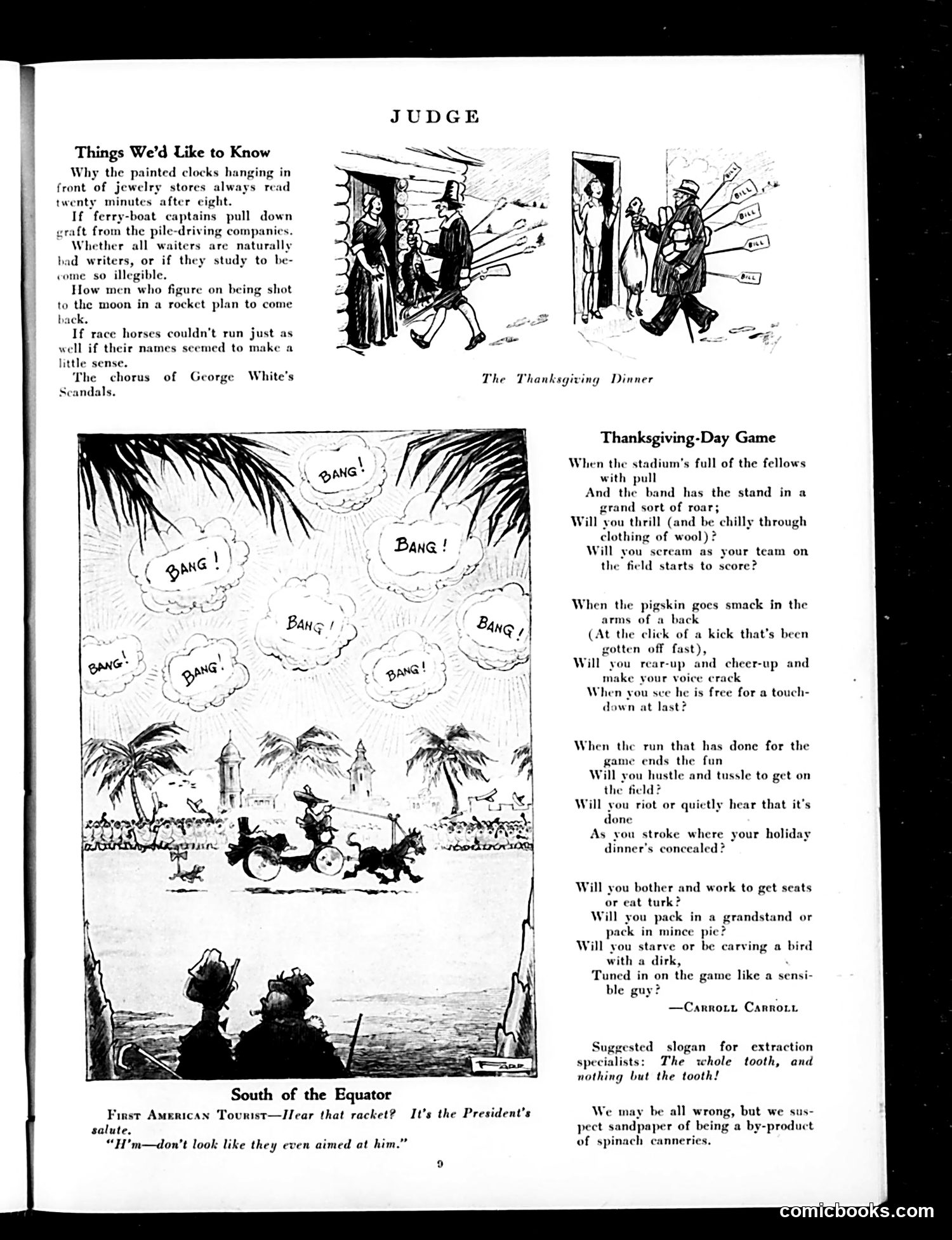
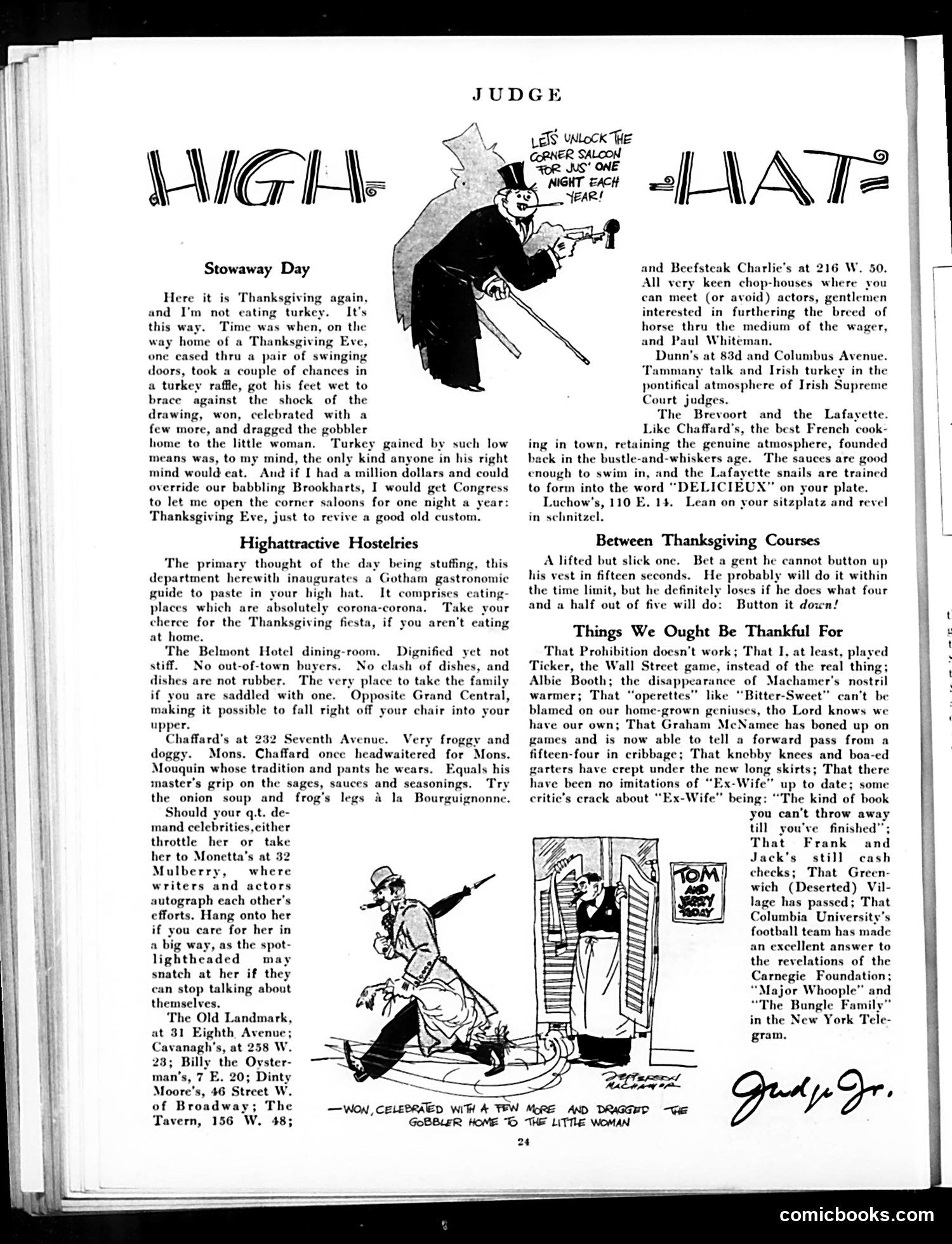
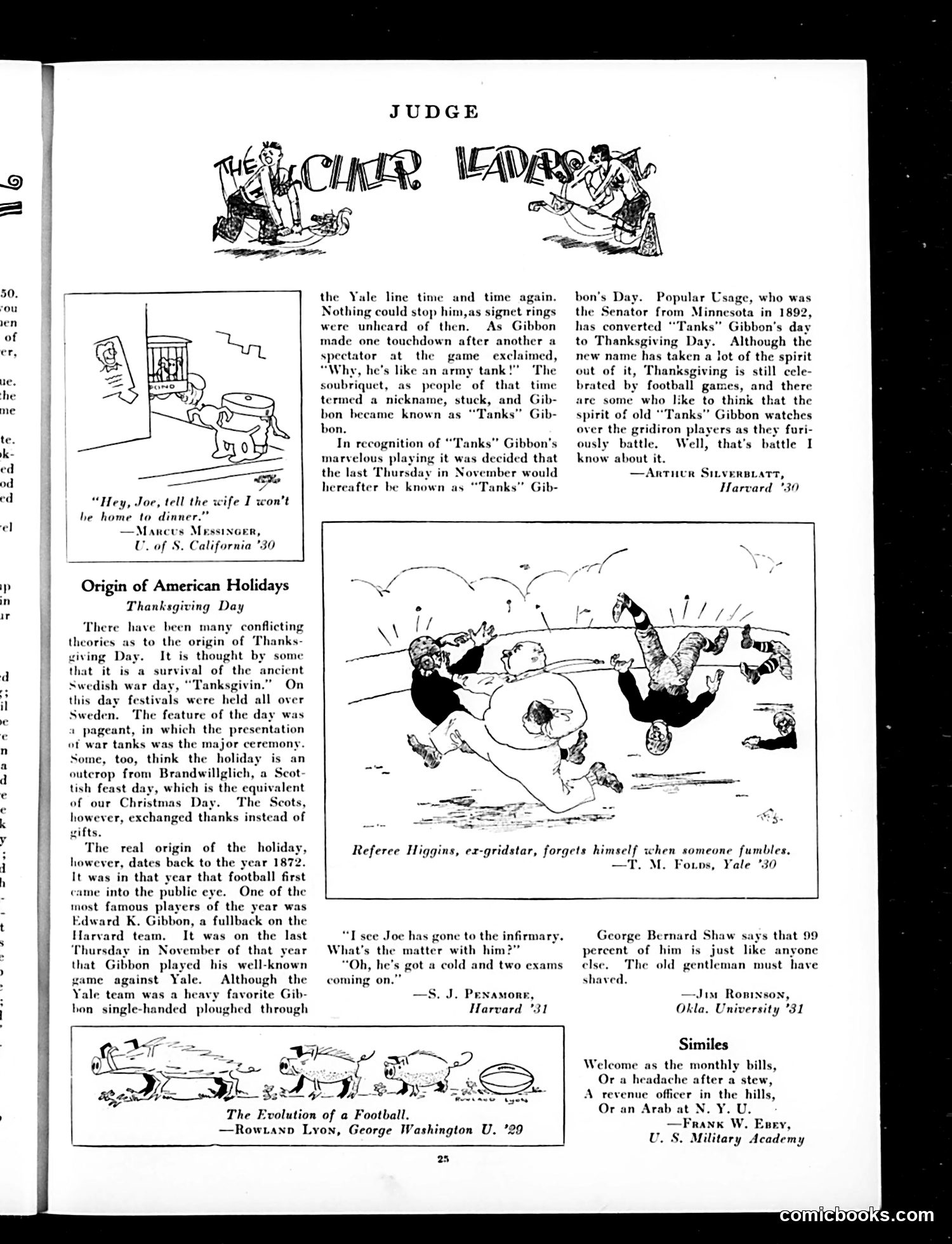
# Judge Magazine Page Analysis This page from Judge contains several satirical pieces targeting American society and politics: **"Things We'd Like to Know"** presents humorous observations about everyday oddities—jewelry store clocks always showing 8:20, illegible waiter handwriting, and absurd racehorse naming conventions. **"Thanksgiving-Day Game"** is a poem by Carroll Carroll satirizing fair-weather football fans, mocking those who attend games for social status ("fellows with pull") rather than genuine enthusiasm, and those who prioritize eating holiday dinner over actually watching the game. **"South of the Equator"** cartoon depicts an American tourist observing gunfire, assuming it's a presidential salute but noting the shots seem poorly aimed—likely satirizing either Latin American political instability or the incompetence of foreign militaries. The final item mocks extraction specialists' advertising slogans, while another brief joke suggests spinach canneries produce sandpaper as a byproduct—pure absurdist humor typical of Judge's style.
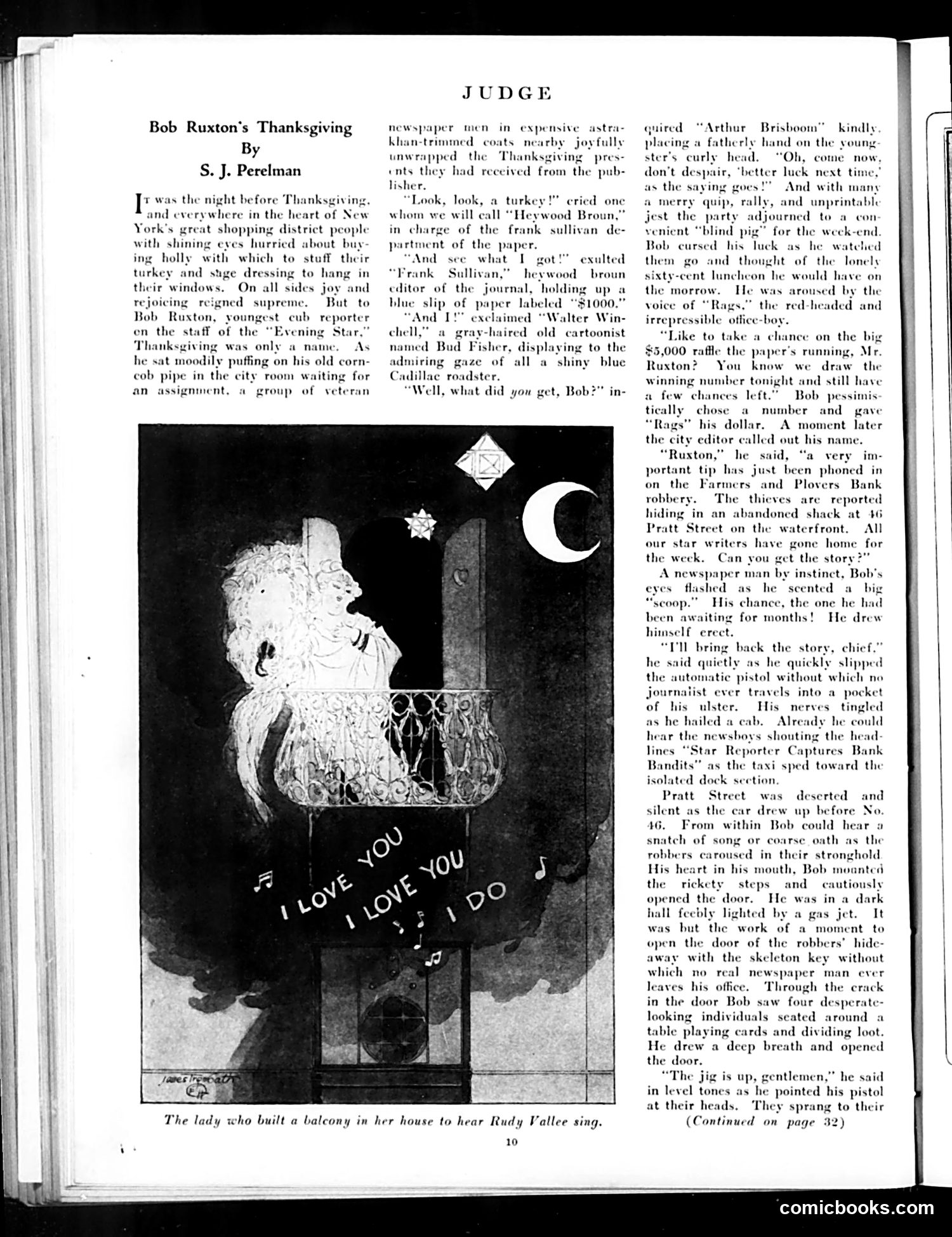
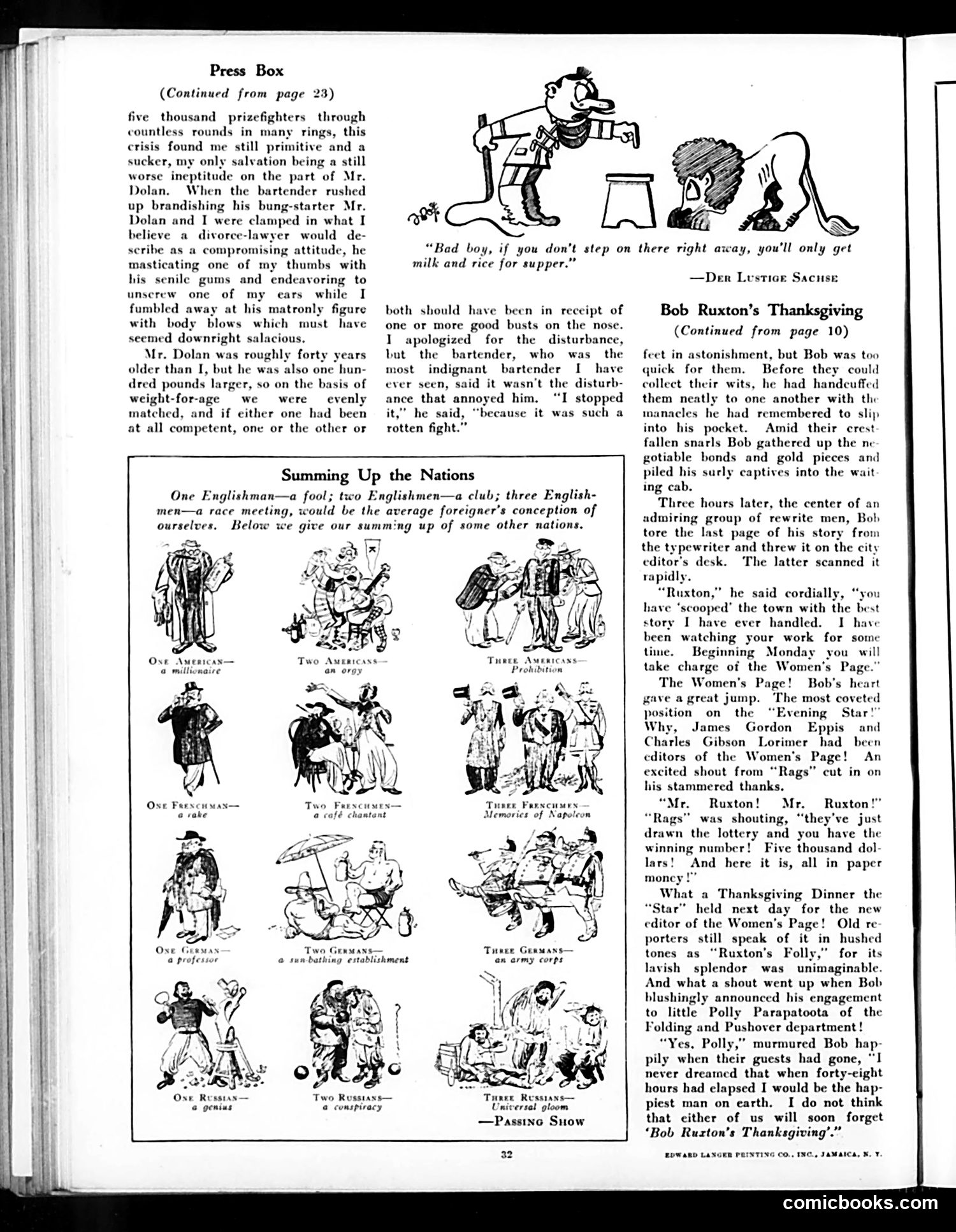
# "Bob Ruxton's Thanksgiving" by S. J. Perelman This is a humorous short story (not primarily a political cartoon) satirizing the newspaper world. The narrative mocks the contrast between established journalists receiving lavish Thanksgiving gifts and young cub reporter Bob Ruxton, who gets nothing. The story references real or fictional newspaper figures of the era: "Heywood Broun," "Frank Sullivan," "Walter Winchell," and "Arthur Brisbane"—prominent journalists whom Perelman playfully names characters after. The illustration shows a woman on a balcony singing along to radio personality Rudy Vallée, contemporary cultural reference. The satire targets newspaper hierarchies and the romanticized "hard-boiled reporter" archetype: Ruxton compensates for his mundane position by pursuing a dangerous bank robbery story solo, armed with a pistol. Perelman gently ridicules both the journalism profession's competitive culture and the era's adventure-story conventions about intrepid newsmen.