
Judge, 1929-11-30 · page 20 of 36
Judge — November 30, 1929 — page 20: what you’re looking at
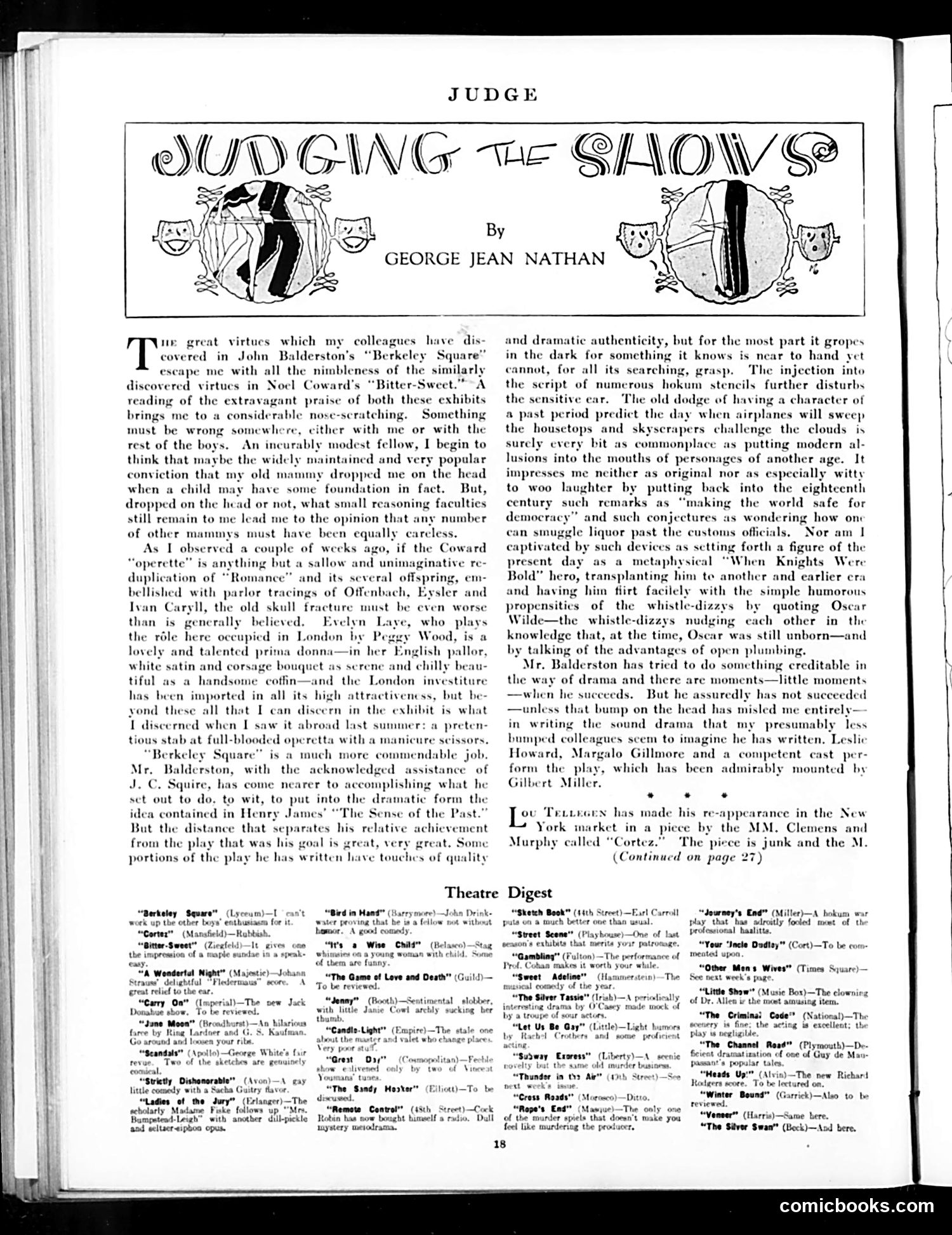
A restored page from Judge, 1929-11-30. Page through the whole issue in the reader above.
📄 Transcribed text from this page (OCR, searchable)
Machine-transcribed from the original scan — historical spelling and the odd misread are preserved.
ne great virtues which my colleagues have dis- | covered in John Balderston’s “Berkeley Square” ape me with all the nimbleness of the similarly discovered virt' n Noel Coward's “Bitter-Sweet.”” A reading of the extravagant praise of both these exhibits brings me to a considerable nose-seratching. Something must be wrong somewhere, cither with me or with the rest of the boys. An incurably modest fellow, I begin to think that maybe the widely maintained and very popular conviction that my old mammy dropped me on’ the head when a child may have foundation fact. But, dropped on the head or not, what small reasoning faculties still remain to me lead me to the opinion that any number of other mammys must have been equally carcless. As I observed a couple of weeks ago, if the Coward “operette” is anything but a sallow and unimaginative re- duplication of “Romance” and its several offspring, em- bellished with parlor tracings of Offenbach, Eysler and Ivan Caryll, the old skull fracture must be even worse than is gencrally believed. Evelyn Laye, who plays the réle here occupied in London by Pi Wood, is lovely and talented prima donna—in her English pallor, white satin and corsage bouquet as serene and chilly beau- tiful as a handsome cotfin—and the London investiture has been imported in all its high attractiveness, but be- yond these all that I can discern in the exhibit is what I discerned when I saw it abroad last summer: a preten- tious stab at full-blooded operetta with a manicure scissors. “Berkeley Square” is a much more commendable job. Mr. Balderston, with the acknowledged assistance of . C. Squire, has come nearer to accomplishing what he set out to do. to wit, to put into the dramatic form the idea contained in Henry James’ “The $ of the Past.” But the distance that separates his relative achievement from the play that was his x great, very great. Some portions of the play he has written have touches of quality some al is Sa erkeley Squi Lyceum) work up the other boys’ enthusiasm for it ‘Cortex (Mansfield)—Rubbish. itter-Sweet” (Zieele It gives © a Wise Child” (Belasco) the impression of a maple sundae in oa a Young woman with chil easy of them are funny “A Wendertal Might” (Majestic) —J: n Straus’ delightful “Fledermaus” score. A rm great relief to the ear. ‘To be reviewed: “dana” (Boot Stag 1. Some “The Game of Love and Death” (Guild) — imental slobber, and dra » but for the most part it gropes in the dark for something it knows is nd yet annot, for all its searching, grasp. The injection into the script of numerous hokum stencils further disturbs the sensitive ear. The old dodge of havin a past period predict the day whe: the housetops and skyscrapers challenge the clouds. is surely every bit as commonplace as putting modern al- lusions into the mouths of personages of another age. It impresses me neither as original nor as especially witty to woo laughter by putting back into the eighteenth century such remarks as “making the world safe for demoe nd such conjectures as wondering how one can smuggle liquor past the customs officials, Nor am 1 captivated by such devices as setting forth a figure of the present day as a metaphysical “When Knights Were Bold” hero, transplanting him te another and earlier era and having him flirt facilely with the ppensities of the whistle-dizzys by quoting Oscar Je—the whistle-dizzys nudging each other in the Ige that, at the time, Oscar was still unborn—and by talking of the advantages of open plumbing. Mr. Balderston has tried to do something creditable in y of drama and there are moments—little moments eds. But he assuredly has not succeeded s that bump on the head has misled me entirely— in writing the sound drama that my presumably bumped colleagues scem to imagine he has written. Leslic Howard, Margalo Gillmore and a competent cast per- form the play, which has been admirably mounted by Gilbert Miller. a character of airplanes will sweep simple humorous —unle * * . x has made rket Murphy called his re-appearance in the New in a piece by the MM. Clemens and “Cortez.” The piece is junk and the M. (Continued on page 27 Digest “Sketch Book™ (141! much better “Steet Scone’ (Playhouse) —One of feet) —Earl Carroll than usual. “Journey's End” (Miller)— n war play that has sdroitly footed mist of th professional haalitta “Your ‘“Incle Dadiey” meated wpoa, “Other See next week's ‘Little Shaw"* (Music Bor)—The clowning Allen i the most amusing item. (Cort)—To be cor ton) —The perf worth you al comedy of the year Wives” (Times Square)— (Imperial\—The ew Jack T Go around “Scandals” aT 1y, Dishonorable”” (Avon)—\ gay y with a Sacha Guitry flavor “Ladies ofthe dary (Erlanger) —The scholarly Madame Fiske follows y Bampstend-Leigh” with another di and eeltser-eipboo opus. pals sucking ber ‘Candle-Light"* (Empire) —The sta about na and valet who Very pr “Grext Oa/" thow ealivened ¢ Yourmans The $25 discuwed. “Remote Contre!” (45th Robin has t himeelf a uystery merolrama. way Exoress” (Liberty) —A scene tat the same old murder bus “Thunder in ty> Ab” Eilictt)—To be nett week's imue. “Cress Reads" (Mormeo)—Ditio, eet) Cork “Rape's End” (Masjue)—The Dull of the murder spiels that doren’t make yo feel like murdering the producer. rh 8 y Hooker? 18 The Criminai Code (National)—The scenery is fine: the acting is excellent; the play w negligibie, “The Channel Read” (Plymouth)—De feient draimatization of one of Guy de Mau- ppular tales, (Alvin)—The pew Richard reviewed “Veneer” (Harris) —Same bere. “The Sitver Swan” (Bock)—And bere. comicbooks.com