
Judge, 1929-11-30 · page 23 of 36
Judge — November 30, 1929 — page 23: what you’re looking at
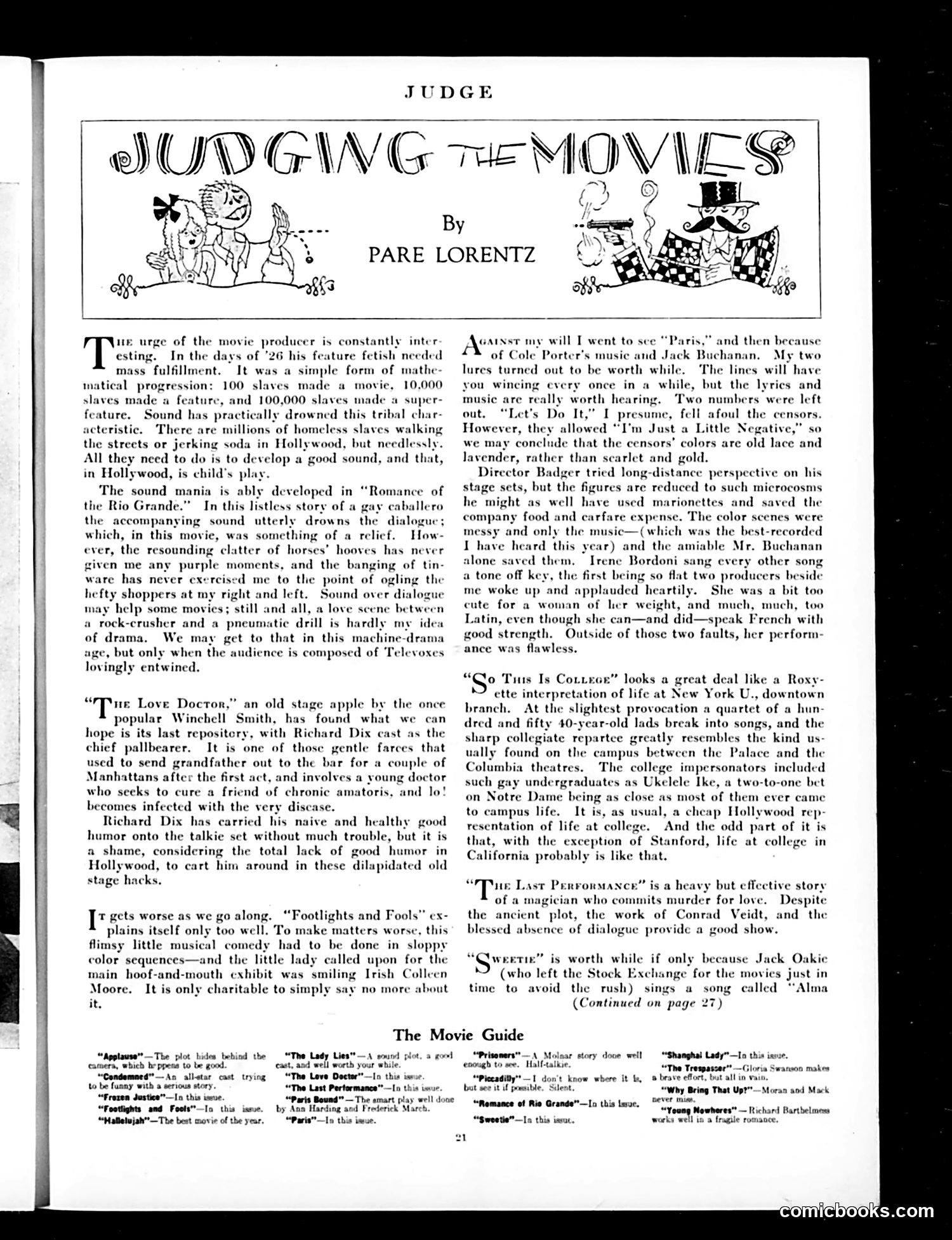
A restored page from Judge, 1929-11-30. Page through the whole issue in the reader above.
📄 Transcribed text from this page (OCR, searchable)
Machine-transcribed from the original scan — historical spelling and the odd misread are preserved.
JUDGE THe Mi tOW TE mm. urge of the movie producer is constantly inter | esting. In the days of '26 his feature fetish needed mass fulfillment. It was a simple form of mathe- matical progression: 100 slaves made a movie, 10,000 slaves made a feature, and 100,000 slaves made a super- feature. Sound has practically drowned this tribs acteristic. There are millions of homeless slaves the streets or jerking soda in Hollywood, but n All they need to do is to develop a good sound, and th: ut, in Hollywood, is child’s play. The sound mania is ably developed in ‘Rom. the Rio Grande.” In this listless story of a gay nee of the accompanying sound utterly drowns the dialogue which, in this movie, was something of a r How- ever, the resounding clatter of horses’ hoov s never given me any purple moments, and the b: ware has never exercised me to the point of ogling the hefty shoppers at my right and left. Sound over dialogue may help some movies; still and all, a love scene between a rock-crusher and a pneumatic drill is hardly my idea of drama. We rn hine-drama age, but only when the audience is composed of Televoxes lovingly entwined. ng of tin- an old stage apple by the once ad Mats Love Doctor,” popular Winchell Smith, has found what we can hope is its last repositery, with Richard Dix tas the chief pallbearer, It is of those gentle farces that used to send grandfather out to the bar for a couple of Manhattans after the first act, and involves a young doctor who seeks to cure a friend of chronic amatoris, and lo! becomes infected with the very disease. Richard Dix has carried his naive and healthy good humor onto the talkie set without much trouble, but it is a shame, considcring the total lack of good humor in Hollywood, to cart him around in these dilapidated old stage hacks, [gets worse as we go along. “Footlights and Fools” ex- plains itself only too well. To make matters worse, this flimsy little musical comedy had to be done in sloppy color sequences—and the little lady called upon for the main hoof-and-mouth exhibit was smiling Irish Colleen Moore. It is only charitable to simply say no more about “Applause’*—The plot hides behind the camera, which br ppens to be good. “Condemned” —An alletar cast trying to be funny with a serious story. “Frozen Justice™—In this inne. “Footlights and Foels"—Io this isme. “Hallelujah” —The beat movie of the year. “Paris” —In this imue. The Movie Guide und then because Buchanan. My two ‘The lines will have but the lyrics and Acatser my will I went to sce “ of Cole Porter's music and Jac lures turned out to be worth while. you wincing every once in a while, music are really worth hearing. Two numbers were left out. “Let's Do It,” I presume, fell afoul the censors. However, they allowed “I'm Just a Little Negative,” so we may conclude that the censors’ colors are old lace and lavender, rather than scarlet and gold. Director Badger tried long-distance perspective on his stage sets, but the figures are reduced to such microcosms he might as well have used marionettes and saved the company food and carfare expense. TH messy and only the music—(wh I have heard this year) and the amiable Mr. Buchanan alone saved them. Irene Bordoni sang every other son, a tone off key, the first being so flat two producers beside me woke up and applauded hed She was a bit too cute for a woman of her weight, and much, much, too Latin, even though she can—and did—speak French with good strength. Outside of those two faults, her perform- ance was flawless. color scenes were the best-recorded “Se Tins Is Correce” looks a great deal like a Roxy- 7 ette interpretation of life at New York U., downtown branch. At the slightest provocation a quartet of a hun- dred and fifty 40-year-old lads break into songs, and the sharp collegiate repartee greatly resembles the kind us- n the Pa and the theatres. The college impersonators included such gay undergraduates as Ukelele Ike, a two-to-one bet on Notre Dame being as close as most of them ever c: to campus life. It is, as usual, a c! resentation of life at college. And the odd part of it is that, with the exception of Stanford, life at college in California probably is like that. me p Hollywood rey 116 Last Perrormance” is a heavy of a magician who commits murder for love. Despite the ancient plot, the work of Conrad Veidt, and the blessed absence of dialogue provide a good show. but effective story 12” is worth while if only because Jack Oakie (who left the Stock Exchange for the movies just in time to avoid the rush) sings a song called “Alma (Continued on page 27) “Prisoners” enough to see. iy" but see it if posible, A Molnar story dove well Half-talkie. “The Trespascer’” —G t know where it fe, a brave effort, but all i ent, “Why Bring That Up?”—Moran and Mack “Romance of Rie Grande”—In this lsu, ST “Ye “Sweetie” —In this imuc. works wel Swanson makes yaheres” — Richard Bartbelmas 0. a fragile romance,