
A complete issue · 37 pages · 1929
Judge — June 29, 1929
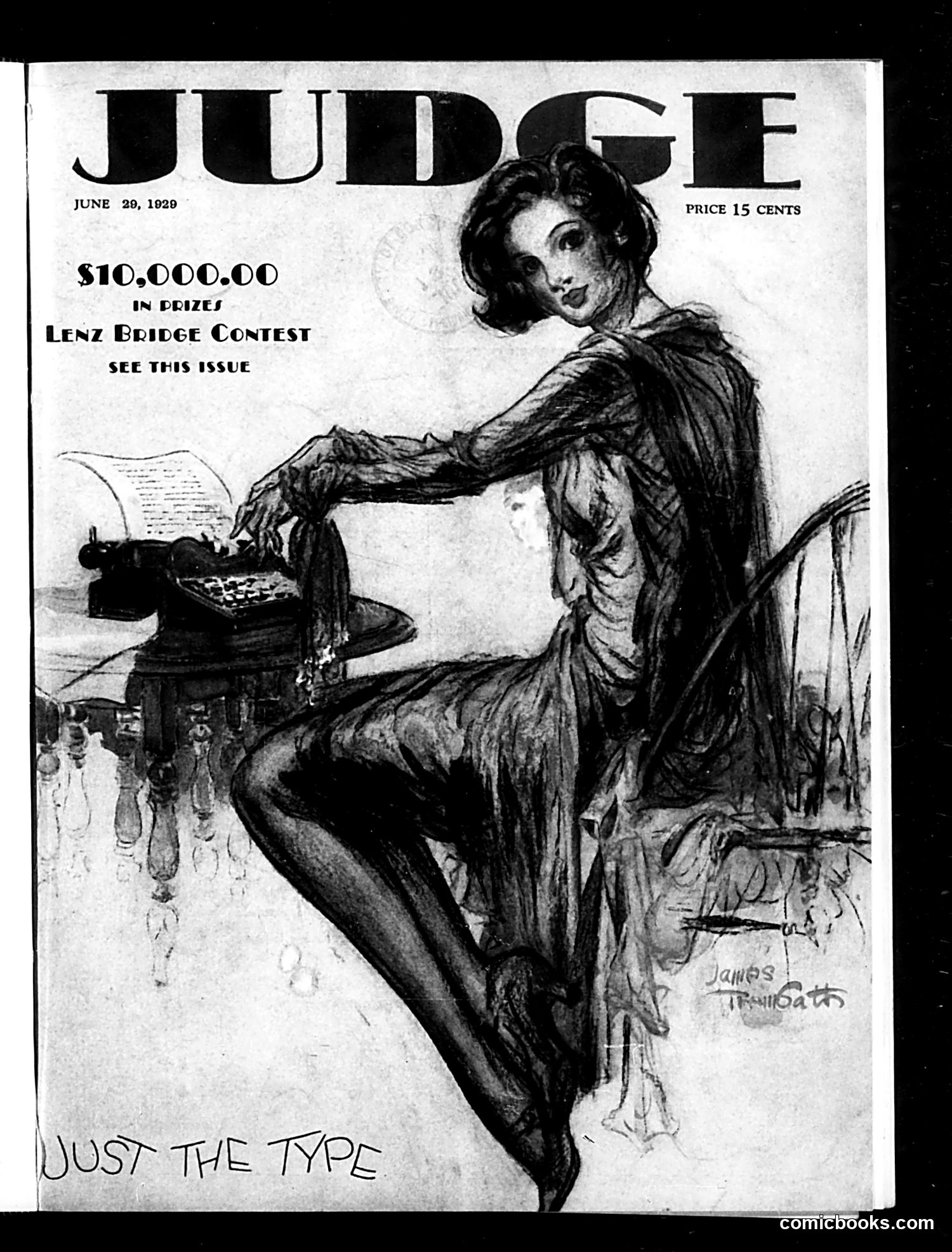
This cover features an illustration titled "Just the Type" by James Montgomery Flagg, a renowned satirical artist. The image depicts a glamorous woman at a typewriter, styled in 1920s fashion with flowing fabric and dramatic pose. The caption's double meaning suggests commentary on modern femininity and gender roles—"the type" references both her appearance as a desirable woman and her literal use of the typewriter, a relatively new workplace tool for women in this era. The cover also advertises a "$10,000.00 in Prizes Lenz Bridge Contest," indicating the magazine's mixed content of satire, humor, and competitions. Published at 15 cents, this reflects Judge's role as popular satirical entertainment for middle-class Americans during the Jazz Age, just months before the 1929 stock market crash.
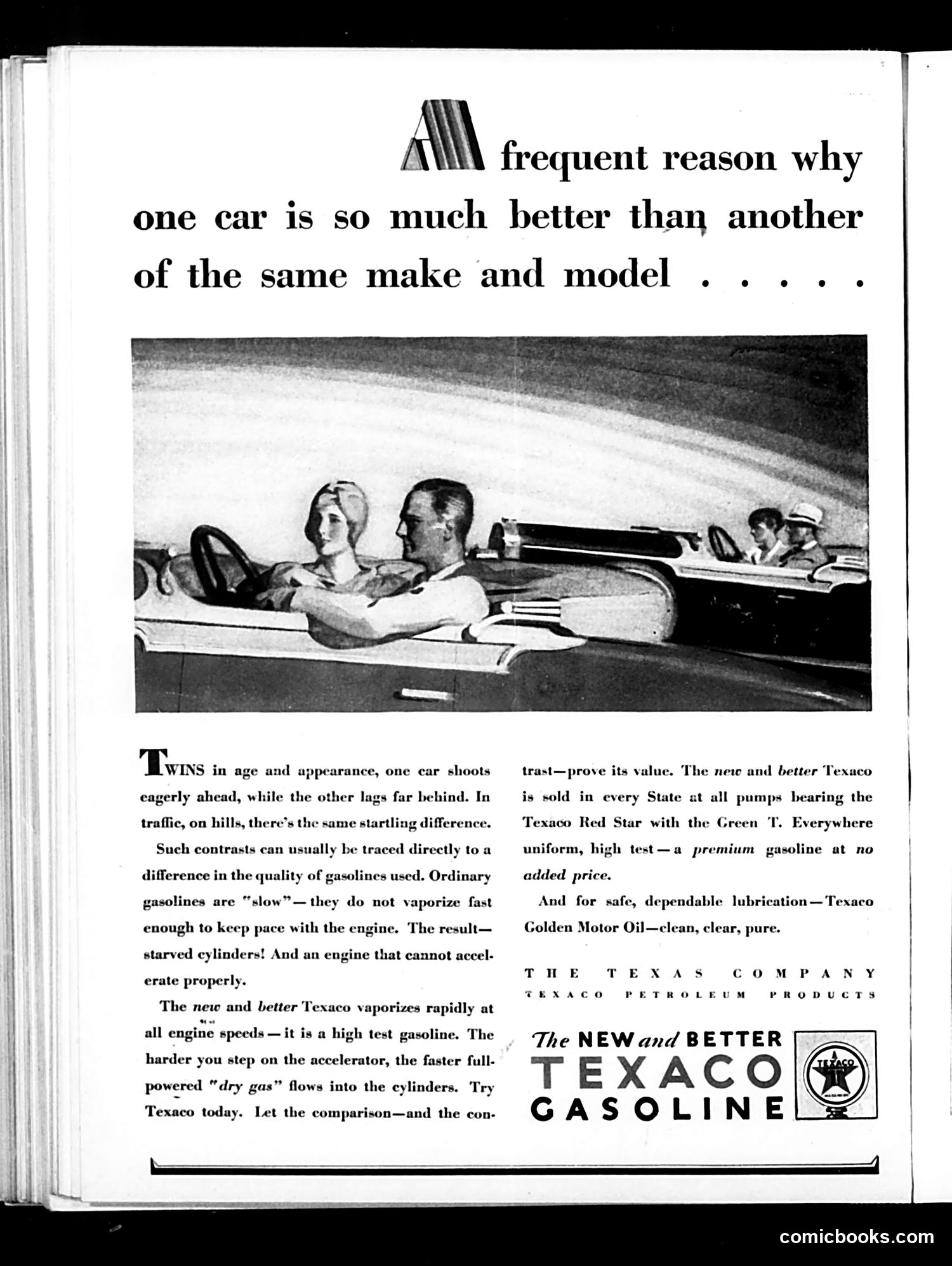
This is **not a cartoon or satire page** — it's a straightforward **Texaco gasoline advertisement** disguised in editorial format. The image shows two convertibles side-by-side, illustrating the headline's claim that identical car models perform differently due to gasoline quality. The "twins in age and appearance" metaphor uses one car lagging behind another to demonstrate why Texaco's premium gasoline supposedly performs better. The text argues that ordinary gasoline vaporizes slowly, starving engine cylinders, while Texaco's higher-test fuel burns faster and more completely, enabling better acceleration and power. The ad promotes Texaco's Red Star gasoline and Golden Motor Oil as premium products at no added price. This is **commercial advertising**, not political or social satire — typical of how early 20th-century ads often mimicked editorial content for credibility.
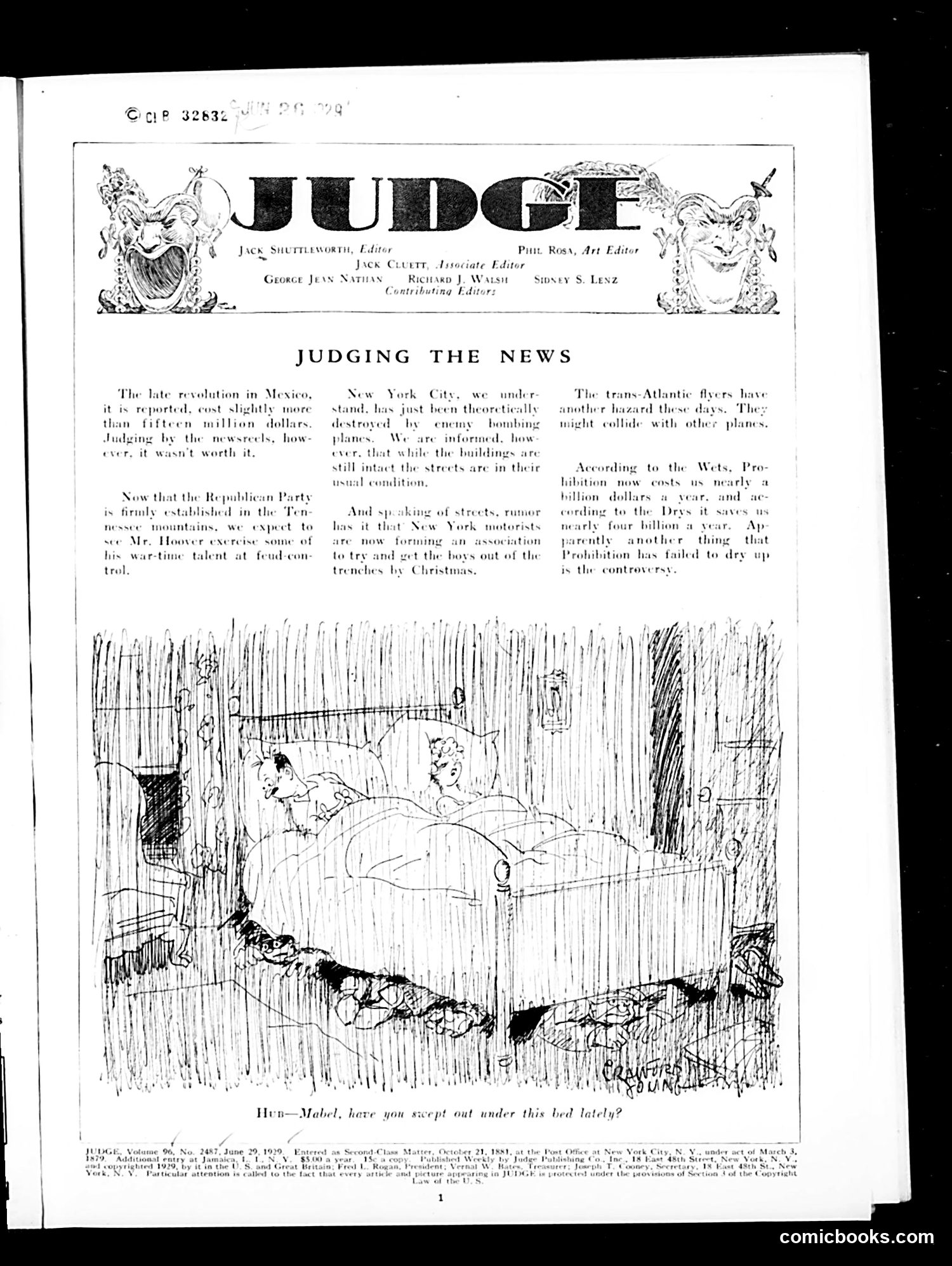
This is a satirical cartoon from Judge magazine (June 29, 1929) titled "Judging the News." The main cartoon depicts a couple in bed, with the husband asking "Hub—Mabel, have you swept out under this bed lately?" The humor satirizes domestic life during Prohibition era America. The visual joke suggests hidden contraband alcohol ("swept out under this bed"), referencing how Americans illegally concealed liquor despite the nationwide alcohol ban (1920-1933). The cartoon implies that even in intimate domestic spaces, Prohibition's effects created absurd situations where husbands joked about their wives' housekeeping being inadequate—or suspiciously convenient for hiding illegal substances. The accompanying text discusses various news items including Mexican revolution, Republican politics, and New York City street conditions, typical of the magazine's commentary format.
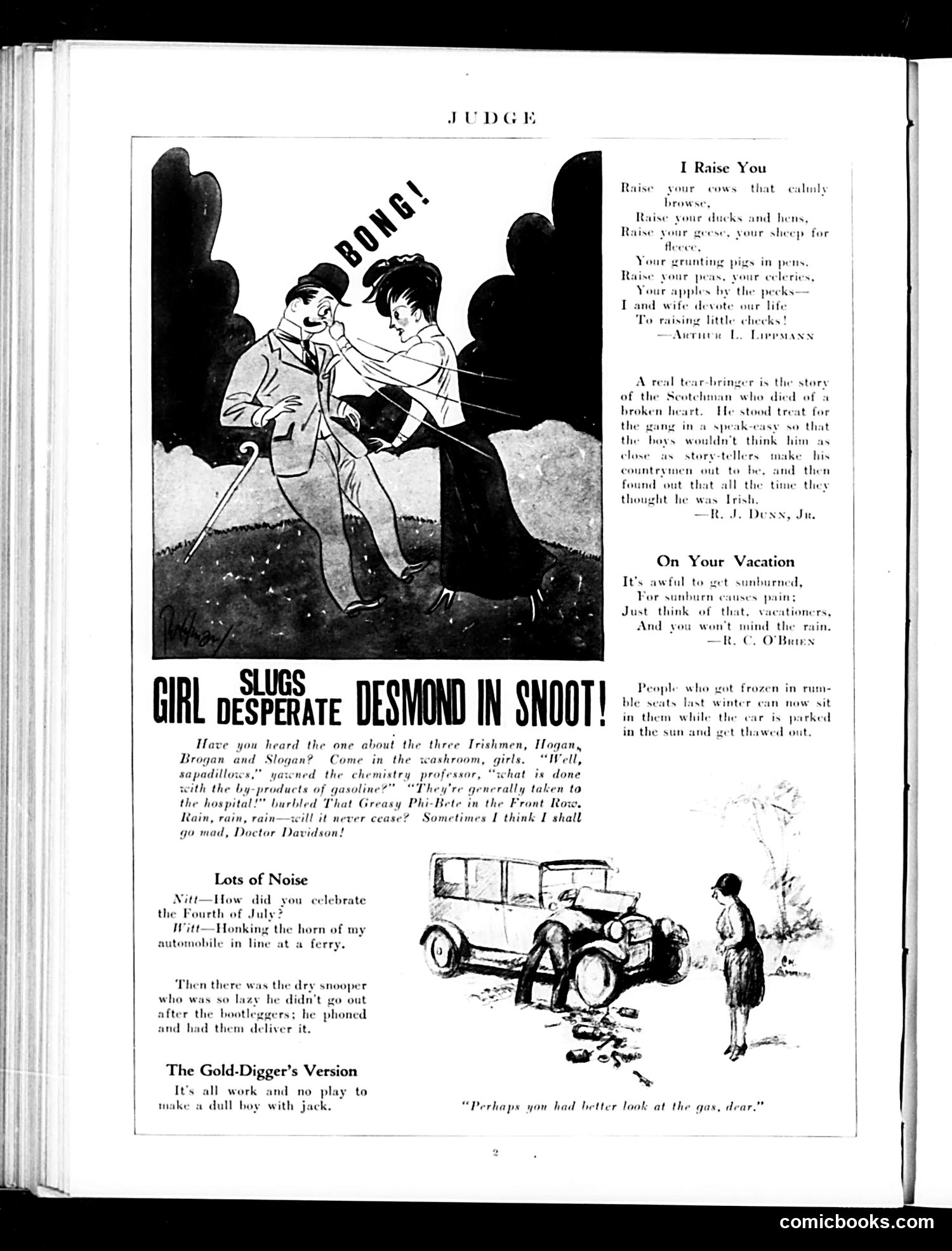
This page contains humor pieces and light verse rather than political cartoons. The main illustrated feature, "Girl Slugs Desperate Desmond in Snoot!," shows a comedic scene of a woman hitting a man with a "BOING!" sound effect—typical slapstick humor of the era. The accompanying text references Irish names (Hogan, Brogan, Sloan) in a washroom scene, suggesting ethnic humor common to the period. Other pieces like "On Your Vacation" and "Lots of Noise" are brief humorous observations about everyday life. The bottom cartoon depicts a broken-down automobile with the caption "Perhaps you had better look at the gas, dear"—a domestic comedy piece playing on early automobile ownership anxieties. Overall, this is general-audience humor rather than political satire.
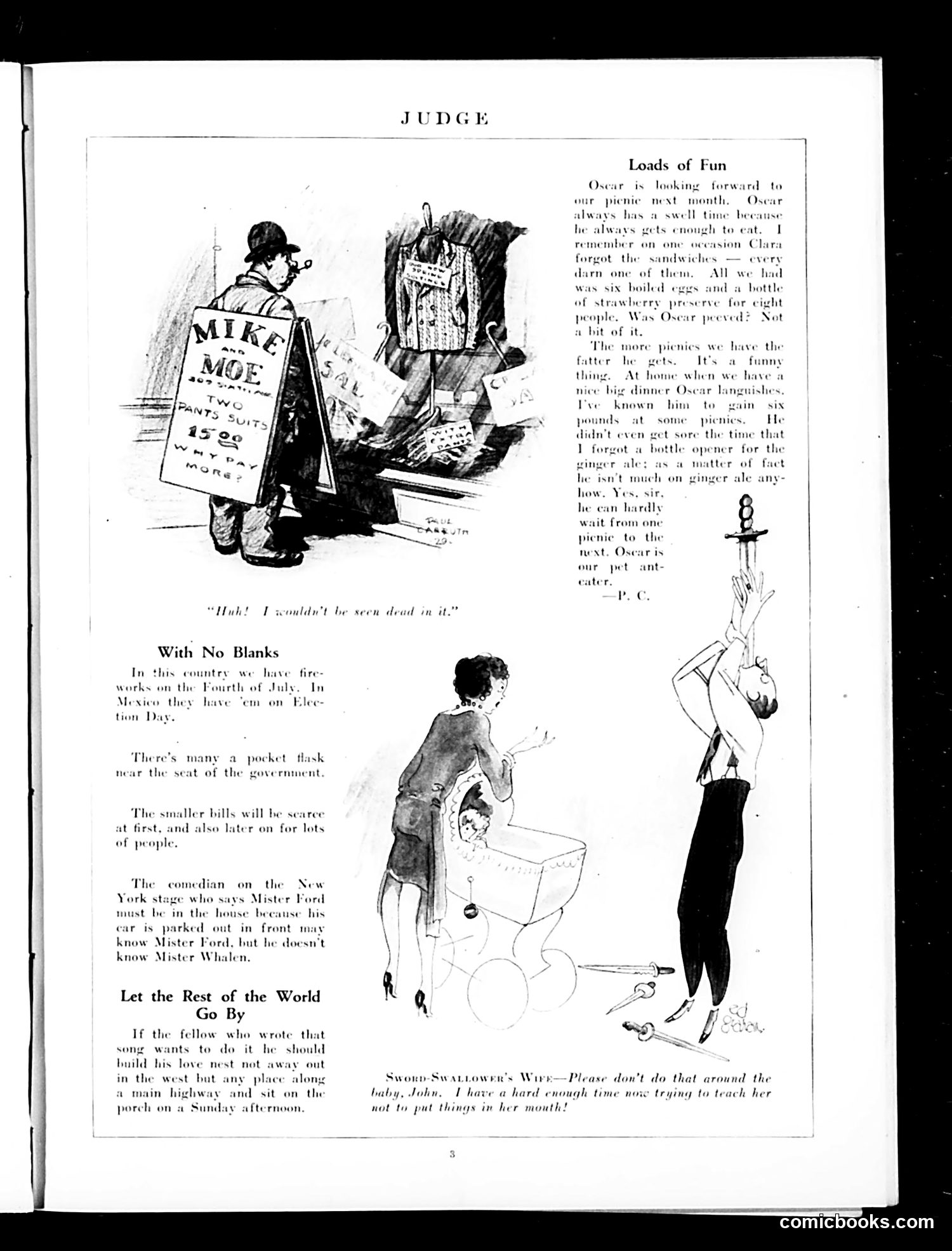
This page contains three separate humor pieces: **"Loads of Fun"** features a man labeled "MIKE and MOE" carrying picnic supplies. The joke criticizes Oscar (likely a pet) for eating everything at picnics, including sandwiches and ginger ale, making him unreliable for future outings. **"With No Blanks"** offers brief observational humor about Fourth of July and Election Day fireworks, pickpockets near government buildings, and a anecdote about a comedian on the New York stage who confuses Mr. Ford (likely Henry Ford) with Mr. Whalen. **"Let the Rest of the World Go By"** satirizes someone who wants to perform a song while avoiding highway traffic—suggesting impractical romantic notions. The final cartoon shows a woman with a baby carriage and acrobatic figure, captioned about a "Sword-Swallower's Wife" concerned about teaching her baby not to put things in its mouth.
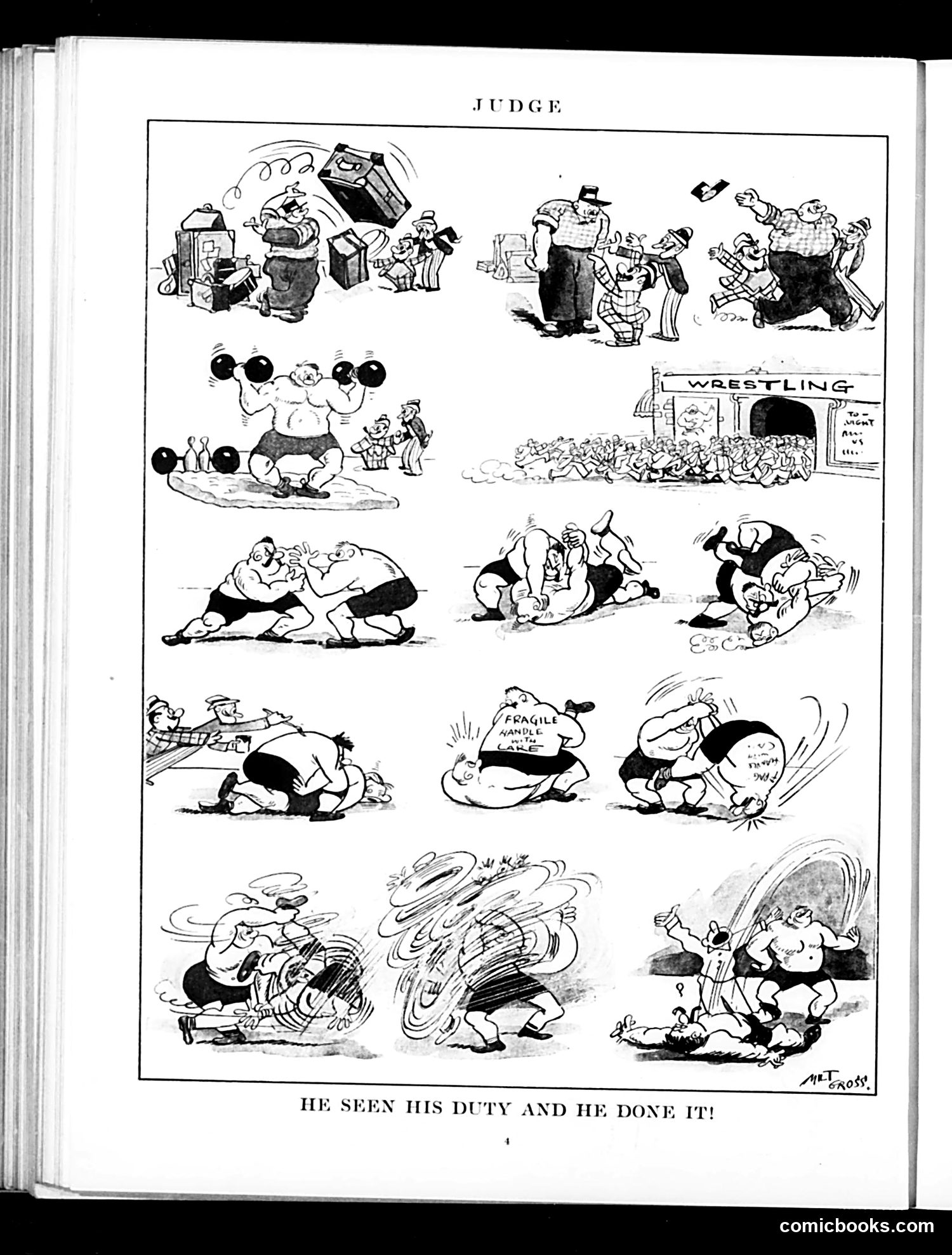
This page titled "He Seen His Duty and He Done It!" depicts a judge performing various physical tasks—hauling luggage, wrestling, lifting weights, boxing, juggling, and general acrobatics. The satire appears to criticize a judge who has abandoned his proper judicial role to engage in circus-like or manual labor activities. The cartoon likely comments on judicial overreach or a specific judge's involvement in inappropriate activities outside courtroom duties. The "Wrestling" tent sign visible in one panel suggests the judge has literally entered entertainment venues rather than maintaining dignity. The exaggerated physical comedy emphasizes the absurdity of a magistrate performing such undignified work, satirizing either a real judicial scandal or general concerns about judicial conduct and propriety in the early 20th century.
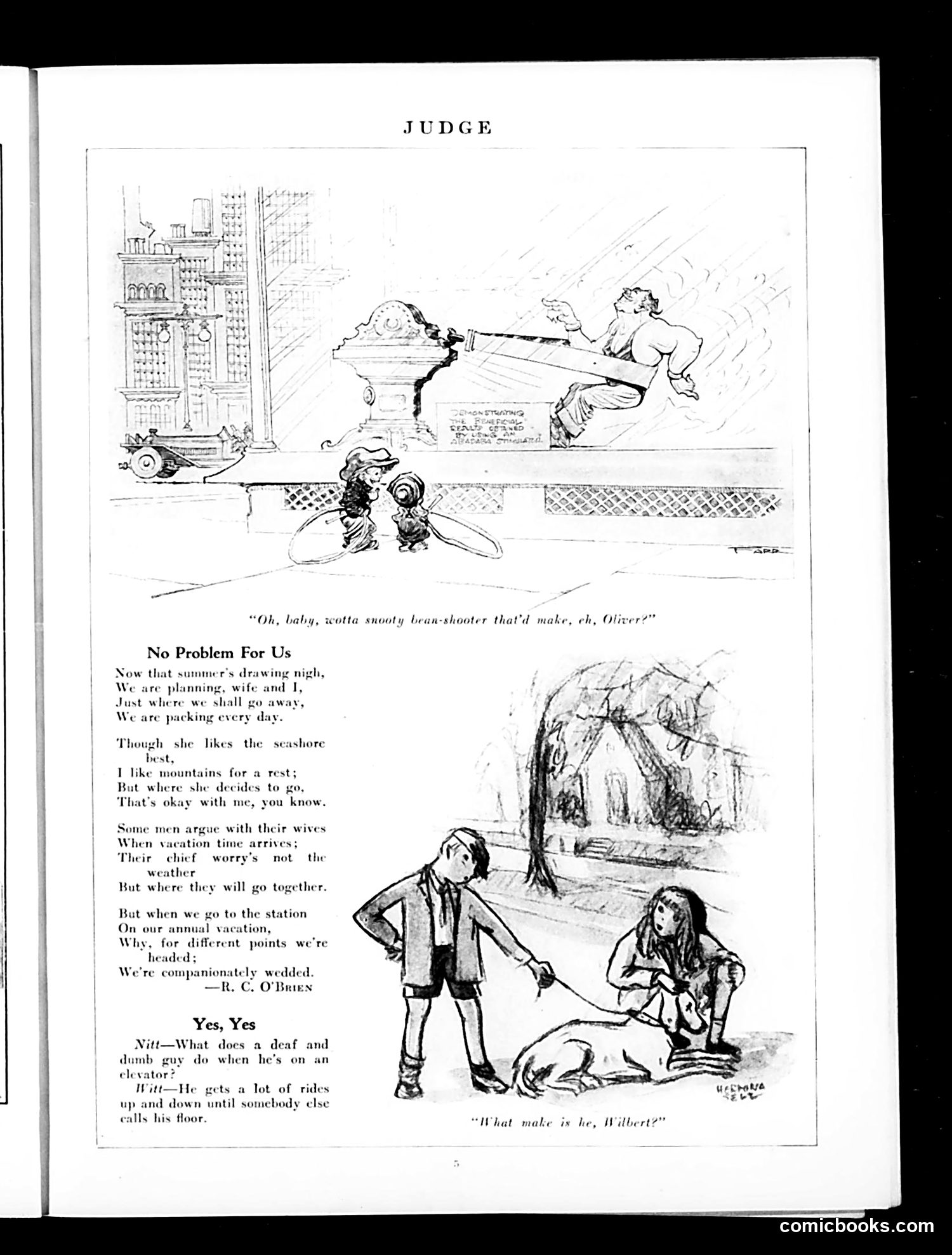
This page contains three separate humorous pieces typical of early 20th-century Judge magazine: **Top cartoon**: Shows a cherub or cupid figure kicking a judge off his bench, with the caption suggesting romantic entanglement interfering with judicial duties—satirizing how personal relationships can compromise professional judgment. **"No Problem For Us"**: A poem by R.C. O'Brien about married couples disagreeing on vacation destinations. The accompanying sketch shows a husband and wife with a dog, illustrating marital compromise during vacation planning. The humor lies in the relatable domestic conflict over where to spend time off. **"Yes, Yes"**: A brief joke contrasting deaf/mute people's directness (calling elevators by knocking repeatedly) with hearing people's passivity (waiting for someone else to call). It's likely an attempt at humor through disability observation, though by modern standards it reads as dated and potentially offensive.
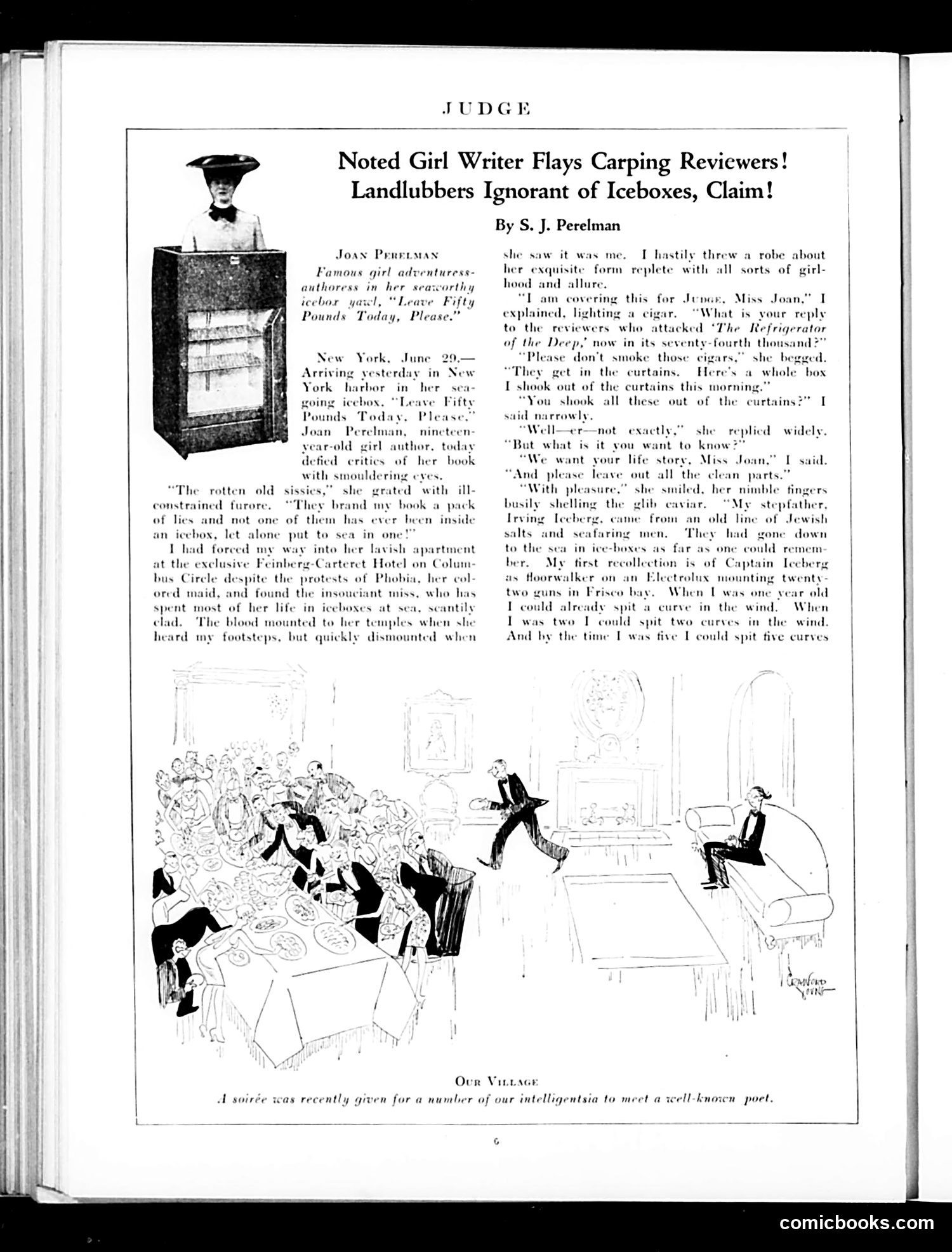
This satirical piece by S.J. Perelman mocks literary criticism and the pretensions of both young writers and their reviewers. The article features **Joan Perelsman**, a 19-year-old girl author who attacks critics of her book "Leave Fifty Pounds Today, Please" by arriving at their offices with an icebox—literally delivering "cold" reviews back to them. The humor operates on multiple levels: it satirizes precious young writers, the harshness of book reviewers, and the absurdity of literal interpretations of figurative language. The accompanying cartoon depicts an intellectual gathering disrupted by this literal delivery, suggesting the chaos caused by her unconventional protest. The piece parodies both literary pretension and the gendered dynamics of criticism in 1920s publishing.
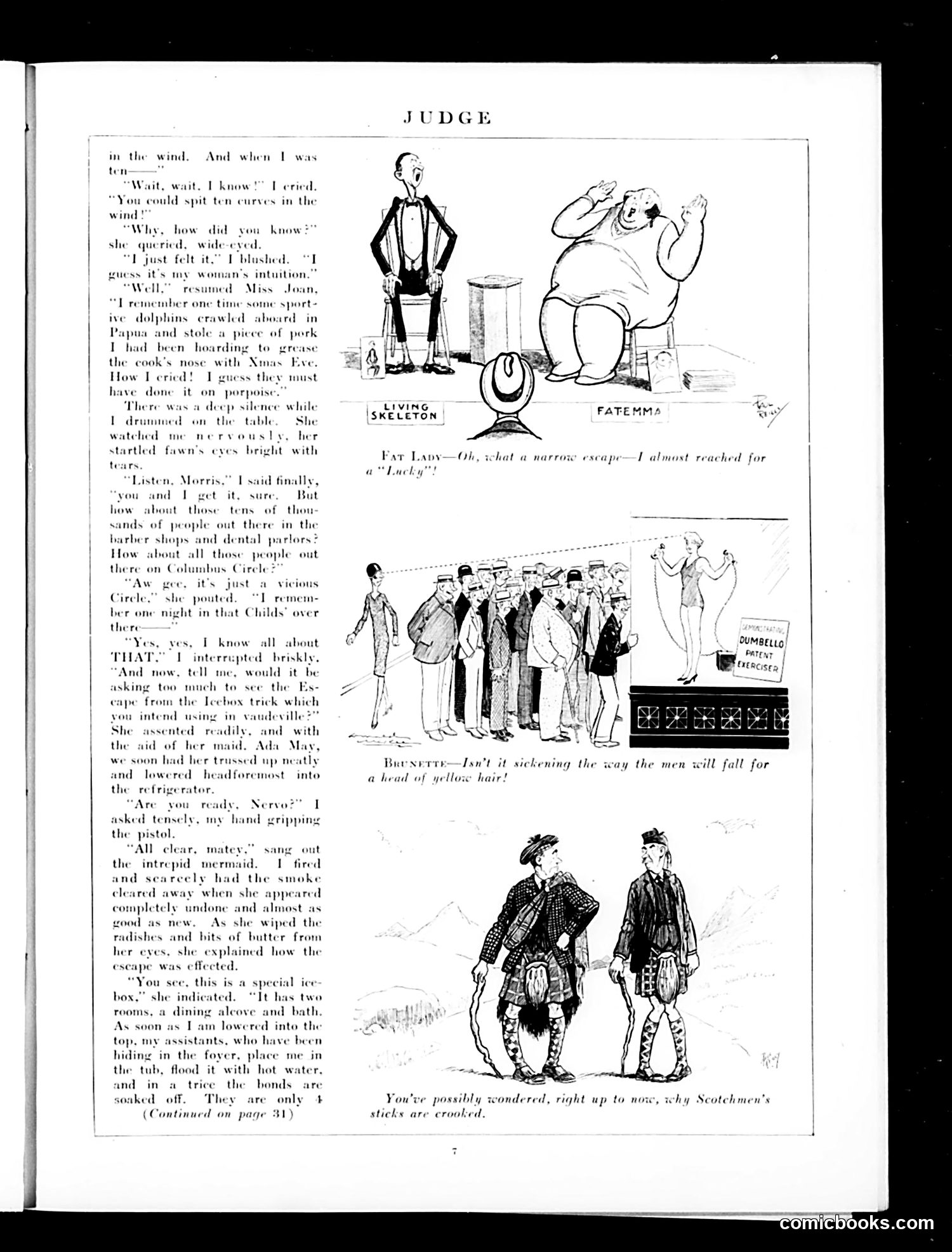
This page from *Judge* magazine contains a satirical story about a magician or vaudeville performer and her escape act, accompanied by cartoon illustrations mocking dated stereotypes. **The Main Story:** A man describes a female performer (possibly named Joan or a stage character) who performs an elaborate escape trick involving being locked in a refrigerator. The narrative is deliberately absurd—she tells rambling anecdotes about dolphins stealing pork, and the escape involves hidden assistants and hot water to loosen bonds. It's satirizing both vaudeville performance culture and women's supposedly illogical thinking ("woman's intuition"). **The Cartoons:** - "Living Skeleton" and "Fat Lady" mock sideshow attractions - "Brunette" cartoon jokes about men being attracted to blonde hair - Two Scotsmen with "crooked sticks" (golf clubs) reference ethnic stereotypes about Scottish golfers **The Satire:** The piece mocks early 20th-century entertainment spectacle, absurd escape artistry, and perpetuates crude gender and ethnic caricatures typical of *Judge's* era—humor that relied on mockery of women, immigrants, and carnival/vaudeville culture.
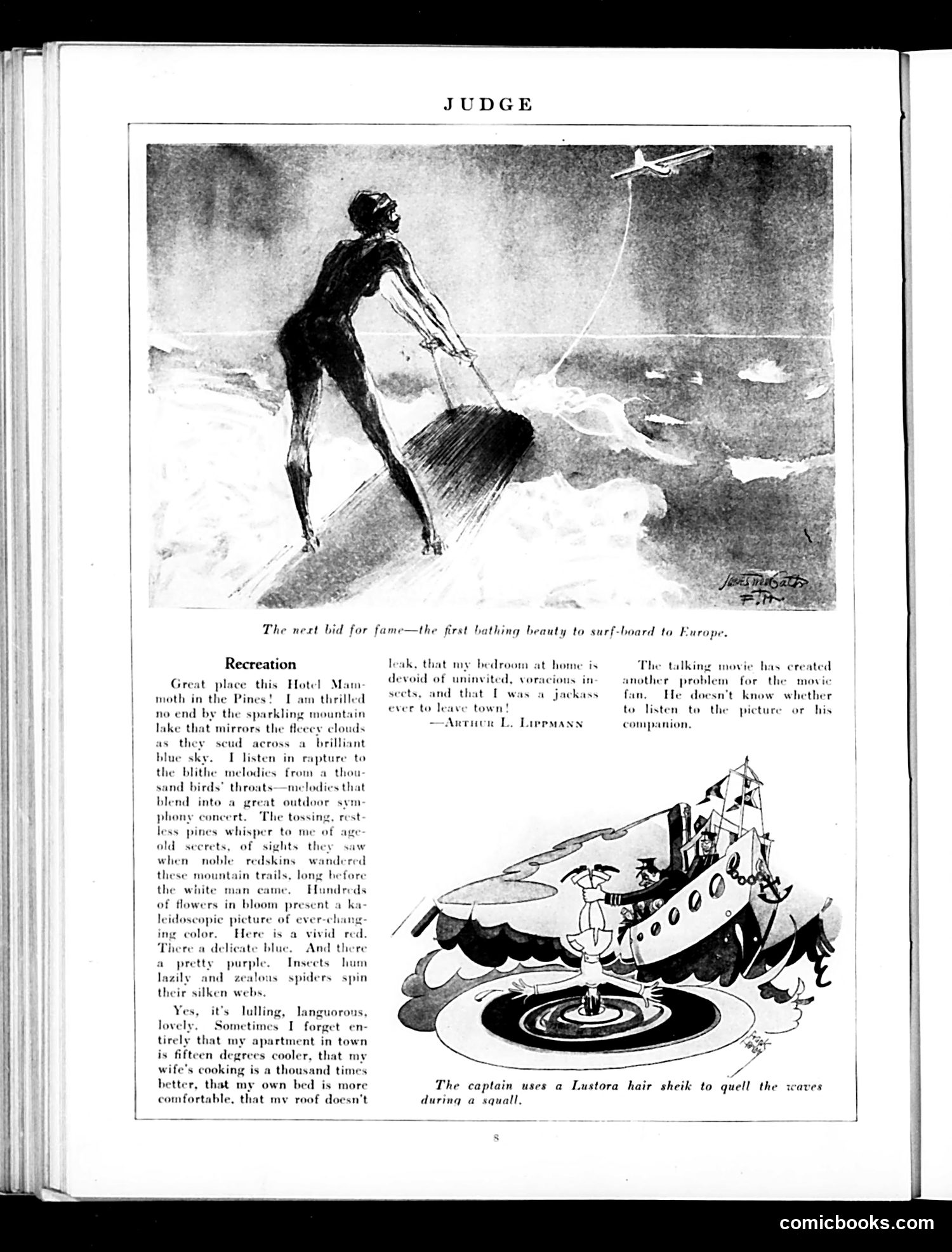
This page contains two distinct satirical pieces: **Top cartoon**: "The next bid for fame—the first bathing beauty to surf-board to Europe" mocks the 1920s obsession with publicity stunts and "bathing beauties" as celebrities. It satirizes how young women sought fame through novelty swimming/sporting exploits, reflecting the era's emerging celebrity culture and the competitive nature of attention-seeking. **Bottom cartoon**: "The captain uses a Lustora hair sheik to quell the waves during a squall" appears to be a product advertisement joke, likely mocking exaggerated advertising claims common in the 1920s-30s, where products were credited with absurd, impossible properties. **Text section** ("Recreation"): A humorous monologue by a hotel guest who romanticizes mountain resort living while contradicting himself—praising nature while admitting he'd rather be home in comfort. It's gentle satire of leisure-class pretension and the gap between vacation fantasy and reality. The final line references talking movies' challenge: simultaneous audio drowns out enjoyment.
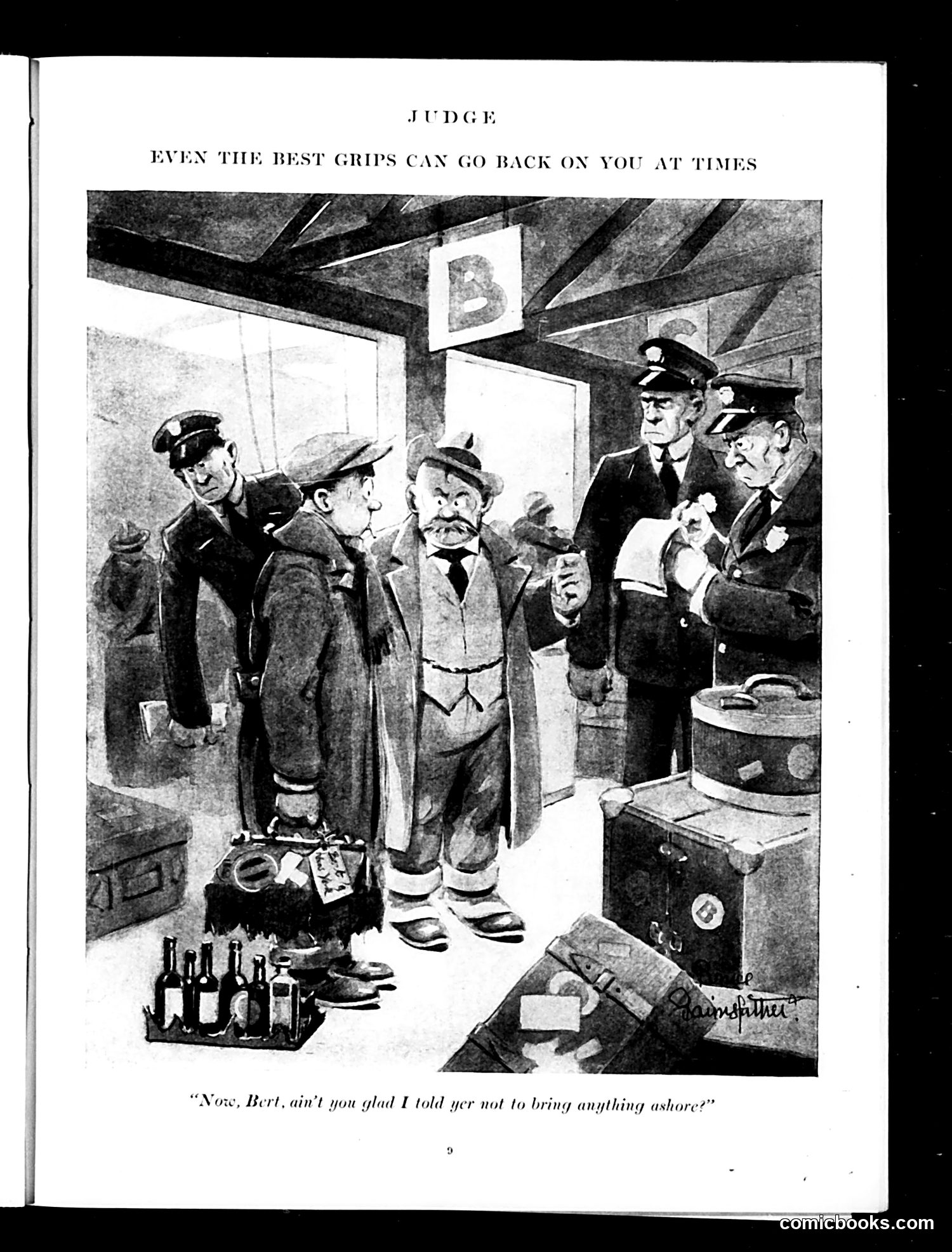
This cartoon satirizes a domestic dispute at customs or immigration. A man with a prominent mustache (appearing to be a traveler or immigrant) stands surrounded by officials while a woman's voice is quoted below: "Now, Bert, ain't you glad I told her not to bring anything ashore?" The joke plays on marital tension: the wife apparently instructed someone (possibly a maid or companion) not to smuggle contraband into the country, yet the husband now faces official scrutiny anyway. The "grips" (suitcases) visible in the scene suggest luggage inspection. The satire targets both marital dynamics—wives controlling husbands' activities—and the era's common customs smuggling practices, suggesting that even well-intentioned spousal advice can backfire when authorities become involved.
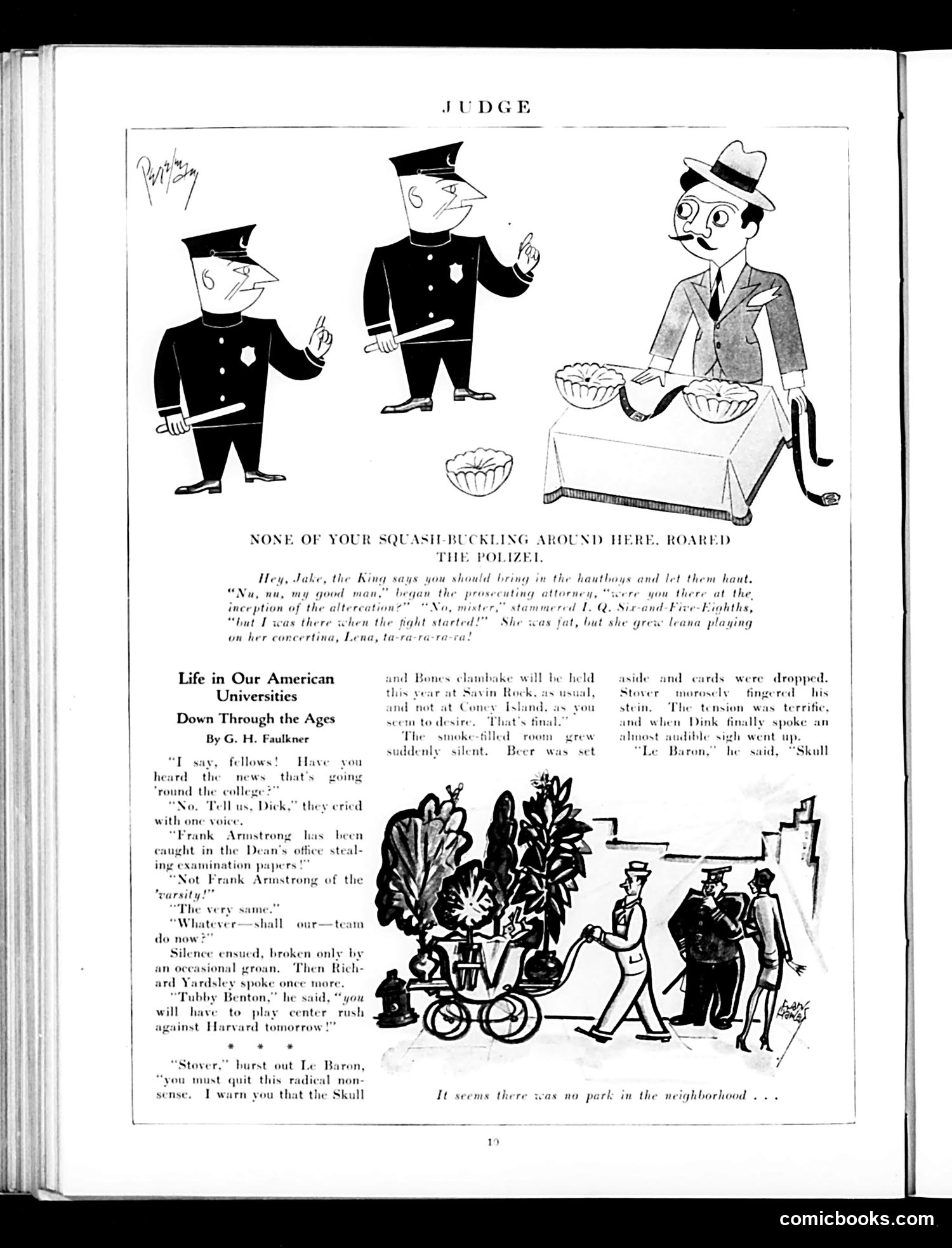
The top cartoon depicts a police judge sternly lecturing two officers about proper courtroom conduct—a humorous commentary on judicial decorum and law enforcement professionalism. The main article, "Life in Our American Universities Down Through the Ages" by G.H. Faulkner, satirizes college student culture and values. It depicts a fictional scandal where student Frank Armstrong is caught stealing exam papers. Rather than expressing moral outrage, the students' primary concern is how this affects their sports team's performance against Harvard—suggesting collegiate priorities were frivolous and athletics-obsessed rather than focused on academic integrity. The narrative mocks students for their casual acceptance of cheating, their devotion to extracurricular activities, and social hierarchies (the "Skull" clambake referenced as exclusive). The absurdist dialogue and exaggerated situations ridicule what the author views as the superficiality and misplaced values of American college life. This reflects early 20th-century intellectual criticism of American universities as privilege-driven institutions disconnected from serious academic purpose.
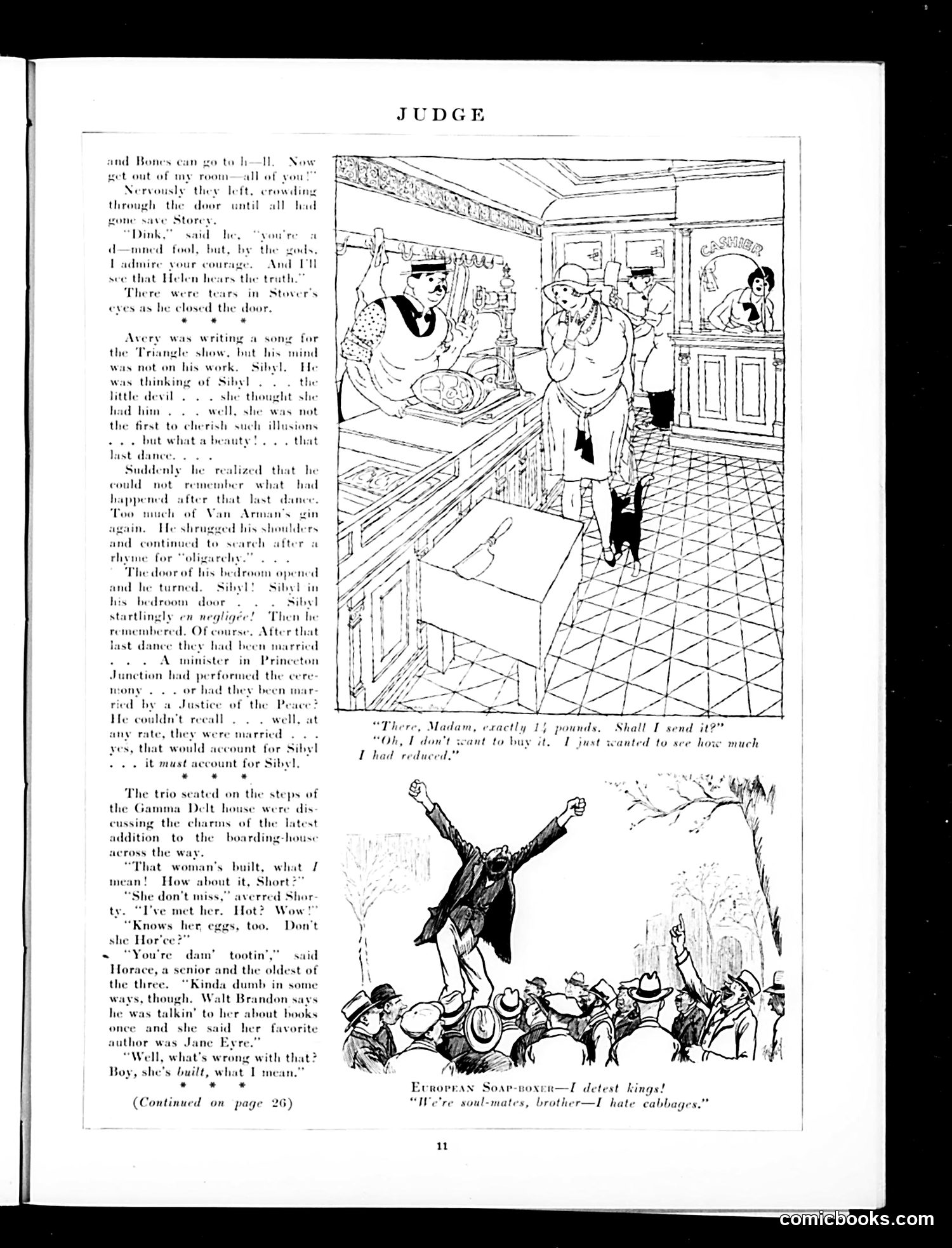
This page from Judge magazine contains two distinct pieces of satirical content: **Upper section:** A serialized story (continued from earlier) about college students at what appears to be Princeton, involving romantic entanglements, drunkenness, and a surprise marriage. The narrative satirizes young men's behavior—drinking ("Van Arman's gin"), casual attitudes toward matrimony, and confusion about whether they were married by a minister or justice of the peace. This mocks collegiate excess and irresponsibility. **Lower cartoon:** Two illustrations satirizing European politics. The top shows acrobatic chaos labeled "European Soap-boxes—I detest kings!" The bottom depicts two figures claiming to be "soul-mates" while hating cabbages, likely mocking ideological fervor and the absurdity of revolutionary rhetoric where people bond over opposing abstract concepts rather than shared values. Both pieces use humor to critique social pretension—upper-class collegiate foolishness above, and European political extremism below.
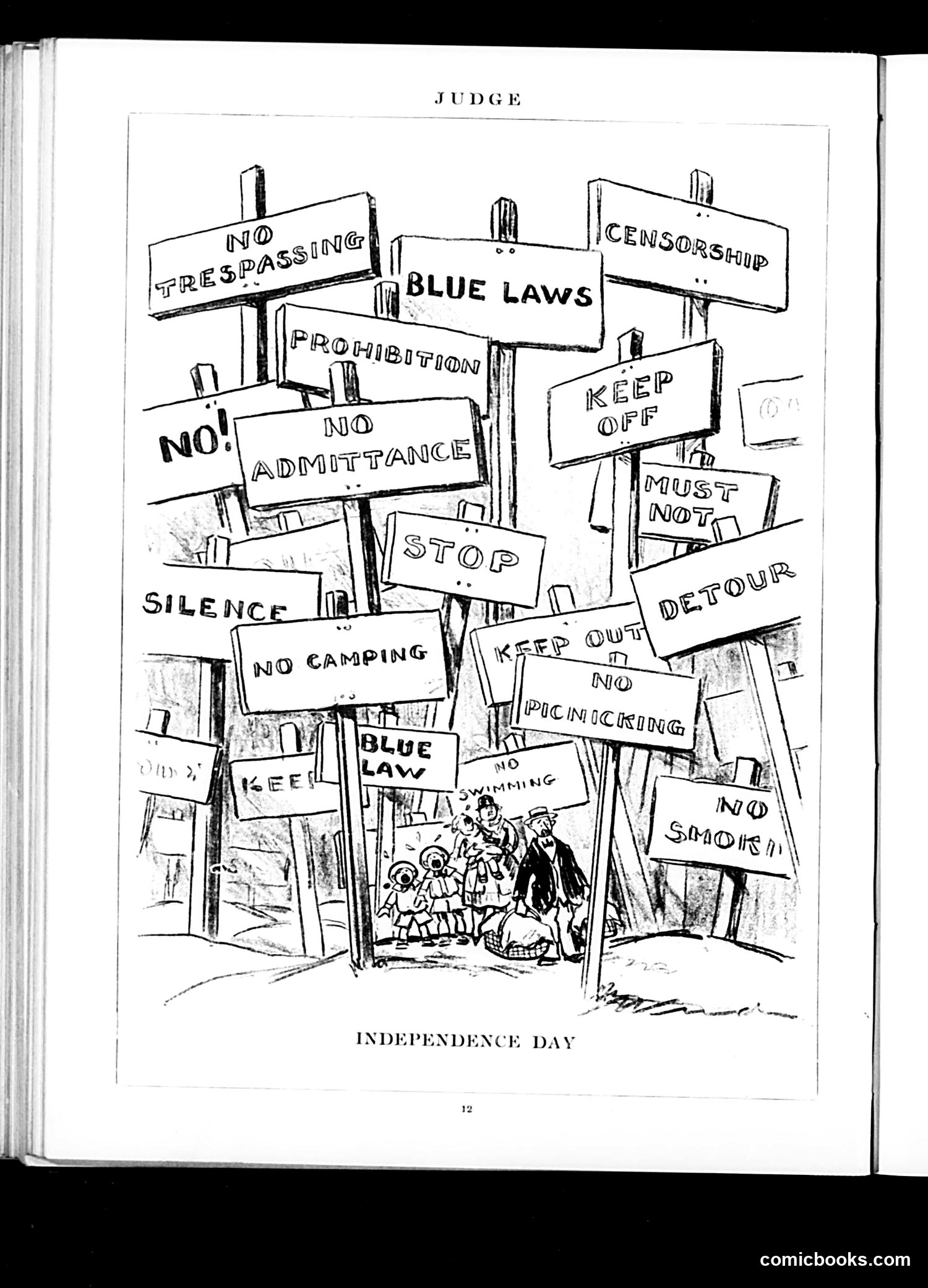
This cartoon satirizes excessive legal restrictions on American citizens' freedom during Independence Day celebrations. The central image shows a family attempting to enjoy a picnic, but they're surrounded by overlapping prohibition signs: "No Trespassing," "Blue Laws," "Censorship," "No Admittance," "Keep Off," "Stop," "No Camping," "Keep Out Detour," "No Picnicking," "No Swimming," and "No Smoking." The satire critiques how regulatory laws—particularly "Blue Laws" (moral legislation restricting Sunday activities)—have ironically constrained the very freedoms that Independence Day commemorates. The ironic title underscores the contradiction: citizens celebrating independence are paradoxically hemmed in by governmental prohibitions, suggesting that American liberty has become increasingly restricted by bureaucratic regulation.
This page contains two main opinion pieces without illustrated cartoons, despite the "Judge on the Bench" header. **"Statesmanship"** praises Owen D. Young, who appears to have successfully negotiated international reparations (likely post-WWI). The writer argues Young should not run for President in 1932, as his talents for industrial/economic leadership are too valuable. The piece suggests capitalism itself needs reform for international relations—a notably progressive stance for the era. **"The Collegiate Line"** humorously catalogs 1920s college slang from Princeton's alumni magazine: "pound the books" (study), "backfired" (failed), "screamed it" (passed easily). The author gently mocks these terms as forced and inauthentic rather than organically developed student speech. **"Army Amateurs"** addresses West Point-Annapolis athletic rivalry, arguing they should resume competitions while questioning whether Army football players are genuinely trained athletes or merely playing for glory—a jab at amateurism standards. The page emphasizes serious policy debate rather than visual satire.
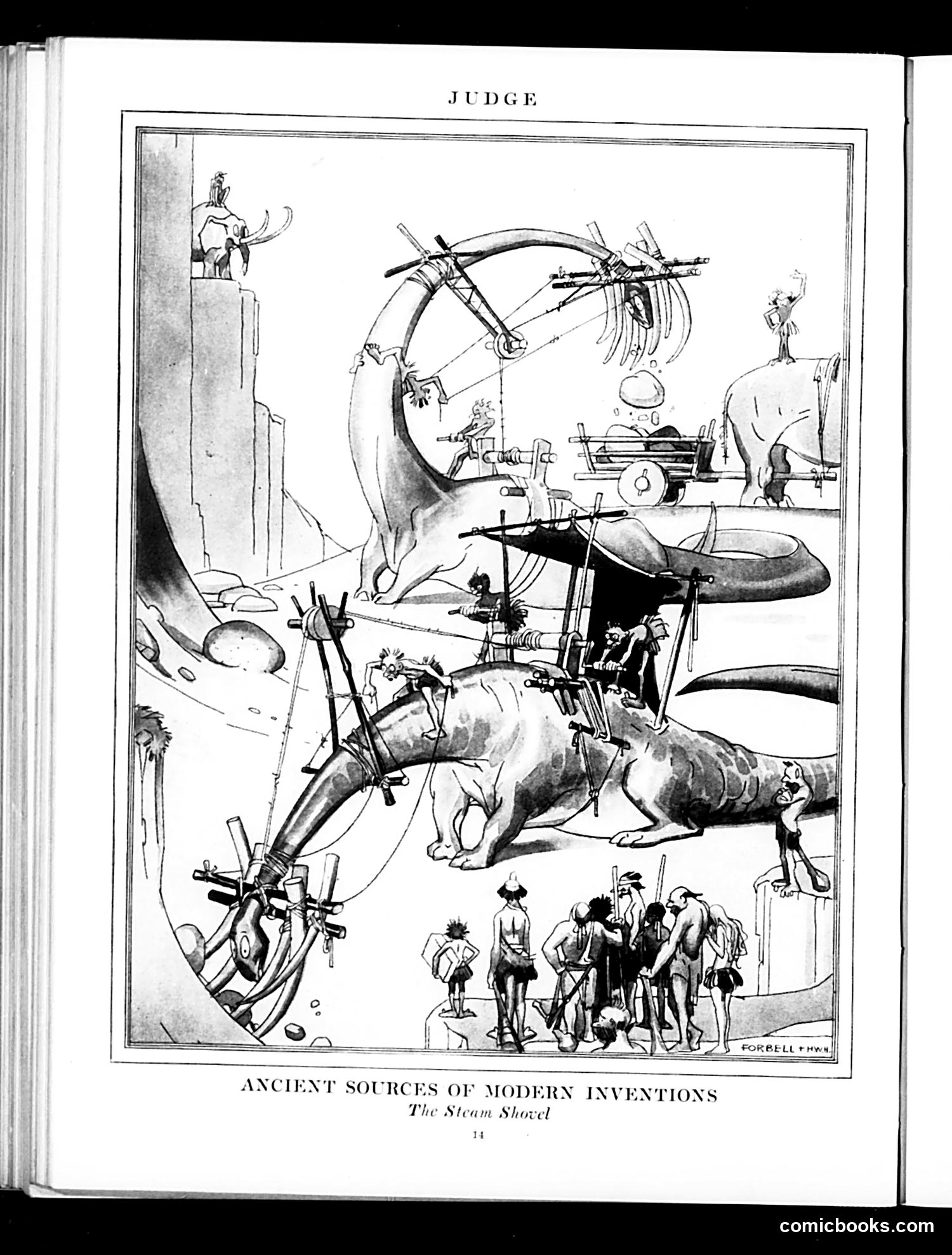
This is a satirical cartoon titled "Ancient Sources of Modern Inventions: The Steam Shovel." It humorously traces the steam shovel's supposed historical origins by depicting various animals and figures operating primitive digging and scooping devices across different eras—from what appears to be ancient times through medieval periods to the present day. The joke suggests that modern mechanical innovations didn't emerge from nowhere but evolved gradually from nature itself and human history. The cartoon shows elephants, hippos, and other creatures using their natural features (trunks, mouths) as "shovels," alongside human figures using increasingly sophisticated hand tools and contraptions. The small group of onlookers at bottom left presumably represents modern observers witnessing this "historical progression." The satire mocks technological hubris by implying that inventors merely copied what nature had already perfected.
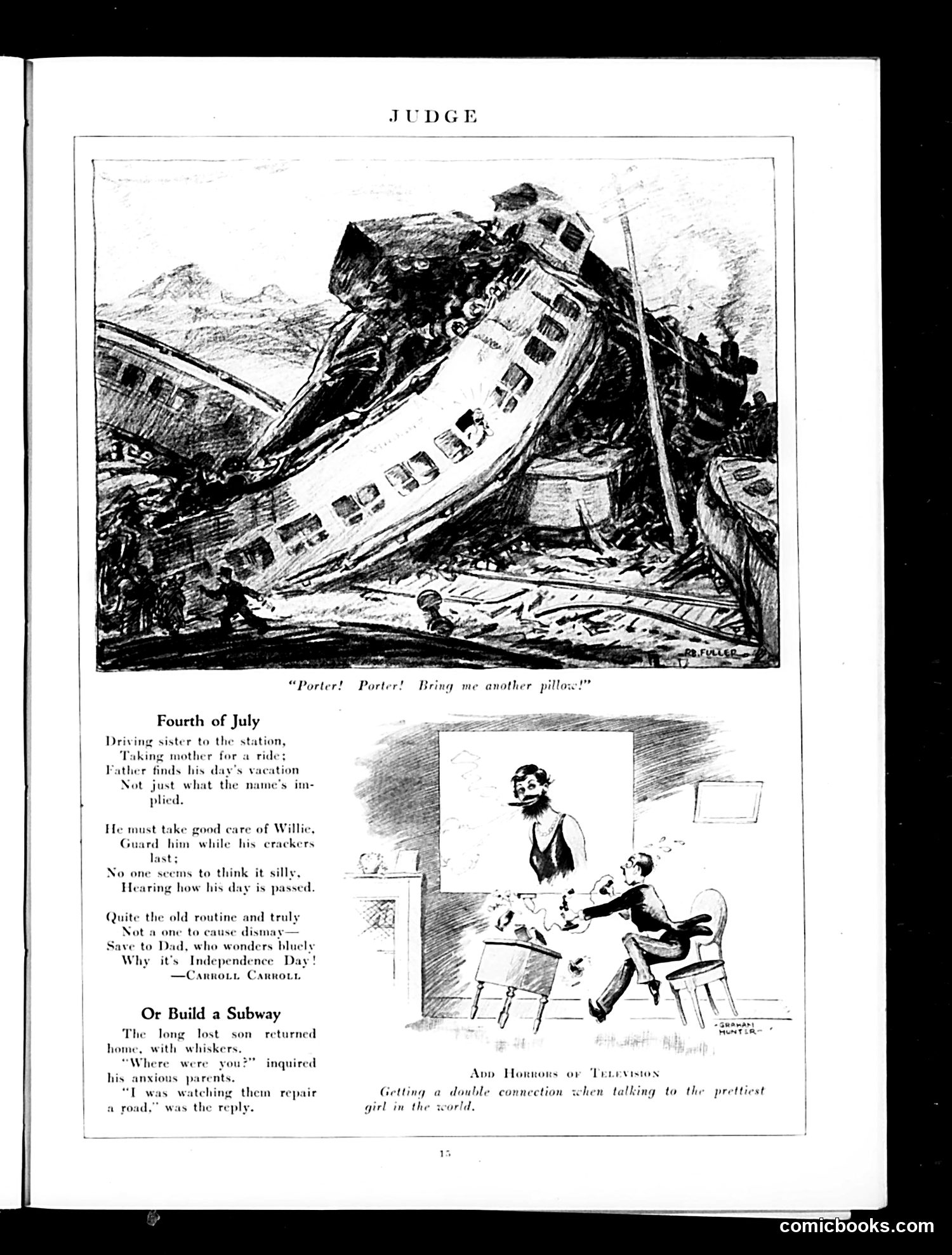
This page contains three separate satirical pieces typical of early 20th-century humor: **Top cartoon**: Shows a wrecked train with a porter being demanded to bring pillows, satirizing poor railroad service and uncomfortable travel conditions. **"Fourth of July" poem**: Mocks how American fathers experience Independence Day—not as a holiday for themselves, but trapped supervising children (Willie and his firecrackers) while family members use them as chauffeurs. The satire is that "Independence Day" offers the father no actual independence or rest. **"Or Build a Subway"**: A brief joke about a son who disappeared, returning with a beard, claiming he was "watching them repair a road." The humor likely references the frustratingly slow pace of public infrastructure projects (subway construction in particular was notoriously prolonged in early 1900s American cities). **Bottom cartoon**: A domestic scene where a young man tries to impress "the prettiest girl in the world" while fumbling with what appears to be an early telephone or communication device, satirizing awkward courtship in the modern age.
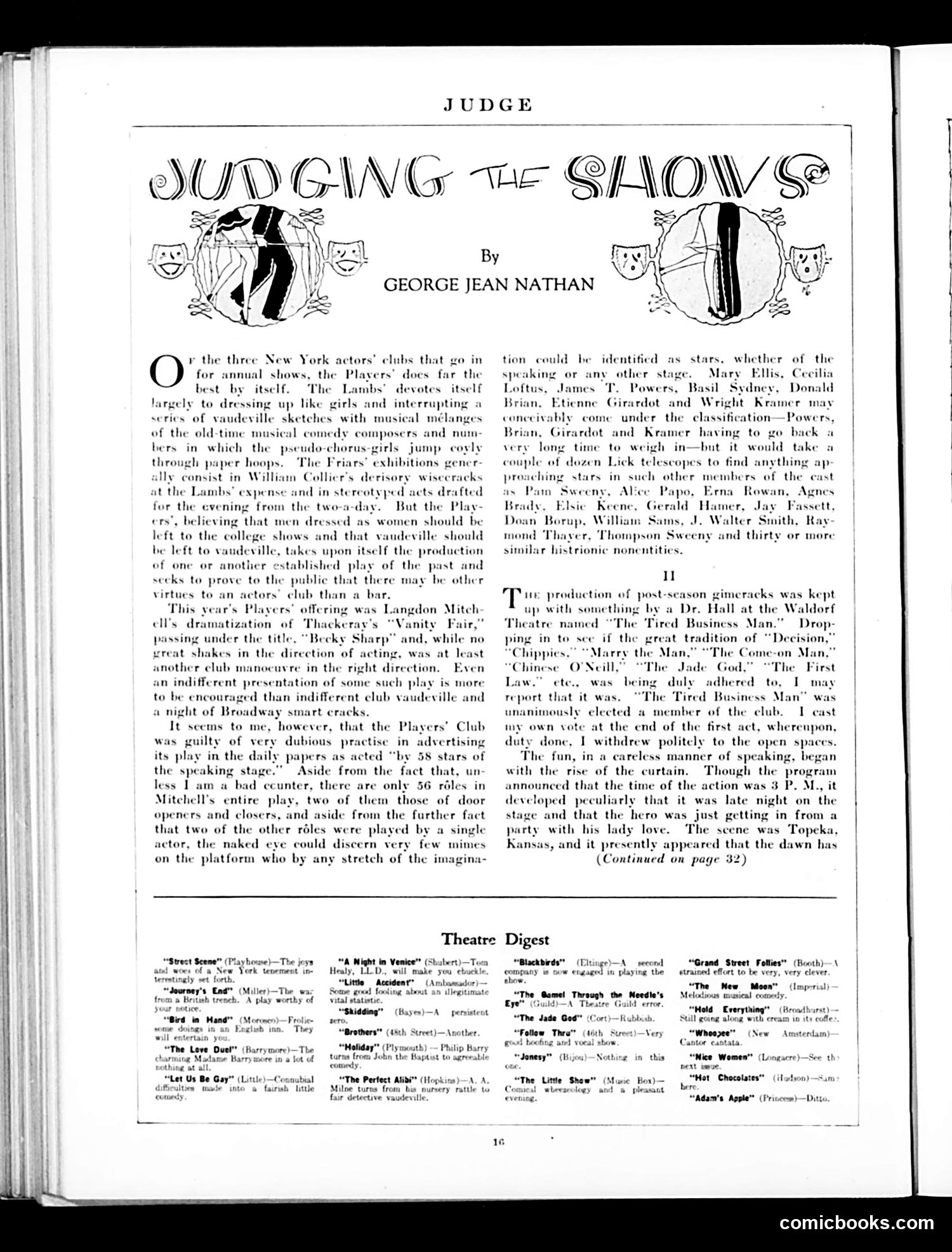
This page contains theater criticism by George Jean Nathan, a prominent drama critic. Nathan critiques New York actors' clubs—the Players, Lambs, and Friars—and their annual theatrical productions. **The main satire:** Nathan mocks the Players' Club's deceptive advertising of their production of "Becky Sharp" (adapted from Thackeray's *Vanity Fair*) as featuring "58 stars." Nathan points out the production only has 56 roles total, some filled by non-actors or duplicated performers, and most cast members are unknown performers hardly qualifying as "stars"—only a handful (Mary Ellis, James T. Powers, Basil Sydney, Donald Brian, etc.) have legitimate credentials. The piece criticizes false advertising while acknowledging the Players' superior approach compared to the Lambs' cross-dressing vaudeville sketches and the Friars' comedy acts.
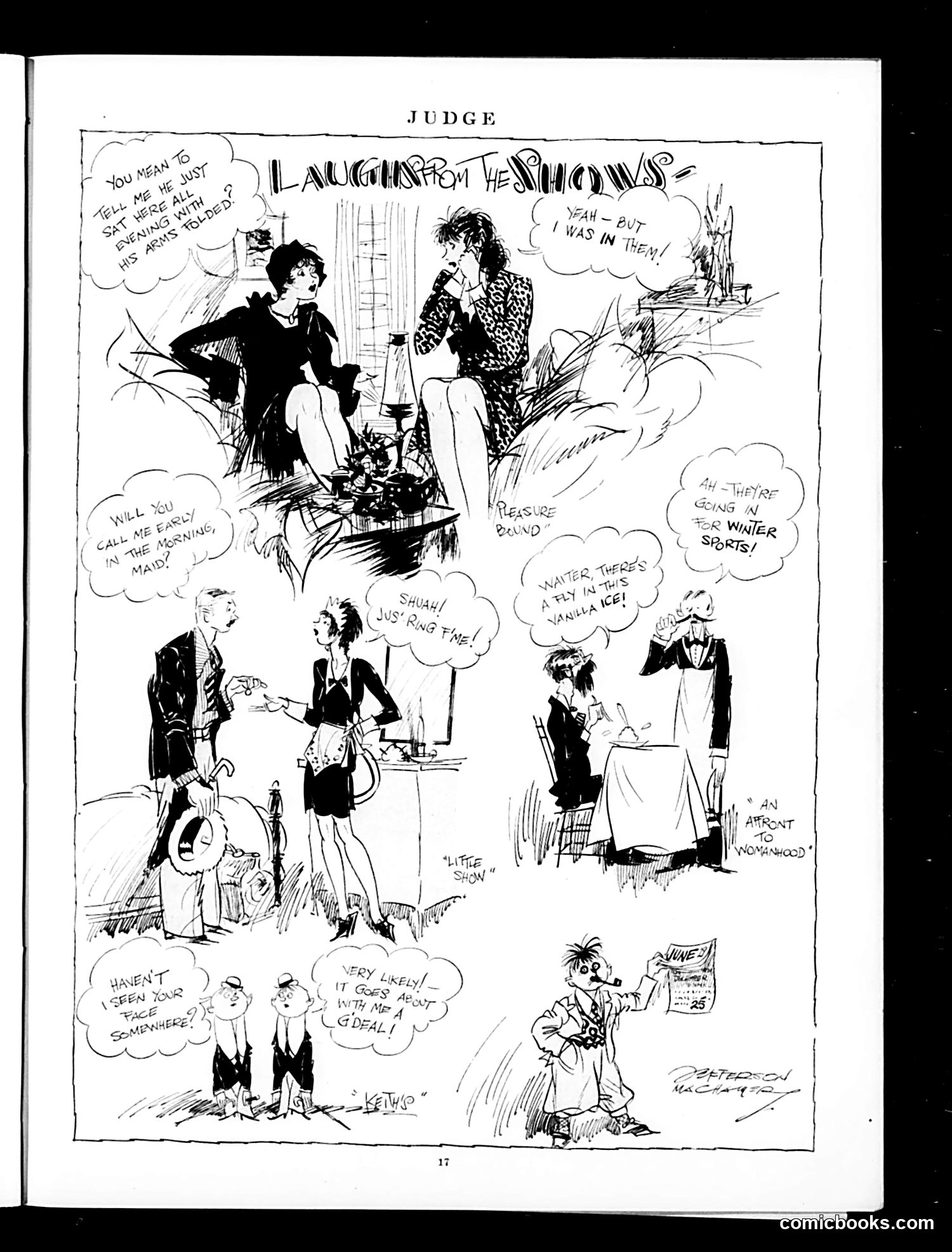
This page presents a satirical comic about social pretense and marital deception. The central scene shows two women in clouds gossiping about their husbands' excuses—one claims he's "just fine," another that "there's a tiny leak" requiring ice. The surrounding vignettes mock upper-class social performances: couples maintaining facades at parties ("Little Show"), men making transparent alibis to avoid spending time with wives ("Haven't seen your face somewhere?"), and a figure reading headlines, likely commenting on the gap between public personas and private truths. The satire targets turn-of-the-century marriage dynamics, where spouses—particularly husbands—invented elaborate excuses to escape domestic obligations. The "pillows" reference suggests these are bedroom/domestic deceptions.
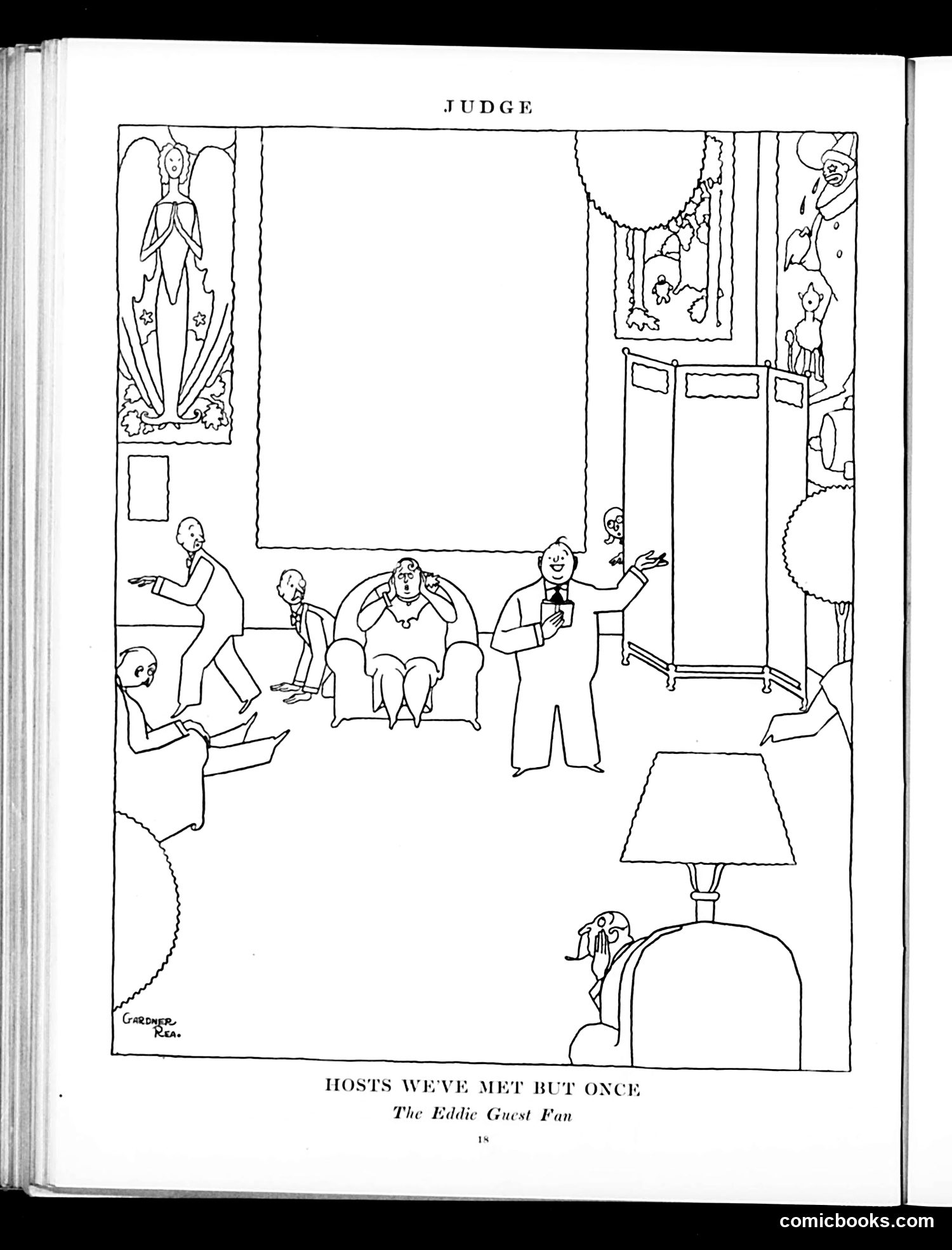
This is a single-panel cartoon titled "Hosts We've Met But Once: The Eddie Guest Pan" from *Judge* magazine. The illustration depicts a courtroom scene with a judge presiding over what appears to be a humorous trial or hearing. Multiple figures are gathered—some seated, others standing and gesturing animatedly. The cartoon's title references "Eddie Guest," likely the poet Edgar Albert Guest, known for sentimental verse. The "pan" (negative critique) suggests this is satirizing Guest's work or reputation among sophisticated audiences. The courtroom setting frames an ironic "trial" of his guest status or artistic merit, mocking the common social obligation of tolerating tedious or unwelcome acquaintances—here represented through the literary world.
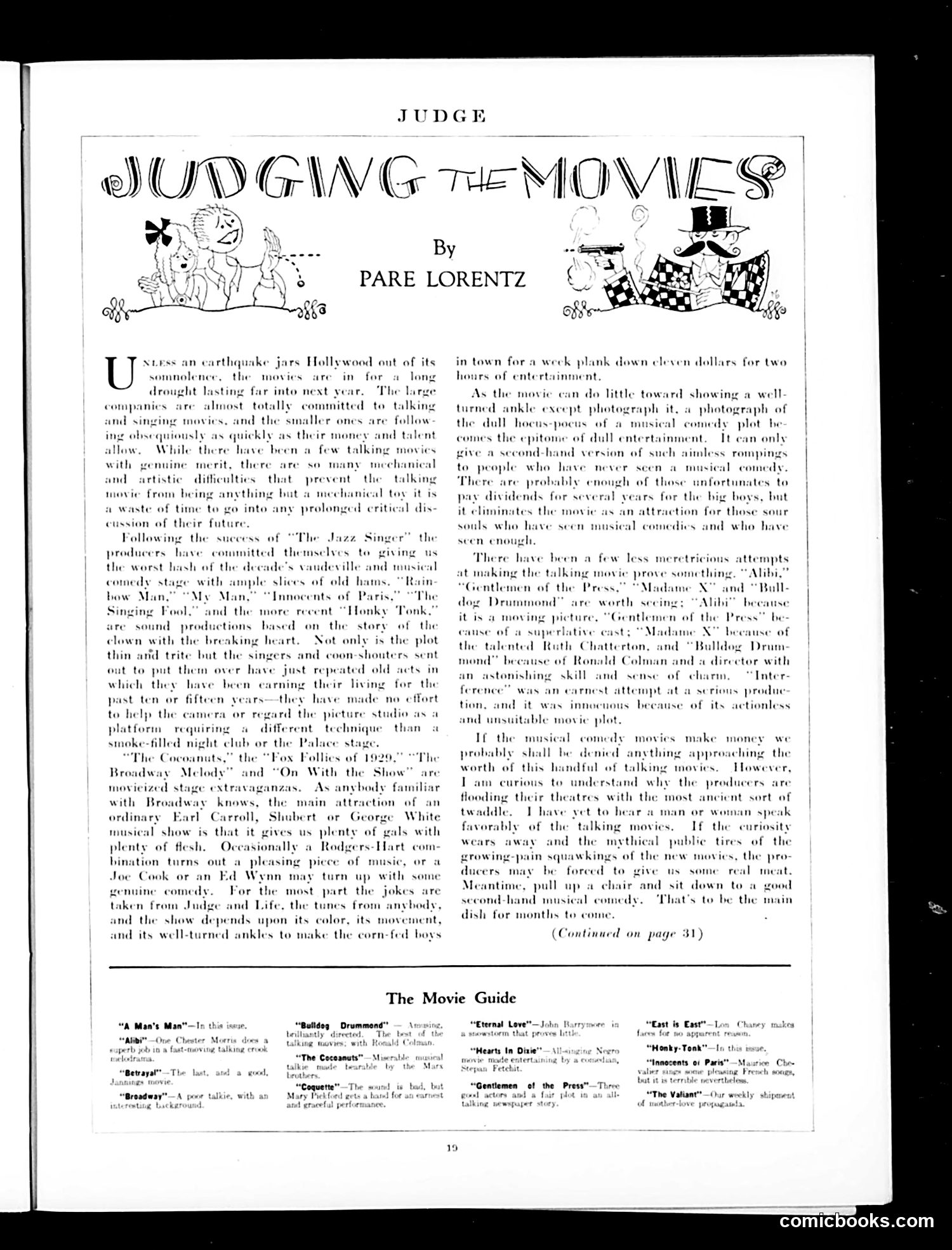
This is a film criticism essay, not a political cartoon. Lorentz critiques Hollywood's early "talking pictures" (sound films), circa 1929. **The satire targets:** - **Hollywood producers** for abandoning artistic merit and flooding theaters with mediocre musical comedies adapted from stage shows, relying on spectacle rather than story - **Recycled entertainment**: producers raid Judge and Life magazines for jokes, rehire aging vaudeville performers, and repeat failed formulas - **Audience contempt**: producers assume audiences want only "well-turned ankles" and physical comedy, not genuine cinema **His point:** While films like "The Jazz Singer" proved talking pictures could work, studios are wasting the medium by importing cheap stage entertainment rather than developing cinema-specific art. He praises few exceptions ("Gentlemen of the Press," "Interference") but warns that audiences will tire of poor-quality "twaddle," forcing producers to actually invest in quality. This reflects genuine 1920s-30s anxiety about whether "talkies" would elevate or debase cinema as an art form.
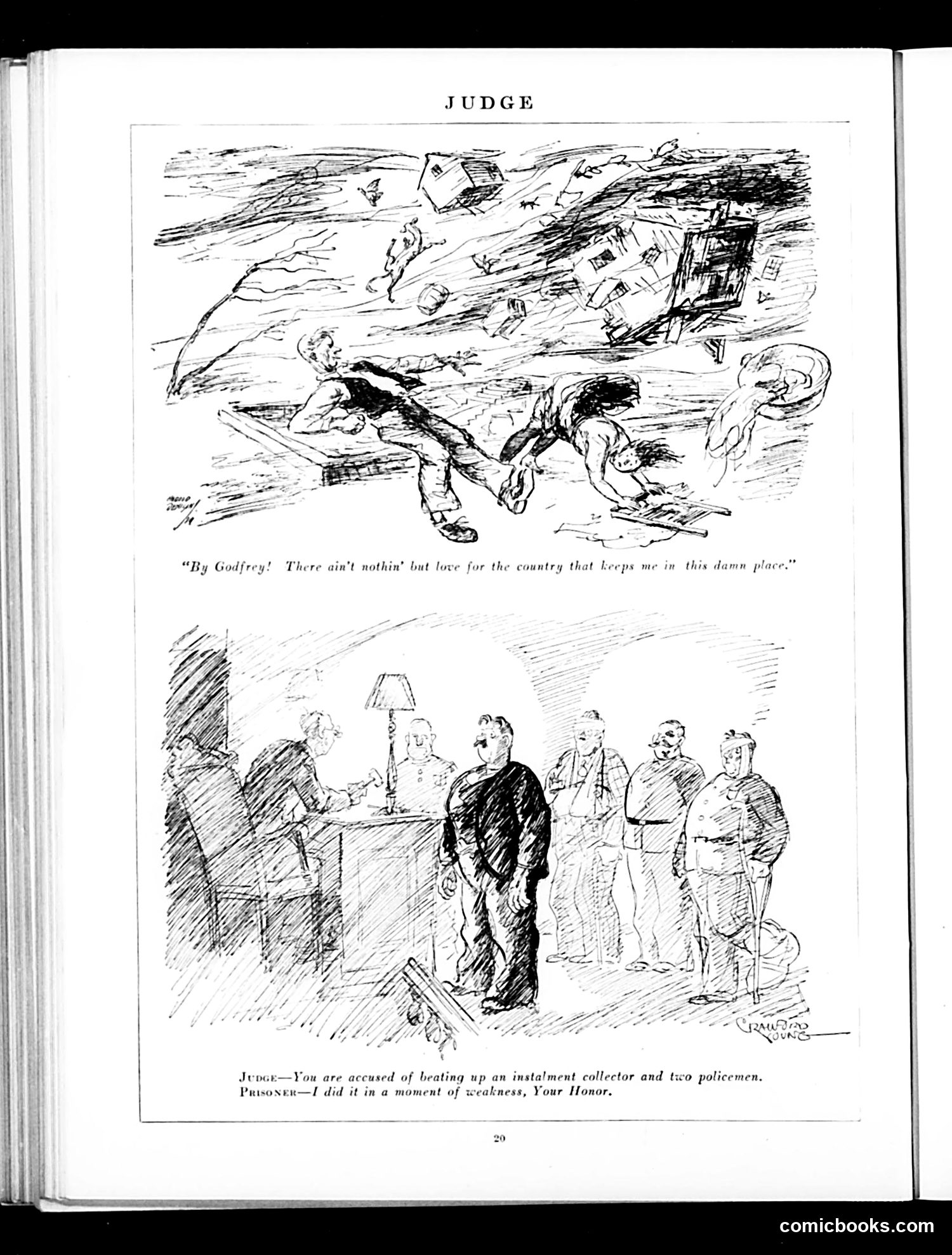
This page from *Judge* magazine contains two cartoons satirizing working-class frustration with debt and authority. The **top cartoon** shows a man violently attacking an instalment collector and police officers amid scattered possessions and debris—depicting the rage of someone unable to pay debts. The **bottom cartoon** is a courtroom scene where the prisoner admits to this violence "in a moment of weakness," then ironically claims patriotic love for his country keeps him imprisoned rather than fleeing. The satire targets the **paradox of poverty**: a man so financially desperate he attacks creditors and police, yet professes love for the country whose system traps him in such circumstances. It's social commentary on working-class desperation during an era of aggressive debt collection, questioning whether patriotism means accepting economic oppression without complaint.
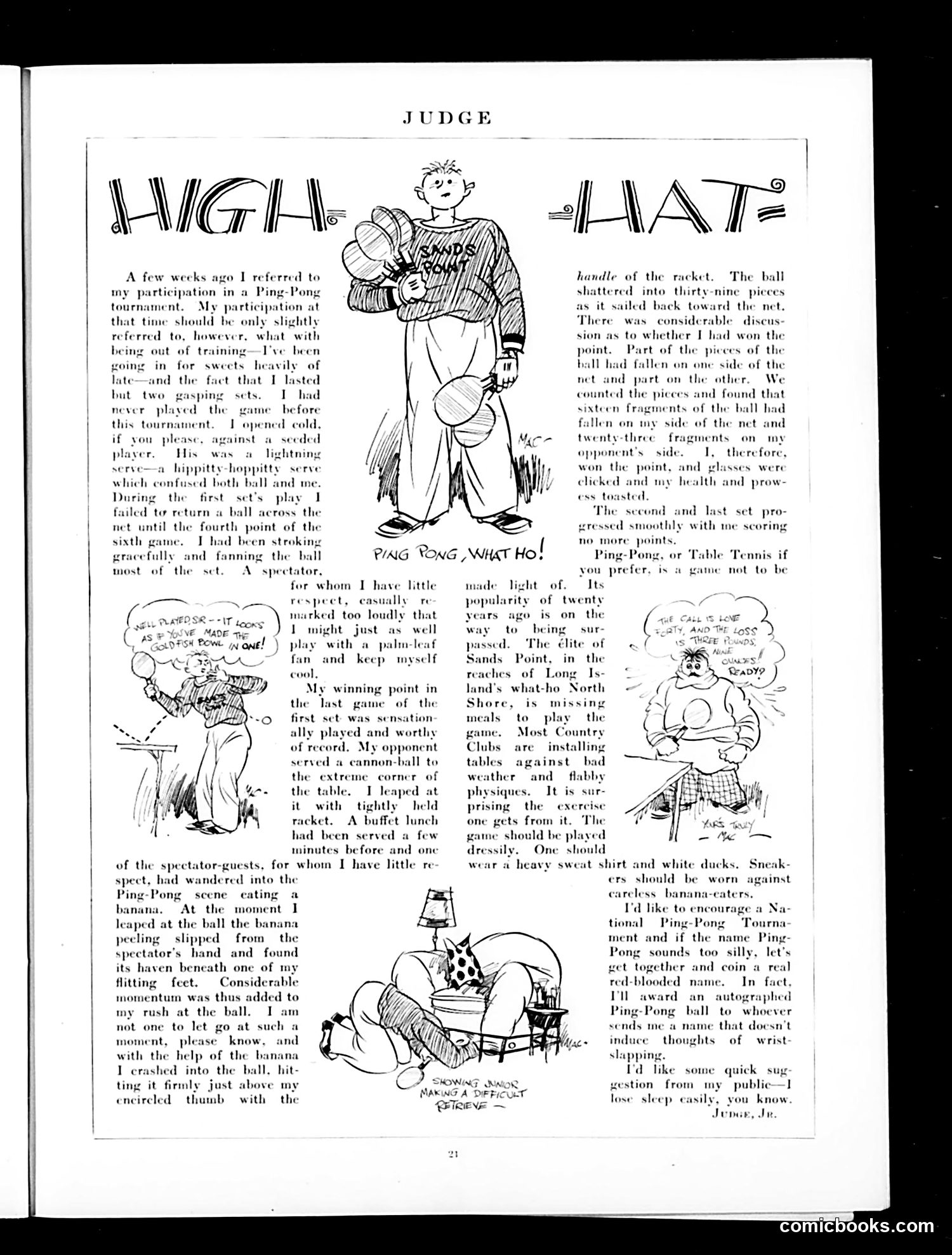
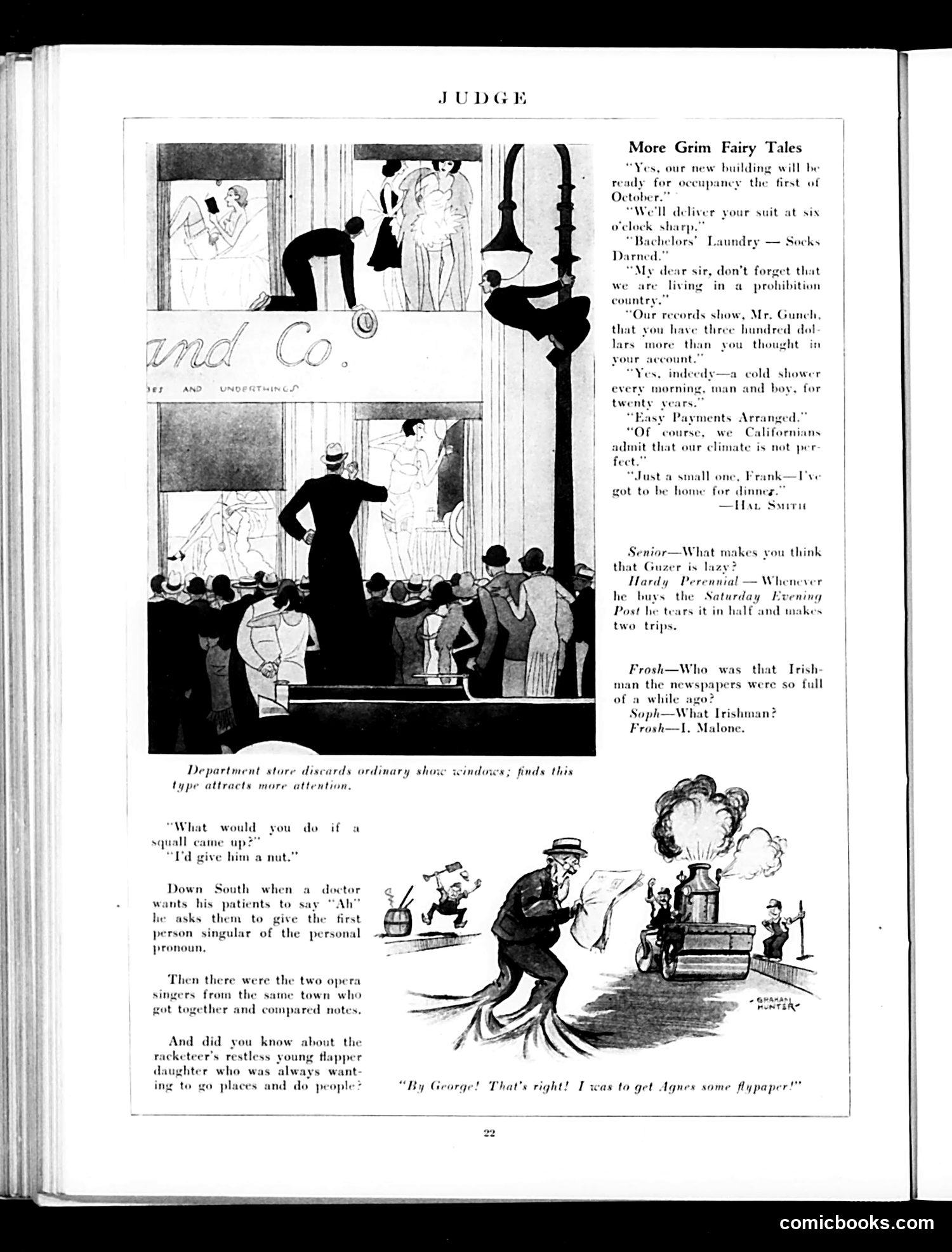
This Judge magazine page contains several brief satirical jokes and two cartoon panels mocking everyday American life, likely from the 1920s-30s era (given references to Prohibition). **Main cartoon (top):** A department store uses a provocative window display—apparently showing scantily-clad figures—to attract crowds, satirizing commercial exploitation masquerading as modernism. **"More Grim Fairy Tales":** These are ironic quips about unkept promises and American life: landlords who miss move-in dates, laundries that lose socks, banks discovering accounting errors, doctors prescribing cold showers, California's overrated climate, and "easy payments" schemes. The satire targets commercial dishonesty. **Bottom cartoon:** A man chases another with flypaper, intending to catch a woman named "Agnes"—a crude joke about pursuing women aggressively. **Miscellaneous jokes** reference Southern dialect humor and campus freshman/sophomore stereotypes. The overall tone ridicules commercialism, broken promises, and social pretense of the era.
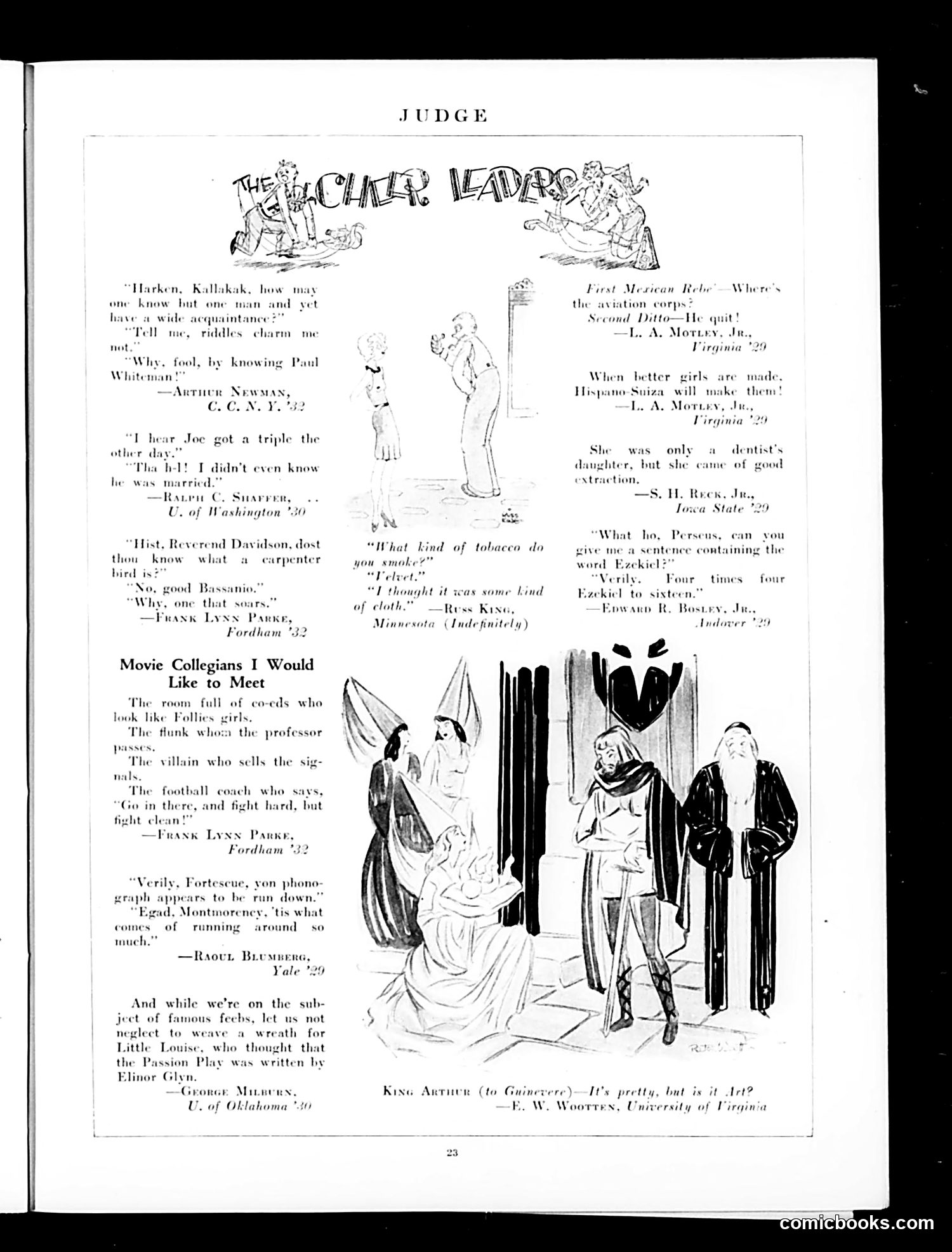
This 1920s college humor page collects jokes and quips from university students, centering on wordplay and cultural references of the era. **"The Clicker Leaders"** section opens with jokes about Paul Whiteman (the famous "King of Jazz"), suggesting knowing one famous person creates the illusion of wide social connection—a dig at social climbing. **"Movie Collegians I Would Like to Meet"** satirizes silent-film fantasies popular among college students, mocking unrealistic romantic ideals (Follies girls, corrupt cinema villains). **Other jokes** include a dig at someone confusing Elinor Glyn (a famous romance novelist) with the author of the Passion Play—suggesting cultural ignorance among the wealthy or fashionable. The **cartoon** (bottom right) appears to show King Arthur and Guinevere in medieval dress, captioned with E.W. Wootten's quip: "It's pretty, but is it Art?"—a meta-joke about artistic pretension. Overall, the page mocks college pretension, dating culture, and superficial cultural knowledge circa the 1920s.
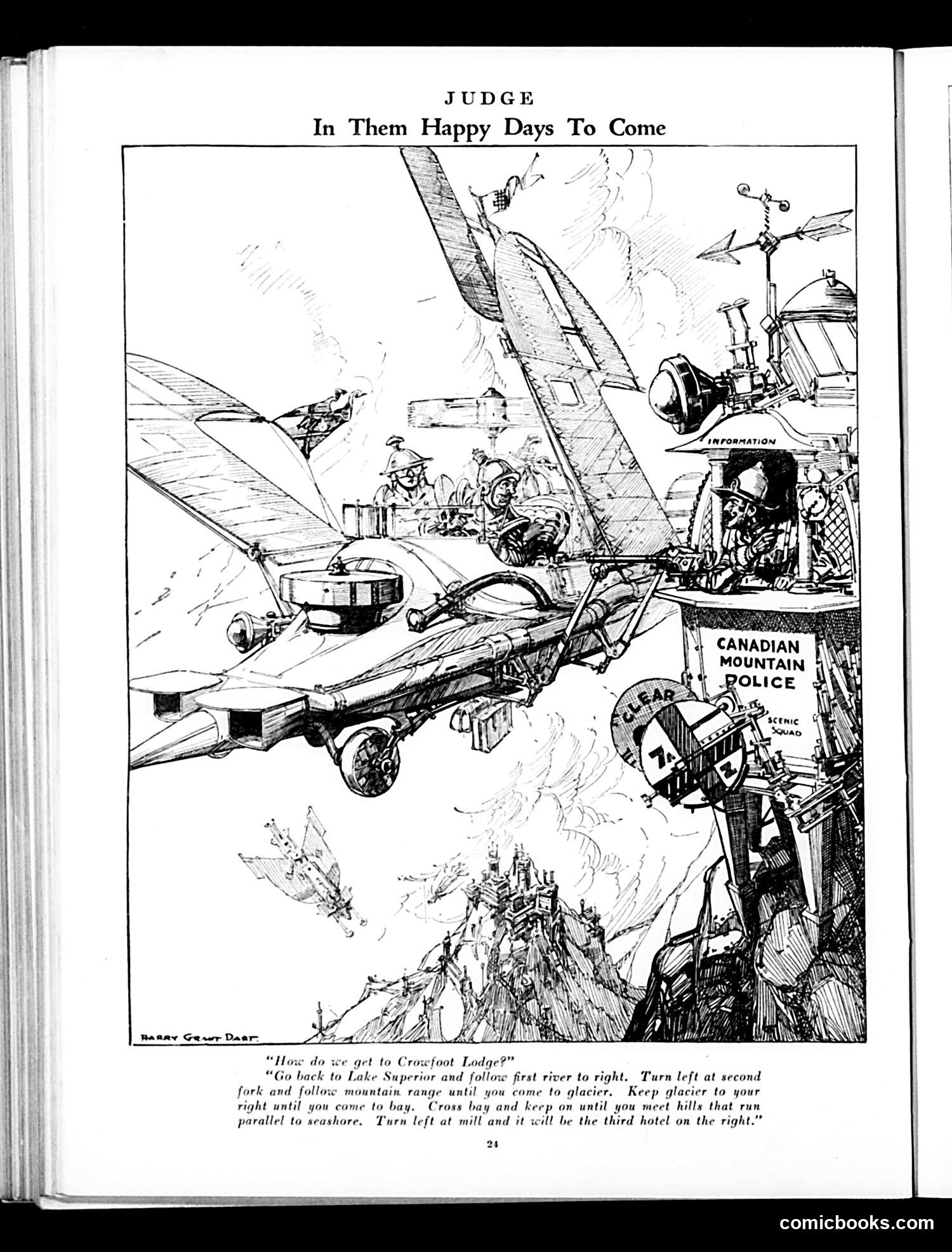
This is a futuristic cartoon titled "In Them Happy Days To Come," depicting an optimistic vision of air travel. The illustration shows multiple aircraft and what appears to be an airfield or landing station, with Canadian Mountain Police visible. The humor derives from the joke's caption: someone asks directions to "Crowfoot Lodge," and receives absurdly complicated instructions involving rivers, glaciers, and mountains—directions suited to wilderness travel, not the advanced air transportation depicted in the scene. **The satire:** This mocks the gap between technological promise and practical reality. Despite having aircraft that can supposedly make travel easy and modern, travelers still receive confusing, roundabout directions as if civilization hadn't advanced. It's commentary on either the unreliability of new technology or the persistence of frontier conditions in remote Canada despite modernization. The artist is credited as "Barry Geyer Dare" (or similar).
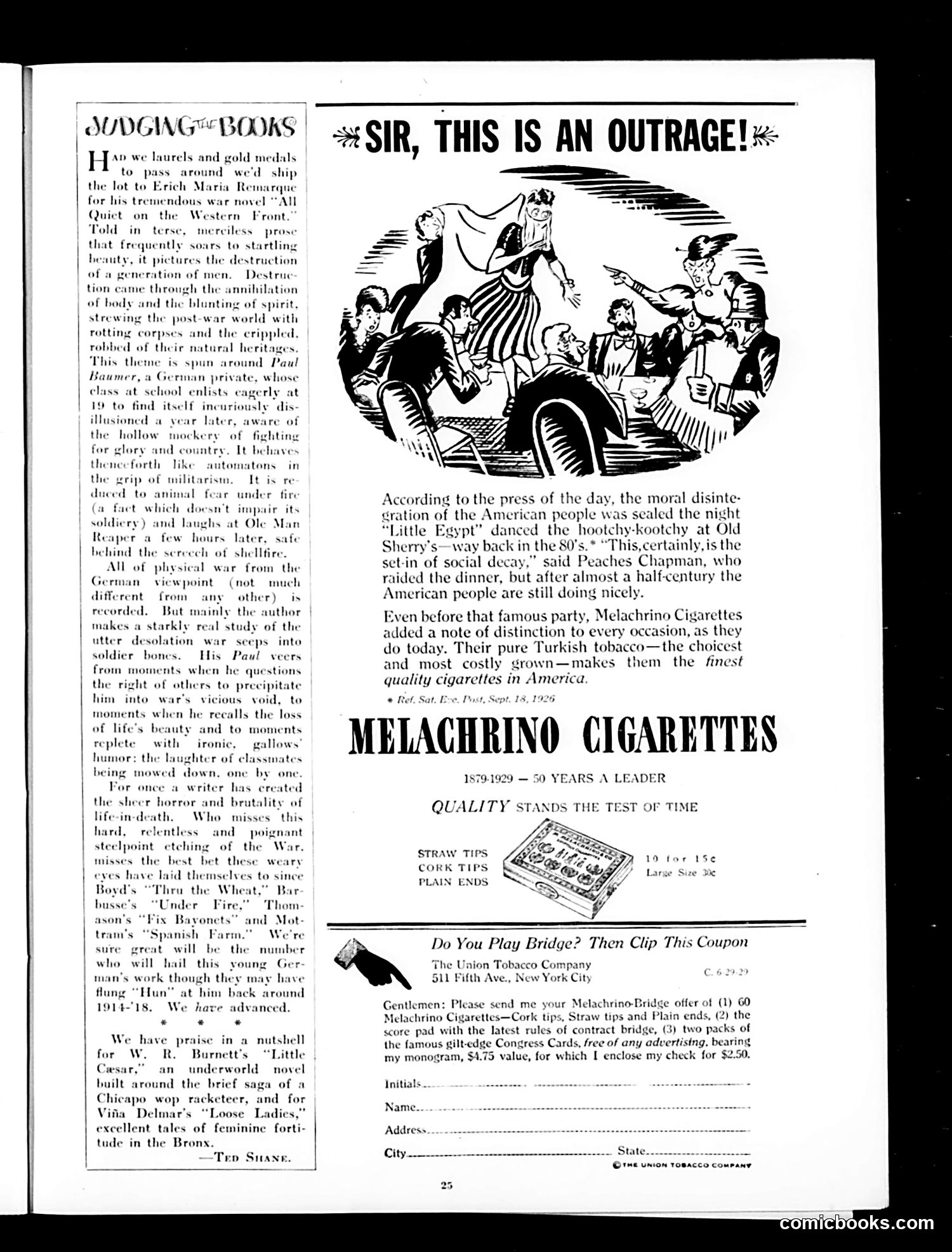
This page combines a book review with a cigarette advertisement and commentary on American moral panic. **The Book Review Section** praises Erich Maria Remarque's *All Quiet on the Western Front*, a German anti-war novel depicting the devastating effects of WWI on soldiers. The reviewer celebrates its unflinching depiction of war's horror and physical/psychological destruction. **The Cartoon and Advertisement** mock hand-wringing about American moral decline. The illustration shows people dancing the "hootchy-kootchy" (a suggestive dance), labeled an "outrage." The text sarcastically references "Little Egypt's" famous dance at an 1890s party as supposedly marking America's moral collapse—yet here we are decades later, "still doing nicely." The cigarette ad cynically exploits this anxiety, claiming Melachrino cigarettes represent enduring quality and tradition (50 years a leader), implying stability amid perceived social decay. The juxtaposition is ironic: the page criticizes moral panic while literally advertising a vice product. The overall message satirizes American prudishness and exaggerated fears about social deterioration.
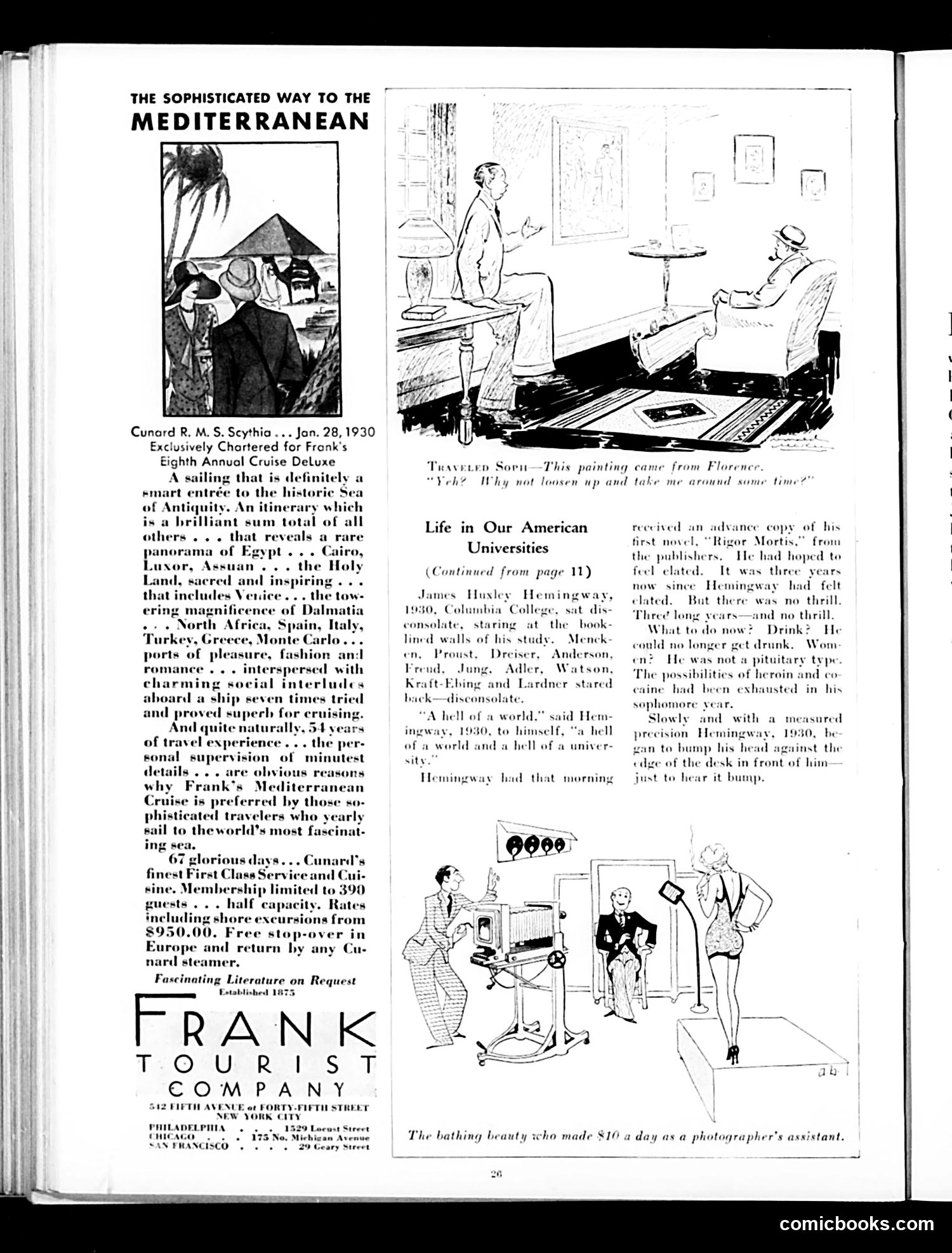
This page contains two distinct elements: **Left side:** Advertisement for Frank Tourist Company's Mediterranean cruise on the Cunard liner *Scythia* (January 28, 1930), marketed as "sophisticated" luxury travel for wealthy clientele—rates from $950. **Right side:** A satirical article titled "Life in Our American Universities" mocking 1930s intellectual pretension. It depicts a fictional Columbia College student named "James Huxley Hemingway" (clearly parodying Ernest Hemingway's famous ennui and literary style). The joke: this young man has absorbed all the fashionable intellectual trends—Freud, Jung, modernist literature—yet feels existentially empty. He's so bored he literally bumps his head on his desk for stimulation. The satire targets both Hemingway's celebrated world-weariness and the affectation of college students imitating literary cynicism. The bottom cartoon depicts "the bathing beauty who made $10 a day as a photographer's assistant"—likely commenting on 1930s commercialization of youth and beauty.
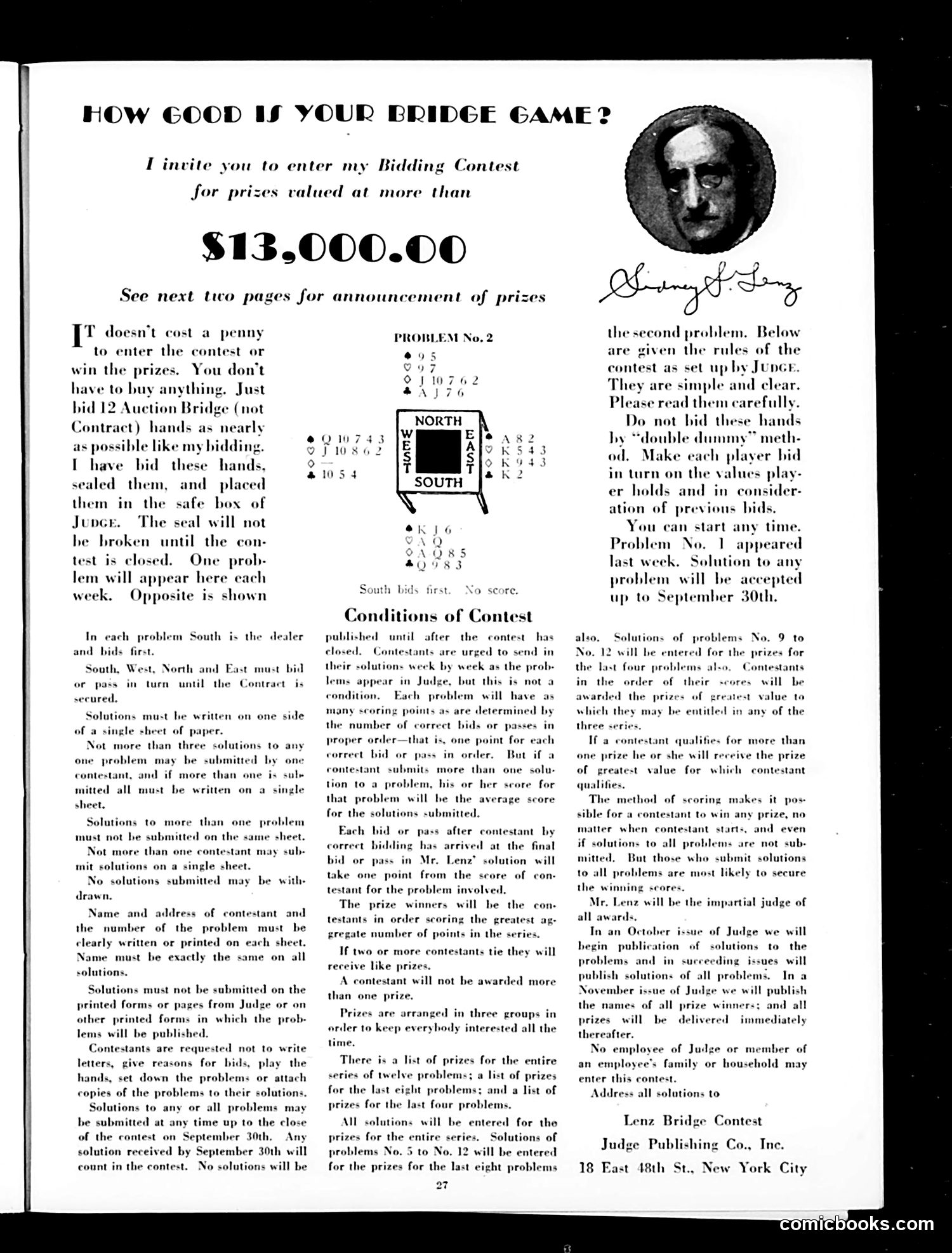
This is primarily a **contest advertisement**, not a satirical cartoon. The page announces a bridge bidding competition sponsored by "Judge" magazine, offering $13,000 in prizes. The contest is organized by **Mr. Lenz** (shown in the portrait), who appears to be a prominent bridge authority of the era. Contestants submit solutions to 12 "Auction Bridge" hands sealed in a judge's safe box, with one problem appearing weekly. Entries are free and judged on how closely contestants' bids match Lenz's sealed bids. **Key context for modern readers:** Bridge was enormously popular in early 20th-century America as parlor entertainment. This "Auction Bridge" (predecessor to Contract Bridge) was a major cultural phenomenon. Magazine contests like this were common promotional vehicles that both drove subscriptions and reflected the public's passionate interest in the game. The page is essentially a rules-and-entry announcement rather than satire—typical content for Judge's back pages.
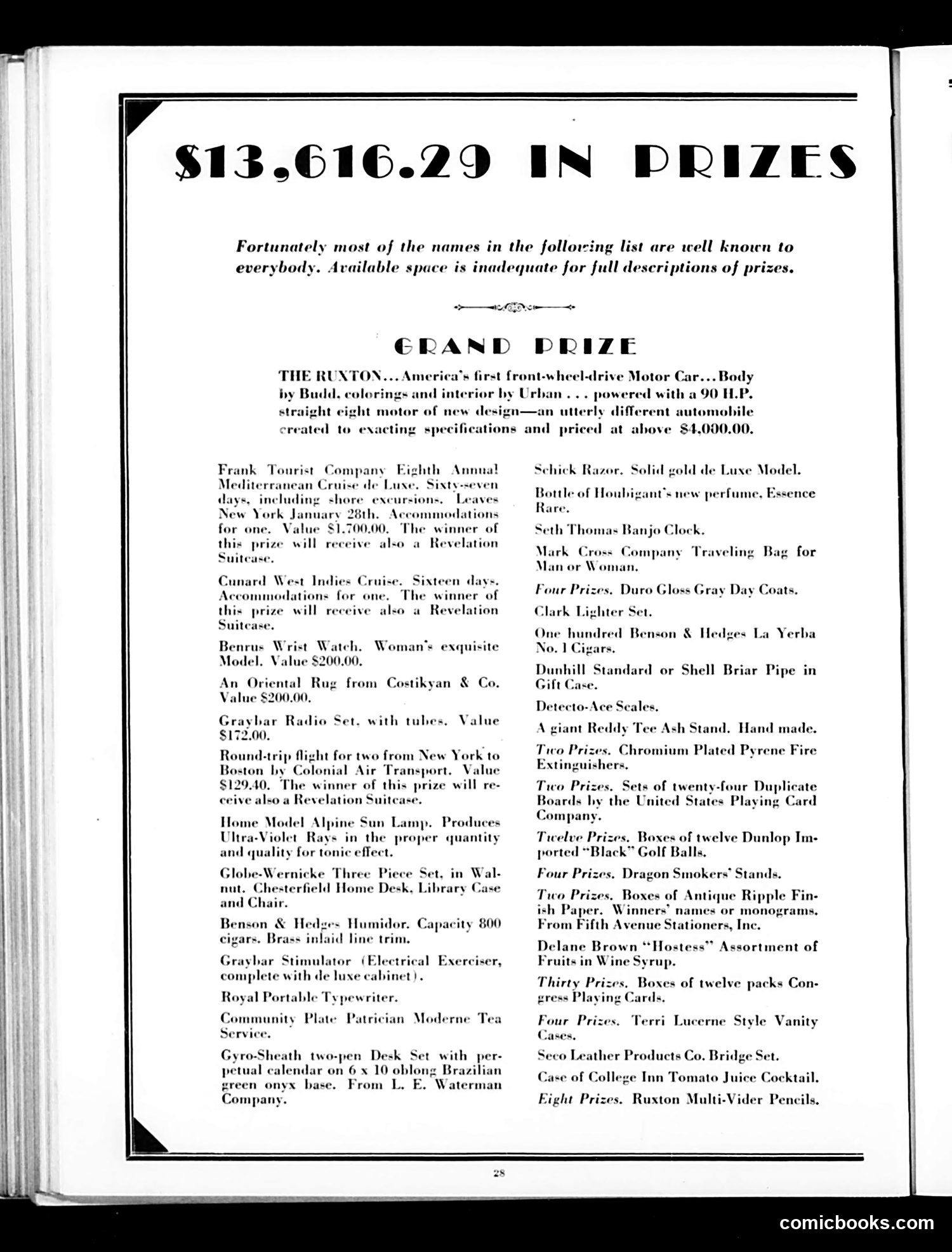
This is primarily a **advertising/promotional page**, not a political cartoon. It lists prizes totaling $13,616.29 for what appears to be Judge magazine's contest or giveaway. The **grand prize** is a Ruxton automobile—described as "America's first front-wheel-drive Motor Car," priced above $4,000, representing a luxury item during this era (likely 1930s based on product references). Secondary prizes reflect Depression-era aspirations: luxury cruises, wristwatches, oriental rugs, radios, golf equipment, and branded goods (Schick razors, Dunhill pipes, Benson & Hedges cigars). The repeated smaller prizes—playing cards, golf balls, ashtrays—suggest mass participation appeal. **Context for modern readers**: This represents how magazines used elaborate prize contests as circulation drivers, showcasing contemporary luxury goods that symbolized success and refinement to middle-class readers during economically uncertain times.
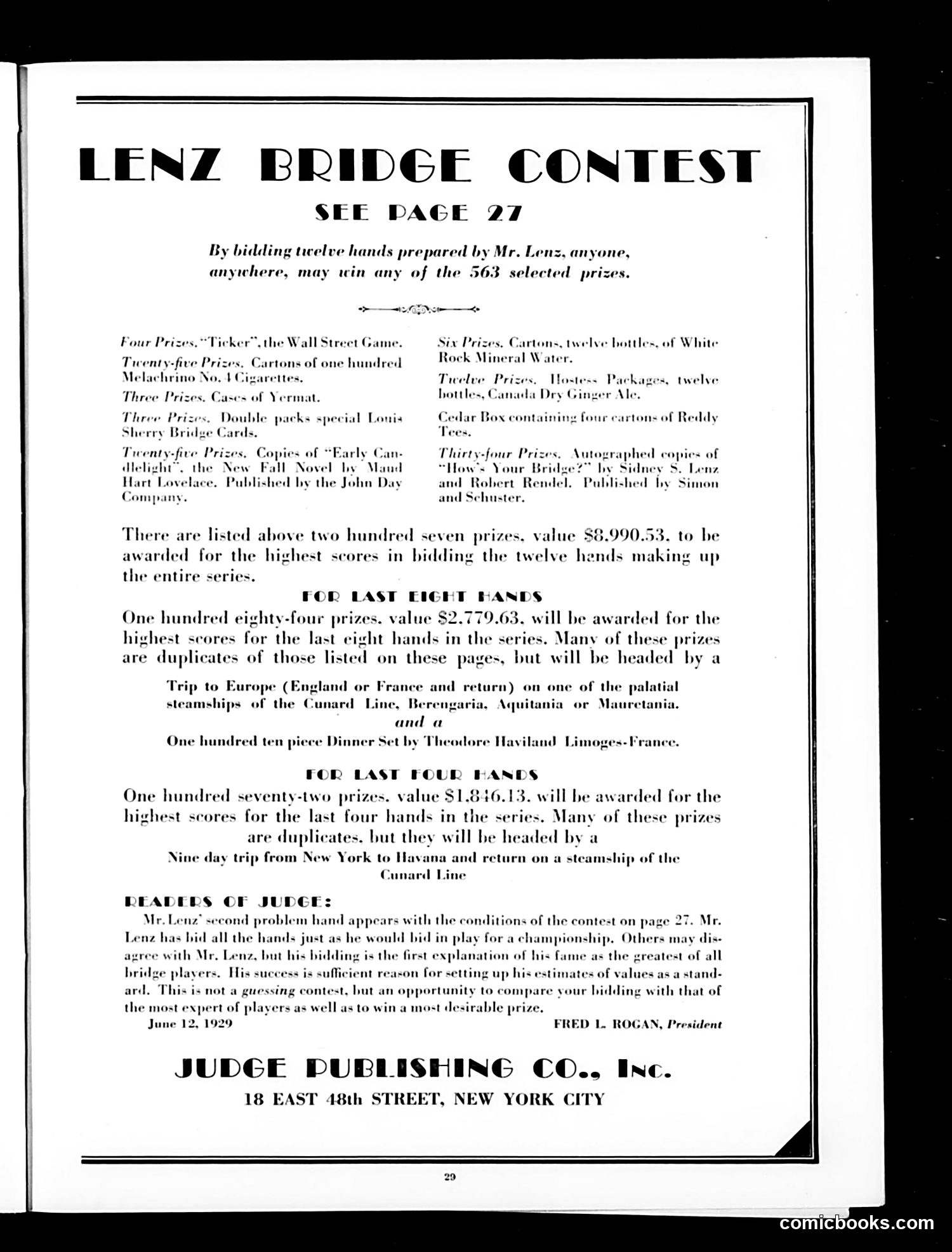
This is primarily an **advertising page**, not a cartoon. Judge magazine is promoting a bridge-bidding contest sponsored by Mr. Lenz, a renowned bridge player. The contest invites readers to bid twelve prepared card hands and compete for 563 prizes totaling nearly $9,000. The appeal targets affluent readers: prizes include European steamship voyages on the Cunard Line, fine dinners, cigarettes, and novels. The contest is framed as educational rather than gambling—readers can compare their bidding strategy directly against Lenz's, presented as "the greatest of all bridge players." The real draw appears to be the **prestige**: the opportunity to test one's skill against an expert and potentially win luxury travel. This reflects 1920s upper-class leisure culture, where bridge was a popular social game among the wealthy. The grand prizes (transatlantic voyages) suggest the contest was intended to generate substantial magazine subscriptions and advertising revenue.
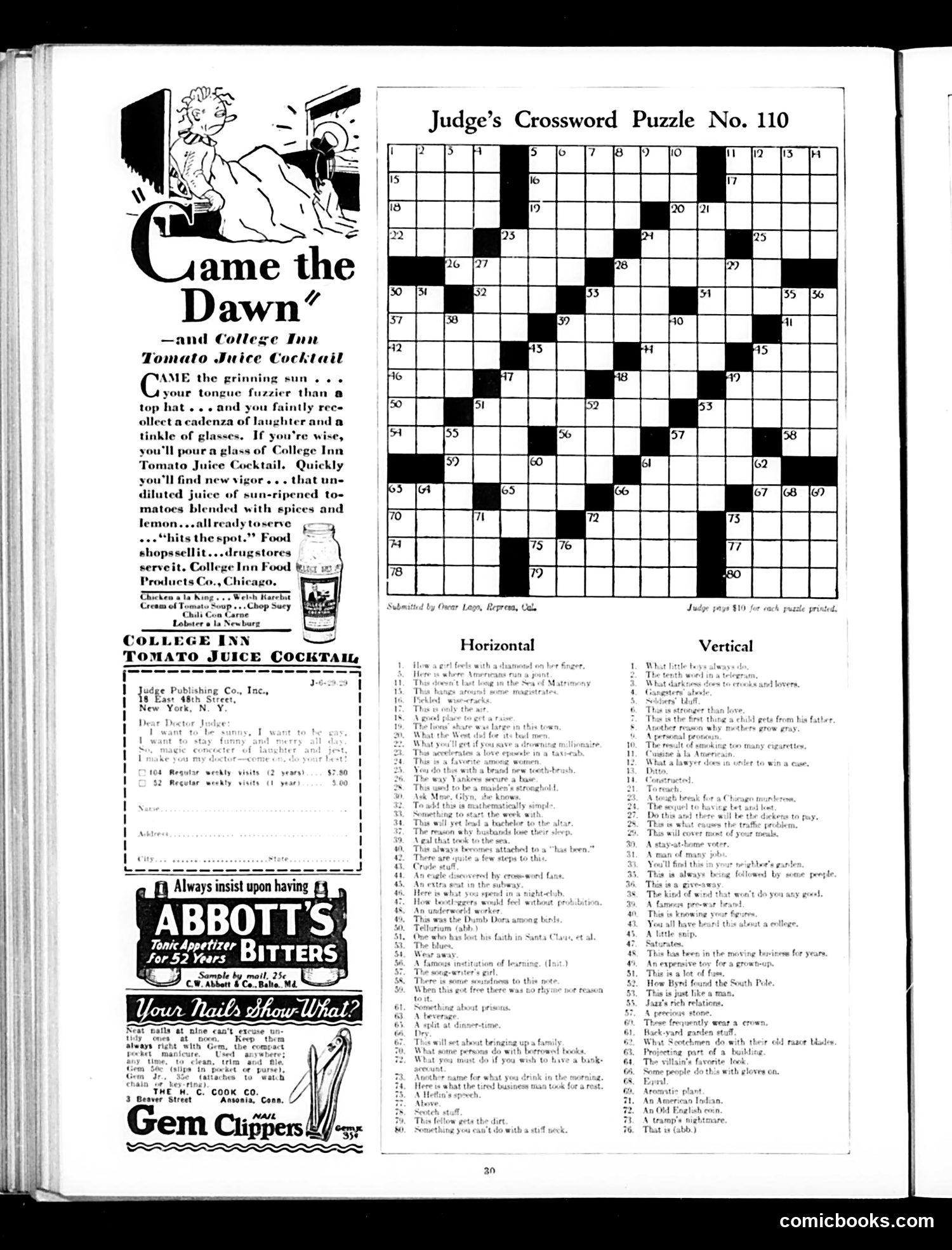
This page is primarily **advertising and a crossword puzzle**, not political satire. The main content consists of: 1. **"Came the Dawn" Advertisement**: A College Inn Tomato Juice Cocktail ad featuring a humorous illustration of a hungover man with disheveled hair, presumably the morning after drinking. The joke plays on the "hair of the dog" remedy—suggesting tomato juice cocktails restore vigor after excessive drinking. 2. **Judge's Crossword Puzzle No. 110**: A standard crossword puzzle with horizontal and vertical clues. 3. **Additional Period Advertisements**: Abbott's Bitters (a medicinal tonic), Gem Clippers (nail care), and other products typical of 1920s-era Judge magazine advertising. The advertising reflects **Prohibition-era humor** (1920-1933), where tomato juice cocktails represent creative ways to enjoy beverages during the alcohol ban. The hungover character is the visual joke—relatable humor for the magazine's readers.
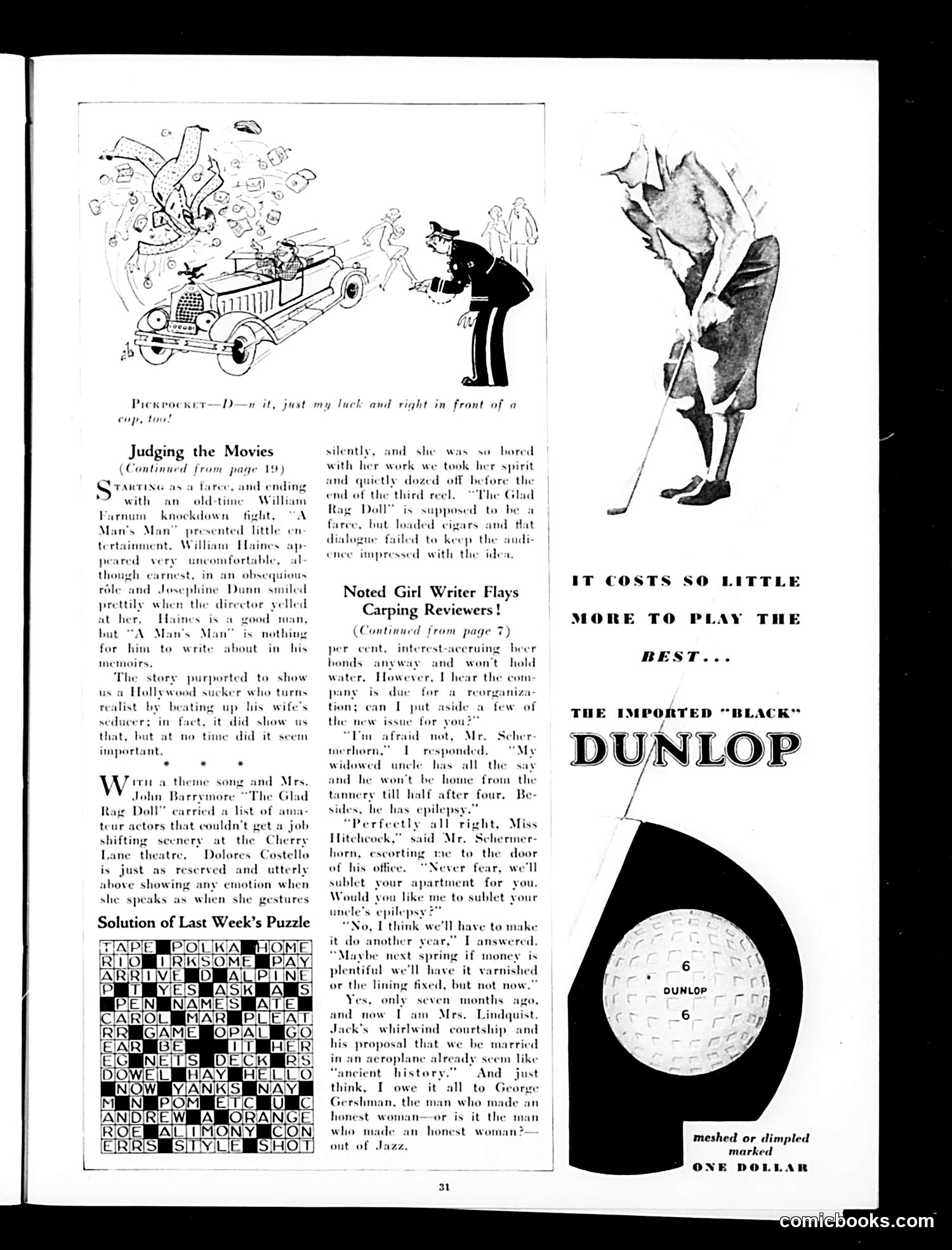
This page contains a movie review section ("Judging the Movies") and unrelated advertisements. The cartoon at top left depicts a car overflowing with objects and debris, with a police officer nearby. The caption reads "PICKPOCKET—D--- it, just my luck and right in front of a cop, too!" This is a simple visual gag: a criminal's bad timing being caught stealing while a law officer is present. The review discusses silent films including "A Man's Man" (William Haines) and "The Glad Rag Doll," criticizing their entertainment value. The right side advertises Dunlop golf balls ("The Imported 'Black'"), showing a large black golf ball with "meshed or dimpled marked ONE DOLLAR" text. The page includes a crossword puzzle solution and miscellaneous period content typical of this magazine format.
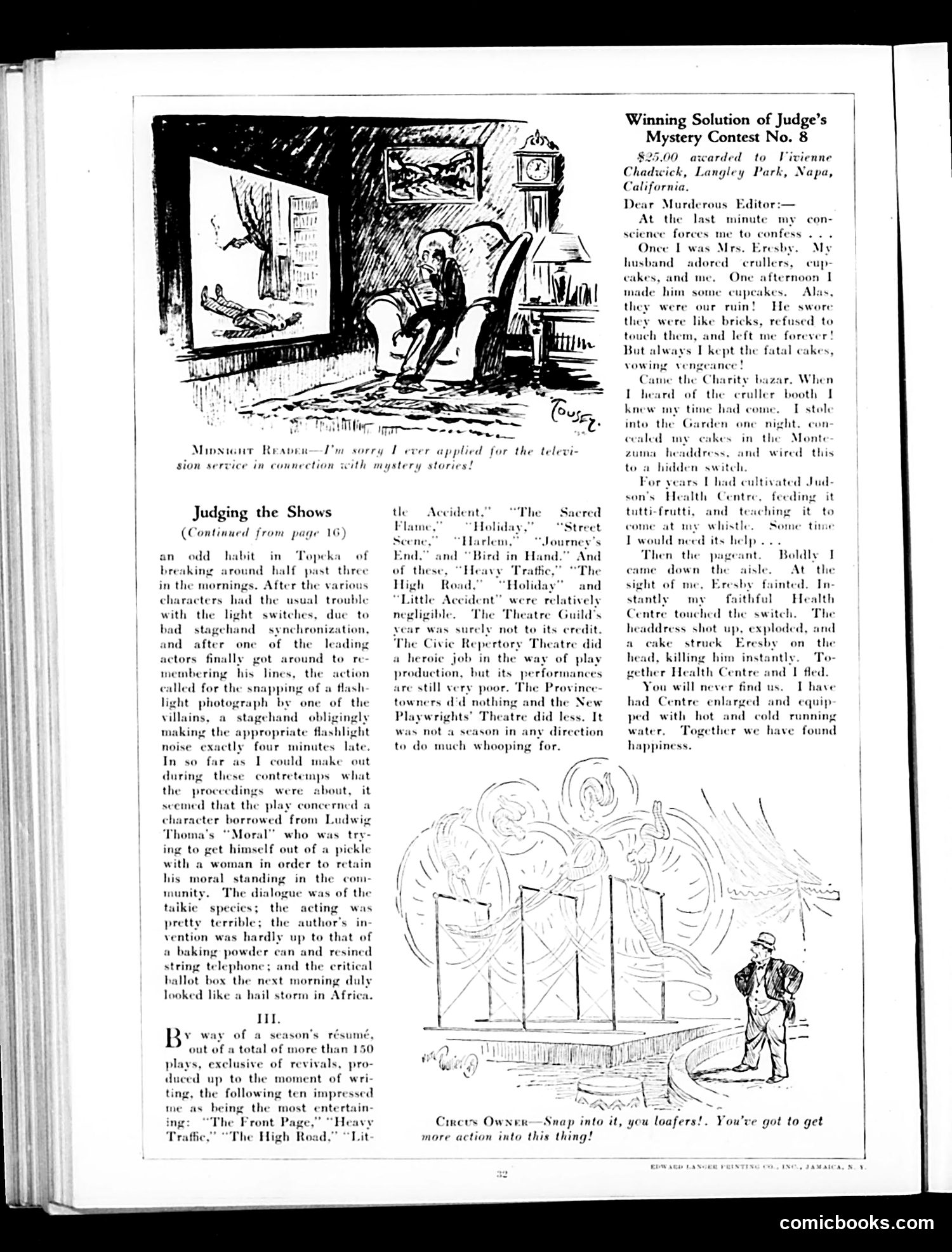
This page contains two distinct pieces: a theater review and a mystery contest solution. **"Judging the Shows"** critiques a season of theatrical productions. The reviewer discusses technical mishaps (lighting delays, forgotten lines) and judges roughly 150 plays, naming "The Front Page" and "Heavy Traffic" as the season's most entertaining works while dismissing others as negligible. The piece satirizes both poor theatrical execution and mediocre playwriting of the era. **The "Winning Solution"** presents a darkly comedic revenge narrative. A woman poisons her ex-husband through sabotaged cupcakes hidden in a Montezuma headdress at a charity bazaar, aided by a "Health Centre" (apparently a trained bird or device). The solution parodies the mystery-contest genre itself—absurdist plotting, elaborate schemes, and gleeful confession to murder. The bottom cartoon shows a circus owner demanding more excitement from performers on a Ferris wheel, illustrating the entertainment industry's constant demand for spectacle. These pieces collectively satirize early 1930s American entertainment culture: theatrical mediocrity, melodramatic storytelling conventions, and the public's appetite for sensational content.
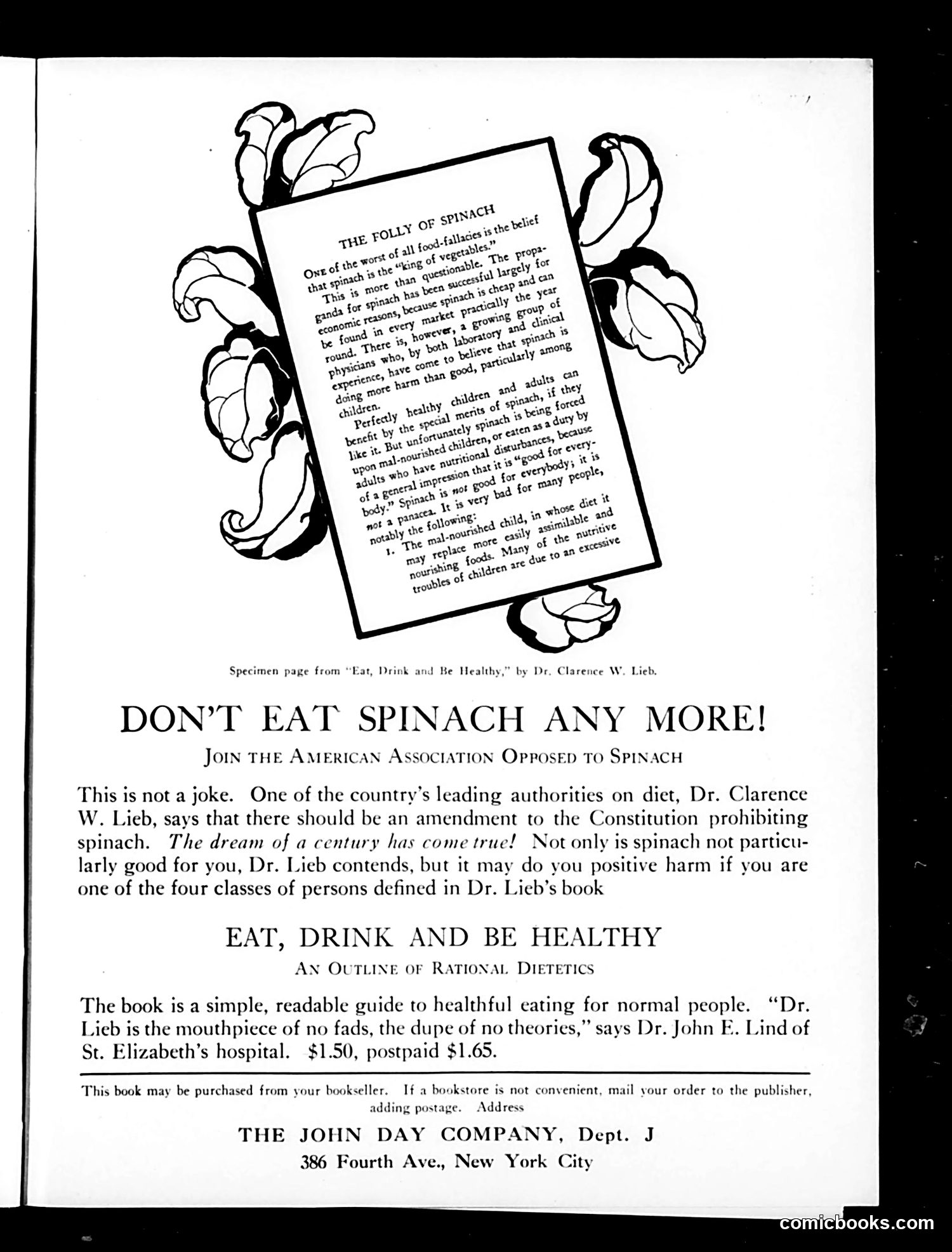
This is primarily **advertising copy** for Dr. Clarence W. Lieb's 1928 diet book, disguised as satirical editorial content. The page mocks the popular health myth that spinach is universally beneficial—likely referencing the widespread belief (erroneously attributed to spinach's iron content) that it builds strength. The "American Association Opposed to Spinach" is a fictional creation for comic effect. Lieb's actual argument appears to be that spinach harms certain groups of people, though the specific conditions aren't detailed here. The joke satirizes how fad diets and health authorities contradict conventional wisdom, while simultaneously promoting Lieb's book as rational, non-faddish guidance. The decorative spinach leaves frame the specimen text excerpt from the book itself, reinforcing the advertisement's humorous tone about rejecting a culturally entrenched "health food."
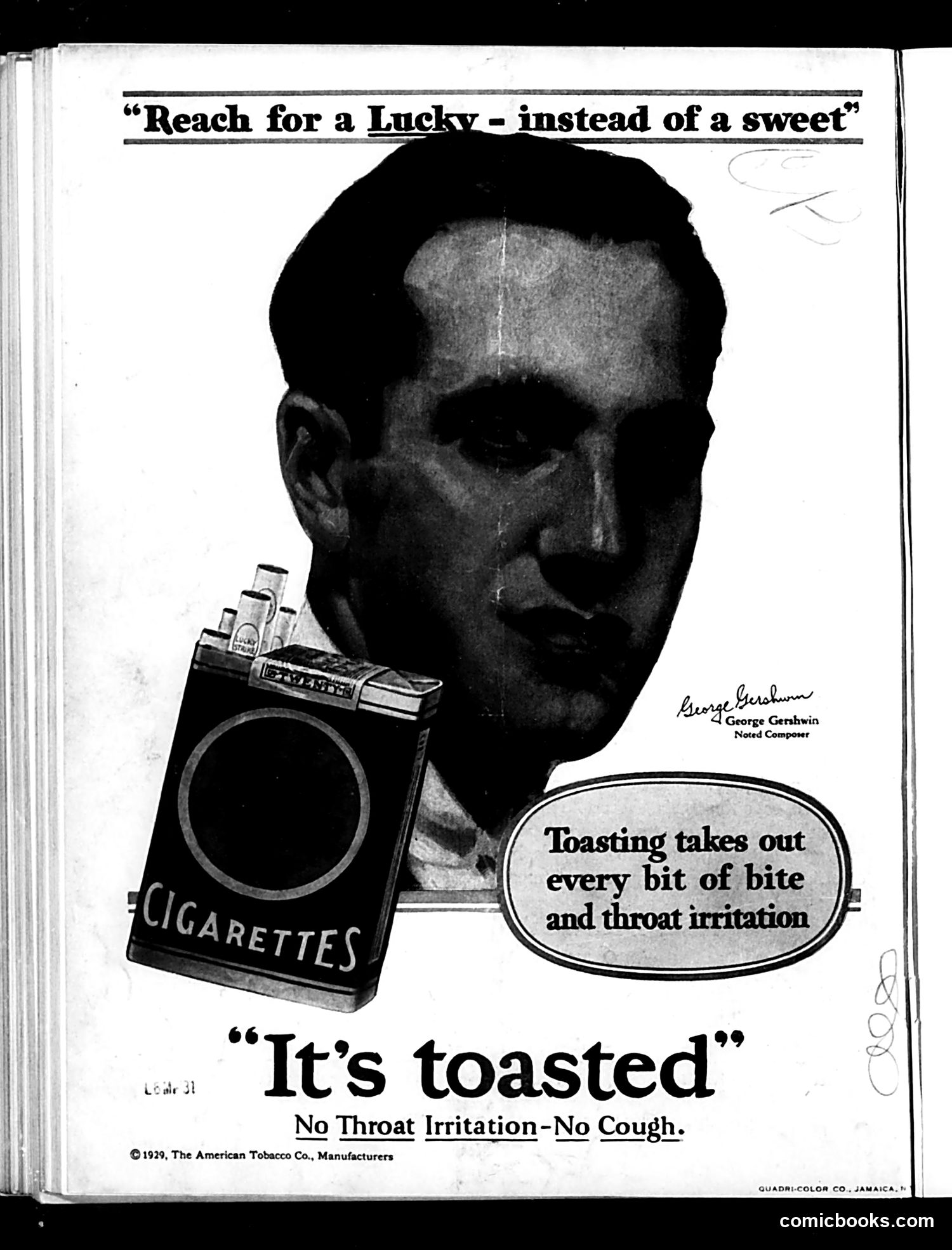
This is a **cigarette advertisement**, not satire or political commentary. It features an endorsement by George Gershwin, the noted composer, promoting Lucky Strike cigarettes. The ad's appeal centers on health claims common to 1920s tobacco marketing: "toasting takes out every bit of bite and throat irritation" and "No Throat Irritation—No Cough." The tagline "Reach for a Lucky—instead of a sweet" positioned cigarettes as a weight-management alternative to candy, targeting women during an era when female smoking was becoming socially acceptable. This represents historical tobacco marketing before health risks were widely acknowledged or regulated. The Gershwin endorsement lent prestige and cultural authority to the product.
I can see this appears to be a mostly blank page from Judge magazine, with only the watermark "comicbooks.com" visible at the bottom. The page contains no discernible cartoon, illustration, text content, or satirical commentary that I can identify with confidence. This could be a blank page from the magazine's interior, a title page, or a scanning artifact. Without visible content—whether political caricatures, social commentary, or advertising—I cannot explain what satire or jokes might have appeared here or identify any historical references. To provide meaningful analysis of Judge's political cartoons and their historical context, I would need a page with actual visible content.