
Judge, 1929-06-29 · page 27 of 37
Judge — June 29, 1929 — page 27: what you’re looking at
What you’re looking at
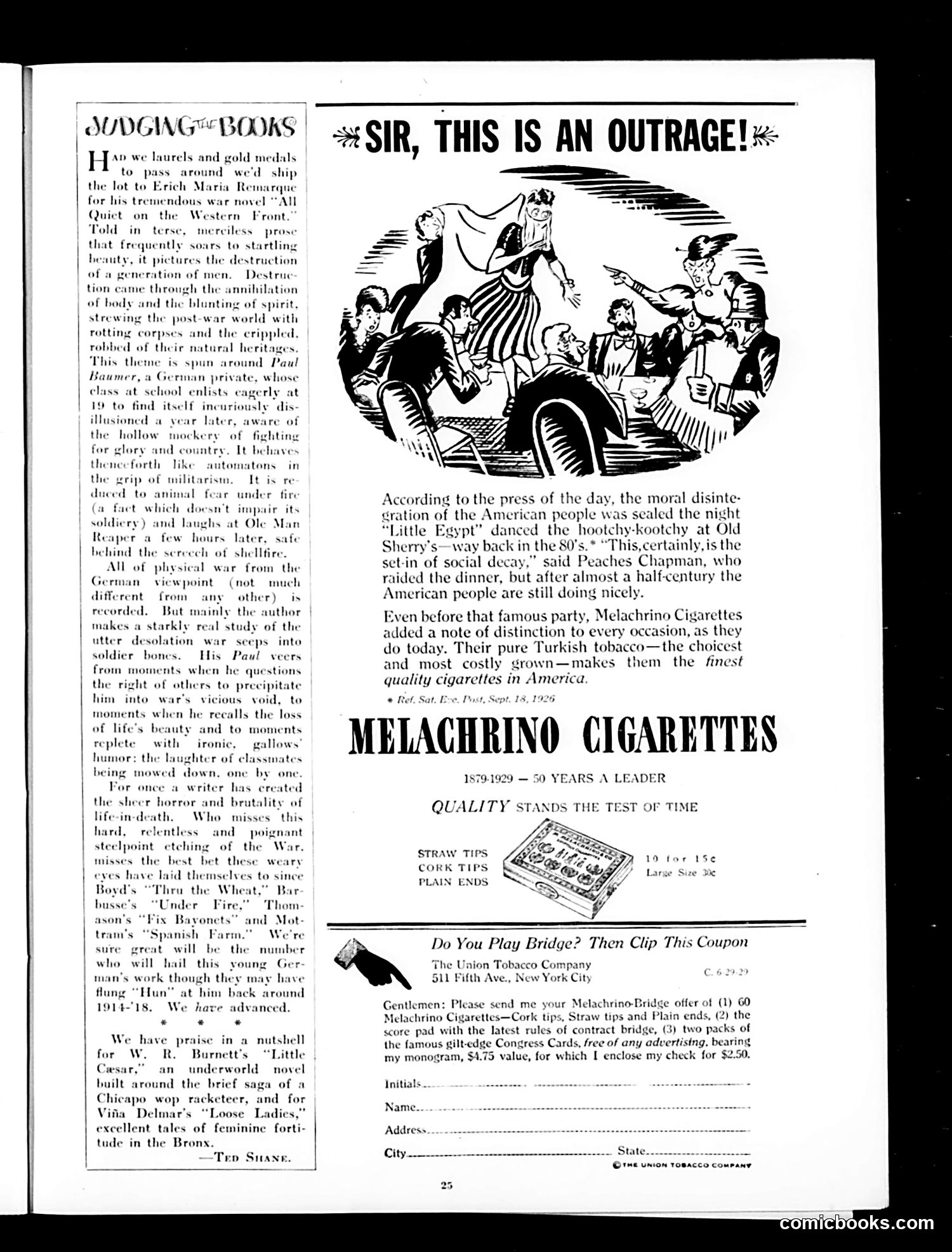
This page combines a book review with a cigarette advertisement and commentary on American moral panic. **The Book Review Section** praises Erich Maria Remarque's *All Quiet on the Western Front*, a German anti-war novel depicting the devastating effects of WWI on soldiers. The reviewer celebrates its unflinching depiction of war's horror and physical/psychological destruction. **The Cartoon and Advertisement** mock hand-wringing about American moral decline. The illustration shows people dancing the "hootchy-kootchy" (a suggestive dance), labeled an "outrage." The text sarcastically references "Little Egypt's" famous dance at an 1890s party as supposedly marking America's moral collapse—yet here we are decades later, "still doing nicely." The cigarette ad cynically exploits this anxiety, claiming Melachrino cigarettes represent enduring quality and tradition (50 years a leader), implying stability amid perceived social decay. The juxtaposition is ironic: the page criticizes moral panic while literally advertising a vice product. The overall message satirizes American prudishness and exaggerated fears about social deterioration.
📄 Transcribed text from this page (OCR, searchable)
Machine-transcribed from the original scan — historical spelling and the odd misread are preserved.
JUDGING BOOKS | H ap we laurels and gold medals to pass around we'd) ship the lot to Erich Maria Remarque for his tremendous war novel “All Quict on the Western) Front. Told in’ terse, merciless prose that frequently soars to startling beauty, it pictures the destruction of a generation of men. Destruc tion came through the annihilation of body and the blunting of spirit. strewing the post-war world with rotting corpses and the crippled, robbed of their natural heritages. This theme is spun around Paul Baumer, a German private, whose class at school enlists eagerly at 19 to find itself incuriously dis- iusioned a year later, aware of the hollow mockery of fighting ory and country. It behaves eforth like automatons in the grip of militarism. It is re duced to animal fear under tire (a fact which doesn’t impair its soldiery) and laughs at Ole Man Reaper a few hours later, safe behind the sereeeh of shelltire. All of physical war from the German viewpoint (not) much different from any other) is recorded. But mainly the author makes a starkly real study of the utter desolation war seeps into soldier bones. His Paul veers from moments when he questions the right of others to precipitate him into war's vicious void, to moments when he reealls the loss of life’s beauty and to moments replete with ironic, — gallows: humor: the laughter of classmates | being mowed down. one by one For once a writer has created the sheer horror and brutality of life-in-edeath, Who misses” this hard, relentless and poignant steelpoint etching of the War. misses the best bet these weary eyes have laid themselves to since Boyd's “Thru the Wheat,” Bar busse’s “Under Fire. Thom- ason’s “Fix Bayonets’ and Mot tram'’s “Spanish Farm.” We're sure great will be the number who will hail this young Ger man’s work though they may have flung “Hun” at him back around 191418. We have advanced. * * * We have praise in a nutshell for W. RR. Burnett's “Little Cwsar,” an underworld novel built around the briefs of a Chicapo wop racketeer, and for Vita Delmar’s “Loose Ladies,” excellent tales of feminine forti- tude in the Bronx. Tro Suane. =#SIR, THIS IS AN OUTRAGE! + According to the press of the day, the moral disinte- gration of the American people was sealed the night “Little Egypt” danced the hootchy-kootchy at Old Sherry’s—way back in the 8¢ Th rtainly, is the set-in of social decay,” said Peaches Chapman, who raided the dinner, but after almost a half-century the American people are still doing nicely. Even before that famous party, Melachrino C added a note of distinction to every occasion, as they do today. Their pure Turkish tobacco—the choicest and most costly grown—makes them the finest quality cigarettes in America. # Ref, Sat, Ev 1, Sept, 18, 1926 MELACHRINO CIGARETTES 1879-1929 — 50 YEARS A LEADER QUALITY StaNnvDs THE TEST OF TIME STRAW TIPS. CORK TIPS PLAIN ENDS Do You Play Bridge? Then Clip This Coupon The Union Tobacco Company non 511 Fifth Ave., New York City C62 Gentlemen: Please send me your Melachrino-Bridge offer of (1) 60 Melachrino Cigarettes—Cork tips, Straw tips and Plain ends, (2) the score pad with the latest rules of contract bridge, (3) two packs of the famous gilt-edge Congress Cards, free of any advertising, bearing my monogram, $4.75 value, for which I enclose my check for $2.50. Initials. Name. Address © tHe Union ToBAcco Company, icbooks.com