
Judge, 1929-06-29 · page 15 of 37
Judge — June 29, 1929 — page 15: what you’re looking at
What you’re looking at
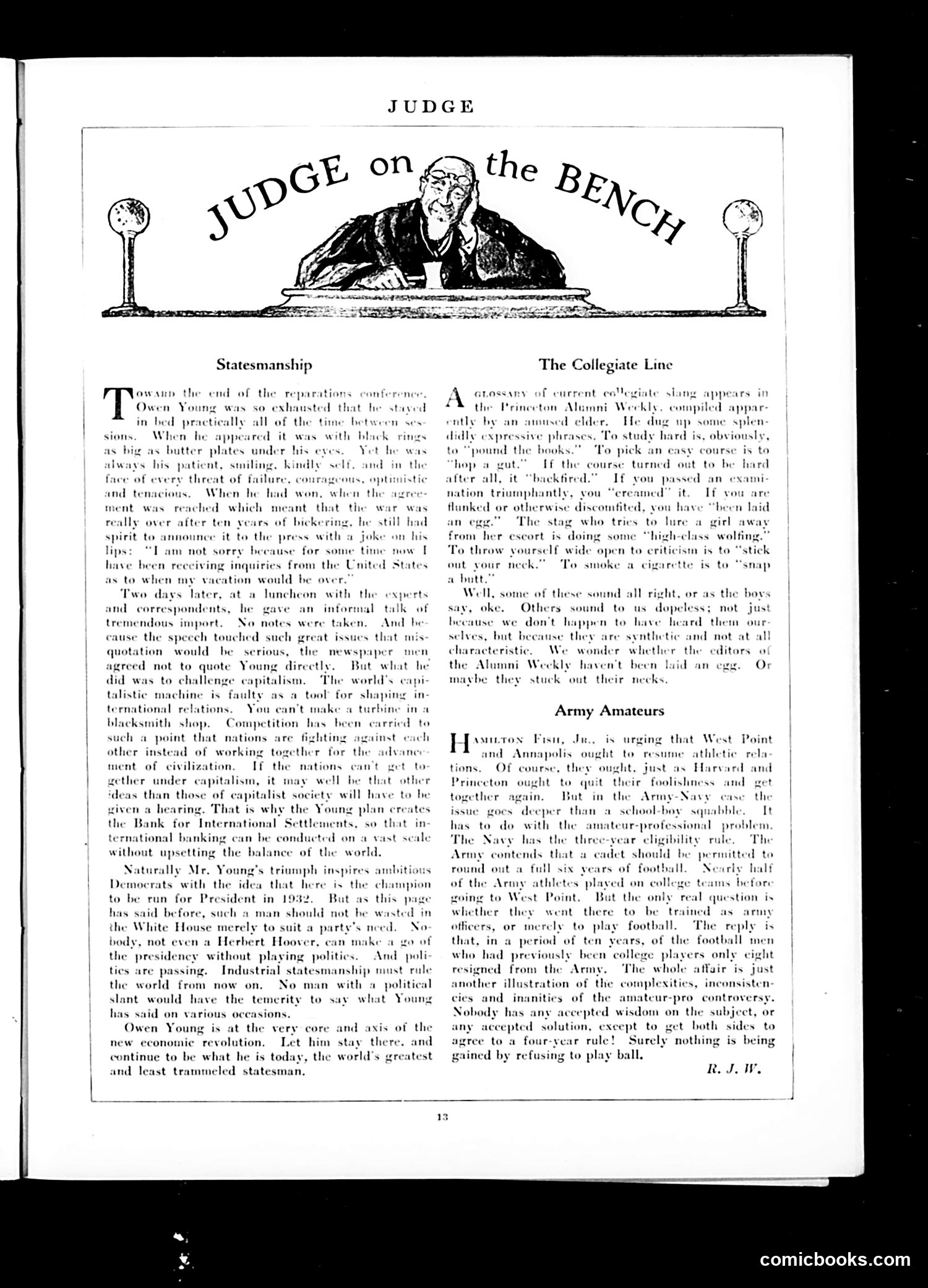
This page contains two main opinion pieces without illustrated cartoons, despite the "Judge on the Bench" header. **"Statesmanship"** praises Owen D. Young, who appears to have successfully negotiated international reparations (likely post-WWI). The writer argues Young should not run for President in 1932, as his talents for industrial/economic leadership are too valuable. The piece suggests capitalism itself needs reform for international relations—a notably progressive stance for the era. **"The Collegiate Line"** humorously catalogs 1920s college slang from Princeton's alumni magazine: "pound the books" (study), "backfired" (failed), "screamed it" (passed easily). The author gently mocks these terms as forced and inauthentic rather than organically developed student speech. **"Army Amateurs"** addresses West Point-Annapolis athletic rivalry, arguing they should resume competitions while questioning whether Army football players are genuinely trained athletes or merely playing for glory—a jab at amateurism standards. The page emphasizes serious policy debate rather than visual satire.
📄 Transcribed text from this page (OCR, searchable)
Machine-transcribed from the original scan — historical spelling and the odd misread are preserved.
Statesmanship owann the end of the reparations conte Owen Y e Wwas exhausted that he in bed practically all of the time between ses sions. When he appeared it’ was with blick rings as big as butter plates under his eves. Yet he was tlways his patient, sti kindly self. and in’ the face of every threat of failure, courageous, optimnisti ind tenacious. When he had won, when the cagre ment was reached which meant that the war was really over after ten years of bickering, he still had spirit to announce it to the press with a eon his lips: “Tam not sorry because for some time now I have been reeciving inquiries from the United States as to when my vacation would be over.” Two days later, at a luncheon with the experts and correspondents, he gave an informal talk of tremendous import. No notes were taken. And he cause the speech touched such great issues that mis quotation would be serious, the newspaper men agreed not to quote Young directly. But what he did was to challenge capitalism. The world’s capi talistic machine is faulty as a tool for shaping in ternational relations. You can’t make a turbine ina blacksmith shop. Competition has been carried to such a point that nations are fighting against cach other instead of working ther for the advance ment of civilization. If the nations can't yet to gether under capitalism, it may well be that other ideas than those of capitalist society will have to he viven a hearing. That is why the Young plan creates the Bank for International Settlements, so that in ternational banking can be conducted on a vast seale without upsetting the balance of the world, Naturally Mr. Young's triumph inspires ambitious Democrats with the idea that here is the champion to be run for President in 1932. But as this page has said before, such a man should not be wasted in the White House merely to suit a party's need. N body, not even a Herbert Hoover, can make a go of the presidency without playing polities. And_ poli tics are passing. Industrial statesmanship must rule the world from now on. No man with a political slant would have the temerity to say what Young has said on various occasions. Owen Young is at the very core and axis of the new economic revolution, Let him stay there. and continue to be what he is today, the world’s greatest and least trammeled statesm: The Collegiate Line aN etossany of current coMegiate sling appears in the Princeton Alumni Weekly. compiled appar ently by an cimused elder. He dug up some splen didly expressive phrases. To study hard is, obvious to “pound the beoks.” ‘To pick an easy course is to hop a te Tf the course turned out to be hh ufter all, it “backfired.” If vou passed an ex nation triumphantly, you “ereamed” it. If vou flunked or otherwise discomfited, you have “been | The stag who tries to lure a girl away om her escort is doing some “high-class wolting.”” throw yourself wide open to criticism is to “stick wr neck.” ‘To smoke a cigarette is to “snap Well, some of these sound all right, or as the boys Others sound to us dopeless; not just we don’t happen to have heard them our » but because they are synthetic and not at all characteristic. We wonder whether the editors o the Alumni Weekly haven't been laid an egy. Or maybe they stuck out their necks, Army Amateurs He ron Fisn, Jn. is urging that West Point and Annapolis ought to resume athletic rela tions. Of course, they ought, just as Harvard and Princeton ought to quit: their foolishness and get But in’ the Army-Navy case the es deeper than a school-boy squabble. It to do with the amateur-professional problem vy has the three-year eligibility rule. The Army contends that a cadet should be permitted to round out a full years of football. Nearly half of the Army athletes played on college teams before going to West Point. But the only real question is whether they went there to be trained as army officers, or merely to play football. The reply is that, in a period of 3 , of the football men who had previously been “ze players only cight resigned from the Army. The whole affair is just nother illustration of the complexities, onsisten, cies and inanities of the amateur-pro controversy. Nobody has any accepted wisdom on the subject, or any accepted solution, except to get both sides to - to a four-year tule! Surely nothing is being to play ball, RILW. comicbooks.com